A stationary ring of tuned resonators reproduced the wave amplification expected near an ultrafast rotating body, moving a half-century-old idea onto a laboratory bench.
Editorial illustration
Conceptual illustration: a stationary resonator ring creates a synthetic rotating medium that amplifies a wave. It is not a photograph of the CUNY experiment or an actual black hole. Generated with Codex Image Gen for The Machine Press, 2026-07-12.
Researchers led by the CUNY Advanced Science Research Center report a laboratory realization of the Penrose-Zel'dovich wave-amplification process. Instead of spinning matter at otherwise impractical speed, the team arranged electronic resonators in a ring and varied them in space and time so electromagnetic waves experienced an effectively rotating boundary. Waves with the right angular character emerged with more energy. The result does not extract energy from an actual black hole; it recreates the governing amplification mechanism in a controllable device. Published in Nature, the work gives physicists a platform for studying extreme rotational dynamics and may inform future photonic and quantum systems.
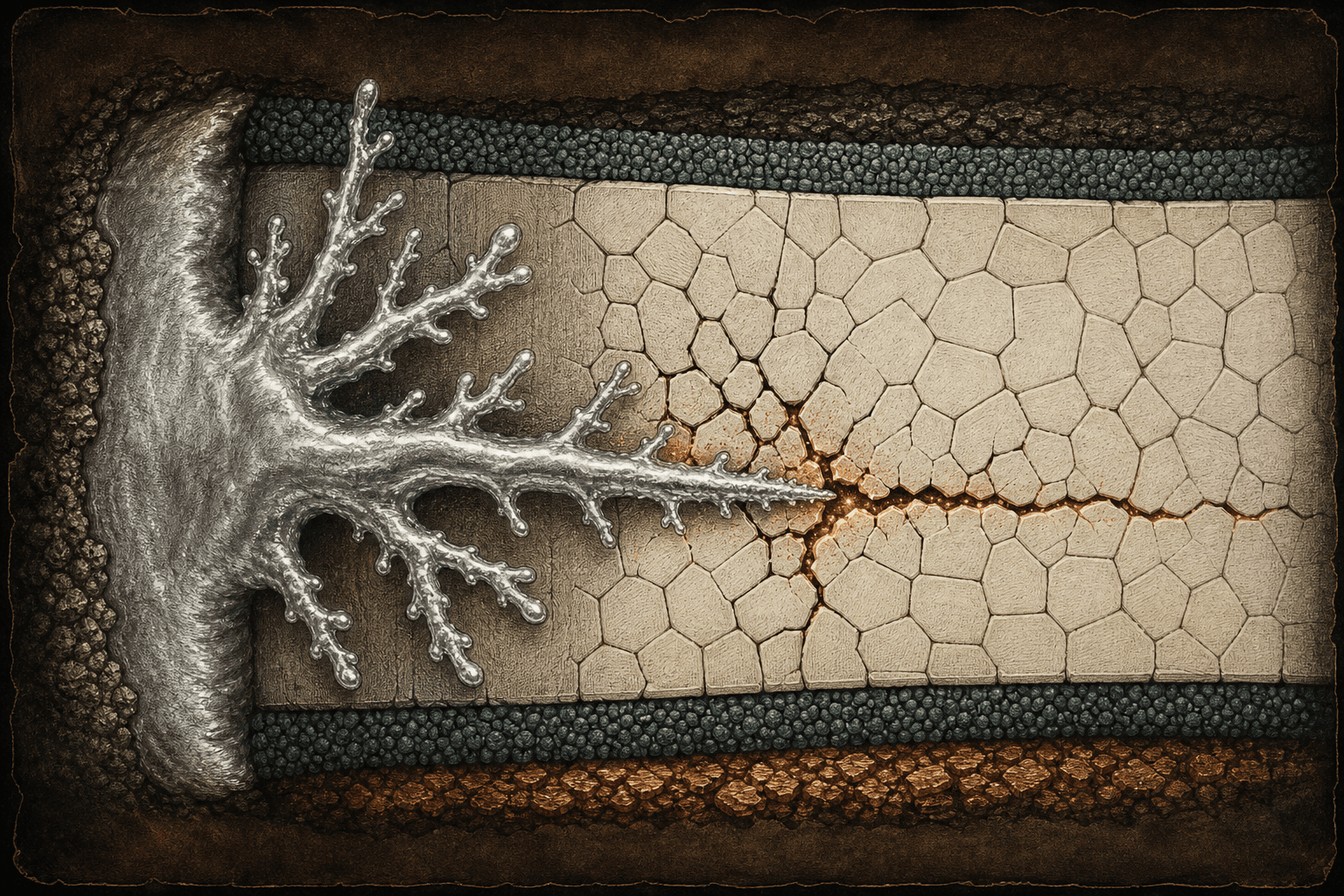
Conceptual illustration: a lithium dendrite concentrates stress and opens a fracture through a ceramic electrolyte. It is not a microscopy image or a commercial battery cross-section. Generated with Codex Image Gen for The Machine Press, 2026-07-12.
Cryogenic microscopy shows solid-state battery dendrites can drive mechanical fractures through a ceramic electrolyte instead of merely linking hidden lithium deposits.
A Max Planck Institute for Sustainable Materials team has resolved a central puzzle in solid-state batteries: how lithium, a soft metal, can penetrate a stiff ceramic electrolyte. Working under vacuum and at cryogenic temperatures, the researchers preserved the reactive interfaces while examining dendrite paths at microscopic scale. Their Nature paper supports a mechanically driven explanation: stress concentrated by a growing lithium filament opens and advances cracks through the garnet electrolyte. That evidence helps separate fracture from a competing theory centered on electron leakage and remote lithium nucleation. It is not a commercial battery breakthrough by itself, but it gives engineers a clearer failure mechanism to design against.
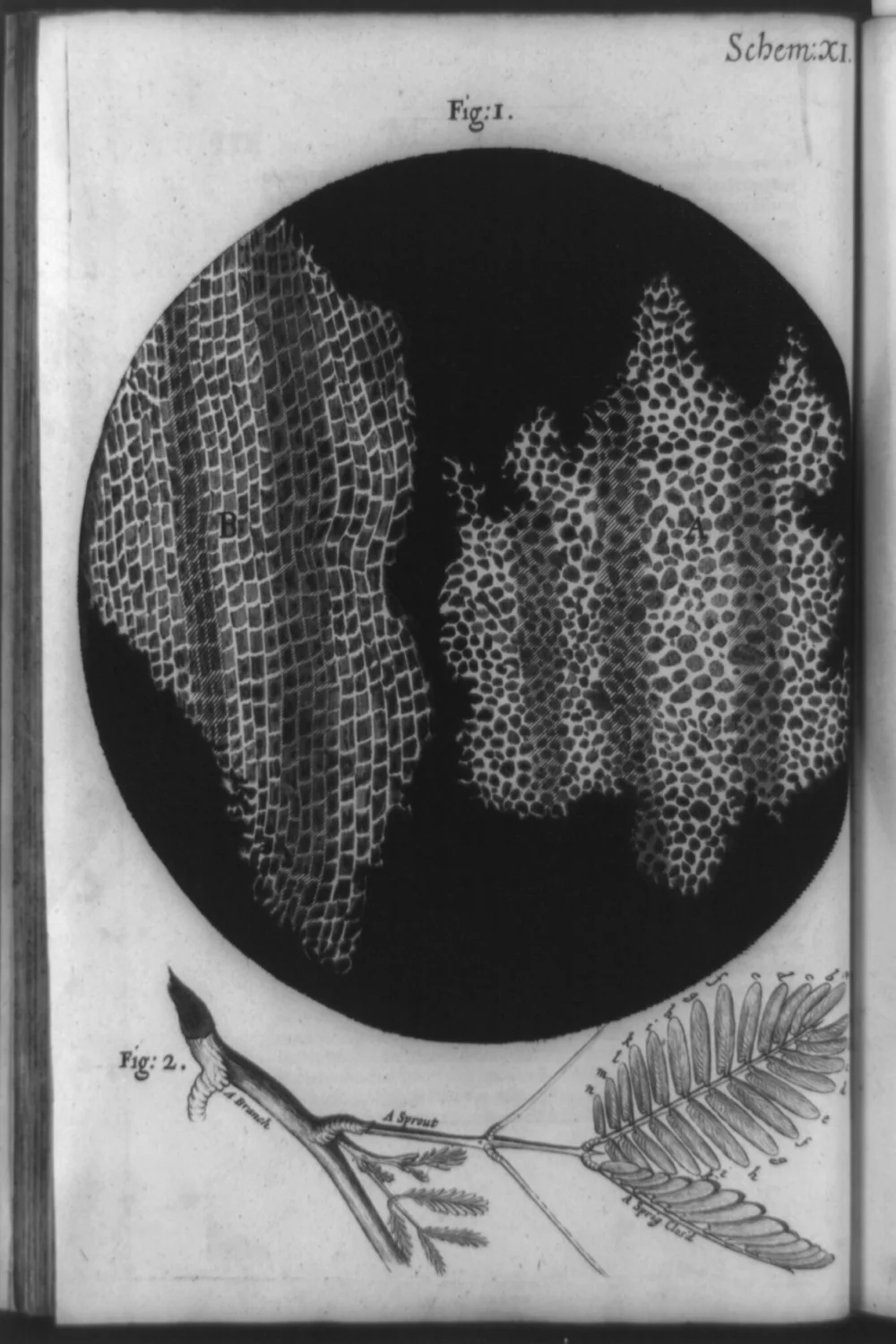
Historical scientific engraving from Robert Hooke's Micrographia, used as an illustration of close surface observation; it is unrelated to Tulane's gold samples and is not experimental evidence. Robert Hooke / Library of Congress, Lessing J. Rosenwald Collection; public-domain 1665 engraving, converted to WebP by The Machine Press.
Tulane researchers say atomic reconstruction can suppress oxygen reactions by as much as a trillion-fold on selected gold surfaces.
A Physical Review Letters study finds that gold's resistance to tarnish is not only a matter of bulk chemistry. On selected crystal faces, surface atoms reorganize into patterns that sharply reduce oxygen adsorption and reaction. The result offers an atomic explanation for gold's familiar durability and a possible lever for catalyst design, where engineers may want to preserve or deliberately interrupt that protective arrangement.
Yale researchers reduced disease progression in mice by removing surface proteins implicated in the movement of misfolded alpha-synuclein.
Yale School of Medicine researchers identified mGluR4 and NPDC1 as neuronal surface proteins that help misfolded alpha-synuclein move through motor circuits. In mouse experiments, removing the proteins preserved dopamine-producing cells and reduced progression after exposure to the toxic protein. The findings are preclinical and do not establish a human treatment, but they narrow the search for interventions that could slow propagation rather than only manage symptoms.
Dartmouth researchers moved a telmisartan-and-olaparib combination from preclinical results into early human cancer trials.
Dartmouth Cancer Center researchers report that telmisartan increased the activity of the PARP inhibitor olaparib in tumors without the homologous-recombination defects that usually predict response. Early human trials are now testing the combination, including in platinum-resistant ovarian cancer. The clinical evidence remains preliminary; the meaningful event is the transition from a repurposing hypothesis into prospective testing.
Illustrative laboratory glassware; it does not depict DT-109, biomedical tissue, Michigan Medicine, or the reported animal study. Rodolfo Clix / Pexels; cropped, resized, metadata stripped, and converted to WebP by The Machine Press.
Michigan Medicine says DT-109 reversed severe fatty-liver disease in animal models by repairing intestinal defenses and limiting toxin exposure.
Michigan Medicine researchers tested the experimental compound DT-109 in animal models of metabolic dysfunction-associated steatohepatitis. The treatment restored gut-barrier function and reduced the passage of damaging microbial products into circulation, while the animals showed reversal of severe disease markers. The work remains preclinical, but it supports treating MASH as a connected gut-liver system instead of a single-organ problem.
A new classification warns that fast-spreading Asian mantises are displacing native insects and expanding with warmer urban conditions.
Researchers have formally classified Hierodula tenuidentata and Hierodula patellifera as invasive in Europe after documenting rapid geographic expansion and ecological interactions. The predators consume native insects and small vertebrates, and encounters with native mantises can end in predation or failed reproduction. Classification does not by itself measure continent-wide damage, but it creates a common basis for monitoring and management.
Oak Ridge researchers nearly tripled heat flow in one direction by aligning charge and atomic vibrations inside a switchable ceramic.
A team at Oak Ridge National Laboratory, Ohio State, and Amphenol used an electric field to reorganize a ceramic's internal polarization and change how phonons travel. Measurements at the Spallation Neutron Source showed thermal conduction rising by almost threefold along the favored direction. The work points toward switchable cooling components, though device-scale efficiency and durability still need testing.
Abstract machine-learning illustration inspired by neuroscience; it does not depict a participant, an Amsterdam UMC scan, or the measured pregnancy-related brain changes. Novoto Studio / Google DeepMind / Pexels; cropped, resized, metadata stripped, and converted to WebP by The Machine Press.
Longitudinal scans from Amsterdam UMC show that pregnancy-related brain change is not a simple replay from one child to the next.
Amsterdam UMC researchers followed 110 women with repeated brain scans, comparing first pregnancies, second pregnancies, and nonpregnant controls. They found overlapping changes but also a distinct pattern during a second pregnancy, suggesting the maternal brain adapts to a different caregiving context rather than repeating a fixed program. The study does not define a diagnostic test, but its design may help separate ordinary adaptation from peripartum mental-health conditions.
Finnish physicists created a two-layer tin-telluride film with edge states that respond to strain.
Researchers at the University of Jyvaskyla and Aalto University report the first experimental realization of a predicted two-dimensional topological crystalline insulator. They grew two layers of tin telluride on niobium diselenide and observed conducting edge states that changed under strain. It is a research platform, not a room-temperature quantum product.
Tokyo researchers controlled nanoparticle deposits by changing bubble concentration, leaving no chemical additive behind after drying.
Tokyo Metropolitan University researchers added ultrafine bubbles to silica nanoparticle inks and found that bubble concentration could reshape the pattern left as each droplet dried. Conventional additives can remain in a printed film and alter electrical or sensing properties; the bubbles disappear. The technique may aid printed sensors and microelectronics, though repeatability across other inks remains to be demonstrated.
The St Bathans find suggests giant flightless geese descended from more recent arrivals than a long-standing isolation story allowed.
An international team led by the University of Otago analyzed a newly described goose from the St Bathans fossil deposits. Its anatomy and evolutionary placement indicate that New Zealand's giant flightless geese may have descended from comparatively recent colonists rather than an ancient isolated lineage. The result reinforces a dynamic picture in which repeated arrivals, extinctions, and adaptation shaped the country's bird life.
Georgia Tech researchers connected sulfoxaflor exposure with altered gene activity and reproductive function in worker bumblebees.
A Georgia Institute of Technology team exposed bumblebees to low doses of sulfoxaflor and examined RNA across tissues. The largest gene-expression changes appeared in ovarian tissue, alongside effects on reproduction and behavior. The work does not quantify field-wide population loss, but it identifies reproductive pathways that regulators and agricultural researchers can monitor.
A half-million-year lava record supports a model in which tectonic flexing squeezes old upper-mantle magma through a persistent leak.
University of Lausanne researchers propose that Mount Etna is fed by magma pockets already present roughly 80 kilometers below Sicily. As the African and Eurasian plates interact, flexing and fractures may push that material upward like liquid from a squeezed sponge. If confirmed, Etna would be a giant analogue of petit-spot volcanoes previously associated with much smaller submarine structures.
Reach readers curious about what people are building. One manually reviewed placement stays active for seven days and remains separate from Desk Picks.
Manual launch intake; automated checkout is not live yet. Payment buys placement, never endorsement, and every submission is reviewed before publication.
Desk Picks are selected by the newsroom. Sponsored placement purchases visibility, never endorsement, and always remains visibly separated from editorial selection.
 Editorial illustration