MIT researchers tested whether adapted image models had learned an illegal harmful capability by reading internal changes instead of generating the prohibited material.
Editorial illustration
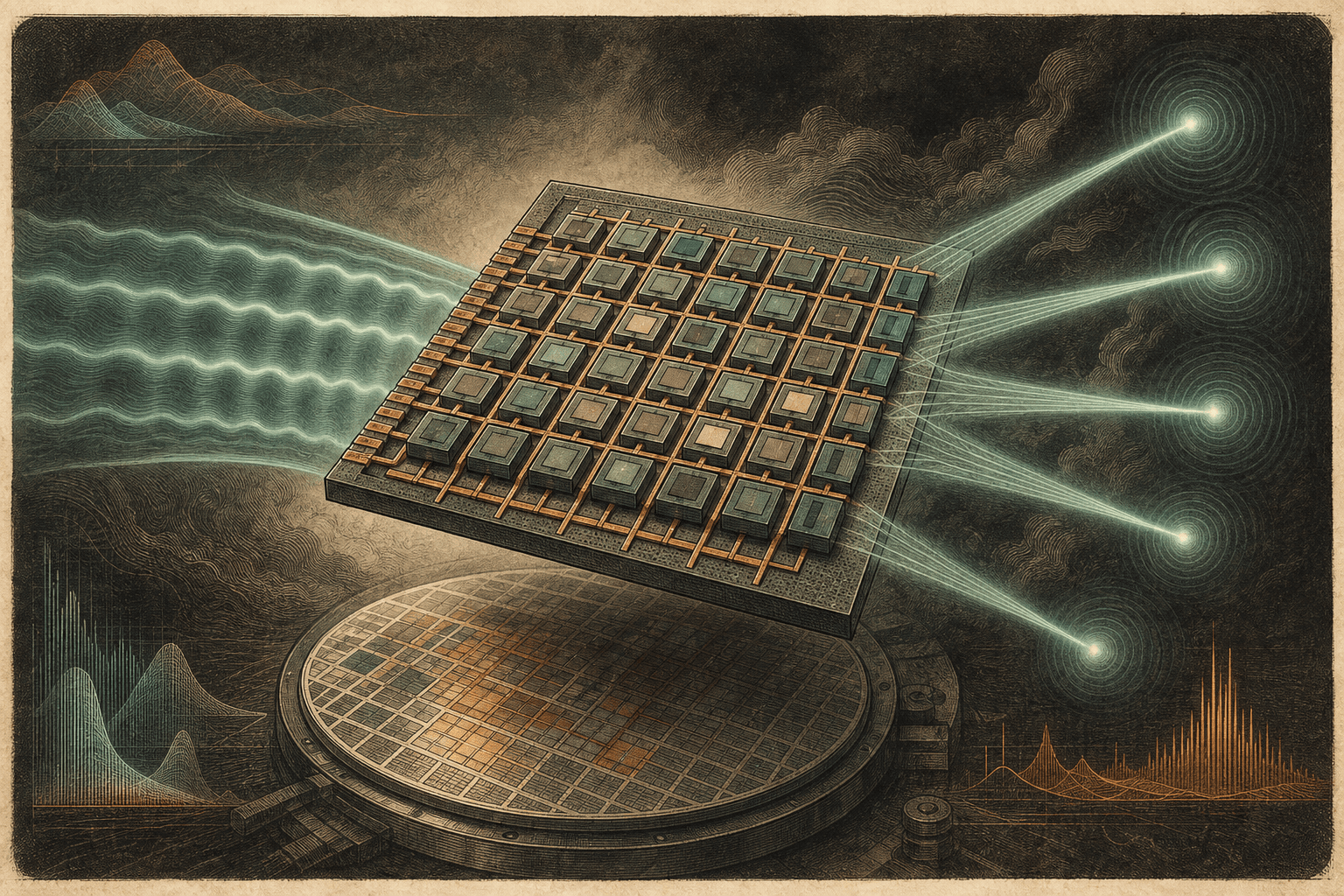
Conceptual illustration: random probes expose patterns inside an adapted model while the output stage stays closed. It does not depict illegal material, a person, or the researchers' exact apparatus. Generated with Codex Image Gen for The Machine Press, 2026-07-13.
A team from MIT, Boston University, and the child-safety nonprofit Thorn reports a way to audit LoRA adapters for harmful specialization without asking the model to produce an image. Gaussian probes feed random inputs into intermediate layers, then measure how fine-tuning changed the model's internal computation. In tests on three model families, the method identified adapters specialized for child sexual abuse material with 100 percent accuracy. That result is limited to the evaluated adapters, but it gives model hosts a scalable route to screen uploads without creating illegal output or exposing reviewers to it.
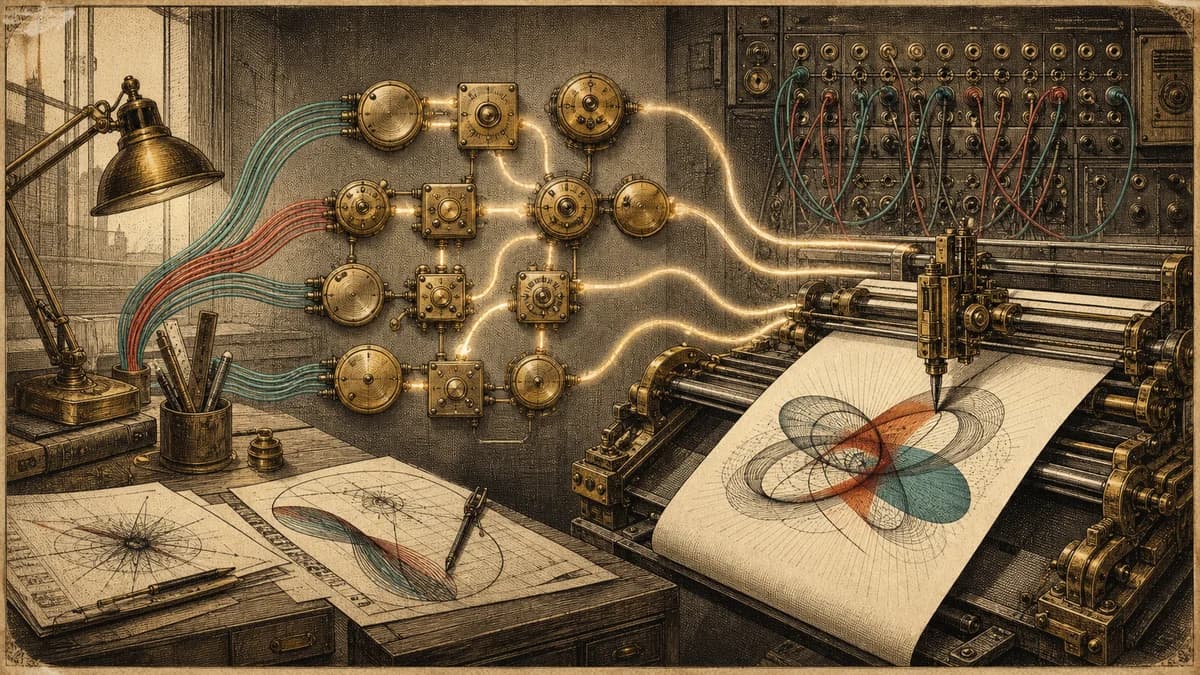
Conceptual illustration: individually addressed phase-change pixels reshape mid-infrared light. It is not a microscope image, device photograph, or performance measurement. Generated with Codex Image Gen for The Machine Press, 2026-07-13.
A 6-by-6 phase-change metasurface gave every microscopic pixel independent control of mid-infrared light through a scalable crossbar circuit.
MIT researchers built a chip-scale spatial light modulator whose microscopic pixels can independently reshape mid-infrared light. Two perpendicular copper-wire layers address a 6-by-6 array; doped silicon heats phase-change material at selected crossings, switching each pixel between optical states without moving parts. The Nature Communications study demonstrates pixel-level control and reliable switching in a lab device made largely with conventional semiconductor processes. Millions of pixels remain an engineering goal, but the crossbar architecture offers a credible path toward compact gas sensors, thermal imagers, pollution monitors, and optical-computing components.
Imec and Diraq coherently operated an eight-qubit silicon array made on a 300-millimeter CMOS-compatible foundry process, extending industrial fabrication beyond isolated pairs.
Imec and Diraq tuned and individually controlled eight silicon MOS spin qubits fabricated with a 300-millimeter CMOS-compatible process. The peer-reviewed Nature Communications paper reports Ramsey dephasing times up to 41 microseconds, Hahn-echo coherence up to 1.31 milliseconds, cascaded readout of the central four qubits, and a two-qubit gate between one neighboring pair. This is a manufacturing-and-control milestone, not a useful quantum computer: the authors say entangling gates across the paired unit cells remain to be shown, while fault-tolerant designs will require higher-dimensional connectivity and more reliable exchange control.
Rendered wafer-scale integrated-circuit illustration; it does not depict TSMC hardware, a production wafer, a process node, or evidence behind the revenue report. Wikideas1 / Wikimedia Commons (CC0 1.0); cropped and converted to WebP by The Machine Press.
TSMC reported second-quarter revenue of NT$1.27 trillion, 36 percent above a year earlier and slightly ahead of market expectations.
Taiwan Semiconductor Manufacturing Co. reported record second-quarter revenue of about NT$1.27 trillion, or $39.6 billion, as demand for advanced chips used in artificial-intelligence systems remained strong. Reuters calculated a 36 percent year-over-year increase; June revenue alone rose 67.9 percent. The release is a sales signal, not yet the full earnings picture: TSMC is scheduled to report second-quarter profit and updated guidance on July 16.
Anthropic began showing tax-inclusive rupee prices in India, while UPI payments remain absent from the rollout.
Claude subscriptions have begun appearing in Indian rupees on Anthropic's website and mobile apps, TechCrunch reports. India is Claude's second-largest market by usage, according to Anthropic, but the localized prices are not simple currency conversions and payments still run through cards or app stores rather than India's widely used UPI network. The rollout reduces exchange-rate ambiguity while leaving a major local payment habit unserved.
The FAA cleared Starship prototypes to fly again after SpaceX changed engine-startup, alarm, and abort systems following May's booster loss.
The Federal Aviation Administration cleared SpaceX to resume Starship tests after reviewing the May booster failure. The agency cited heat effects on propulsion components and erroneous engine-alarm settings; SpaceX says it changed the startup sequence and re-light, alarm, and abort systems. A flight could occur as soon as July 16 and would carry test third-generation Starlink satellites. Clearance confirms the investigation stage is complete, not that the redesigned systems have succeeded in flight.
Waze added conversational map updates, personalized route suggestions, Gemini destination search, and a motorcycle mode.
Google says Waze is rolling out personalized navigation based on trip history and city traffic, conversational reporting for closures and outdated addresses, and a less-chatty voice mode. A Gemini-powered destination search is entering global beta, while a motorcycle mode launches first in seven countries with two-wheeler-specific hazards and restrictions. Users can choose alternate routes or disable personalization; the announcement describes product availability, not measured safety or travel-time gains.
Staged technology illustration; it is not a Flock interface, LAPD system, camera feed, contract record, or evidence of surveillance activity. Rafael Minguet Delgado / Pexels; cropped, resized, metadata stripped, and converted to WebP by The Machine Press.
The LAPD cited civil-liberties, privacy, data-storage, and sharing concerns as it declined to renew a three-year camera contract.
The Los Angeles Police Department will allow its contract with license-plate-camera company Flock Safety to expire, according to statements reported by local outlets and TechCrunch. The department's chief information officer cited unresolved privacy, civil-rights, security, storage, and data-sharing concerns. Flock said the decision surprised the company and that it expects to address what it called misconceptions. The move ends this contract; it does not by itself settle whether cameras keep recording or whether a revised agreement returns.
NASA maps show more than 200 Brooks Range watersheds discolored as thawing permafrost exposes minerals to water and air.
NASA Earth Observatory reports that satellite, aerial, and ground surveys across more than 600 miles of Alaska's Brooks Range have found orange water in over 200 watersheds. Many changes appeared within the past 10 to 12 years as air and ground temperatures rose. Scientists say thawing permafrost likely exposes minerals that release iron, sulfuric acid, and trace metals. The mapping connects abrupt color change to a plausible mechanism while ongoing fieldwork measures ecological and drinking-water consequences.
In pooled randomized trials, 95 adults gained about one pound and became more sedentary after six weeks of modest sleep restriction.
Columbia researchers pooled randomized crossover trials in which 95 adults followed their normal sleep schedule and, in another six-week period, delayed bedtime by 90 minutes. Wrist monitors showed roughly 80 minutes less sleep, an average one-pound weight gain, and 17 more sedentary minutes per day. The experiment supports a short-term causal effect under controlled conditions; it does not establish how much weight any individual would gain over a year or replace diet and activity evidence.
Mouse recordings found decision-related activity in primary somatosensory cortex, supporting a feedback-loop model rather than a one-way hierarchy.
University of Illinois researchers recorded neural activity while mice navigated a virtual corridor and made perceptual decisions. They observed decision-related signals in the primary somatosensory cortex and evidence that higher brain regions were feeding information back into that early sensory area. The PNAS study challenges a simple pipeline in which sensing precedes decision-making. It may inspire more efficient artificial networks, but the authors do not present a direct AI architecture or human-brain result.
Illustrative fiber-optic macro photograph; it does not show the NTU apparatus, a Poisson spot, optical skyrmions, or experimental evidence. Atlantic Ambience / Pexels; cropped, resized, metadata stripped, and converted to WebP by The Machine Press.
NTU Singapore generated four kinds of optical skyrmion in one Poisson spot using a laser and a small circular disc instead of a fabricated metamaterial.
Nanyang Technological University researchers report that a classic diffraction effect can generate optical skyrmions, stable topological patterns in the properties of light. Shining a laser around a circular obstruction produced spin, Stokes, electric-field, and magnetic-field skyrmions within one Poisson spot. The Optica result offers a simpler research platform than engineered metamaterials. Proposed uses in storage, communications, and computing remain prospective; the demonstrated advance is accessible generation and comparison of the light structures.
Physicists replaced one restrictive composition rule and derived real-number theories that make the same experimental predictions as conventional quantum mechanics.
Researchers at Heinrich Heine University Düsseldorf and the German Aerospace Center revisited the claim that quantum mechanics fundamentally requires complex numbers. By changing how composite systems are represented, they found a family of real-number formulations that are experimentally indistinguishable from the conventional theory. The Physical Review Letters paper does not make imaginary numbers useless; it narrows what experiments can establish about whether complex numbers are a physical necessity or an especially convenient language.
A simulation found methane from a south-pole landing could reach the north pole in under two lunar days and accumulate in scientific cold traps.
Researchers modeling the European Space Agency's Argonaut lander found that methane exhaust could hop across the nearly airless lunar surface and reach the opposite pole in less than two lunar days. Within seven lunar days, the simulation placed more than half the released methane in permanently shadowed cold traps, where scientists hope to study ancient organic material. The Journal of Geophysical Research: Planets result is a model requiring mission measurements, but it argues for contamination monitoring before lunar traffic grows.
Two decades of Hubble data and new Webb measurements revealed Omega Centauri's first confirmed stellar-mass black hole through its companion star's motion.
Astronomers used astrometry from Hubble observations spanning 2002 to 2023, sharpened with Webb data, to track a visible star orbiting an unseen 4.46-solar-mass object in Omega Centauri. The mass rules out a neutron star, making oMEGACat BH-2 the cluster's first detected stellar-mass black hole. Its 94-year orbit is the longest known for a black-hole binary. One object does not account for the thousands predicted by models, but it establishes a method for finding the missing population.
SceneSmith coordinates designer, critic, and orchestrator agents to create object-rich 3D rooms that load directly into physics simulators for robot training.
MIT CSAIL and Toyota Research Institute built SceneSmith, a system in which three vision-language-model agents design, criticize, and approve simulation-ready rooms for robot training. The team generated more than 1,300 scenes; rooms held up to six times as many objects as earlier baselines, while more than 200 users preferred SceneSmith's realism more than 90 percent of the time. A pretrained policy trained largely on real-world data completed a test in an unseen generated scene, and human evaluators agreed with an automated critic more than 99 percent of the time. Generation still takes multiple hours per scene, and deformable objects remain outside the current system.
Reach readers curious about what people are building. One manually reviewed placement stays active for seven days and remains separate from Desk Picks.
Manual launch intake; automated checkout is not live yet. Payment buys placement, never endorsement, and every submission is reviewed before publication.
Desk Picks are selected by the newsroom. Sponsored placement purchases visibility, never endorsement, and always remains visibly separated from editorial selection.
 Editorial illustration