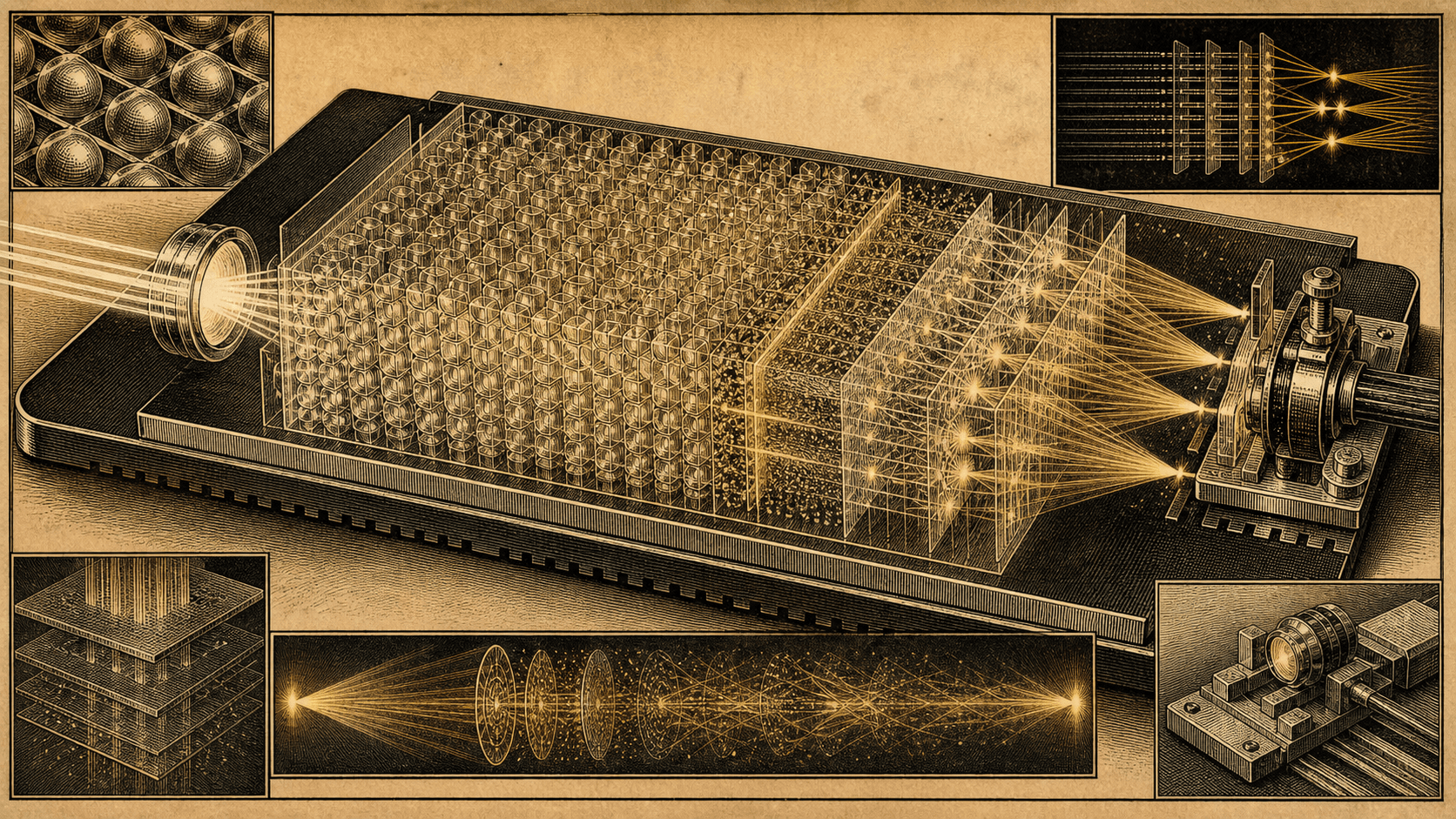
A task-agnostic diffractive encoder creates a huge random feature map, leaving only a small digital readout to train.
Editorial illustration
Conceptual diffractive optical encoder; not a chip photograph or literal study plot. Original editorial illustration generated with built-in Codex Image Gen for The Machine Press, 2026-07-17.
Researchers reported a random-projection optical neural network whose diffractive encoder can be printed in about 15 minutes and supplies roughly four million optical neurons at 500-nanometer spacing. A fixed physical layer scatters light into a high-dimensional representation; a digital readout with about one thousand trainable weights performs classification. Reported benchmark accuracy reached 97% to 99%. This is a laboratory demonstration, not a general-purpose optical computer, but it shows that one quickly manufactured optical front end can be reused across tasks.
Conceptual cometary outgassing altering an orbit; not a telescope image or impact forecast. Original editorial illustration generated with built-in Codex Image Gen for The Machine Press, 2026-07-17.
A missed predicted position and weak tail showed near-Earth object 1998 SH2 is an active comet pushed by escaping gas.
NASA reclassified 1998 SH2 after its post-flyby position no longer matched an orbit governed by gravity alone. Astrometry showed nongravitational acceleration from escaping gas, while follow-up observations revealed a faint coma and tail. Now designated P/1998 SH2, it is not a newly announced impact threat. The case matters because apparently inert objects can move differently when weak outgassing is present, and planetary-defense orbit models must account for that force.
First-time users showed no statistically significant change in neovascular macular-degeneration risk.
Johns Hopkins compared records from 12 databases for adults starting GLP-1 drugs or comparators. More than 200,000 first-time semaglutide users plus other cohorts showed no significant increase or decrease in new neovascular AMD. The retrospective study concerns one eye condition and should not guide medication changes without a clinician.
A dual-branch Transformer combines GNSS reflections from Tianmu-1 and Fengyun-3 into broader coverage.
The model learns each satellite separately before fusing them on a 36-kilometer grid. The product reached 79.7% average monthly coverage and a reported 0.88 correlation with NASA's SMAP reference. Ground comparisons were weaker and arid regions performed best, so broader validation remains necessary.
Multiple satellite references can expose an ionospheric disturbance hidden in one apparently clean link.
A new method combines several carrier-phase tests instead of trusting one reference. In a ten-hour, 96.3-kilometer ship experiment using six BeiDou references and three baselines, the collaborative rules improved detection sensitivity. The result still needs trials in rougher seas and other interference environments.
SOX2-amplified cells recruit suppressive myeloid cells before invasive cancer is established.
MD Anderson models showed SOX2-amplified cells releasing CCL2 and inflammatory signals that recruit suppressive myeloid cells. Blocking the IL-1 receptor reduced those cells, delayed tumors, and improved survival. This identifies a possible immunoprevention route, not a patient-ready treatment.
Hermit crabs in undersized shells kept eating but appeared to absorb less from the same food.
Tufts researchers found constrained crabs did not reduce food intake but produced more waste, suggesting lower nutrient assimilation. That could keep body size compatible with scarce housing. The mechanism is specific to this study and is not a human weight-control analogy.
Marshall Fire mobility data found people moving toward socially familiar communities, with unequal access.
NYU Tandon analyzed more than 200,000 anonymized devices. Evacuees often traveled 20 to 60 kilometers toward demographically familiar communities rather than simply the nearest safe place. Wealthier and whiter residents had wider access. One fire and incomplete device coverage limit generalization.
A screen expanded coat proteins available for attaching enzymes, while a five-gene deletion points toward safer carriers.
Tufts expanded candidate Bacillus spore anchors from 12 to 33. One PET-enzyme fusion showed four times the assay activity, while another worked better on actual PET. Because durable spores can germinate, the team proposed deleting five required genes. Industrial scale and environmental safety remain unproven.
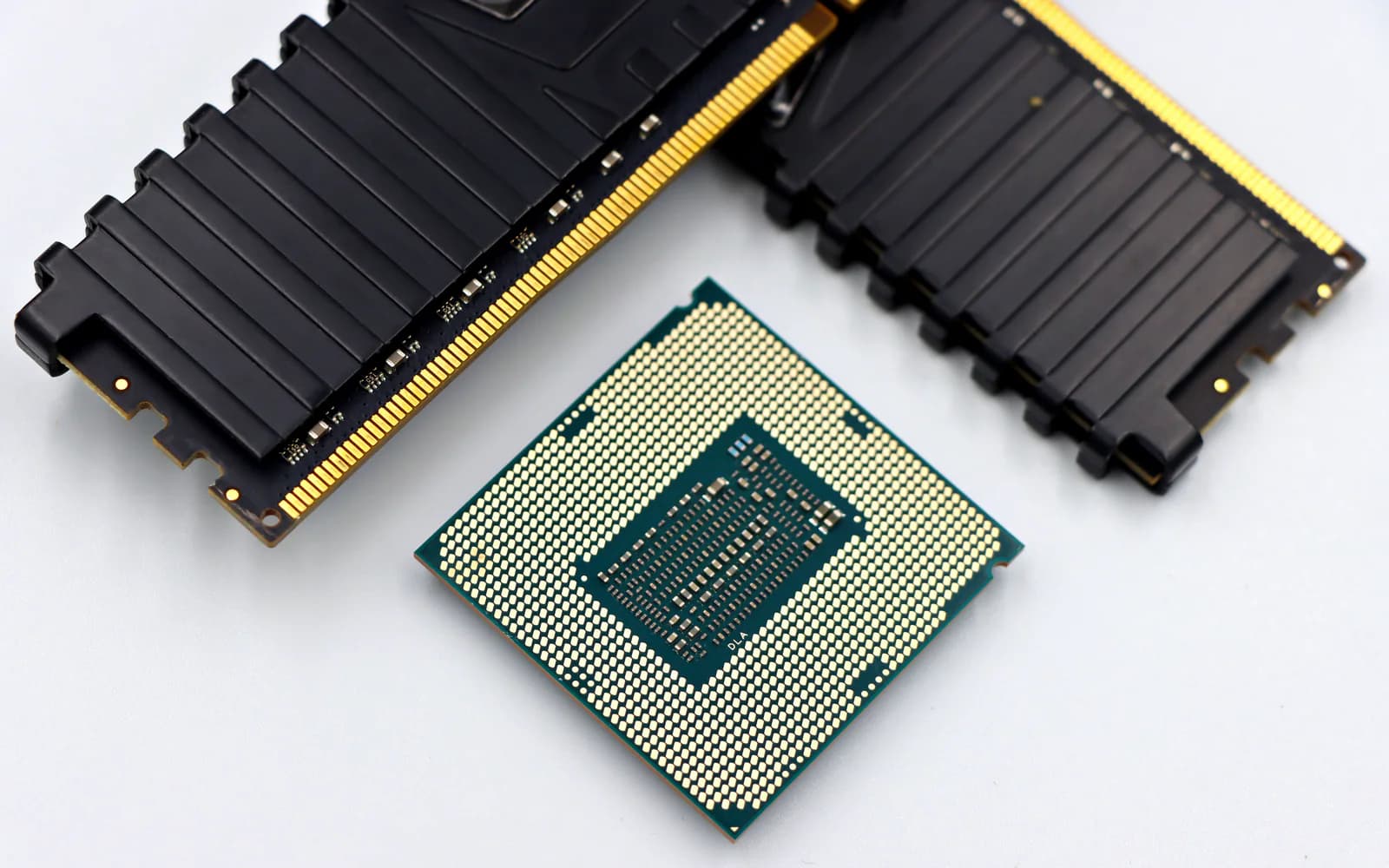
Generic rigid components used in contrast; not the Tufts thread prototypes. Marta Branco / Pexels; cropped, resized, metadata stripped, and converted to WebP by The Machine Press.
Transistors, sensors, and interconnects made as flexible fibers can bend, coil, and repair a broken connection.
Tufts engineers built thread-form components that conform to clothing without a rigid board. Demonstrations combined fiber transistors, sensors, and connections; a eutectogel conductor restored contact after cut ends were rejoined and gently heated. Wash durability, skin safety, and mass manufacturing remain open.
Deleting DDX3X was lethal to female mouse embryos while males survived, exposing a sex-specific translation safeguard.
A UNC-led mouse study found that deleting X-linked DDX3X from developing heart tissue killed female embryos while males partly compensated with a Y-linked gene. DDX3X helps translate structured cardiac messages. The mechanism is established in mice, not a diagnosed human syndrome.
Unidentified grid file image; not SIRIUS, LLNL, or a fusion facility. Robert So / Pexels; cropped, resized, metadata stripped, and converted to WebP by The Machine Press.
LLNL and Pacific Fusion's four-stage generator repeatedly delivered 60 gigawatts into a test load.
The SIRIUS prototype surpassed 3,000 shots, delivering roughly 60 gigawatts in 100-nanosecond pulses with about 95% transfer efficiency. Component failures stayed within reliability requirements. This advances an accelerator module; it is not fusion-energy gain or proof of an economical plant.
Computation and atomic-layer deposition identified magnesium oxide as a promising interface layer.
Argonne researchers tested ultrathin coatings on a sulfide solid electrolyte. Magnesium oxide improved interfacial stability; predicted-stable zirconium oxide performed poorly because reaction products impeded lithium. The method speeds comparison but does not deliver a complete long-life solid-state cell.
NSF, NRAO, and the Naval Observatory will test operations for the proposed ngVLA.
The partnership will connect new instruments with existing sites to test synchronization and long-distance data handling. The proposed ngVLA envisions 266 antennas but is not a completed observatory. The pathfinder asks whether separated dishes, clocks, networks, and processing can act as one instrument.
The LLNL-built detector kept its resolution after 2.6 years in deep space and exercised its pipeline during a gravity assist.
The sensor collected data as Psyche passed within 2,864 miles of Mars at over 12,000 miles per hour. The encounter tested sensitivity, radiation effects, repair operations, cosmic-ray monitoring, and processing rather than mapping Mars. The instrument maintained expected resolution; asteroid arrival is due in 2029.
Illustrative code-screen file image; not GitHub Projects or named repository code. Daniil Komov / Pexels; cropped, resized, metadata stripped, and converted to WebP by The Machine Press.
Advanced filters are generally available, letting teams combine conditions and search by review or deployment status.
GitHub Projects can combine filter terms with logical AND and OR. New qualifiers isolate pull requests by review state, and deployment filters retain 90 days of history. The release improves how planning items are found; it does not alter permissions or replace issue automation.
Desk Picks are selected by the newsroom. Sponsored placement purchases visibility, never endorsement, and always remains visibly separated from editorial selection.
 Editorial illustration