Across fourteen models, typed programs usually matched or beat rigid JSON calls—and held up better when the surrounding context decayed.
Editorial illustration
Conceptual illustration: programmatic tool calling can express chained and parallel actions, but benchmark gains do not remove execution or security risk. Original editorial concept art generated with built-in Codex Image Gen for The Machine Press, 2026-08-08.
Researchers compared programmatic tool calling, where a model writes against typed Python stubs and receives execution results in one turn, with native JSON tool calls across 14 language models on Berkeley Function Calling Leaderboard v4. The programmatic approach matched or exceeded JSON in 11 models; the authors report a 10.6 percent gain for the GPT-5.6 family, parity or improvement for 13 models under parallel fan-out, and stable performance in a context-rot test where the JSON baseline fell 2.3 percent on average. These are author-reported benchmark results, not proof that arbitrary generated code is safe or cheaper to execute in production.
Conceptual illustration: a theoretical control budget constrains how transition-rate changes move mean completion time in finite Markov chains. Original editorial concept art generated with built-in Codex Image Gen for The Machine Press, 2026-08-08.
A general result bounds how much any one transition can change a completion time—and makes every gain trade against the rest of the pathway.
A new theoretical result constrains how the mean first-passage time of any finite Markov chain responds when one transition rate changes. The authors show that each logarithmic sensitivity is bounded in magnitude by one and that all of the sensitivities sum to minus one, creating what they call a conserved control budget. In their analysis, changing an activation barrier or well depth can move many rates at once but cannot shift the completion time more than changing one rate; the same framework bounds kinetic-proofreading discrimination by the number of checkpoints and links it to substrate sensitivity. This is a mathematical preprint with implications for reaction networks and biological kinetics, not an experimental measurement of a particular molecule.
A reference-free framework scores conversational-agent tests for consistency, complexity and policy coverage before they score a model.
The framework uses language-model judges to inspect benchmark quality and produce diagnostics without requiring a separate reference answer for every item. The authors compare its judgments with human annotations, test benchmarks generated by models of different capability, and inject controlled degradations; they report that the metrics consistently separated quality levels across domains and judges. Because the assessor itself relies on model judgments, the result is a tool for benchmark auditing rather than an independent ground truth.
Illustrative developer-workstation file image; it does not show MIST, SCOPE, model context, benchmark items or reported results. Dhirendra Singh Dhami / Pexels; cropped, resized, metadata stripped, and converted to WebP by The Machine Press.
MIST tests clean, misleading, correct and irrelevant context together so resistance cannot masquerade as selective judgment.
The MIST benchmark renders each reasoning item under four matched context conditions and measures how often misleading context flips an otherwise correct answer. The authors say susceptibility appeared across the open models they tested; their SCOPE training method reduced those flips while preserving accuracy when context was correct, clean or irrelevant. The preprint argues for evaluating selective trust rather than blanket resistance, but does not establish immunity to adversarial context in deployed systems.
Omega-0 couples latent visual foresight to whole-body actions instead of separating walking from household manipulation.
Omega-0 predicts controller-compatible whole-body action latents from language, vision and robot state while learning compact future-observation embeddings rather than reconstructing video. Its accompanying Omega-HOME dataset contains more than 40 hours of synchronized household humanoid data. The authors report that one model produced concurrent movement and manipulation across 11 real-world tasks and outperformed their comparison policies; the preprint does not establish open-ended household reliability or safety.
DyPES-VLA shares predictions about scene change while leaving each embodiment its own native control expert.
DyPES-VLA learns a shared representation of object motion, contact and interaction-induced change, then translates it through embodiment-specific feed-forward experts without manually aligning every robot's action format. The authors report 98.0 percent success on LIBERO, 59.25 percent on RoboCasa-GR1 and 89.02 percent on RoboTwin 2.0 across simulation and real-world evaluations. Those benchmark results support cross-embodiment transfer within the tested settings, not a universal controller for arbitrary hardware.
An automated pipeline built structured and rubric-scored variables from nine EHR tables, then linked each output back to its support.
The Nimblemind Multi-Agent System generated 132 structured and 70 rubric-scored aggregate features from nine electronic-health-record tables and attached evidence and rubric provenance. On 500 dummy patient records from one institution, adding the aggregates raised held-out AUROC from 0.895 to 0.963 for reduced-ejection-fraction phenotyping and from 0.870 to 0.910 for preserved-ejection-fraction phenotyping. The authors call for external validation; this was feature-engineering research, not a clinical diagnostic trial.
A new learner matches the lower-bound shape for every fixed best-in-class risk, up to universal constants.
For binary hypothesis classes with finite VC dimension, the authors construct an agnostic PAC learner whose excess-risk guarantee adapts to the best achievable error in the class. They say its sample complexity matches established lower bounds up to universal constants for every fixed optimal risk, settling the rate rather than optimizing the very large displayed constant. This is a theoretical learning result and does not imply a practical training algorithm for modern foundation models.
NASA OSAM-1 robotics file image used as a general manipulation motif; it does not show the MRI device, experiment or authors, and use does not imply NASA endorsement. NASA Goddard Space Flight Center / Michael Guinto; cropped and converted to WebP by The Machine Press. Use does not imply NASA endorsement.
A magnetic-resonance-safe master-slave manipulator combines manual, digital and collaborative control for bedside intervention.
The 2+1-degree-of-freedom system uses elastomeric fluid actuators for remote angulation and low-friction graphite piston cylinders for needle insertion, with sub-newton force transparency and sub-millimeter motion transmission reported over bedside piping lengths. The team demonstrated assisted tissue penetration, virtual fixtures and motion compensation, then reported functional viability in a preliminary in-vivo pig experiment inside an MRI scanner. This is early device research, not evidence of safety or effectiveness in human procedures.
A disk-galaxy simulation found mass-losing stellar clumps migrating inward well ahead of a classical dynamical-friction estimate.
Researchers tracked nine long-lived clumps in an isolated disk-galaxy simulation; eight moved inward while losing 60 to 90 percent of their starting mass. A Chandrasekhar-style dynamical-friction model captured broad dependencies on mass and radius but overestimated the inspiral time by factors of about two to ten for six clumps. The discrepancy points to effects such as clump interactions, non-circular orbits and a changing disk potential within this simulation, not a direct observation of a named galaxy.
RP-OPSD concentrates teacher guidance around pivots that advance or redirect a solution across seventeen languages.
RP-OPSD estimates reasoning pivots from the distributional shift between teacher views with and without an English reference solution, then concentrates privileged distillation and reference anchoring around those points. Across mathematical reasoning benchmarks in 17 languages and multiple difficulty levels, the authors report gains over their multilingual and on-policy self-distillation baselines. The findings concern benchmark transfer and token-level analysis, not broad fluency or cultural competence.
SPT-3G and Planck data produced a foreground-robust template intended to clear contamination from primordial-wave searches.
The team combined SPT-3G polarization and reconstructed lensing data with a Planck cosmic-infrared-background tracer, then tested estimators with different foreground immunity. Simulations put residual foreground bias below 10 percent of the template power spectrum's statistical uncertainty for the profile-hardened construction; data-difference tests found no significant contamination. Its residual lensing B-mode power averaged about 0.48 over the stated angular range, which the authors call the highest delensing efficiency for such a template to date; it has not detected primordial gravitational waves.
GeniWorld renders numerical controls as visual actions to separate a robot body's kinematics from its environment's dynamics.
GeniWorld uses robot-description rendering to convert actions into spatial visual representations, then combines autoregressive video prediction with high-frequency kinematic control. The authors report better in-domain performance and zero-shot behavior in randomized unseen environments despite training on limited fixed scenes, plus gains when model-generated trajectories augmented small real-world datasets. The preprint presents controlled evaluations of a learned world model, not certification that simulated success will transfer to arbitrary physical settings.
Unidentified electrical-grid file image; it does not show the modeled system, a named utility, an outage or the study result. Robert So / Pexels; cropped, resized, metadata stripped, and converted to WebP by The Machine Press.
Planning generation, transmission, storage and stabilizing hardware together favored batteries that could do two jobs.
The study adds simplified inertia and voltage-stability constraints directly to expansion planning instead of selecting stabilizing measures afterward. In the tested power-system scenarios, the integrated formulation reduced modeled system costs and favored grid-forming battery storage over single-purpose measures such as static synchronous compensators because batteries could serve both energy and stability needs. These are model results under the paper's assumptions, not a forecast for a named grid or a procurement recommendation.
Three super-resolution methods improved detection over thick slices, but their dominant mistake was deleting real signal rather than inventing it.
Researchers degraded one-millimeter FLAIR scans from 29 ADNI participants to simulated three- and five-millimeter acquisitions, reconstructed them with two learned methods and cubic interpolation, and compared lesion segmentation with expert annotations. Every reconstruction improved detection over the raw thick slice, but small real lesions were erased more often than false lesions were hallucinated, especially at greater thickness; ECLARE preserved the most small-lesion signal. This small retrospective simulation does not validate super-resolution for clinical diagnosis.
UQ-Loc attaches a full three-dimensional covariance to every voxel and uses that uncertainty during pose solving.
UQ-Loc extends a scene-coordinate-regression localizer with a covariance head that predicts an anisotropic positive-definite uncertainty matrix per voxel. Training adds spatial smoothing, while inference weights pose seeds and tests inliers using the predicted covariance; the authors report consistent localization gains and calibrated uncertainty in their experiments. The abstract does not establish performance across all sensors, weather, maps or safety-critical driving conditions.
Packs a Raspberry Pi Zero 2W, square display, thumb keyboard, three USB ports, swappable batteries, and accessible storage into a palm-size Linux terminal.
Visit Hackberry Pi ZeroOriginal editorial concept art generated with built-in Codex Image Gen for The Machine Press, 2026-08-02; carried into the 2026-08-08 edition.
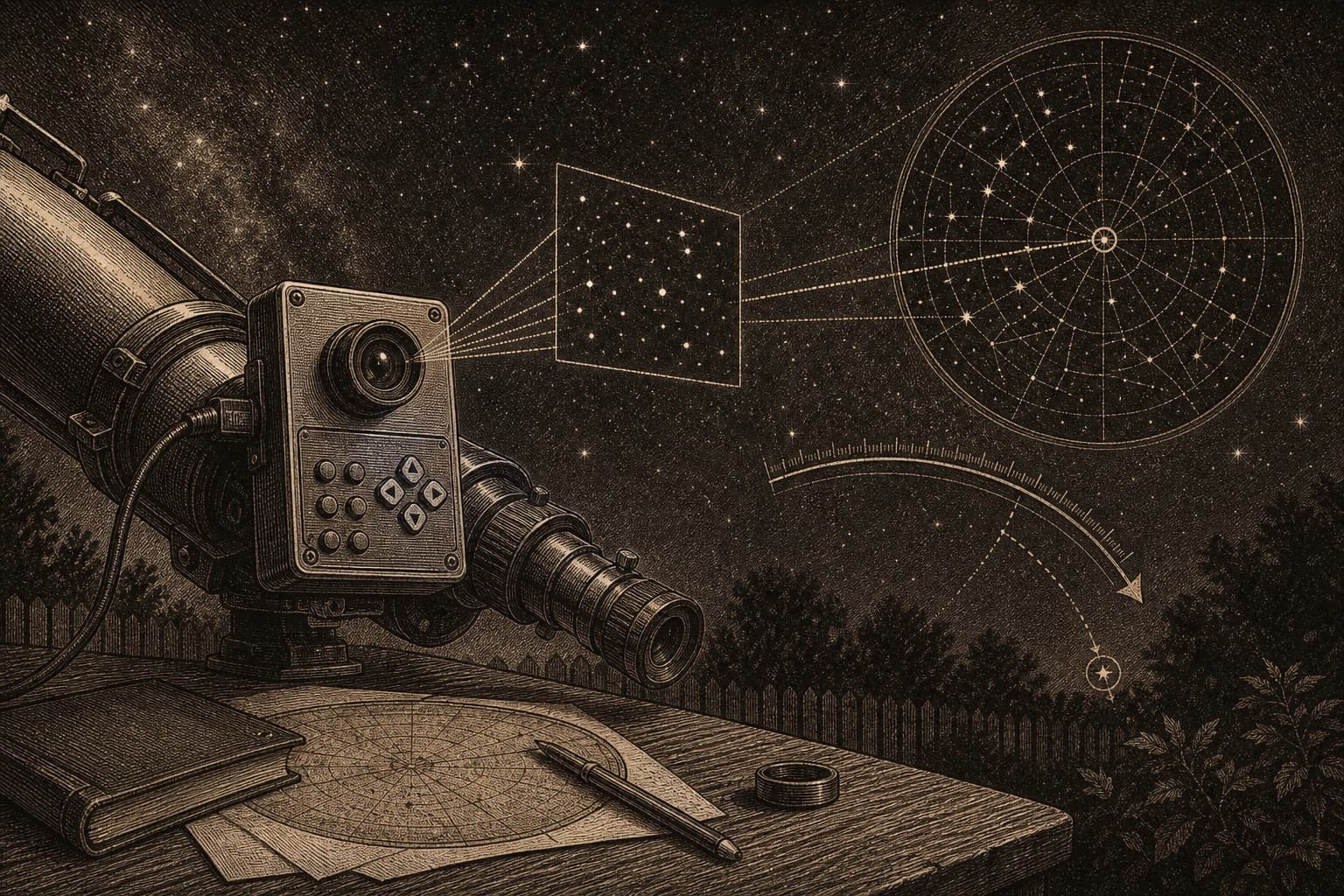
Mounts a Raspberry Pi camera beside a telescope, plate-solves the star field, and combines GPS and inertial sensing to guide push-to observing without a separate alignment routine.
Visit PiFinderOriginal editorial concept art generated with built-in Codex Image Gen for The Machine Press, 2026-08-02; carried into the 2026-08-08 edition.
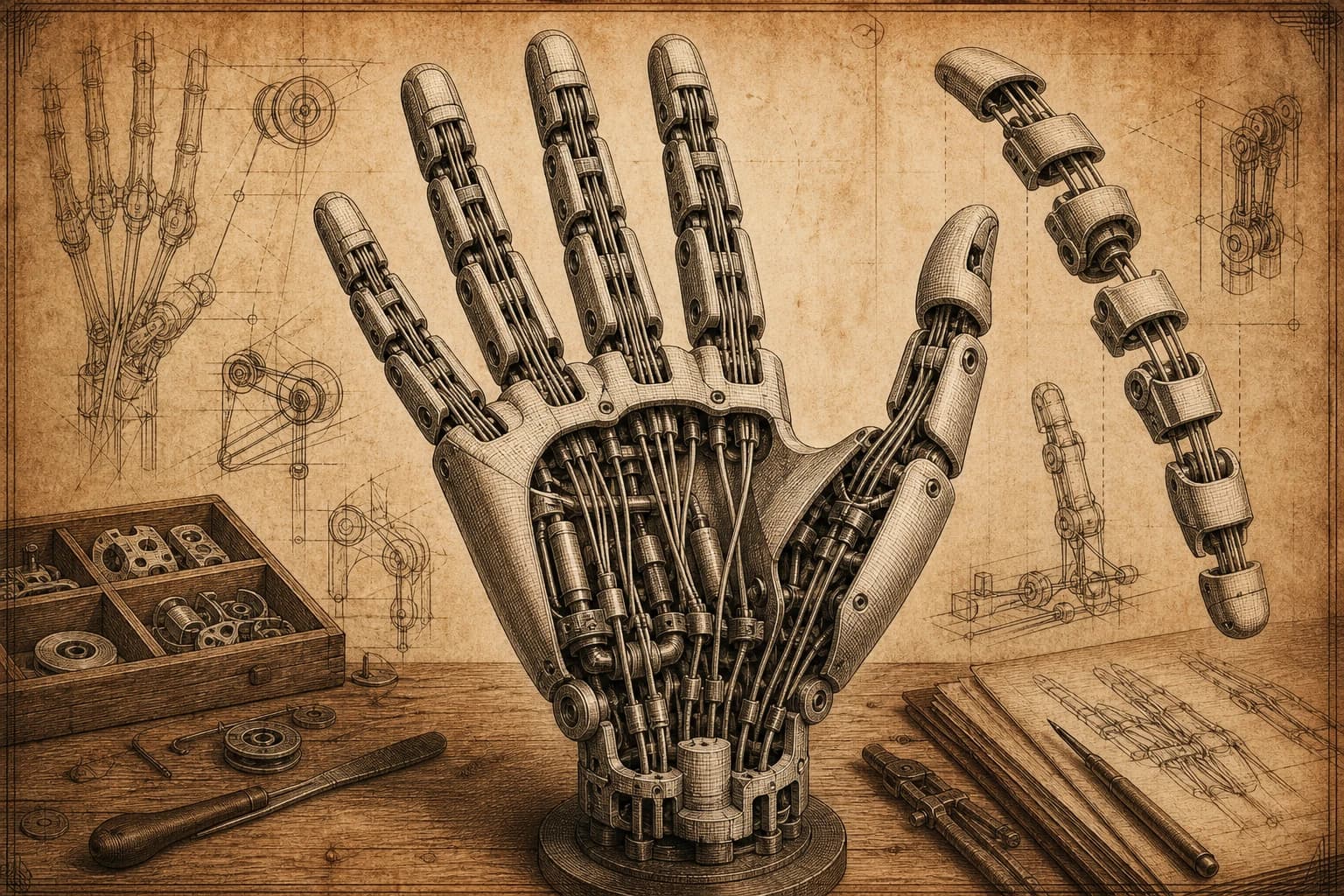
Routes tendons through a modular five-finger, 16-joint hand with seven controlled degrees of freedom, printable parts, firmware, an SDK, ROS 2 tools, and simulation assets.
Visit Aero Hand OpenOriginal editorial concept art generated with built-in Codex Image Gen for The Machine Press, 2026-08-02; carried into the 2026-08-08 edition.
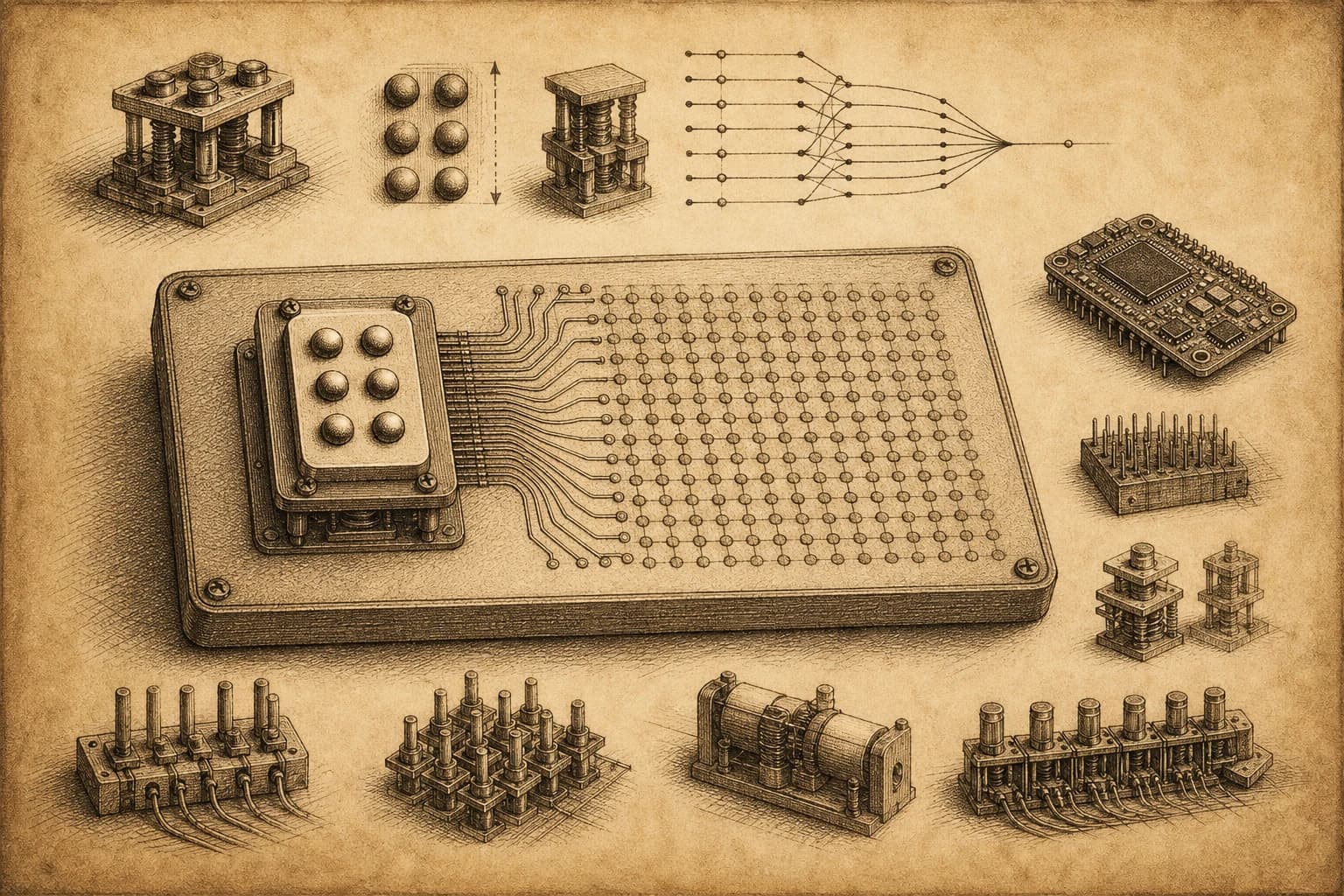
Explores pairing one physical refreshable Braille cell with a tactile sensor matrix representing virtual character positions, reducing the amount of moving hardware under study.
Visit BrailleTouchOriginal Codex Image Gen concept art from 2026-07-10; carried forward through the validated 2026-08-07 edition.
Desk Picks are selected by the newsroom. Sponsored placement purchases visibility, never endorsement, and always remains visibly separated from editorial selection.
 Editorial illustration