A red JWST source once proposed as a galaxy at redshift 32 moved against its background, identifying it instead as a cold Milky Way brown dwarf.
Editorial illustration
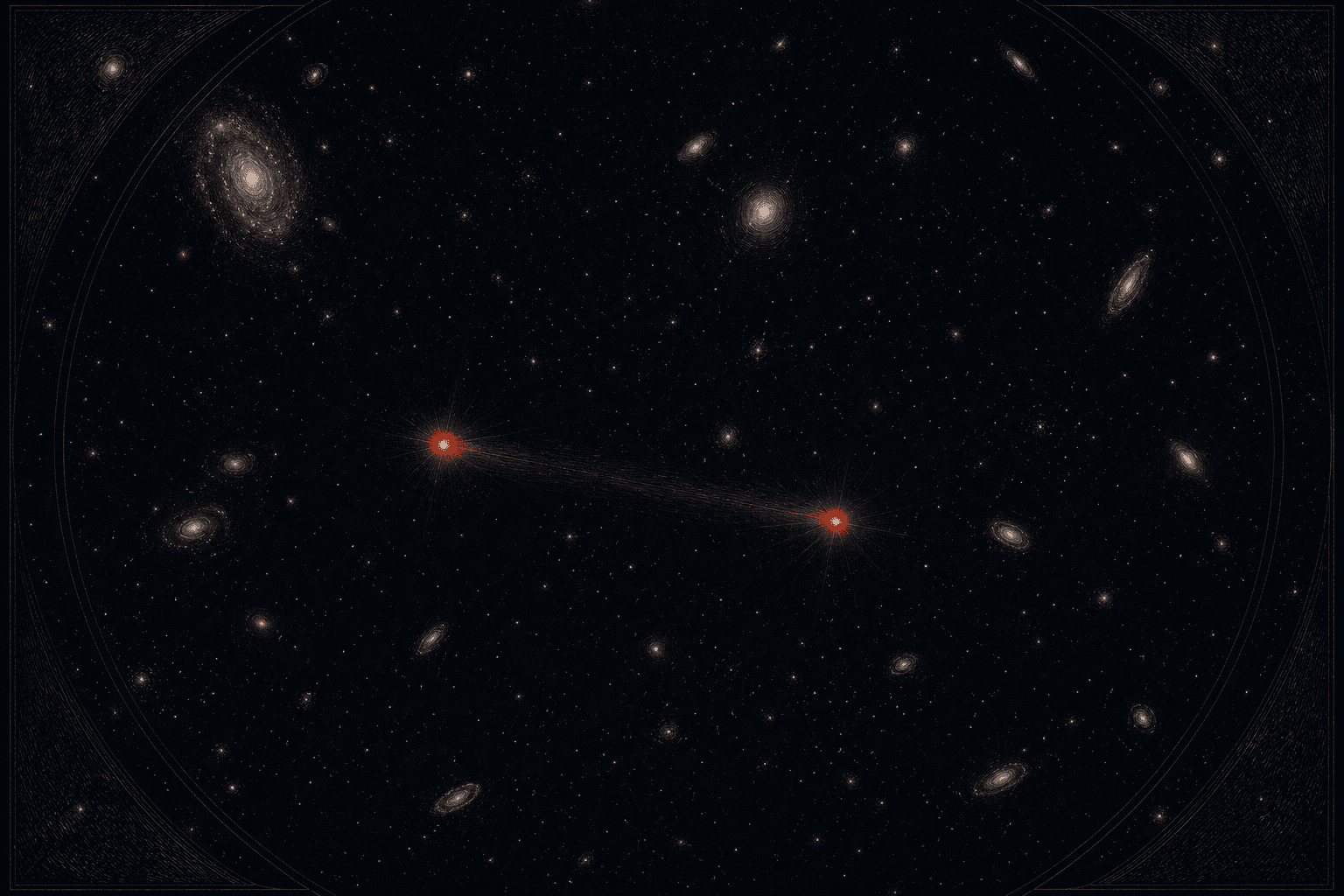
Conceptual illustration: multi-epoch JWST astrometry showed that the unresolved red source Capotauro moves and is not an extreme-redshift galaxy. Original editorial concept art generated with built-in Codex Image Gen for The Machine Press, 2026-08-10.
Researchers compared new JWST medium-band imaging with discovery observations separated by about 3.5 years and measured Capotauro moving 132 plus or minus 20 milliarcseconds relative to 68 compact reference sources. That motion rules out an extragalactic object at more than six sigma, according to the preprint. Template fitting instead favors a roughly 350-kelvin Y-type brown dwarf about 730 parsecs away. The result shows why multi-epoch imaging matters when unresolved cool stars imitate extreme early-galaxy colors; it remains an author-reported preprint submitted to MNRAS.
Conceptual illustration: optical fields levitated, controlled and rapidly rotated fabricated silicon nanorods in a laboratory study. Original editorial concept art generated with built-in Codex Image Gen for The Machine Press, 2026-08-10.
Optical fields levitated nanofabricated silicon cylinders, tuned their oscillations above one megahertz and drove rapid rotation without contact.
A team reports levitating uniform silicon nanorods as narrow as 50 nanometers and as long as 1,500 nanometers, then controlling their translation, alignment and rotation with light. The measured oscillation frequencies could be tuned from 10 kilohertz to above one megahertz, while optical torque produced high rotation rates. The authors propose the platform for precision torque sensing and, at smaller scales, future quantum tests. Those latter uses are goals rather than demonstrated applications, and the work is a laboratory preprint.
TEPA keeps superseded evidence for audit while removing it from the active retrieval set when the world changes.
Append-only memory can keep obsolete facts alive after newer evidence contradicts them. TEPA gives each keyed precedent an explicit validity state, revokes older active precedents on conflict and preserves their history. In controlled reversal tests over 50 seeds, the authors report 0.950 accuracy for TEPA versus 0.210 for append-only and last-write-wins memory; similar results appeared in file-backed execution. The method handles single-hop validity, while the paper says multi-hop retrieval and long-context selection remain unresolved.
Illustrative programming file image; it does not show SimWAM, autonomous-driving software, a vehicle, a benchmark or reported results. Nemuel Sereti / Pexels; cropped, resized, metadata stripped, and converted to WebP by The Machine Press.
SimWAM uses a video generator only during training, then discards it so a smaller action model can plan trajectories on its own.
SimWAM co-trains a pretrained video expert and a lightweight action expert through a shared attention interface, while masking future frames from the action branch. At inference, the video branch is removed. The authors report a 91.5 PDMS score on NAVSIM, lower latency than compared world-action planners and zero-shot transfer to nuScenes. These are benchmark results from a preprint, not evidence of road-ready autonomous driving.
A stream of one-way messages drove an identical subordinate model into behavior neither model produced alone.
Researchers tested pairs of AI agents with the same decoding temperature and found that interaction could create a distinct dynamical state. When a boss agent repeatedly sent messages while ignoring replies, the subordinate did not simply copy the boss or revert to its isolated behavior; when both listened, both moved toward a similar interaction-induced state. A simple kinetic model reproduced the principal effects. The preprint studies controlled exchanges, not ordinary deployed assistants.
A video framework separates what belongs in a reflection from where that reflected content should appear.
MirrorWorld adds two training objectives to video inpainting: semantic relation distillation links the visible scene to the mirror region, while geometric transformation alignment learns the reflected layout. The team repurposed four mirror-video datasets into a unified reconstruction benchmark and reports improvements over representative image-reflection and video-inpainting baselines. The result is a research benchmark for generated reflections, not a guarantee that arbitrary synthetic video obeys optics.
SemBridge adds semantic-token supervision during training while leaving continuous-latent speech generation unchanged at inference.
Continuous speech models preserve acoustic detail but make linguistic structure less explicit. SemBridge anchors hidden states and the acoustic latent space to discrete semantic tokens during training, then removes that supervision path at inference. Across zero-shot text-to-speech and score-conditioned singing tests, the authors report lower word and character error rates while maintaining competitive speaker similarity and perceptual quality. The claims remain benchmark results from a preprint.
CreativeInstruct marks spans where a post-trained language model should recover diversity without abandoning answer quality.
The method trains models to insert special creativity spans, aiming to recover base-model diversity while retaining post-training quality. It also introduces a graph-edit metric for narrative structure. In the authors' human study, annotators preferred CreativeInstruct outputs as more creative than post-trained baselines in 70.3 percent of comparisons; reinforcement learning from the creative checkpoint also improved reported AMC and MATH results. These are preprint evaluations, not a general measure of creativity.
Staged cybersecurity file image; it does not show a real phishkit, victim, campaign, stolen data or system analyzed in the study. Rafael Minguet Delgado / Pexels; cropped, resized, metadata stripped, and converted to WebP by The Machine Press.
A study of 1,300 kits found substantial component reuse—and 21.8 percent used no evasion mechanism at all.
Researchers examined phishkits collected from 2020 through 2023, including their code, communication channels and data-exfiltration behavior. They found dynamic redirection and traffic attribution mechanisms, plus frequent use of messaging services to receive stolen data. Yet 284 of 1,300 kits used no evasion, and major components were often similar or identical across samples. The authors argue this predictability could support detection at scale; the preprint does not describe a current named campaign.
CoinRAG reuses cached, query-relevant semantic units instead of repeatedly encoding full retrieved passages.
CoinRAG first retrieves broad chunks, then identifies smaller information nuggets and assembles their precomputed key-value representations with compact context. On LongBench multi-hop question-answering tasks, the authors report lower prefill costs and a 5.3 percent average relative F1 improvement under a standard fast-latency budget compared with their baselines. The result is an efficiency claim on selected benchmarks, not proof that fine-grained cache reuse preserves every source nuance.
SkillProx replays diagnosis-driven edits, rolls back regressions and audits whether each stored instruction still earns its place.
The framework treats textual agent skills as modular knowledge rather than model weights. Its forward step tests proposed edits on the same task batch and reverses regressions; its backward step decomposes a skill into auditable units, estimates each unit's contribution and consolidates or removes it behind a validation gate. Across multiple language-model backbones, the authors report a three-percentage-point average accuracy gain over their strongest gradient-based baseline. The evidence is benchmark-bound preprint work.
A map of 21 open tools found dense coverage of evaluation and guardrails but broad gaps in governance, law and finance.
The study maps open-source evaluation and security tools against 32 subcategories in an extended AI-risk taxonomy using an LLM-assisted analysis of code and documentation, followed by three independent reviewers. The reviewers reached moderate agreement, and the final mapping achieved a reported 75.5 percent F1 after majority voting. Coverage clustered around technical and operational controls, leaving legal, governance and market risks sparse. The taxonomy is a planning aid, not a certification of any tool.
Blast Radius predicts which memories a coding agent will need and archives low-value transcripts without losing their bytes.
The proposed memory layer estimates how far a new prompt reaches through code and conversational context, then evicts material into a reversible archive. Across seven tested OpenAI models, the authors report 17 to 26 percent lower token use and the lowest overflow rate among their comparison policies. Of 450 archived records, none were recalled in the reported runs. That last result may reflect the test distribution; this is an author-defined preprint evaluation, not an independent production audit.
Conceptual Visualising AI file image; it is not a chart, model diagram, telecom system, energy measurement or result from the reported study. Tim West / Google DeepMind / Pexels; cropped, resized, metadata stripped, and converted to WebP by The Machine Press.
Encoding telecom time-series as images cut reported input length and inference energy while improving anomaly detection in the tested models.
The authors rendered multivariate telecom metrics as two-dimensional plots for vision-language models instead of serializing every number as text. They report 3.6- to 10.4-fold input-token reductions and 1.8- to 2.5-fold measured inference-energy reductions across three model families. A fine-tuned vision model also outperformed the paper's text and classical baselines on anomaly detection. The result was accepted at ECRES but remains workload-specific; it does not establish that images are universally more efficient or accurate.
P-Bench targets statistical mistakes that survive correctly executed code but invalidate an agent's scientific conclusion.
P-Bench contains 425 open-ended hypothesis-testing tasks across economics, biology and medicine, requiring an agent to choose a method, compute a p-value and interpret the result. The authors say current agents often execute code correctly while violating assumptions behind the test. Their open-weight Fisher-R1-14B model, trained with verified statistical rewards, improved single-trial success by 21 percent relative to DeepSeek-V4-Pro on average. The benchmark and model are preprint contributions, not validation for unsupervised science.
Mechanistic attacks mapped and pruned sparse safety features inherited from autoregressive parent models.
Researchers tested diffusion language models that generate by iterative denoising rather than next-token prediction. They report that pruning mapped safety neurons raised attack success rates from 2.6 to 73.8 percent on LLaDA and from 1.9 to 86.6 percent on Dream; a separate offline steering method transferred attacks to several targets with reported success as high as 86.9 percent. These figures come from the authors' threat model and preprint codebase and should not be generalized to every diffusion model.
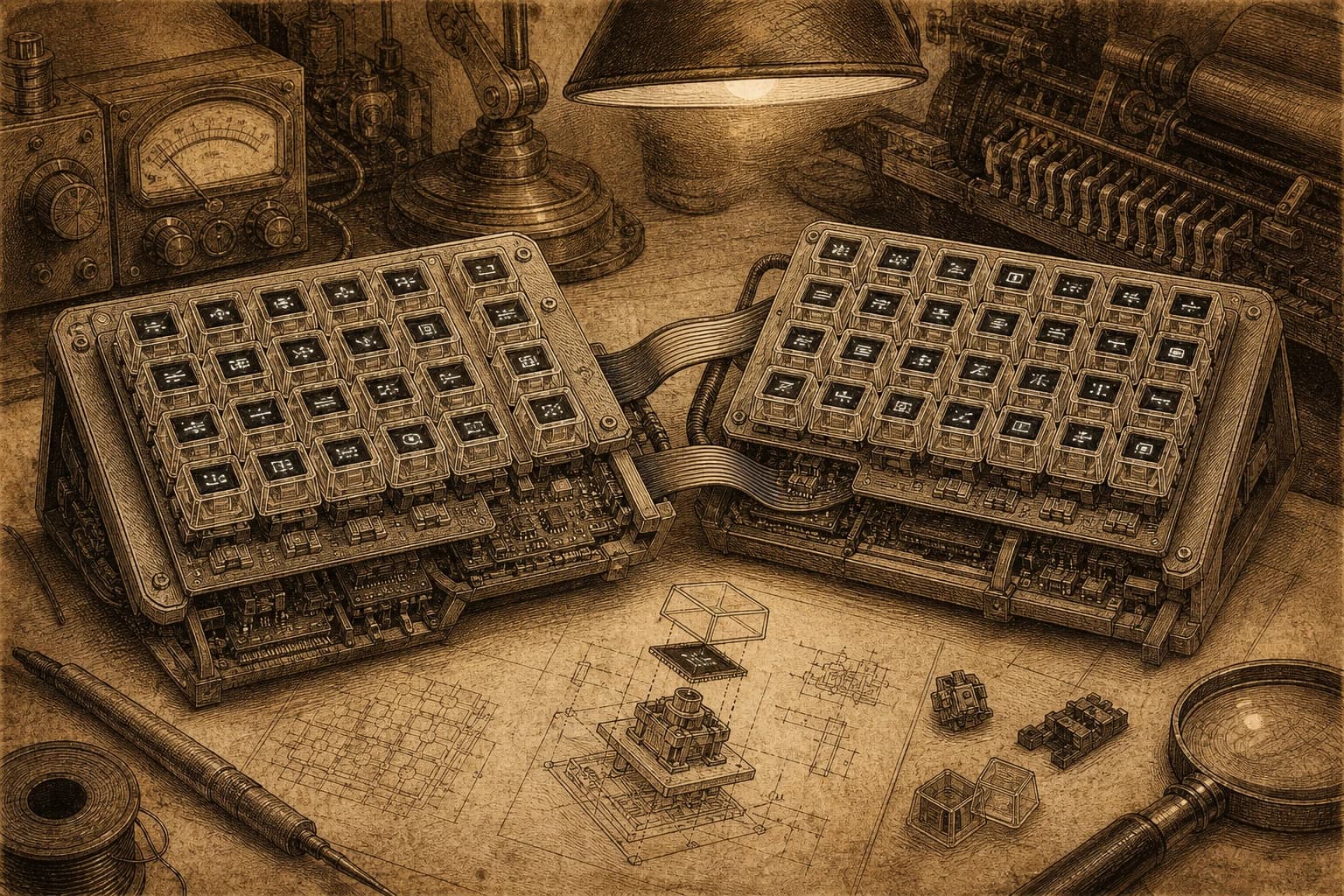
Splits 72 mechanical keys between two halves and puts a tiny OLED beneath each transparent keycap so displayed legends can change with layouts and languages.
Visit PolyKybdOriginal editorial concept art generated with built-in Codex Image Gen for The Machine Press, 2026-08-09.
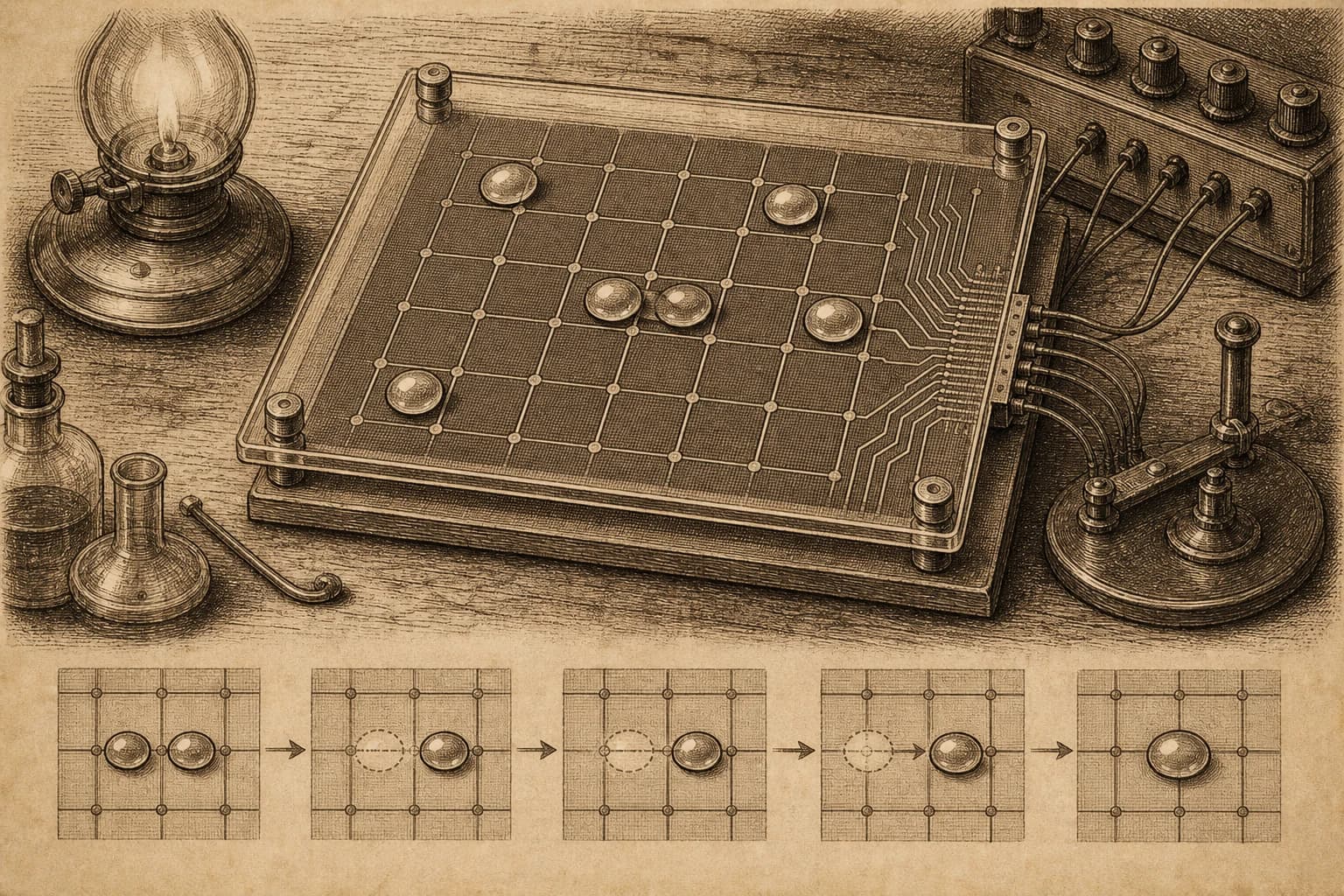
Moves and combines small liquid droplets across an addressable electrode grid, providing an open tabletop platform for digital microfluidics experiments.
Visit OpenDropOriginal editorial concept art generated with built-in Codex Image Gen for The Machine Press, 2026-08-09.
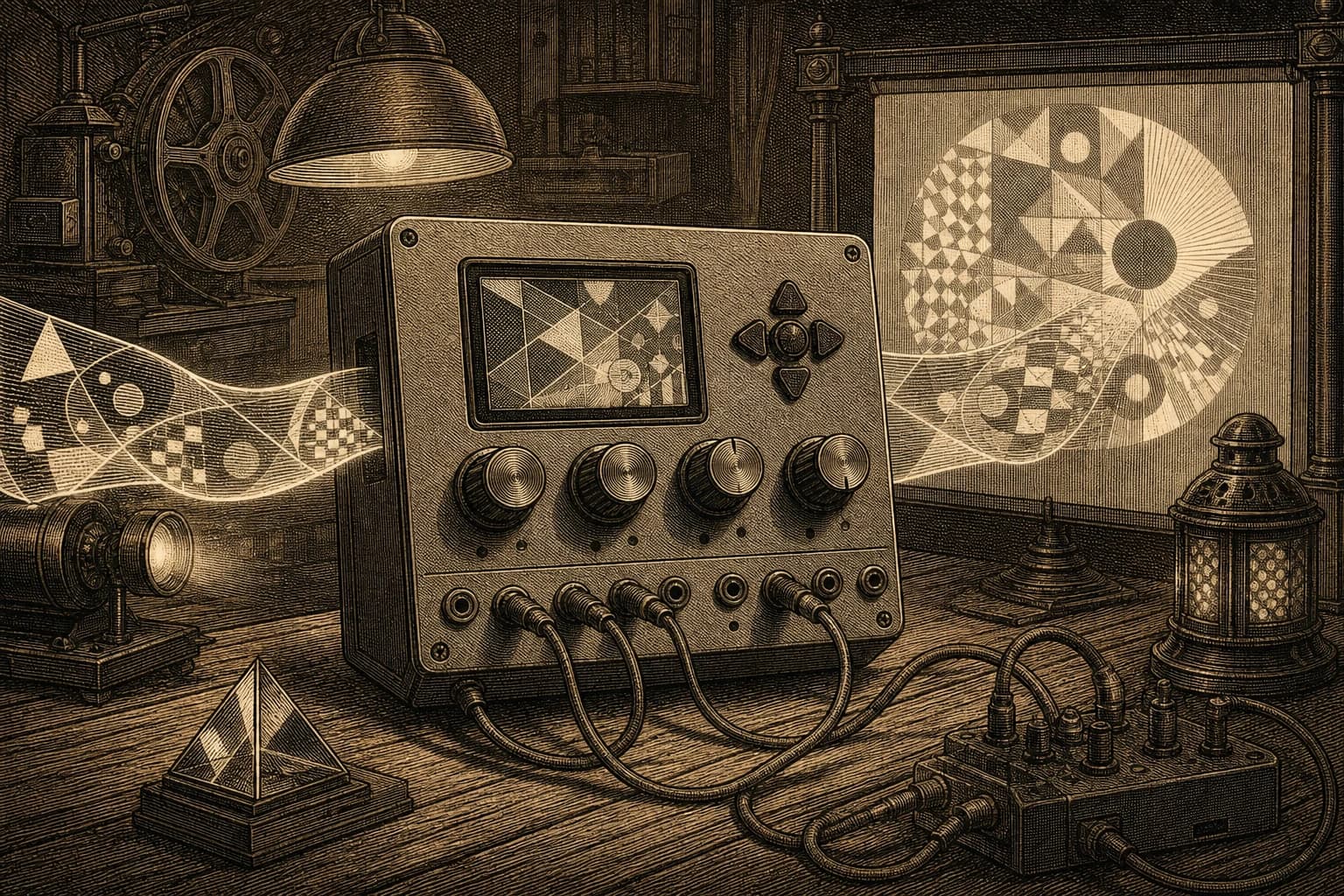
Runs video samples and shaders on a Raspberry Pi Zero, exposes four knob or control-voltage inputs, and can pass compatible external capture through visual effects.
Visit recurBOYOriginal editorial concept art generated with built-in Codex Image Gen for The Machine Press, 2026-08-09.
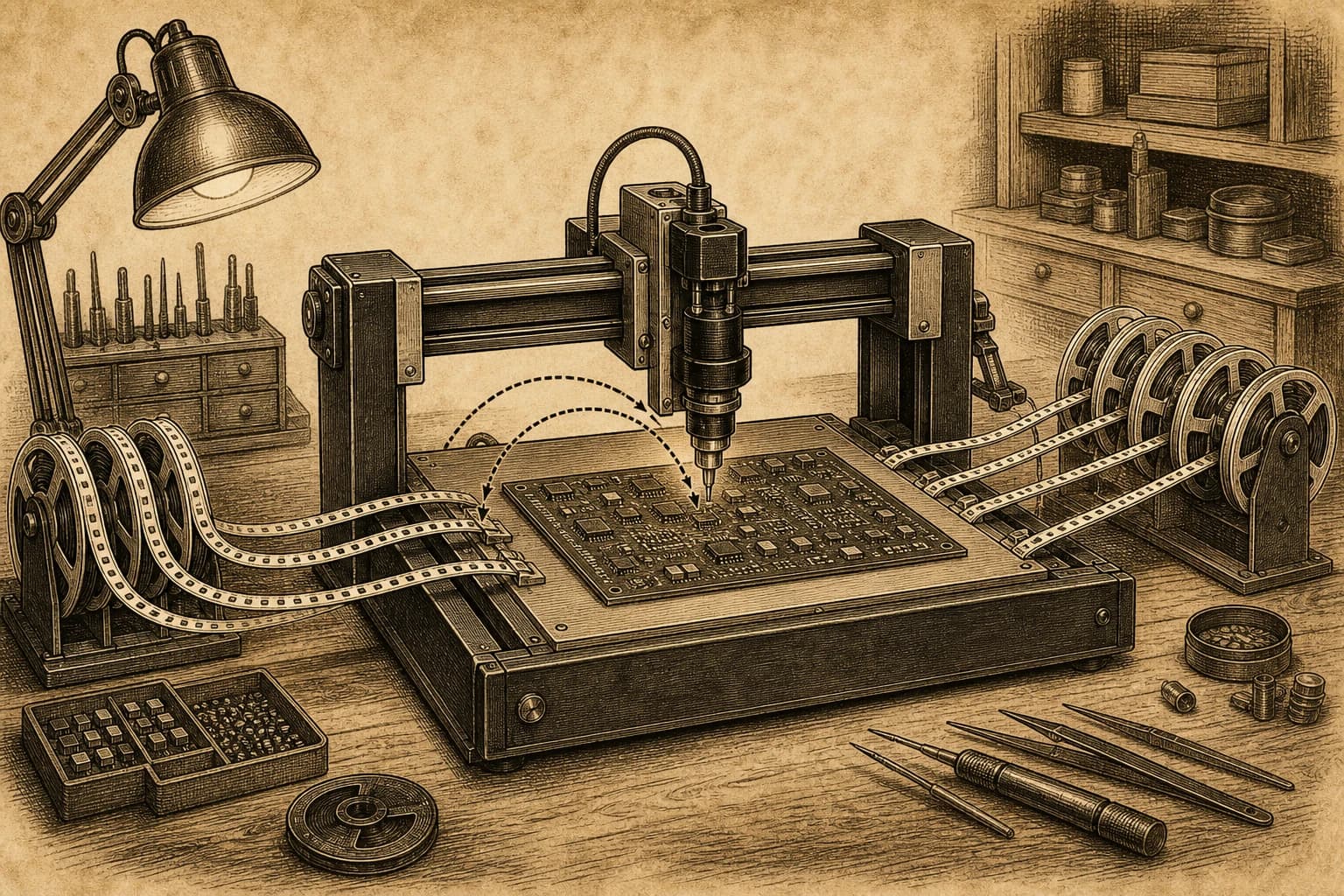
Uses a desktop gantry, placement head, and component feeders to assemble electronic parts onto circuit boards; its primary repository says machines run in active production.
Visit LumenPnPOriginal Codex Image Gen concept art from 2026-07-10; carried forward from the validated 2026-08-08 edition.
Desk Picks are selected by the newsroom. Sponsored placement purchases visibility, never endorsement, and always remains visibly separated from editorial selection.
 Editorial illustration