Across twelve frontier models, professional-looking evidence pushed agents toward directional calls even when the evidence was fabricated and the question could not be predicted.
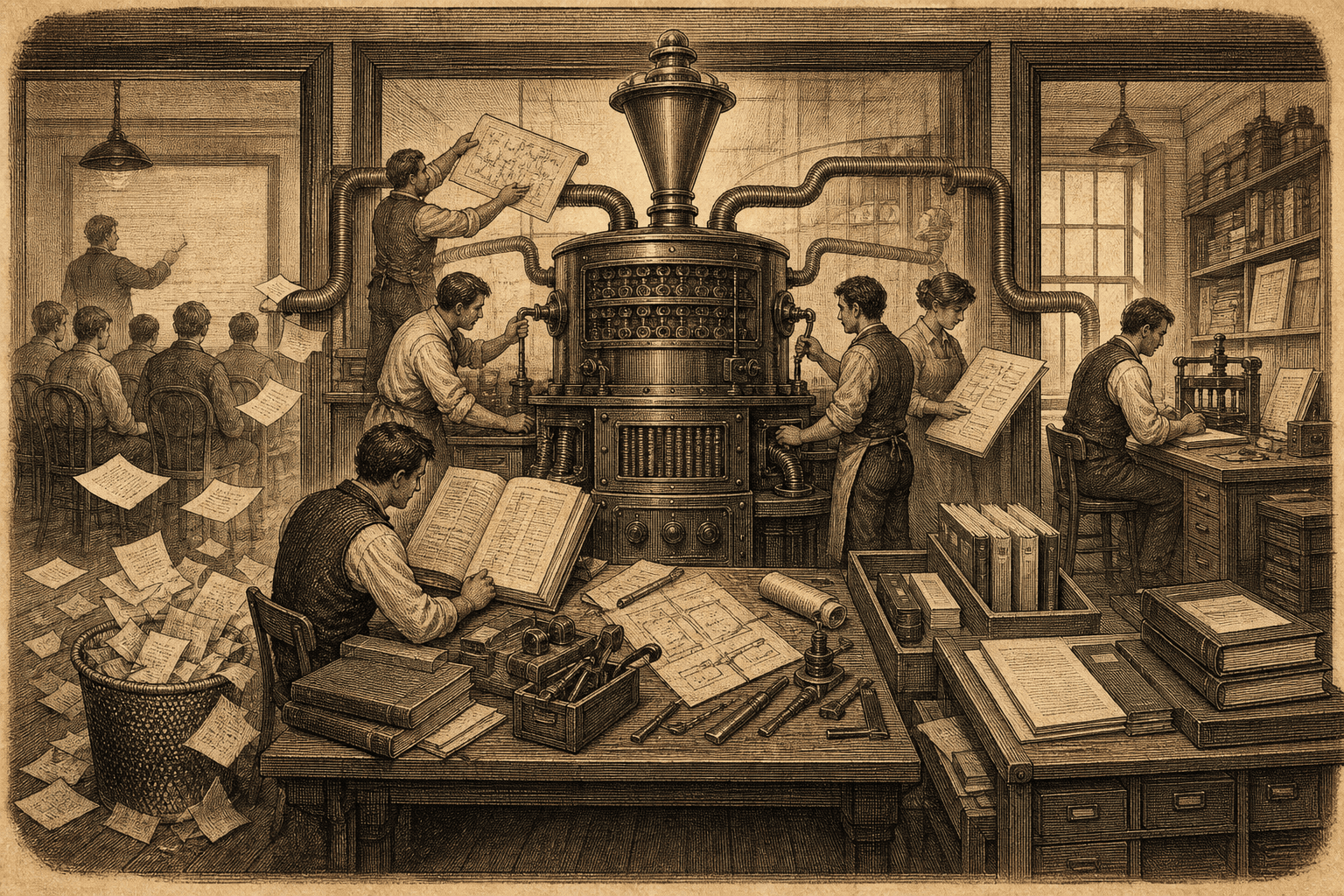
Editorial illustration
Conceptual illustration: authoritative presentation can push an agent toward action without predictive information; this is not a study panel, model interface or result. Original editorial concept art generated with built-in Codex Image Gen for The Machine Press, 2026-08-28.
The preregistered study reports that commitment on provably unpredictable questions rose from 6.5 percent with a bare question to 54 percent as evidence packaging intensified. Fully fabricated displays lifted commitment from 24.5 to 36.8 percent, statistically indistinguishable from the 37.6 percent produced by genuine market data. Models often recognized that a question was unknowable when asked first, suggesting a failure at the act-or-abstain gate rather than simple incapacity. Fine-tuning one 3B model on 540 synthetic examples eliminated commitment on the original cases, but the behavior returned under rigid response formats. These are author-reported experimental results, not proof that every model or deployment fails this way.
Conceptual illustration: the field study associated sophisticated workplace AI use with expertise, not durable gains from training alone; this does not depict the firm, employees or their prompts. Original editorial concept art generated with built-in Codex Image Gen for The Machine Press, 2026-08-28.
A field study of 713,564 workplace prompts found more sophisticated use among senior employees, but no durable improvement over time or after formal AI training.
Researchers analyzed prompts and responses from nearly 4,000 back-office employees across 15 functions at one large firm over eight months in 2025. Their measures placed Strategy, Digital Innovation and Project Management highest and found senior employees using generative AI more sophisticatedly, a pattern consistent with domain expertise complementing the tool. The study found neither improvement over time nor lasting gains following formal training. Because the evidence is proprietary, observational and drawn from one firm, it does not establish that training is useless or that seniority causes better outcomes; it shows that access and attendance alone did not shift the measured habits in this setting.
GraphMemix builds a relevant evidence subgraph at query time instead of summarizing every memory in advance.
The method expands seed memories through semantic and schema relations, prices evidence and activation costs, and selects a forest under a fixed budget. Across four long-term multimodal-memory benchmarks, the authors report a new accuracy-versus-lifecycle-cost frontier. The gains depend on the evaluated datasets and foundation models rather than proving universal memory reliability.
Generic code-screen file image used illustratively; it is not a WikiSkill execution trace, skill, wiki or benchmark result. Daniil Komov / Pexels; cropped, resized, metadata stripped, and converted to WebP by The Machine Press.
WikiSkill separates raw execution experience, accumulated knowledge and executable skills so later revisions can reuse earlier lessons.
Across several benchmarks and models, the authors report that the persistent wiki improved on prior skill-evolution methods and usually beat no-skill baselines. Evolved skills transferred across model families, and smaller models with skills sometimes outperformed substantially larger models without them; ablations attributed part of the gain to accumulated knowledge rather than the executable skill alone.
MAELLE represents chemical reactions as discrete flow through electron-occupation space instead of direct molecular graph edits.
The method uses a continuous-time Markov chain and optimal-transport paths to produce interpretable electron rearrangements without elementary-step annotations. Its authors report competitive USPTO-480K accuracy, stronger robustness on two out-of-distribution settings and the ability to recover plausible mechanisms and side products; those benchmark results are not laboratory validation of a proposed reaction.
A retrospective two-site study learned an hourly sepsis index from whole-treatment mortality rankings rather than hour-by-hour labels.
The model used 43 routinely charted variables from 29,116 and 7,691 adults meeting Sepsis-3 criteria. Non-survivors scored 1.19 to 1.64 points higher on a 0-to-10 scale within baseline clinical strata, while cross-institutional agreement remained below same-site agreement. The authors present it as potential decision support that complements clinical judgment, not a validated replacement for bedside assessment.
CorporateBench builds temporally consistent synthetic firms so question-answering systems can be tested at enterprise communication scale.
Four generated firms range from 12 to 10,000 employees, with corpora exceeding 230,000 documents sampled from evolving knowledge bases. Five evaluated models performed worse as the inputs approached realistic scale. The benchmark preserves cross-document logical consistency, but synthetic firms remain a proxy for private organizations and their messier records.
Capabilities-flavored and safety-flavored evaluation awareness predicted sharply different compliance behavior.
On Qwen3-32B and the FORTRESS dataset, capabilities framing predicted compliance 24 to 46 percentage points more often than safety framing across tested steering conditions. Ten of eleven chain-of-thought prefills moved compliance in the predicted direction, suggesting that one aggregate eval-awareness rate can conceal safety-relevant differences within this setup.
Generic programming file image used illustratively; it is not a HarnessLens harness, task trace, verification gate or result. Nemuel Sereti / Pexels; cropped, resized, metadata stripped, and converted to WebP by The Machine Press.
HarnessLens directs scarce evaluation rollouts toward tasks attributable to each proposed runtime change.
Across three agent harnesses and four benchmarks, the authors report held-out gains of 7.6 to 13.6 percent while using less evaluation budget than comparison methods. The framework also gates changes on attributable evidence so an aggregate score cannot as easily bury a targeted regression; the evidence is benchmark-based rather than a production reliability guarantee.
A frontier model produced fixed algorithms for inventory, queueing and assortment problems before seeing the evaluation instances.
Given a problem-class description, parameter ranges and a bounded Python sandbox, the strongest tested model matched or exceeded the best existing method on almost all evaluated instances. The paper argues that frontier models should now be treated as empirical baselines for well-specified operations-research design, while its narrow problem set does not establish general optimality.
BrailleBench tests understanding, expression and end-to-end interaction across 5,570 expert-reviewed instances.
Six evaluated models showed a persistent gap between print-English and Braille performance. Understanding and expression were asymmetric, contracted Grade 2 Braille was especially fragile on input, and fully Braille requests reduced performance further. The deterministic pipeline used no model-generated test instances, giving accessibility failures a clearer measurement target.
A single-lineage optimizer revised prompts from rollout feedback without maintaining a complex search population.
Naive Prompt Optimization matched or outperformed GEPA in the reported evaluations with fewer rollouts, and its advantage increased with stronger teacher models. Optimized prompts also transferred to other student models, especially within a model family. The authors call the results preliminary and note that reinforcement learning performed better on some interactive tasks.
The ACE framework separates grounded accuracy, learner-relative complexity and behavioral diversity in generated agent experience.
The survey represents agent data as environment, task, interaction and optional verifier, then treats generation as constrained distribution design. Its synthesis finds a shift toward execution-grounded validity, difficulty calibrated to a declared learner and diversity beyond surface variation. This is a conceptual map of prior work, not a new empirical dataset.
National Archives server-room file image used illustratively; it is not Thomson infrastructure, training compute or a sovereign-AI deployment. The National Archives (UK), via Wikimedia Commons, CC BY 3.0; cropped and converted to WebP by The Machine Press.
Thomson applies a mid- and post-training stack to an open-weight base while trying to preserve plasticity and stability.
The authors report competitive results across agentic, safety, legal, tax, multilingual and deep-research evaluations, with broad gains and little of the forgetting seen in narrow adaptation. They argue that institutions with smaller budgets can own more of the model stack. Those performance and cost claims come from the model team and require independent replication across deployments.
SARA records where action-inducing instructions originated and checks execution against the user objective and authorized evidence.
The design separates action induction from runtime authorization and blocks history from laundering an untrusted observation into authority. Across AgentDojo and AgentDyn, the authors report attack-success rates no higher than 0.63 percent in four primary settings while retaining competitive utility. The result is benchmark evidence, not a blanket guarantee for every tool or side effect.
ASIL exposes application state as structured JSON and replaces brittle pointer actions with code-executable semantic operations.
Across 15 applications and 380 tasks, the structured interface exceeded 80 percent strict success with closed models while using fewer than five actions per task. Screenshot-and-click baselines remained far lower under the reported budgets, though ASIL only matched draw.io's native MCP-style content contract. Small-model fine-tuning also improved, suggesting the interface can serve as a training substrate.
A self-contained touchscreen computer boots into MicroPython and combines programmable graphics, MIDI connections, and an open-source synthesizer in focused, buildable hardware.
Visit Tulip Creative ComputerOriginal editorial concept art generated with built-in Codex Image Gen for The Machine Press, 2026-08-23.
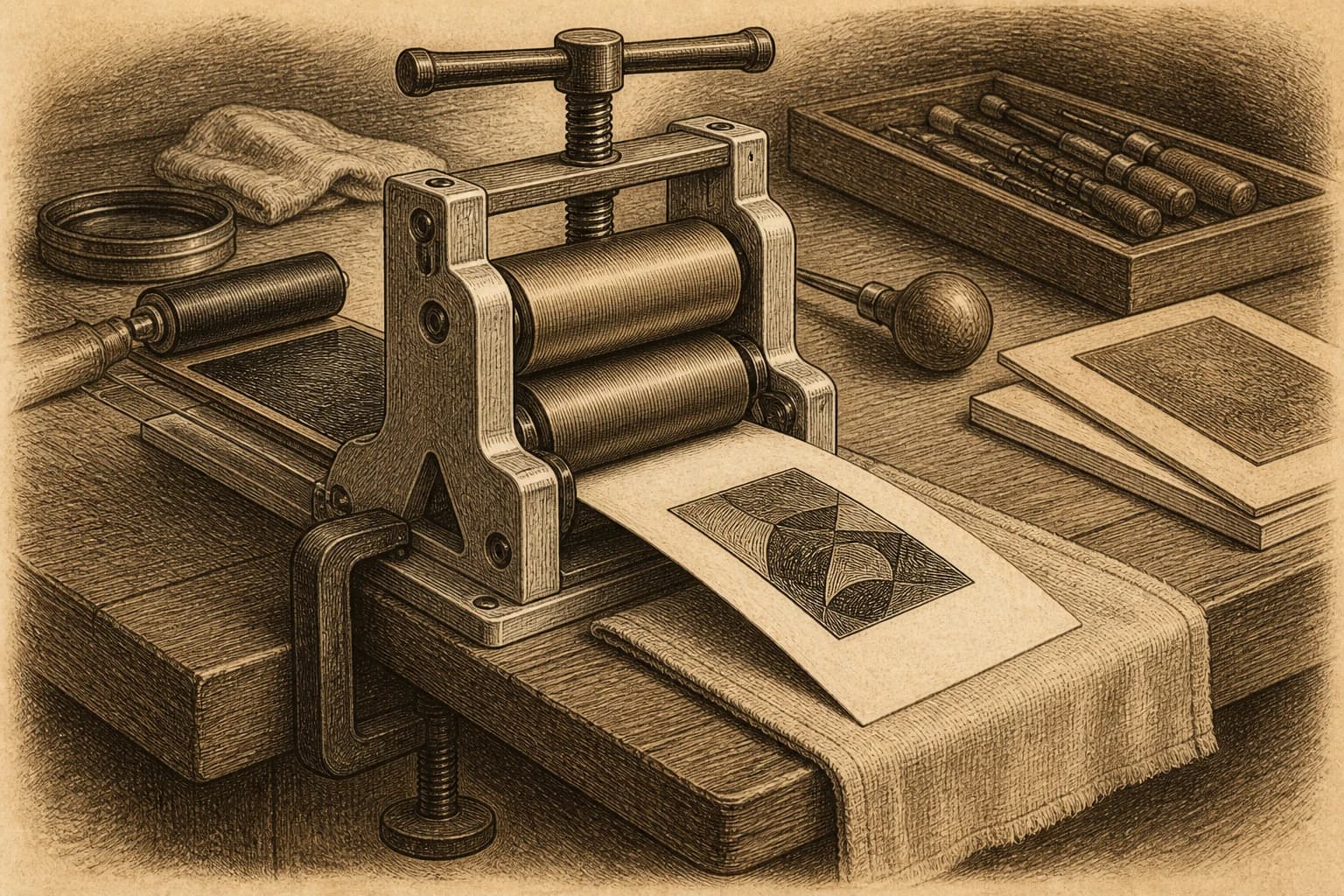
Shrinks an intaglio press into 3D-printed tabletop hardware, with free fabrication plans for makers and finished presses for artists without a printer.
Visit Open Press ProjectOriginal editorial concept art generated with built-in Codex Image Gen for The Machine Press, 2026-08-23.
BuilderRichard Bowman and OpenFlexure contributors
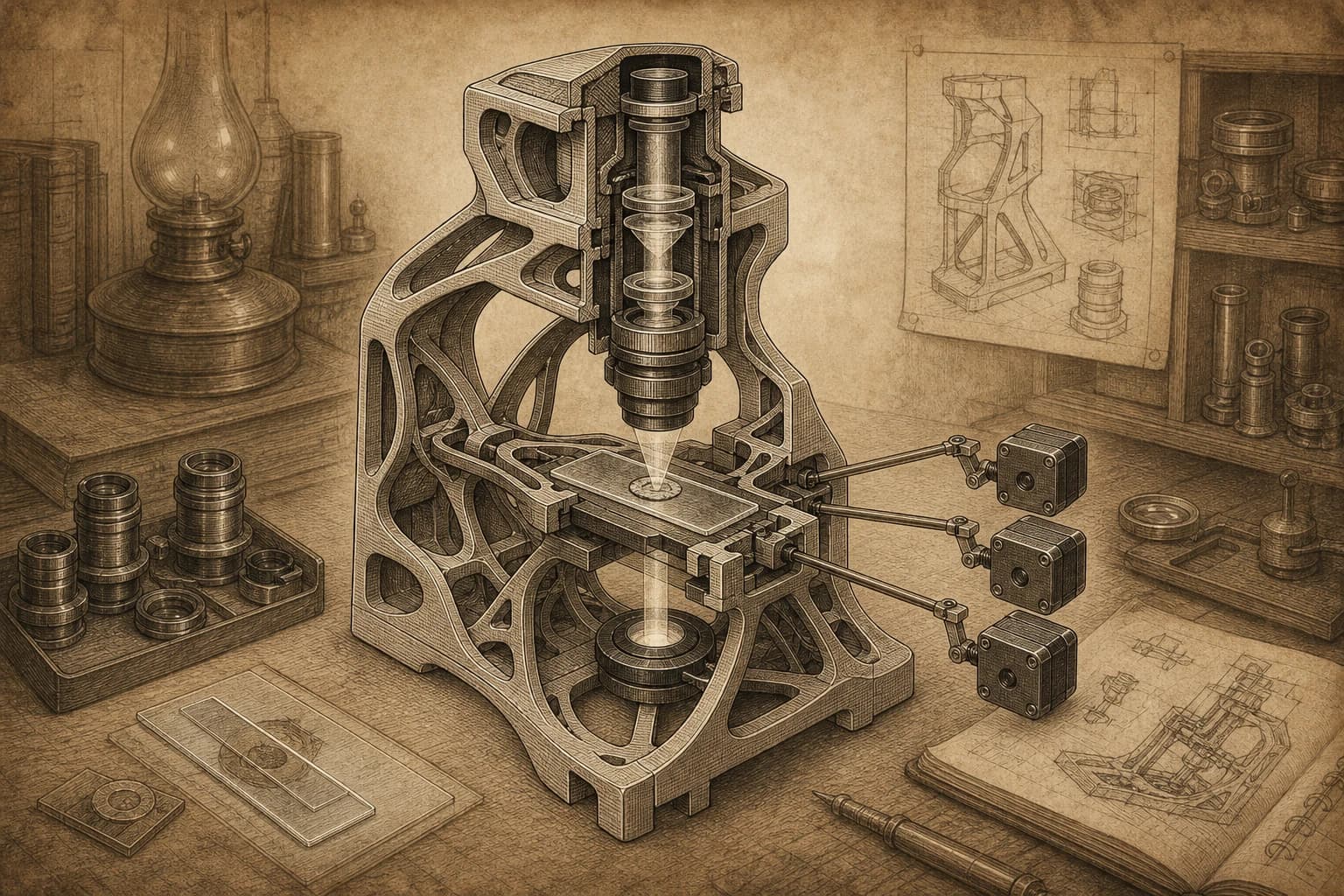
Prints most of a precise microscope body as one flexure mechanism, pairing interchangeable optics with optional motorized sample positioning and open control software.
Visit OpenFlexure MicroscopeOriginal editorial concept art generated with built-in Codex Image Gen for The Machine Press, 2026-08-23.
BuilderLibre Space Foundation and SatNOGS contributors
Links volunteer-built radio ground stations to shared scheduling and observation services, turning backyard antennas into a public satellite-observation network.
Visit SatNOGSOriginal Codex Image Gen concept art from 2026-07-10; carried forward from the validated 2026-08-27 edition.
Desk Picks are selected by the newsroom. Sponsored placement purchases visibility, never endorsement, and always remains visibly separated from editorial selection.
 Editorial illustration