An information-theoretic analysis bounds how well any text representation can recover a speaker's intent when language leaves context unresolved.
Editorial illustration
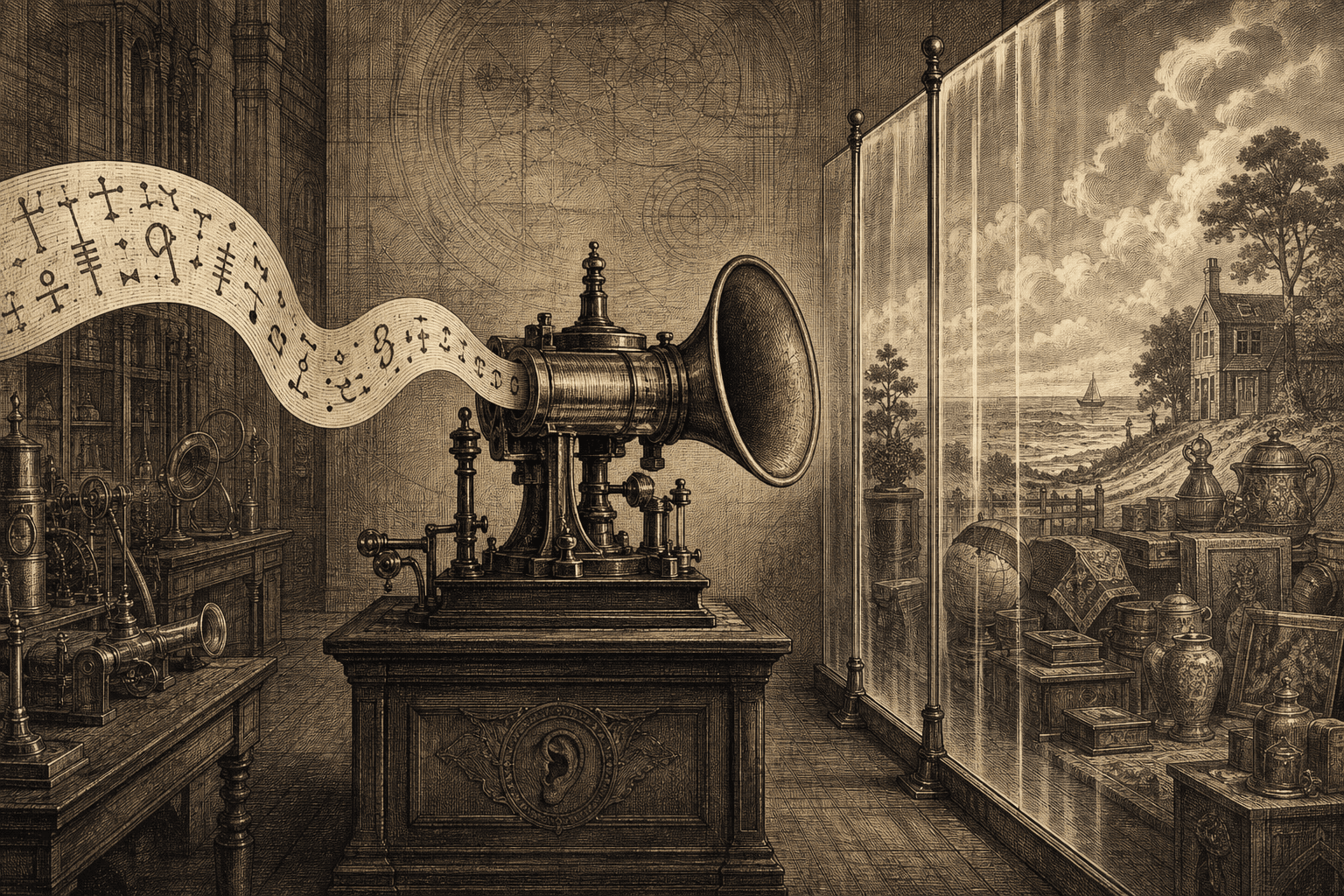
Concept illustration of the gap between utterance form and intended meaning when context remains outside a text-only listener's reach. Original editorial illustration generated with built-in Codex Image Gen for The Machine Press, 2026-08-31.
The authors model language use as a joint distribution over meanings, contexts and utterances, then derive upper bounds for any decoder working from a representation of the utterance alone, including modern language-model hidden states. The remaining uncertainty separates into an irreducible component and a component that only extralinguistic context can resolve. Experiments on artificial languages, Mandarin zero-pronoun resolution and color reference support the theory; the result is a limit on text-only recovery, not a claim that useful language learning from text is impossible.
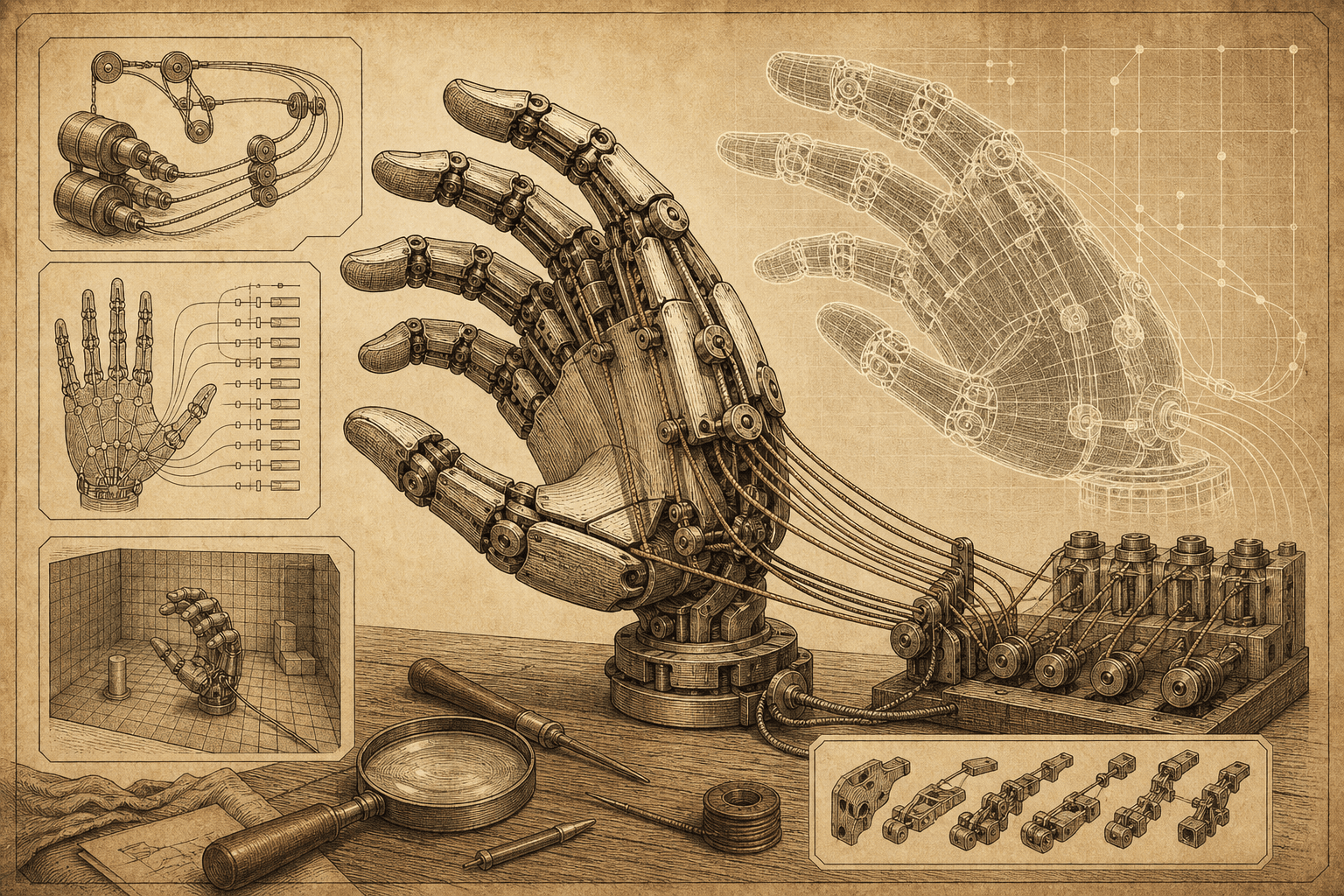
Concept illustration of a tendon-driven robot hand packaged with its transmission model and simulation-to-hardware tooling. Original editorial illustration generated with built-in Codex Image Gen for The Machine Press, 2026-08-31.
Aero Hand Open releases a cable-driven anthropomorphic hand with its transmission model, actuation map, training environment and deployment stack.
Moving actuators away from the joints can make an anthropomorphic hand cheaper, but the shared cable transmission is harder to simulate and individual joints are not independently commandable. The project packages a simulation of that transmission, an identified map between motor commands and the coupled joints, and reinforcement-learning tooling. Its authors report that policies trained entirely in simulation run on the physical hand without fine-tuning or state estimation, and they release the mechanical design and software stack; broader dexterity still requires independent testing.
A probabilistic formulation exposes the bias in common eviction heuristics and enables decode-time correction.
The paper formalizes optimal KV-cache eviction, proves the general problem computationally hard and recasts practical eviction as expectation estimation. From that view, existing methods become zero-variance biased estimators that can be modified to correct for discarded entries during decoding. The probabilistic variants were more robust across tasks at the same compression budget in the reported experiments, though the formulation does not remove the underlying computational hardness.
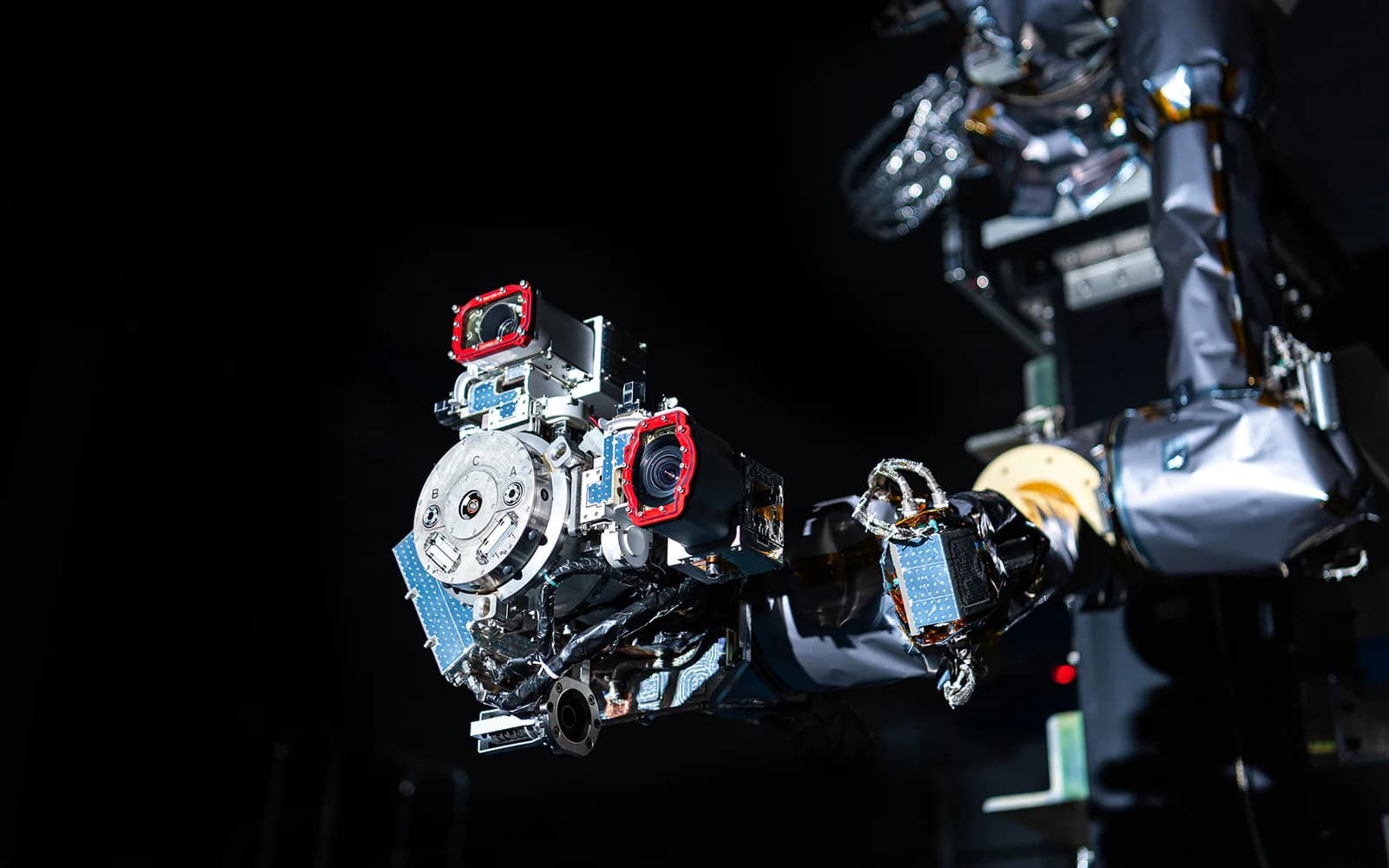
NASA's OSAM-1 servicing arm, used as robotics file imagery. It is not a voice-controlled system or test from the paper; use does not imply NASA endorsement. NASA Goddard Space Flight Center / Michael Guinto; cropped and converted to WebP by The Machine Press. Use does not imply NASA endorsement.
Simulated speech-recognition errors weakened refusals and allowed unsafe plans from embodied AI systems.
The study combines simulated automatic-speech-recognition errors with SafeAgentBench and POEX to test whether corrupted user input changes embodied-agent behavior. The authors report that some errors preserve enough structure to create harmful ambiguity, while others weaken refusal behavior and permit unsafe plans. Automatic correction reduced risk in some cases but not consistently, so the result identifies an input-channel safety problem rather than a universal correction strategy.
PULSAR indexes compact page summaries before exact rescoring across investment decks and diligence documents.
The production system searches page images directly instead of refreshing OCR and figure descriptions for changing visual documents. On ViDoRe V3, the authors report 15.1-times lower median vector-search latency than an unpooled setup with less than 0.01 absolute loss in NDCG@10 and Recall@10; production median vector search was 156 milliseconds. The deployment report covers 2.4 million pages across more than 3,000 deals since March 2026, but the claims come from the operating organization and paper authors.
A heterogeneous mixture-of-experts layout concentrates routed capacity instead of placing it after every token-mixing layer.
CE-MoE separates token-mixing depth from routed expert depth, using a smaller number of expert layers alongside additional attention, Mamba-2 or dense feed-forward layers. Across matched models from 2 billion to 31.5 billion total parameters, the authors report comparable validation loss and downstream scores. At the largest scale, the design used 33.3 percent fewer GPU-hours while improving average downstream score and inference throughput in their experiments.
A cross-tracker study treats vulnerability remediation as flow control when discovery outruns repair capacity.
The analysis uses Apache Jira, Mozilla Bugzilla, Red Hat errata, five public Jira organizations and an npm dependency graph. It reports heavy-tailed resolution times and estimates that 94 to 100 percent of arrivals in the primary trackers entered queues at or above capacity. Severity-first sequencing and reserved capacity reduced critical-item delay in the simulations, while owner-level results showed that nominal capacity helps only when the right expertise can reach the demand.
SignRR retrieves articulated sign segments and refines the full sequence instead of synthesizing motion from scratch.
Retrieval preserves rare hand configurations and signer articulation, but direct concatenation can break rhythm and style. SignRR begins with a dictionary of real motion segments, then uses a part-aware residual VQ-VAE to refine the complete sequence and handle length differences in latent space. On PHOENIX14T and CSL-Daily, the authors report state-of-the-art back-translation with competitive pose quality; the benchmarks do not establish fluency across all sign languages or signers.
Generic fiber-connector file image used as a cable-routing motif. It does not show ChainSplat, its objects, apparatus or results. Brett Sayles / Pexels; cropped, resized, metadata stripped, and converted to WebP by The Machine Press.
ChainSplat reconstructs deformable ropes and hoses from multi-view RGB video using an articulated screw-theoretic state.
The framework represents a deformable linear object as rigid links joined by revolute joints, then combines that compact analytic model with Gaussian splatting to recover geometry, appearance, kinematics and dynamics. Real-world experiments reported leading prediction, reconstruction and rendering results, plus real-time state and force estimation and trajectory optimization. The tests cover cables, ropes and hoses under the paper's setups, not unrestricted deformable-object manipulation.
GeoNeXt reframes depth and surface-normal estimation as next-frame prediction inside a pretrained video generator.
The method adapts a video generative model to jointly represent images and geometry targets rather than training separate task-specific diffusion systems. Its authors report stronger zero-shot monocular depth and normal estimation than prior generative competitors with substantially less training data, and performance near discriminative systems trained on more than 100 times as much data. Those comparisons remain benchmark results from the proposing team.
InstructMesh lets novices select flawed regions and apply fabrication-aware geometric corrections through language or sliders.
Generative 3D models can look plausible while containing holes or thin regions that fail after fabrication. InstructMesh edits the intermediate latent representation to open or seal voids and adjust local thickness without requiring expert modeling tools. Two user studies found that novices could identify and repair fabrication-relevant failures and preferred a hybrid of slider controls and natural-language input; the work evaluates repair assistance, not guaranteed printability.
A policy-controlled verifier checks cross-organization agent events without trusting live services or one platform's logs.
Each proposed bundle can include sender authentication, log commitments, witness-backed checkpoints, append-only continuity, delegation evidence and receiver-signed receipts when policy requires them. In a prototype covering 300 workflows and 1,200 valid bundles, all targeted corrupted or policy-insufficient bundles were rejected without a reported false acceptance. The verifier establishes evidence sufficiency under a chosen policy; it does not infer delivery or receipt merely from transport or log inclusion.
Across 30 models, verbal confidence frequently diverged from logits or semantic-entropy uncertainty.
The study compares linguistic confidence with internal signals across eight classification tasks and two generation tasks. Association was weak on average, instruction tuning often raised reported confidence while worsening calibration, and attitude cues inflated scores without improving alignment. Score exemplars sometimes preserved rank ordering, but the authors conclude that verbal confidence needs multi-axis evaluation before it enters reliability pipelines.
New York City skyline file image used as a generic built-environment visual. It does not show damaged buildings, source imagery or results from GeBDA. Walid Ahmad / Pexels; cropped, resized, metadata stripped, and converted to WebP by The Machine Press.
GeBDA asks a general vision-language model to emit building boxes and damage labels as one variable-length sequence.
Instead of a dedicated detector, the preliminary system represents each building as coordinates followed by a damage class and predicts the full set autoregressively from before-and-after satellite images. The open Gemma-based implementation produced promising localization and grading results under the paper's prompt formulation. The abstract does not establish operational disaster-response readiness, and the authors characterize the implementation as preliminary.
A split-conformal method wraps predicted function fields with finite-sample spatial coverage guarantees.
The method reduces a normalized residual field to a spatial quantile, then calibrates a scaling factor on held-out data. The authors prove that the resulting band contains the true solution on at least a specified fraction of the domain with a target probability, covering continuous domains and fixed discretizations. Darcy-flow and Navier-Stokes experiments produced tighter bands than existing corrections while retaining target coverage under the study's assumptions.
EvoUndo verifies whether agent-generated changes can be reversed from states other than the one that created them.
Across 600 unseen self-evolution tasks, the framework found 197 capability-improving mutations that failed recoverability checks. Conventional repair recovered none under the original representation; an extended recovery calculus and exact state addressing raised oracle-defined recovery sharply in controlled strata. Results differed on one interaction across model backbones, reinforcing the paper's claim that rollback requires co-design across verification, grounding and recovery language rather than another prompt.
Independent builders turning improbable ideas into real things.
Four editorial selections
$7 for seven days
Paid work is clearly labeled
Placement is never endorsement
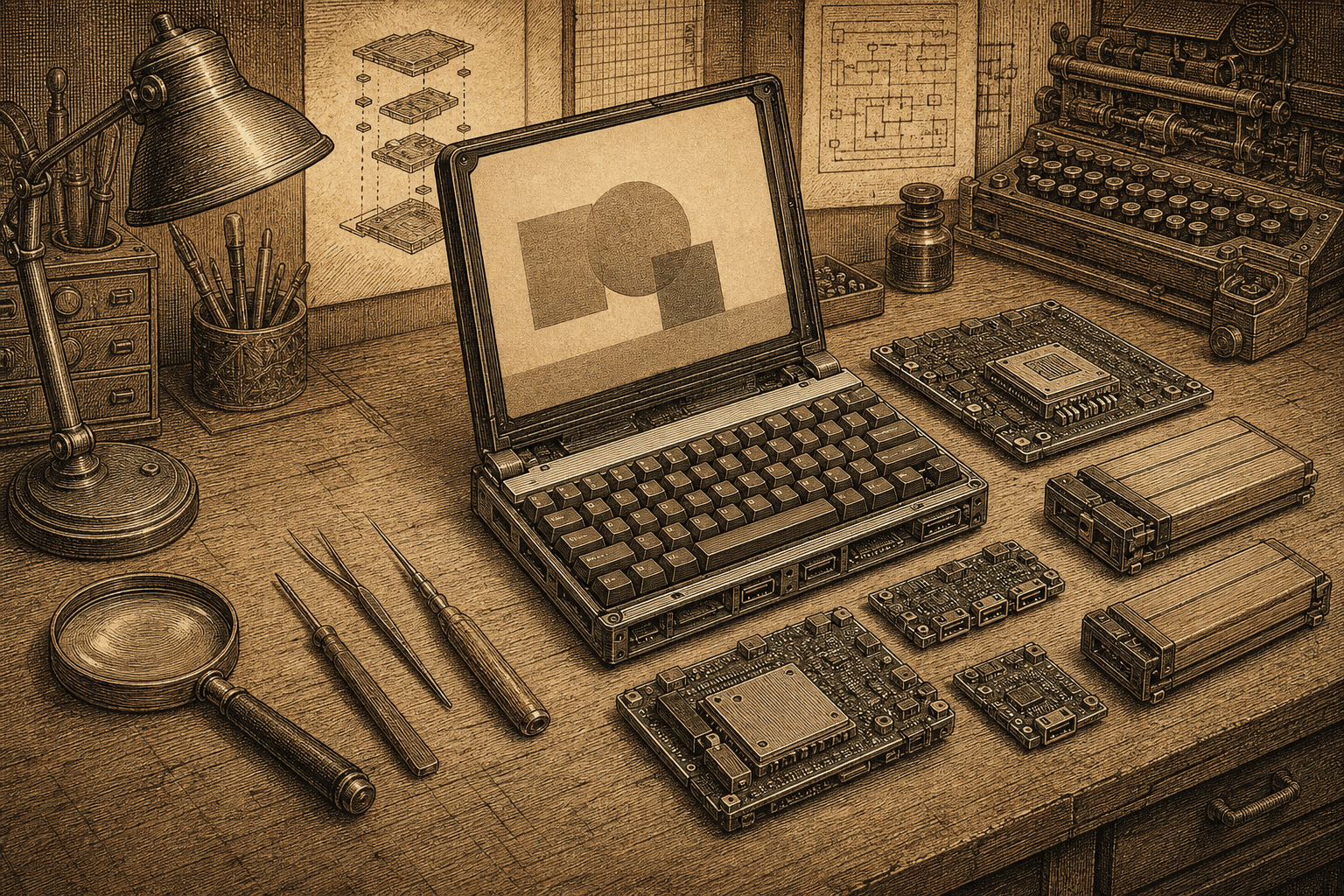
Original editorial concept art generated with built-in Codex Image Gen for The Machine Press, 2026-08-30; carried into this issue from the active weekly handoff.
Reworks a laptop into public, swappable modules: processor, port boards, keyboard, trackpad, and user-serviceable battery packs can evolve without sealing the whole machine.
Visit MNT Reform NextOriginal editorial concept art generated with built-in Codex Image Gen for The Machine Press, 2026-08-30; carried into this issue from the active weekly handoff.
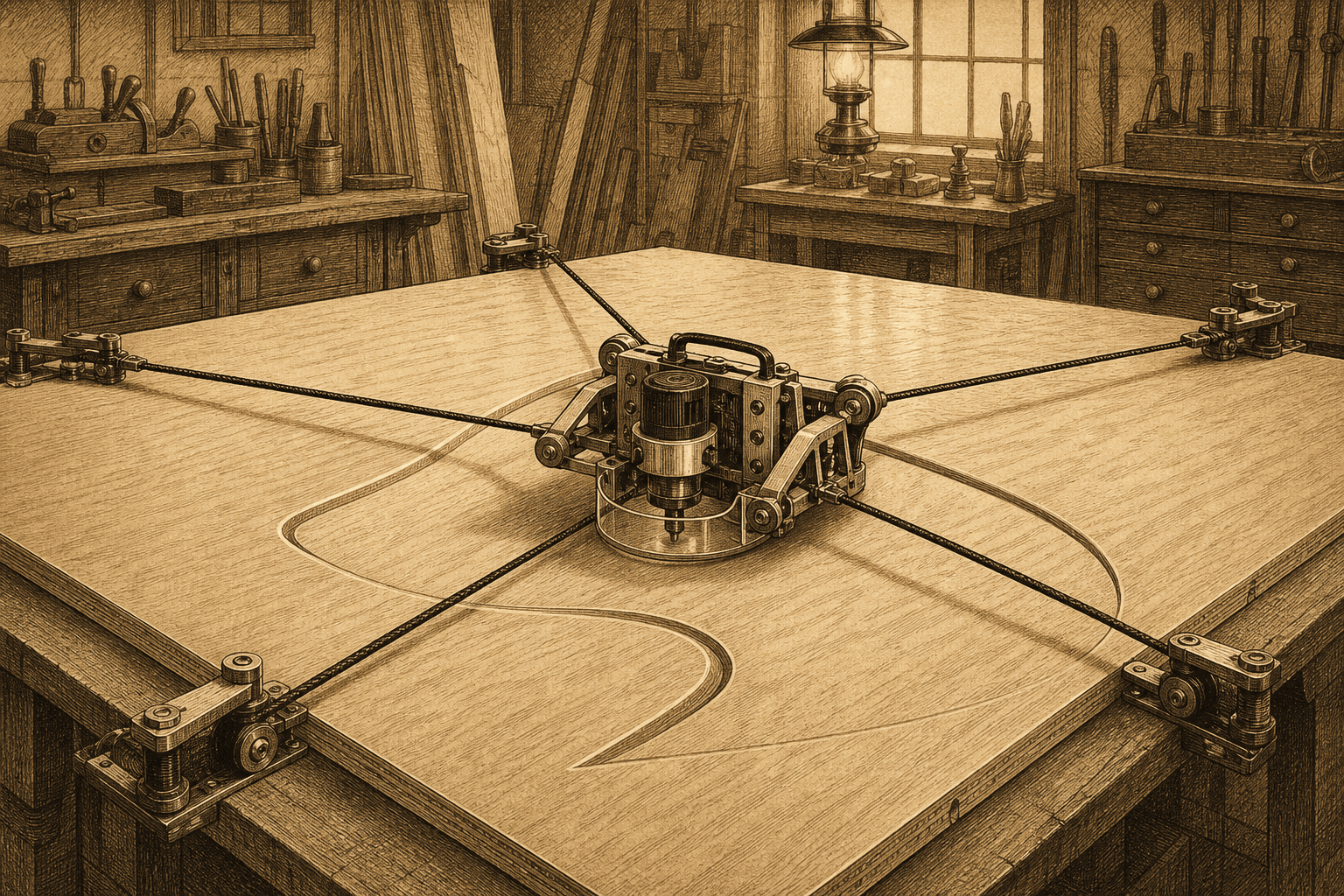
Pulls a compact router sled across full sheets with four measured belts, trading a bulky gantry for corner anchors and community-developed control software.
Visit Maslow 4Original editorial concept art generated with built-in Codex Image Gen for The Machine Press, 2026-08-30; carried into this issue from the active weekly handoff.
BuilderRory Aronson, Rick Carlino, Tim Evers, and FarmBot contributors
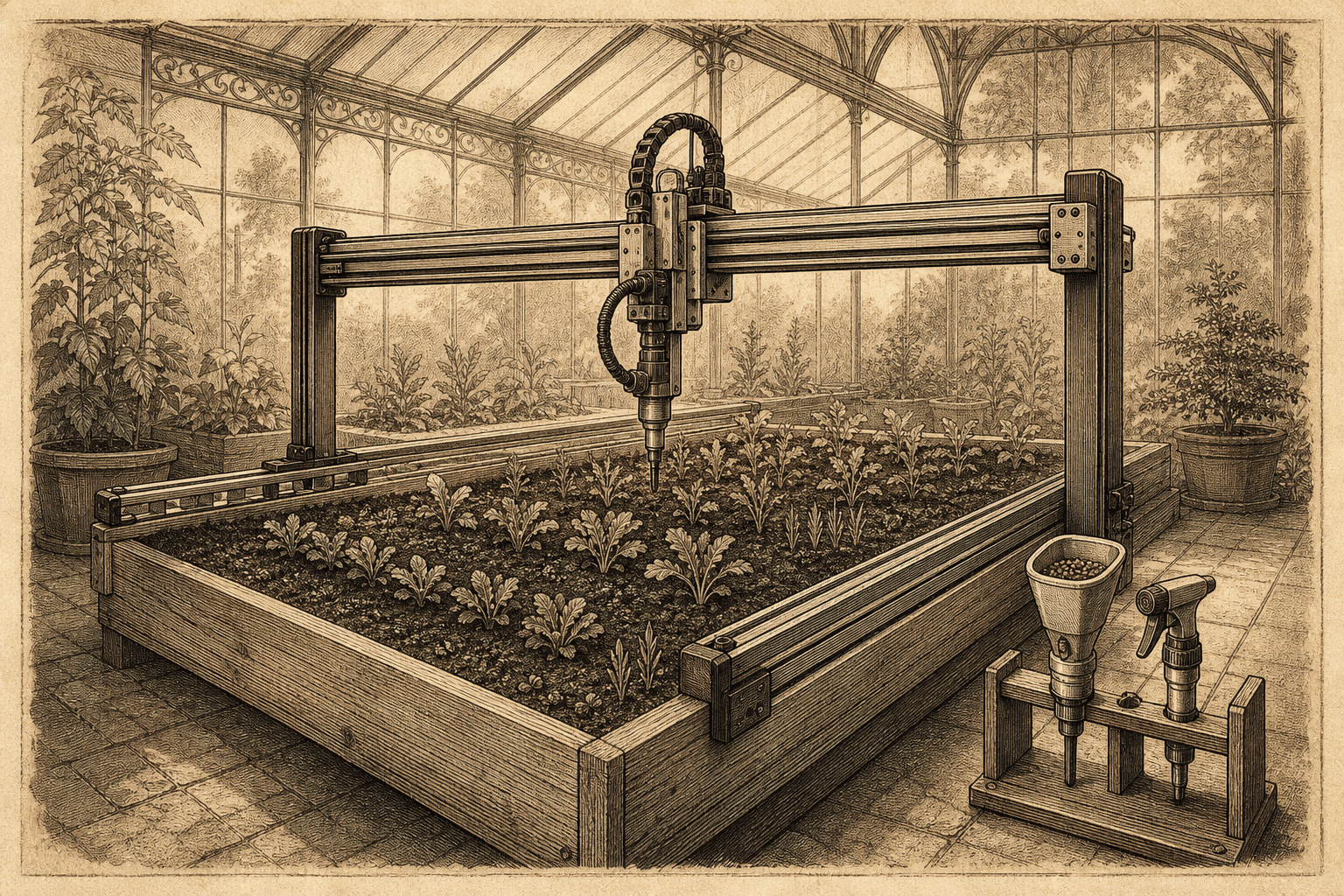
Moves an interchangeable tool head across a raised bed to place seeds, water plants, and measure soil, backed by published hardware, software, data, and documentation.
Visit FarmBot GenesisOriginal editorial concept art generated with built-in Codex Image Gen for The Machine Press, 2026-08-30; carried into this issue from the active weekly handoff.
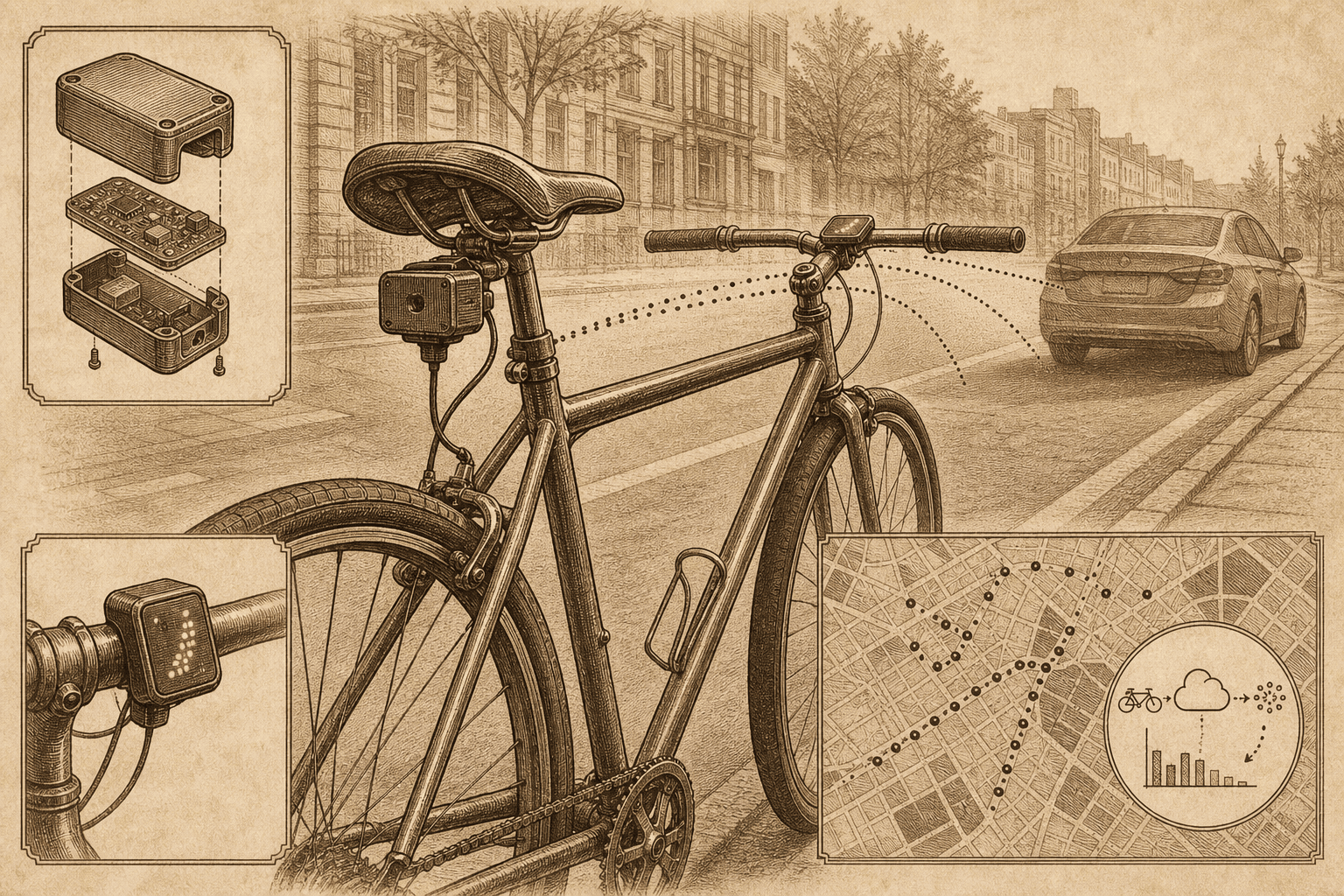
Combines a DIY bicycle distance sensor, GPS, and a shared portal so volunteer riders can map close passes and study where street design needs attention.
Visit OpenBikeSensorOriginal Codex Image Gen concept art from 2026-07-10; carried forward from the validated 2026-08-30 edition.
Desk Picks are selected by the newsroom. Sponsored placement purchases visibility, never endorsement, and always remains visibly separated from editorial selection.
 Editorial illustration