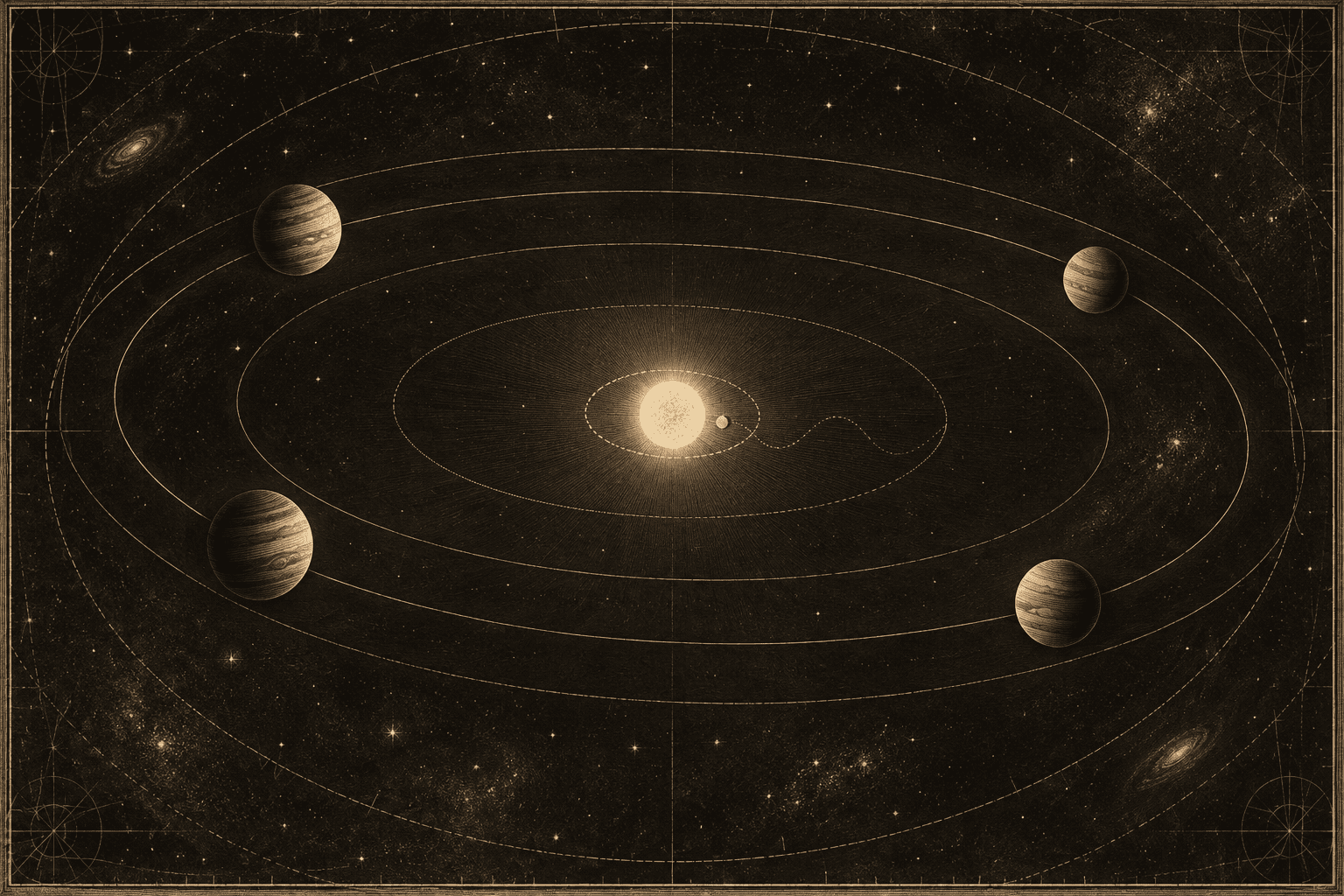
Stellar wobble points to a close-in companion inside the system’s four imaged outer planets.
Editorial illustration
Concept illustration of a possible fifth HR 8799 companion inferred from stellar motion; not a direct image or measured orbit. Original editorial illustration generated with built-in Codex Image Gen for The Machine Press, 2026-09-21.
A team combined Gaia absolute astrometry and Hipparcos–Gaia proper-motion anomalies with radial velocities and high-contrast imaging to infer another substellar companion in the HR 8799 system. The allowed orbits span roughly 0.3 to 6 astronomical units, with solutions peaking around 2 to 3 AU and masses near 10 to 14 Jupiters. Dynamical modeling says a low-eccentricity object in that range can coexist with the long-lived resonant chain of the four directly imaged outer planets and may shape the inner edge of the warm debris belt. It is an indirect astrometric inference, not a fifth planet photograph.
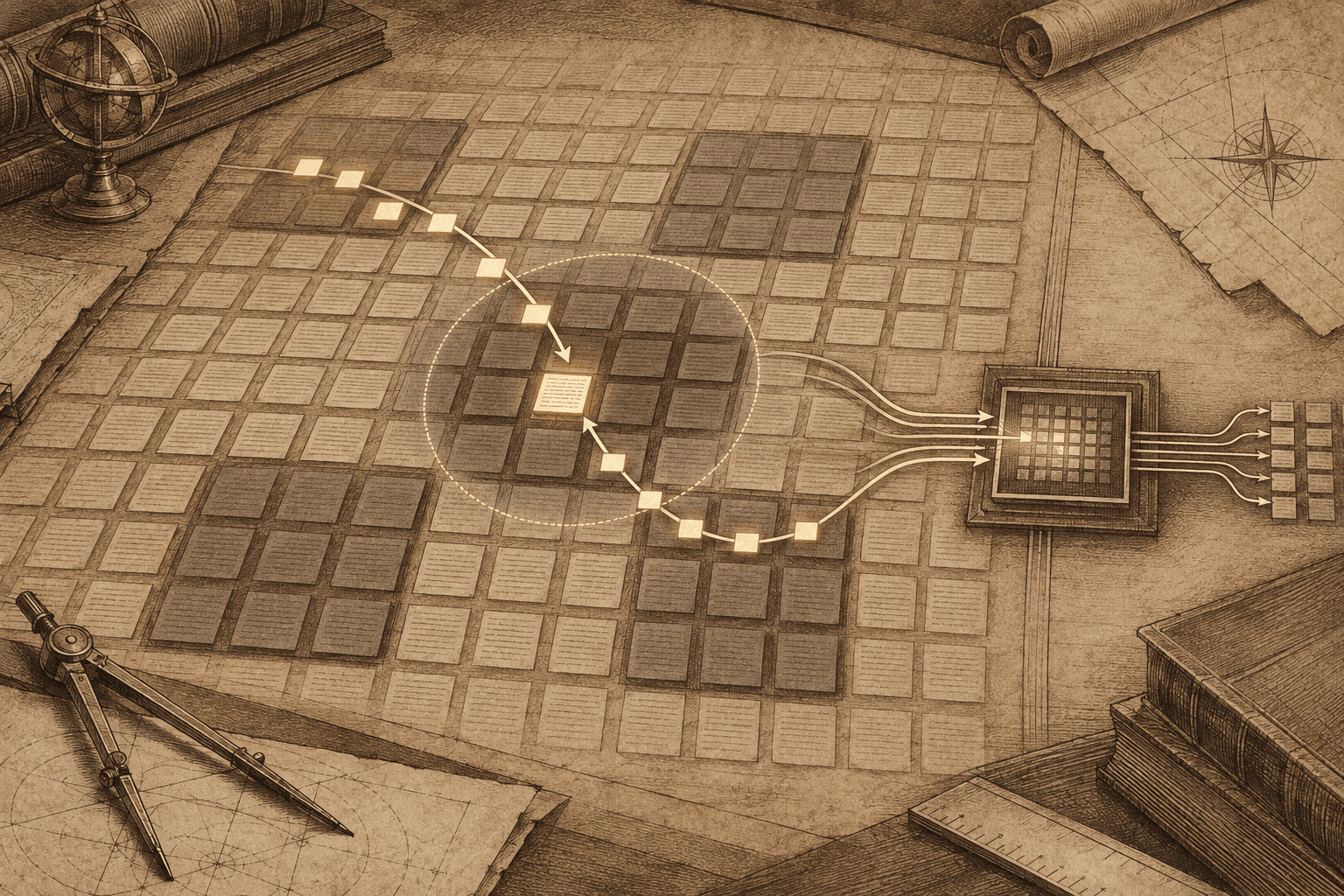
Concept illustration of sparse-attention selection; not a measured performance chart or actual processor. Original editorial illustration generated with built-in Codex Image Gen for The Machine Press, 2026-09-21.
Radius-bounded selection recovered important tokens that block averages would miss.
RBS-Attention addresses “mean dilution” in long-context prefill: a block of keys can appear unimportant on average while hiding a strongly relevant token. Its training-free selector combines a centroid branch with a radius-based rescue branch, then runs ordinary block-sparse FlashAttention. On H100 GPUs with a 128,000-token context and Qwen3-30B-A3B, the authors measured a 5.97-fold end-to-end reduction in time to first token against their comparison setup; standalone prefill attention sped up 20.65-fold. A dense Qwen3-32B comparison scored 88.65 on RULER versus 89.52 with dense attention. Those are reported benchmark results for specified models and hardware, not a general speed guarantee.
A JWST/JADES search found no pristine Population III galaxy among 84 helium emitters.
A team searched 84 strong helium-emitting galaxies at redshifts three to seven for signs of the first metal-free stars, combining ultraviolet line ratios, metallicity estimates, active-galaxy screening and resolved stellar-population fits. It found no pristine Population III galaxy. One object nicknamed The Blueberry is its strongest candidate for a mixed Population III and enriched-star system, but an enriched starburst could also explain its young, blue stellar population. The study argues that spatially localized early-star signatures can disappear in whole-galaxy measurements.
Wikideas1’s generic wafer rendering illustrates chip-design research; it does not depict the reported FPGA designs or their benchmark. Wikideas1 / Wikimedia Commons (CC0 1.0); cropped and converted to WebP by The Machine Press.
A two-stage high-level synthesis workflow beat direct RTL design on eleven FPGA tasks.
Researchers compared several ways to let language-model agents design FPGA circuits. Their combined method first designed in high-level synthesis, then refined the generated RTL. Across eleven benchmark tasks, it achieved a 2.6-fold geometric-mean speedup over direct RTL design. The authors attribute the gain to reusable high-level abstractions followed by low-level optimization. This is an FPGA benchmark, not evidence of fabricated production chips.
A six-clinician pilot found more vignette facts and more unsupported clinical inferences from an AI interviewer.
A clinician-grounded test platform used simulated patient vignettes to compare open-ended psychiatric intake approaches. In a 25-minute pilot with six clinicians, the LLM interviewer recovered 88.0% of embedded clinically relevant items versus 38.9% for clinicians, but made unsupported clinical inferences more often, 56.8% versus 27.8%, and identified safety concerns less often, 33.3% versus 66.7%. The small simulated study is a quality-assurance probe, not evidence that the system is safe for patient use.
AeRove switched between flight and pipe rolling in 200 milliseconds and cut current draw in its rolling mode.
AeRove uses propeller guards as wheels and a spring-loaded bistable mechanism to shift between flight and rolling without continuous reconfiguration power. In tests, rolling drew 0.7 amperes versus 10 amperes in continuous flight, supporting an estimated range increase from 144 to 2,057 meters. Autonomous trials on a 51-centimeter steel pipe included bends, obstacle hops and simulated leak markers. Separate carbon-dioxide tests found a stronger sensing response while perched than hovering under the tested conditions.
A proposed memory-assisted link avoids requiring photons from two processors to arrive together.
A single atom in a high-finesse cavity acts as a temporary quantum memory between two processor links. The proposed protocol entangles the atom with a photon from one processor, waits for a photon from the second, then reads out the atom to entangle the processors. In the authors’ rate model, avoiding simultaneous photon arrival changes a quadratic photon-delivery penalty to approximately linear scaling over a broad range; the photons also need not be indistinguishable. These are theoretical rate estimates under modeled decoherence, not a deployed quantum network.
The hot Saturn’s spectrum also shows water, while starspots and clouds complicate its composition.
JWST/NIRSpec transmission observations of WASP-52b yielded the first reported carbon-dioxide detection in that atmosphere and a confirmation of water. The team modeled unocculted starspots to explain a steep near-infrared slope and found suggestive evidence for uneven high-altitude clouds along the planet’s terminator. Composition remains uncertain because molecular abundances trade off against clouds and stellar contamination; different retrieval assumptions allow sub-solar through super-solar metallicity.
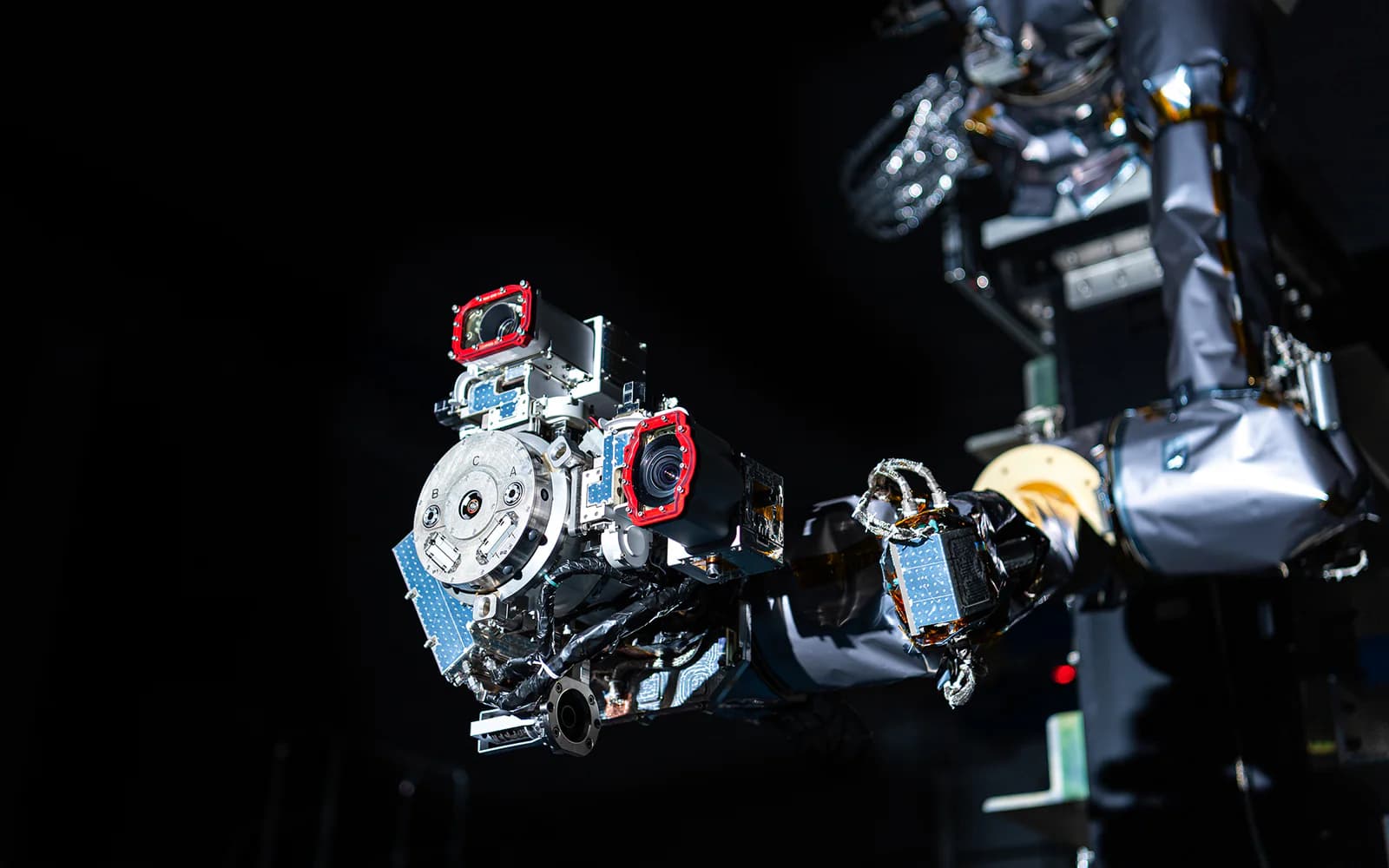
NASA OSAM-1 file photograph used illustratively; it does not depict SafeStage, a tested policy, a safety violation or an endorsement. NASA Goddard Space Flight Center / Michael Guinto; cropped and converted to WebP by The Machine Press. Use does not imply NASA endorsement.
SafeStage checks risks before, during and after manipulation across 97 scenarios.
SafeStage separates task success from manipulation safety in 97 designed scenarios. It evaluates initial hazards, unsafe contacts and trajectories during execution, and unstable or unsafe final states after nominal completion. Tests of representative vision-language-action and world-model-based robot policies found that completed tasks could still contain safety violations, with different policies failing at different stages. The benchmark diagnoses failure modes in a controlled protocol; it does not certify a real robot as safe.
LEGIT binds reported quality and cost to a tested configuration and signed evaluation record.
The LEGIT proposal gives marketplace buyers a signed credential that records an agent configuration, task domain, evaluation budget, measured quality and cost per solved task. Reputation can connect later outcomes to the same identity, subject to the reliability of submitted feedback. The authors show that configurations with similar success can have different costs, and that comparisons change with the budget used for testing. Their Sybil analysis estimates manipulation costs under stated deposit and fee assumptions; this is a protocol proposal, not proof that an open marketplace is trustworthy.
Targeted real-world reinforcement learning lifted two long-task success rates with limited rollouts.
PARTS keeps a pretrained robot policy frozen for routine portions of a task and trains residual corrections at bottleneck subtasks. Agent-generated selectors and success checks provide local rewards even when the complete task rarely succeeds. On bimanual YAM and single-arm Franka experiments, full-task success rose from 32% to 61% and 50% to 95%, respectively, with tens of minutes of real-world reinforcement-learning rollouts per task on average. Humans still chose bottlenecks and handled physical resets.
A model combines periodic drives and tunable dissipation to stabilize many-body states.
Researchers propose interleaving Floquet Hamiltonian engineering with weak measurement so dissipation steers a central-spin system toward a target entangled state. Analytical and numerical results for a semiconductor quantum dot produce spin-squeezed and Schrödinger-cat states stable against modeled dephasing. The approach may generalize to systems with periodic drives and controllable measurement strength, but this paper reports a theoretical construction rather than a demonstrated device.
Archival Hubble imaging and post-explosion data point to a binary progenitor.
A study of nearby transitional Type IIb/Ib supernova SN 2026dix found a point source at its location in multiple pre-explosion Hubble images. Light curves, spectra and stellar-model comparisons favor an interacting binary with a warm, luminous supergiant primary, estimated at roughly 6,750 to 7,750 kelvin, and a less luminous hot dwarf companion. The identification is consistent with the data and models; the presumed progenitor has not been established by a direct pre-explosion spectrum.
Generic code-screen file photograph used illustratively; it does not depict VLA-Feedback, a robot action or the reported results. Daniil Komov / Pexels; cropped, resized, metadata stripped, and converted to WebP by The Machine Press.
A light final denoising step brought fresh visual feedback into an existing action chunk.
VLA-Feedback pairs a slower diffusion planner with a fast visual correction at the final denoising step of each action. Rather than rerun the full model whenever the scene changes, it updates the pending action using the newest observation. The authors report the same performance as GR00T on static LIBERO tasks, while dynamic simulation success rose from 27.5% to 85.0% and average real-robot success from 51% to 73%. These are results in the reported tasks and comparison setup, not general deployment performance.
A track mechanism engaged bistable suction cups and towed 7.94 kilograms.
A wall-climbing robot uses track-mounted bistable suction cups that latch without continuous adhesion power and release as the track moves. The reported prototype climbed glass, wood, metal and painted surfaces vertically, sideways and upside down. In its tests it towed a 7.940-kilogram load, 2.25 times its own weight. The demonstrated surfaces and payload are specific test conditions, not a general guarantee for building maintenance.
A trapped-ion demonstration maintained enhanced frequency precision across much longer total measurements.
Researchers embedded a Fock-state gain inside a Qdyne frequency-measurement protocol, taking short interrogations while allowing precision to accumulate across a long run. On a trapped calcium ion, quantum-enhanced precision persisted for total measurement times seven orders of magnitude beyond the dephasing limit and scaled as time to the power minus three-halves. With an n=3 state, the experiment reached 0.5 microhertz precision on an 86-megahertz carrier and a reported 7.1-decibel gain over n=0. The result is a laboratory sensing demonstration, not a deployed nanoscale instrument.
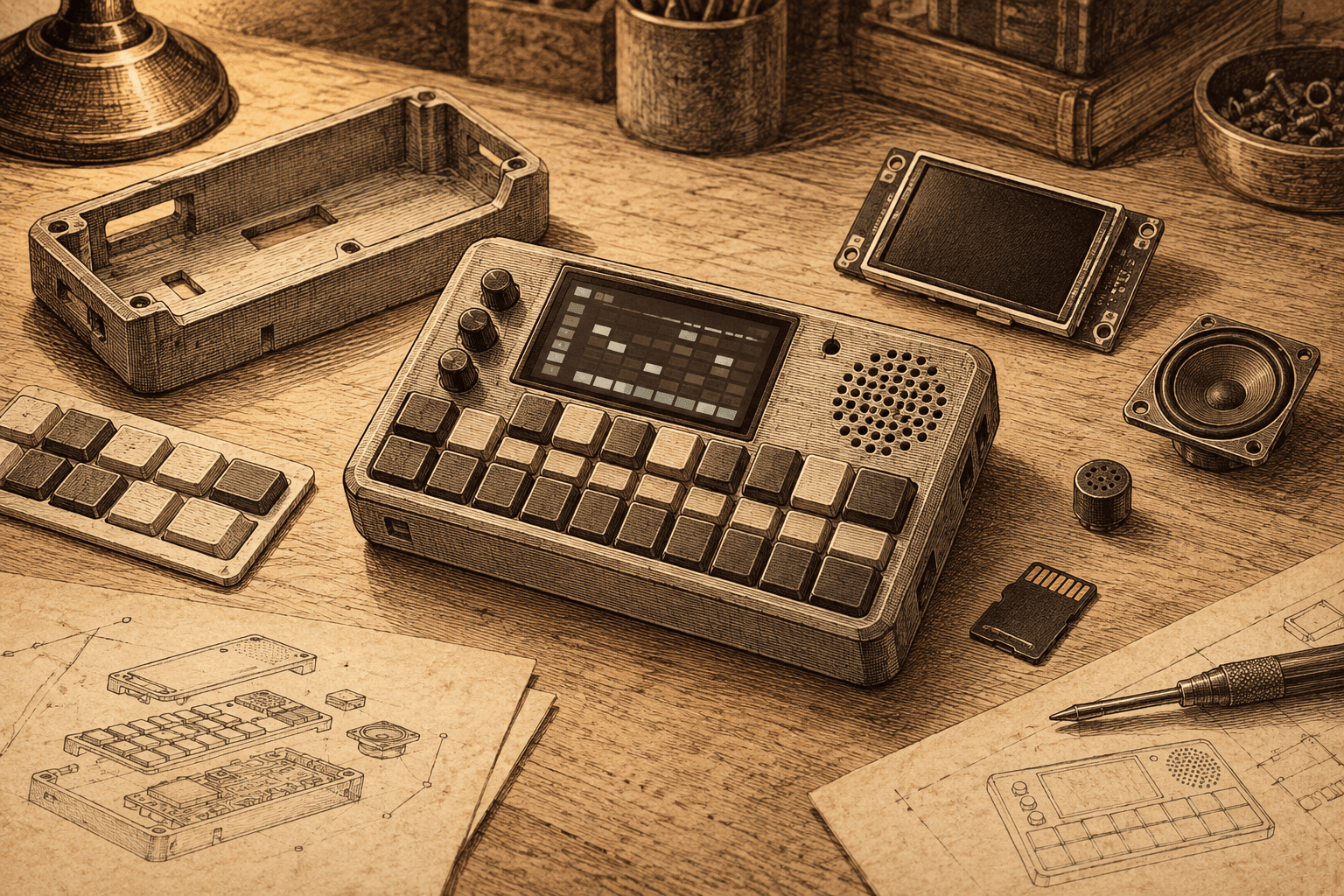
Turns a Cardputer-ADV, a printable shell, and open firmware into a pocket four-track instrument with synthesis, drums, microphone sampling, resampling, and step sequencing.
Visit MicroGrooveOriginal editorial concept art generated with built-in Codex Image Gen for The Machine Press, 2026-09-20.
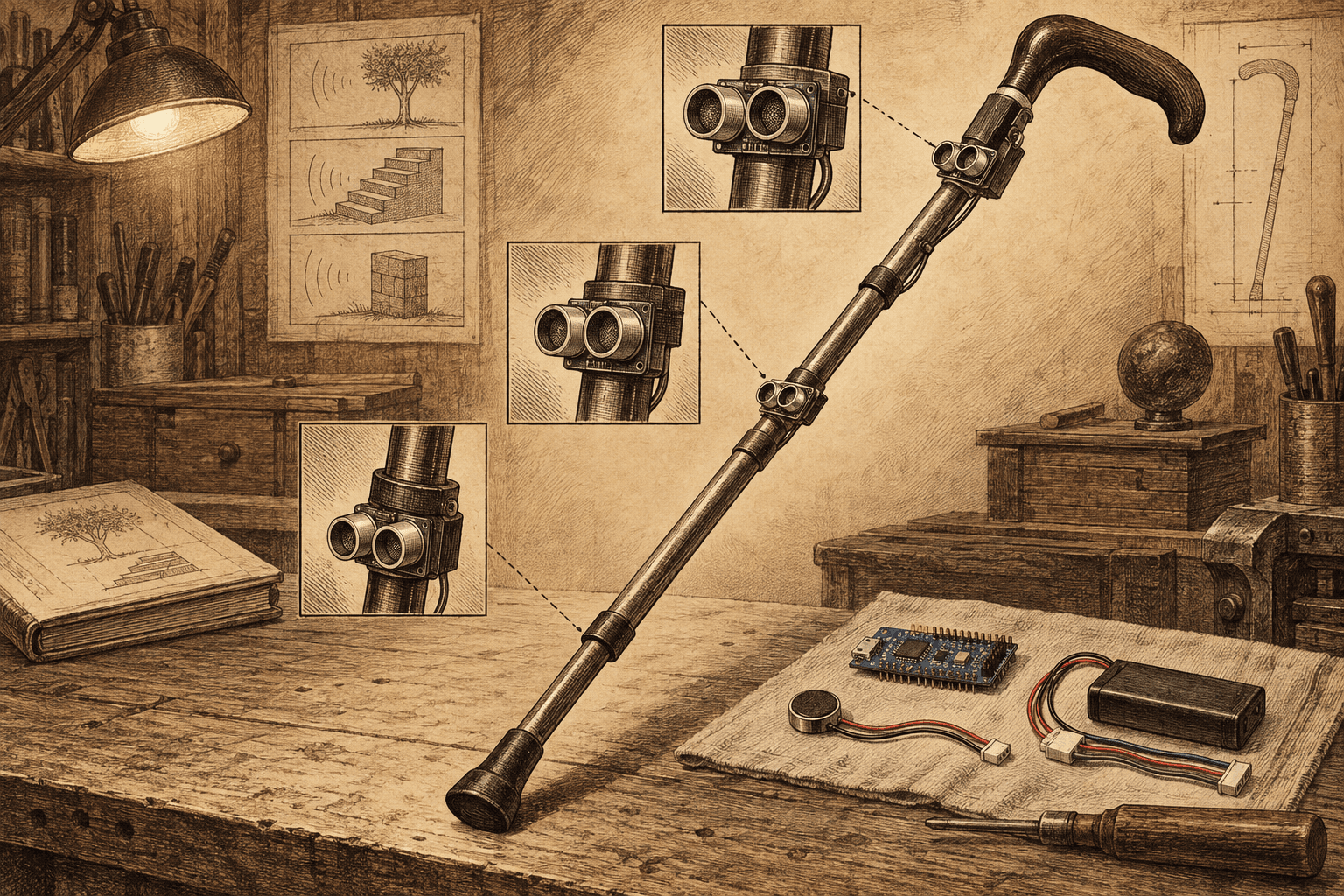
Combines three ultrasonic modules, a small controller, and one vibration motor so a buildable cane prototype can signal obstacles at different heights without audio, an app, or a phone.
Visit Sense CaneOriginal editorial concept art generated with built-in Codex Image Gen for The Machine Press, 2026-09-20.
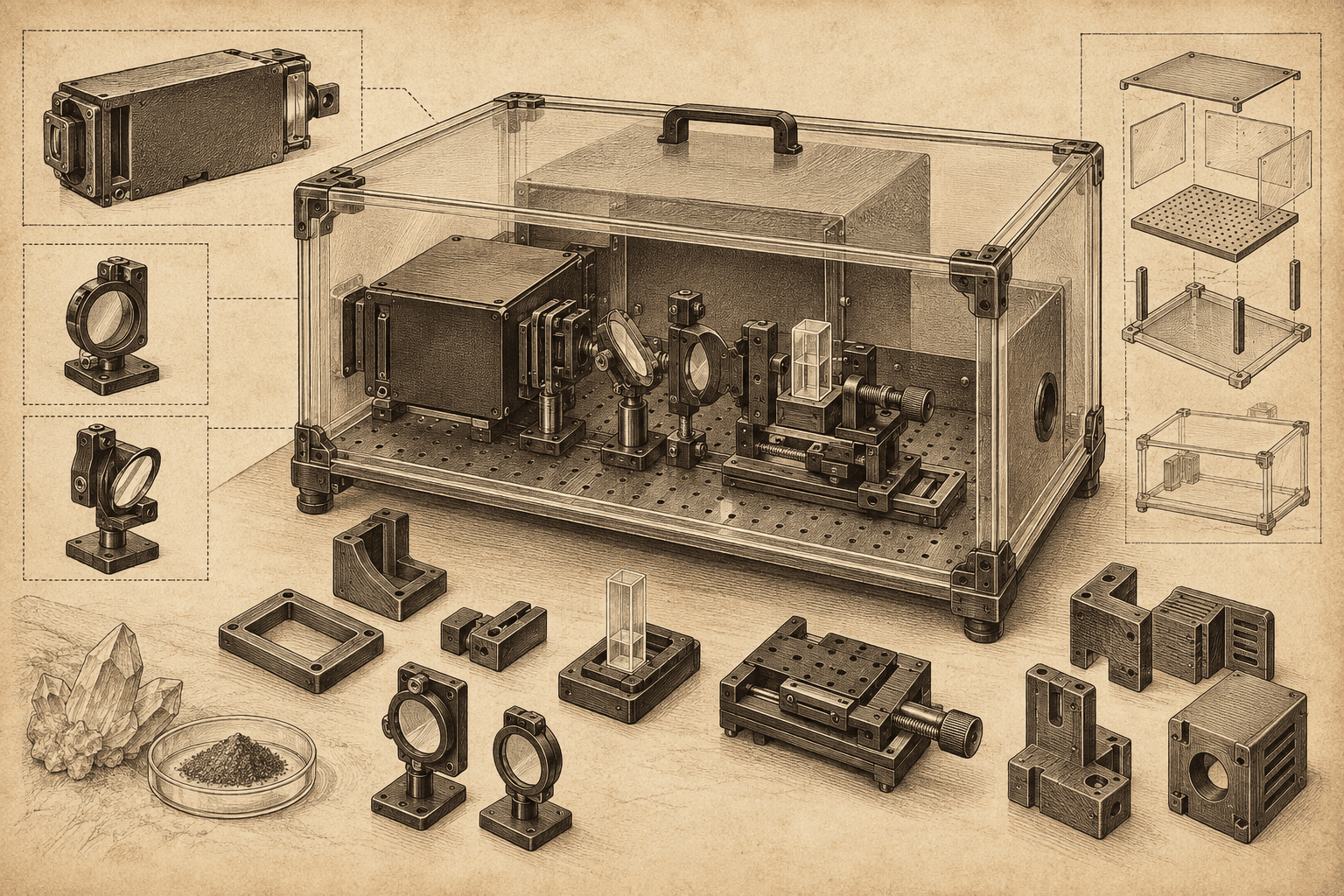
Pairs a surplus spectrometer, filtered 532-nanometer excitation, and printable mechanics in a documented Raman setup for optics education and cautious exploratory materials analysis.
Visit DIYramanOriginal editorial concept art generated with built-in Codex Image Gen for The Machine Press, 2026-09-20.
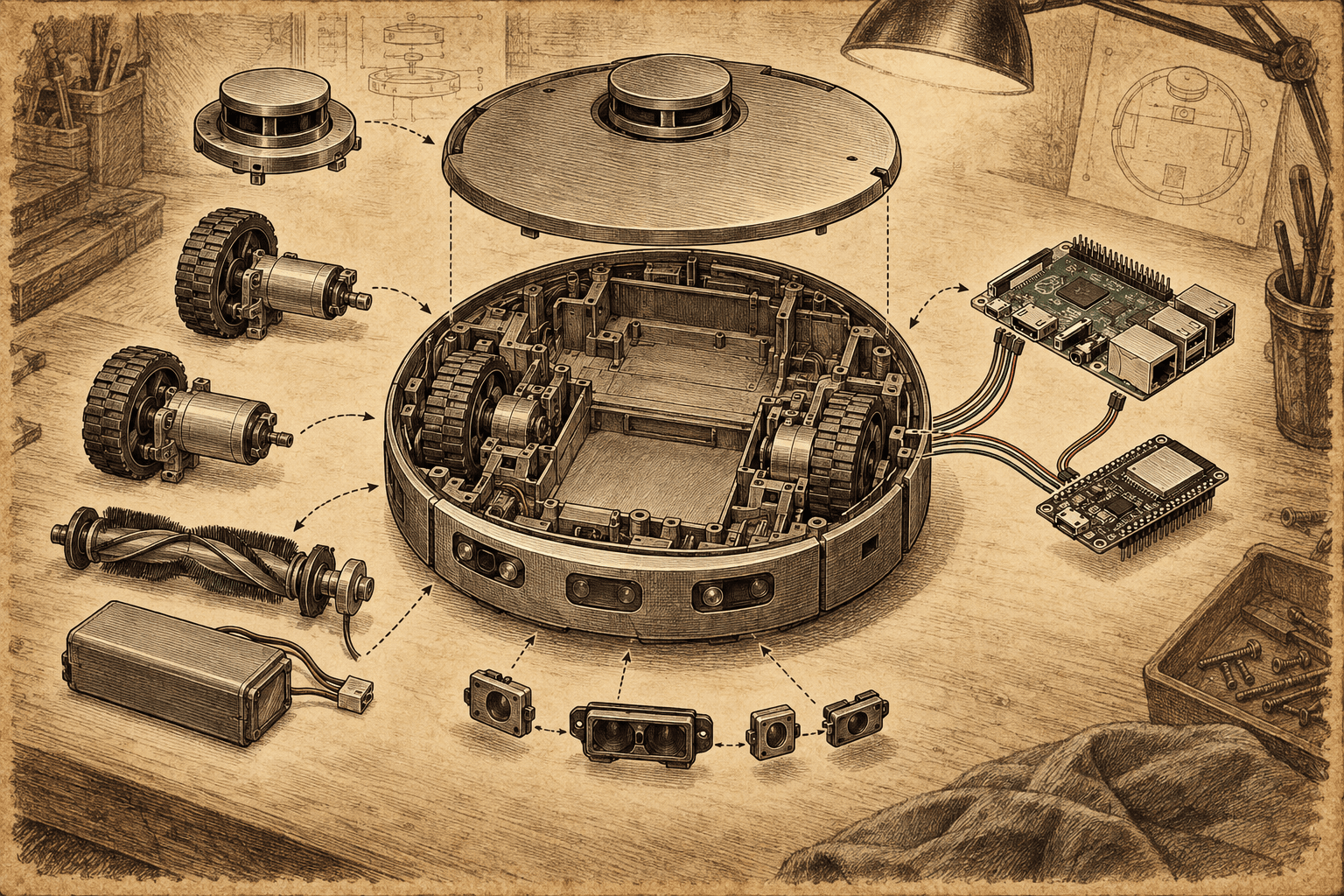
Documents replacing a cloud-disabled robot vacuum's locked control electronics with a Raspberry Pi, an ESP32, and ROS 2 while reusing its chassis, motors, battery, sensors, and lidar.
Visit the build serialOriginal Codex Image Gen concept art from 2026-07-10; carried forward from the validated 2026-09-20 edition.
Desk Picks are selected by the newsroom. Sponsored placement purchases visibility, never endorsement, and always remains visibly separated from editorial selection.
 Editorial illustration