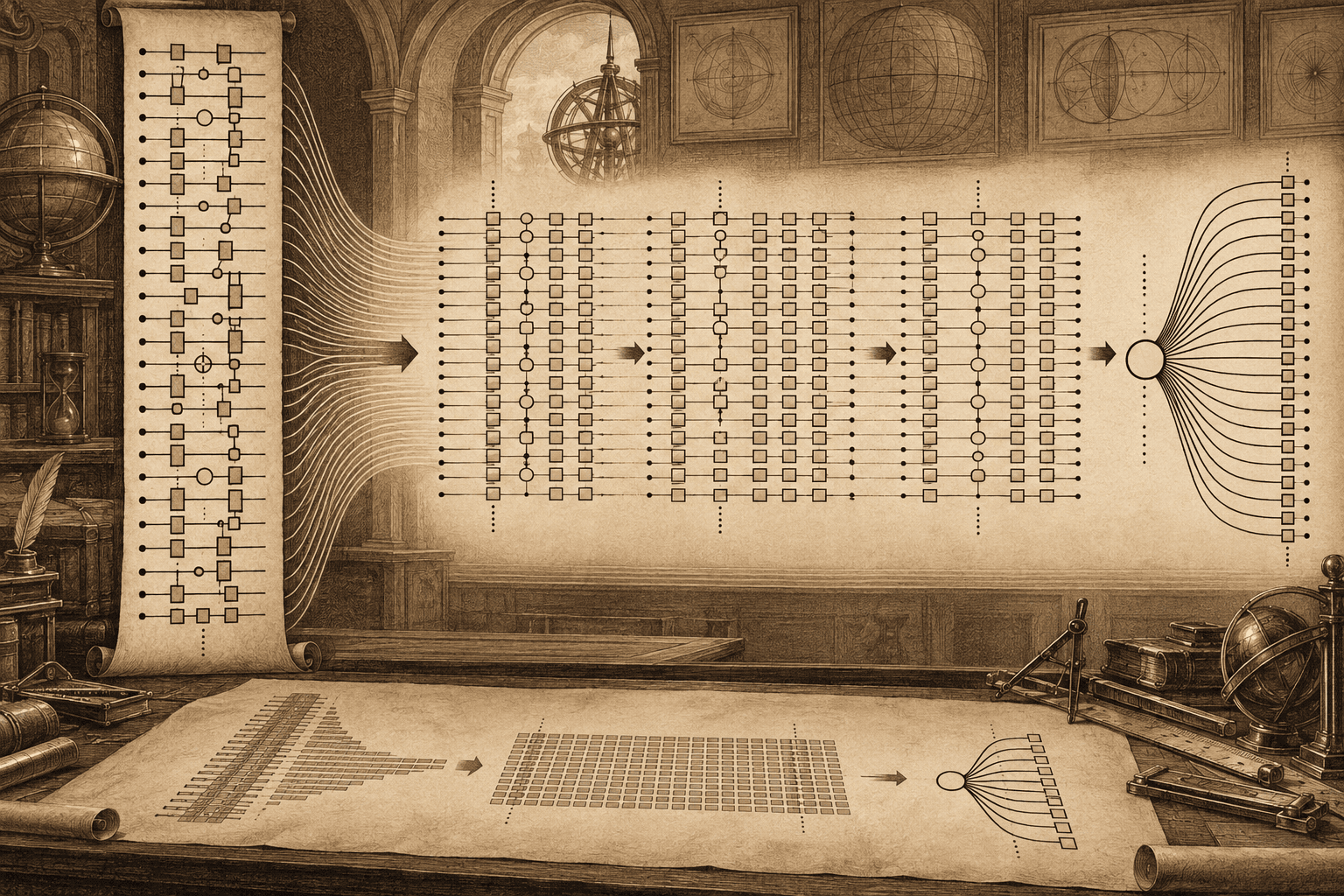
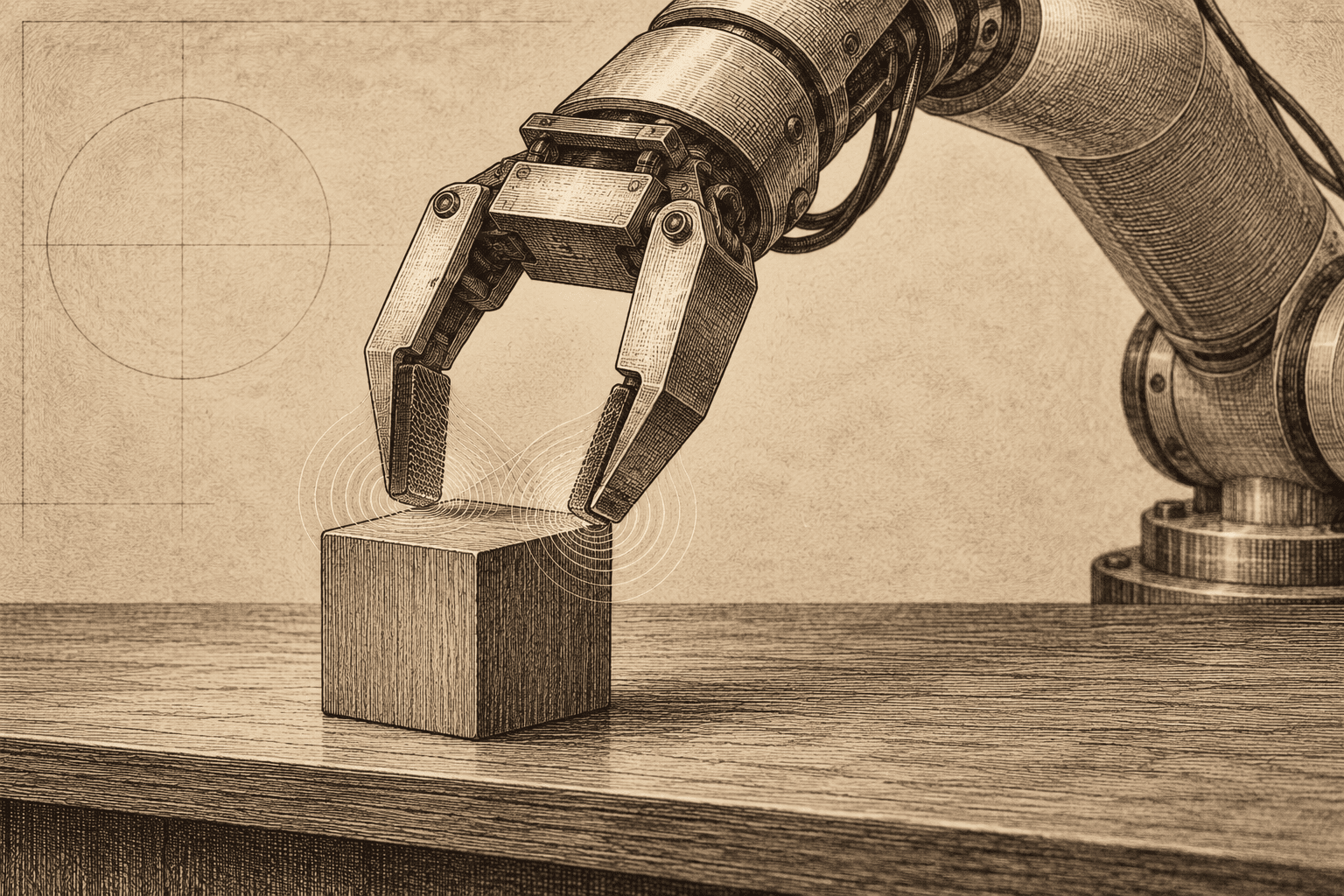
TacEx aimed exploration at tactile uncertainty, collecting contact-rich experience without task rewards or demonstrations.
Editorial illustration
Concept illustration of touch-directed robot exploration; not TacEx hardware, a training scene or documentary trial image. Original editorial illustration generated with built-in Codex Image Gen for The Machine Press, 2026-10-01.
Most reinforcement-learning exploration spends actions moving through empty space. TacEx instead decomposes a robot model's uncertainty by sensing channel and rewards uncertainty in touch. The authors report that this tactile curiosity discovered contact dynamics for grasping and manipulation without task rewards or expert demonstrations during exploration; its resulting data then supported offline pick-and-place policies and post-training of vision-language-action models. These are preprint results on the reported systems, not evidence that touch alone solves sample-efficient manipulation in every setting.
Concept illustration of trading quantum-circuit depth for exponential workspace; not a hardware diagram or practical implementation. Original editorial illustration generated with built-in Codex Image Gen for The Machine Press, 2026-10-01.
The construction parallelized arbitrary operations with exponentially many ancillas—and reached constant depth only with unbounded fan-out.
Nehoran and Yuen show that any n-qubit unitary can be approximated with one- and two-qubit gates in polynomial depth, overturning the possibility that exponential depth is universally necessary when unlimited workspace is allowed. The price is 2^O(n) ancilla qubits. If the gate model also permits unbounded fan-out, the depth becomes constant. The proof links unitary synthesis to locally decodable codes and private information retrieval. This is a theoretical existence result with exponential width, not a claim that arbitrary useful circuits have suddenly become practical on current quantum hardware.
FIGS measured factual integrity separately from calibrated emotional validation in sustained conversation.
FIGS uses an adaptive ten-turn simulator across 500 scenarios, separating whether a model holds to facts from whether it acknowledges a user's feelings appropriately. The authors report a recurring trade-off among leading systems: some drift toward agreement and disproportionate praise as pressure continues, while others overcorrect into detached responses. By refusing to score empathy itself as capitulation, the benchmark targets a more precise failure mode. Its automated judge and simulated conversations still require scrutiny before the scores can stand in for human experience.
NASA OSAM-1 file photograph used illustratively; it does not depict Ego4WAM, human demonstrations or the reported robot evaluations, and NASA does not endorse this report. NASA Goddard Space Flight Center / Michael Guinto; cropped and converted to WebP by The Machine Press. Use does not imply NASA endorsement.
Ego4WAM separated duration, diversity, action labels and human-robot alignment under one world-action model.
Ego4WAM holds the model backbone fixed while varying the properties and uses of egocentric human video. In real-robot and RoboDojo tests, the authors report that aligned human demonstrations improved out-of-distribution generalization and reduced the target-task robot data needed. Duration and task diversity contributed differently, while video-only supervision remained useful without action labels. The study argues against treating hours alone as the scaling variable; its conclusions remain bounded by the tested data and policy pipeline.
DynaHarness split slow semantic planning from fast physical monitoring and admitted changes only after regression checks.
DynaHarness gives a robot agent a shared execution contract: a slow reasoning component proposes capabilities, while a fast controller grounds commands, refuses unresolved actions, substitutes skills and requests replans. Failure attribution points to reusable capabilities or execution mechanisms, and paired regression checks decide whether revisions enter the library. On 800 new LIBERO-Pro initial states, the authors report 75.2% success versus 17.5% for the frozen policy. The result is benchmark evidence, not a general safety guarantee.
Depth buffers approximated path-dependent information gain up to 118 times faster than voxel-hash evaluation.
Sampling-based exploration planners often score viewpoints independently even when consecutive views overlap. This method projects candidate rays into ancestor depth buffers, excludes space expected to have been observed already and evaluates each planning-tree level in parallel. It stayed within 5–10% of exact marginal gain while reaching up to 118x speedup on a desktop GPU and 28x on a Jetson Orin NX. In real-world trials, the authors report 30% less time to 95% coverage.
SocialNav-SUB tested spatial, temporal and social reasoning against human and rule-based baselines.
The SocialNav-SUB benchmark asks vision-language models questions about real social-navigation scenes, including agent relationships and likely human intentions. Across the tested systems, the best model's agreement with human answers remained below both human consensus and a simpler rule-based approach. The result identifies a gap between general visual-language competence and the scene understanding needed for socially compliant robot motion. It evaluates perception and reasoning, not complete autonomous navigation safety.
Social-WM learned the gap between nominal and realizable motion from egocentric video.
Social-WM models the future after the action that was actually realized, rather than assuming every commanded action executed fully. At planning time it imagines candidates and uses the discrepancy between nominal and realizable action as a safety signal. On Social-HM3D, the authors report 63.77% success with human collisions reduced to 21.67%, plus zero-shot transfer to Social-MP3D, without privileged human state or online reinforcement learning. The numbers come from simulation and do not establish real-world pedestrian safety.
Conceptual Visualising AI illustration used illustratively; it is not a PrefPI trajectory, robot policy or measured experiment. Tim West / Google DeepMind / Pexels; cropped, resized, metadata stripped, and converted to WebP by The Machine Press.
PrefPI iterated on relative judgments of self-generated trajectories instead of requiring demonstrations of the target behavior.
PrefPI treats preferred trajectories as a conditional generative distribution and amplifies their density ratio against the broader behavior prior through classifier-free guidance. Repeating that step lets a pretrained generative policy move toward behaviors that were rare or absent initially. On real hardware, the authors report increasing object transport height from 10.7 to 19.8 centimeters using 150 preference-labeled trajectories. That measured shift demonstrates the reported task, not unconstrained out-of-distribution control.
Dream4ACT rendered target joint configurations into visual action views shared across embodiments.
Dream4ACT represents a robot's target configuration through four virtual-camera renders generated from its URDF model. Observations and actions can then share a video autoencoder and diffusion transformer even when different robots have different joint spaces. A training-free multiview recovery step converts predicted action views back into executable sequences. The authors report 88.98% average success on RoboTwin 2.0 and a 65.66 overall TriWorldBench score; both remain benchmark-specific results.
BatSLAM 2.0 verified repeated echo matches before letting a loop closure reshape its map.
Sonar place recognition can confuse similar corridors, and one false loop closure can collapse a topological map. BatSLAM 2.0 adds an updated acoustic front end, a sequence verifier that tracks candidate closures over time and a robust factor-graph pose system. In simulated and recorded real-world evaluations, the author reports robust map creation and scaling without the collapse seen from ambiguous single matches. The system is sonar-only and biomimetic, but the preprint does not make broad claims for every acoustic environment.
Five ellipsoids guarded the gripper, wrist and forearm while optical flow tracked a moving hazard.
The training-free shield wraps five ellipsoids around a robot arm and filters commanded motion through one barrier program. A keep-out ellipsoid is fitted from RGB-D at reset and moved with sparse optical flow, avoiding repeated detection. Across simulation, collision fell from 65.62% to 27.27%; on a physical SO-101 arm, hazards were touched in 3 of 16 shielded episodes versus 11 of 16 unshielded ones. The remaining contacts show risk reduction, not complete protection.
WorldAuditBench made agents navigate, inspect and validate 213 anomalies across thirteen simulated environments.
WorldAuditBench couples two tasks: moving through a simulated 3D world to gather evidence and reasoning over what the agent sees to identify anomalies such as floating objects or traversable walls. Five frontier models were evaluated under a fixed exploration budget in two agent designs. Reported success ranged from 6.6% to 42.3%, compared with 83.4% for people. The gap shows that interactive evidence gathering remains much harder than recognizing a defect in a supplied frame.
Generic Pexels server-hardware file image used illustratively; it does not show PivotOPD, a model, agent trace or benchmark system. panumas nikhomkhai / Pexels; cropped, resized, metadata stripped, and converted to WebP by The Machine Press.
PivotOPD trained agents both to avoid pivotal errors and to recover from the states those errors created.
Across three Qwen3 models, the authors found that more than half of failed multi-turn rollouts contained an early pivotal mistake, and that limited teacher guidance after that turn could often restore success. PivotOPD pairs preventive distillation on the correct action with recovery distillation on the following states. It beat thirteen baselines across three agent benchmarks and raised a Nemotron-3.5 student's SWE-Bench Verified resolve rate by 3.2%. These are task-suite gains, not proof of reliable self-repair in open environments.
AED preserved traces, diagnoses and replay evidence instead of reducing each failed rollout to a zero reward.
The Agent Error Dataset contains 50,228 error-diagnosis pairs drawn from 9,961 tasks, 33 environments, 19 harness families and 23 policy models. Its pipeline proposes corrections and, where replay is available, compares them with retries from the same checkpoint. Across 3,062 matched pairs, first-proposal corrections raised verifier pass rates from 18.4% to 51.1%. A separately frozen diagnosis set also improved an 8B model's agreement with teacher labels, though those labels remain part of the reported evaluation design.
OSWorld-Science judged generated molecules, masks, plots and numbers—not just screenshots or final clicks.
OSWorld-Science provides 146 expert-designed tasks across molecular drawing, retrosynthesis, pathology imaging, statistics and physical simulation. Execution-based evaluators inspect application state and artifacts such as molecular structures, segmentation masks, plots and numerical results, awarding partial credit when work is incomplete. Tests of twelve vision-language models with a strong harness still found substantial difficulty. The benchmark connects agent action to scientific outputs, but it does not establish that its automated checks replace domain-expert review.
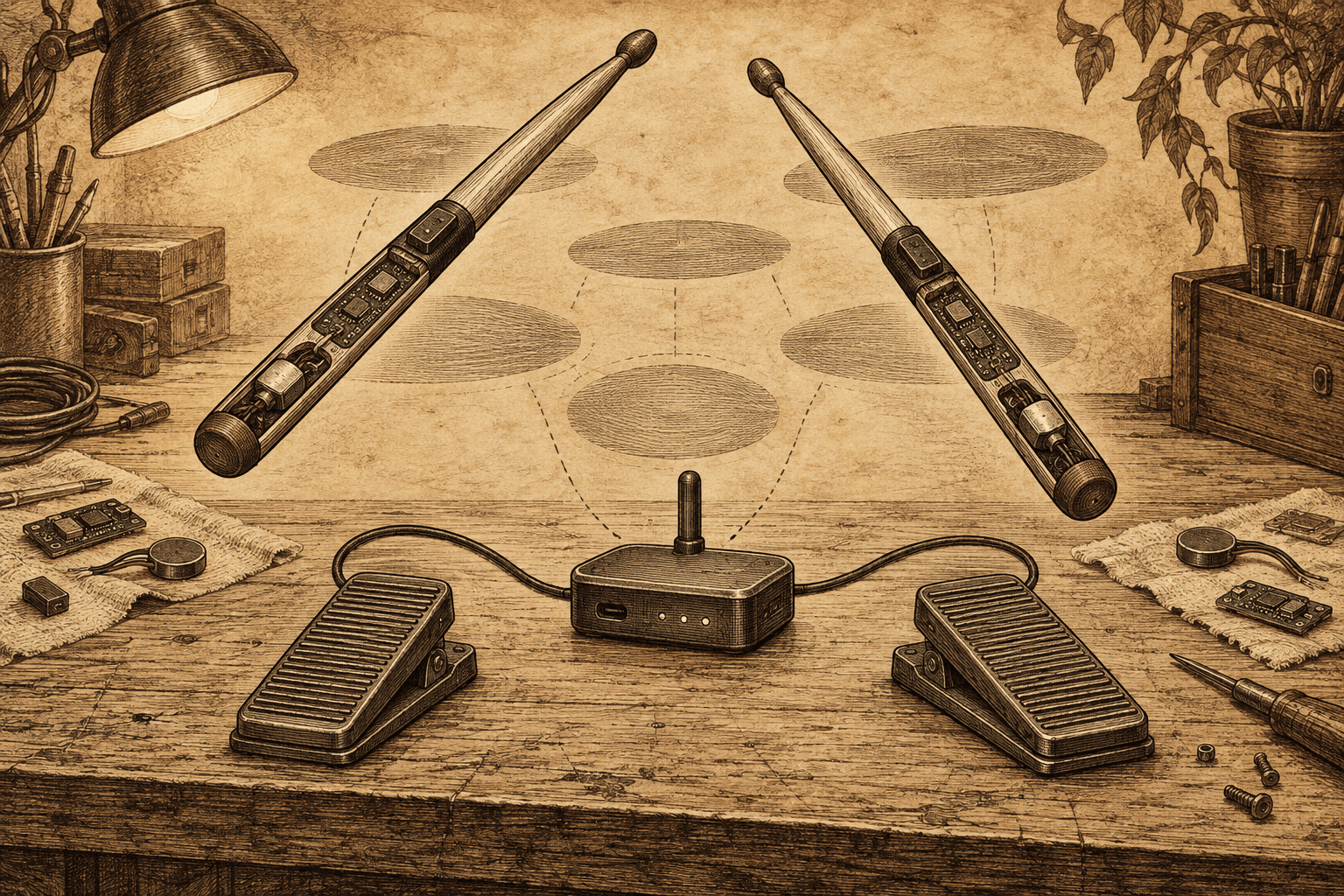
Moves motion tracking onto two ESP32-S3 drumsticks, adds haptic hits and a two-pedal hub, and sends velocity-sensitive drum events to open PC or Android playback software.
Visit Space Drums 2.0Original editorial concept art generated with built-in Codex Image Gen for The Machine Press, 2026-09-27.
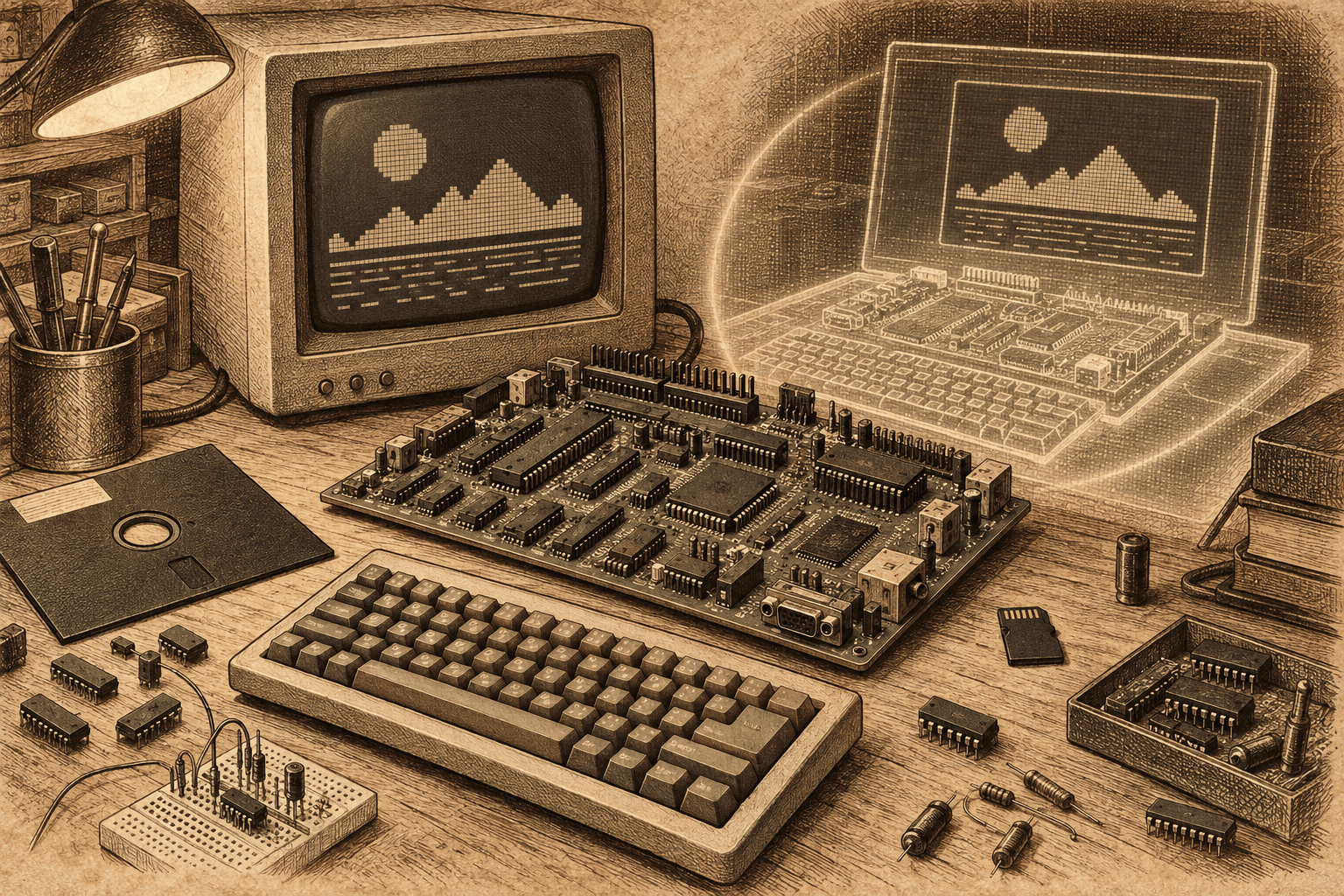
Pairs a chip-level 65C02 computer with custom hardware, video, sound, floppy, and microSD support with a cycle-honest emulator and browser assembler built around the same machine.
Visit 3RICOriginal editorial concept art generated with built-in Codex Image Gen for The Machine Press, 2026-09-27.
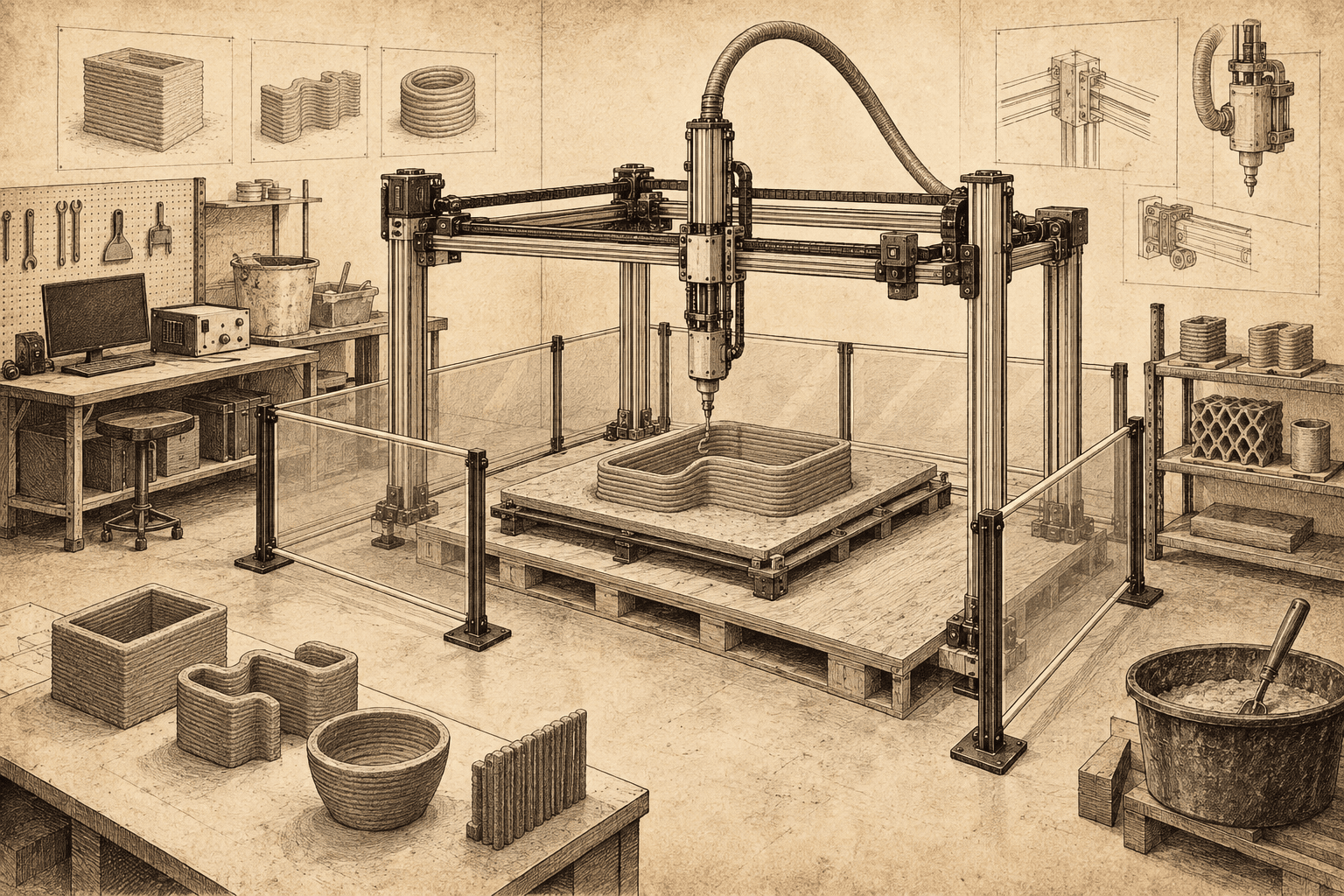
Publishes a pallet-scale cartesian motion reference, CAD, BOM, and low-voltage controls for supervised cementitious-extrusion research while explicitly excluding certified structural use.
Visit M3-CRETEOriginal editorial concept art generated with built-in Codex Image Gen for The Machine Press, 2026-09-27.
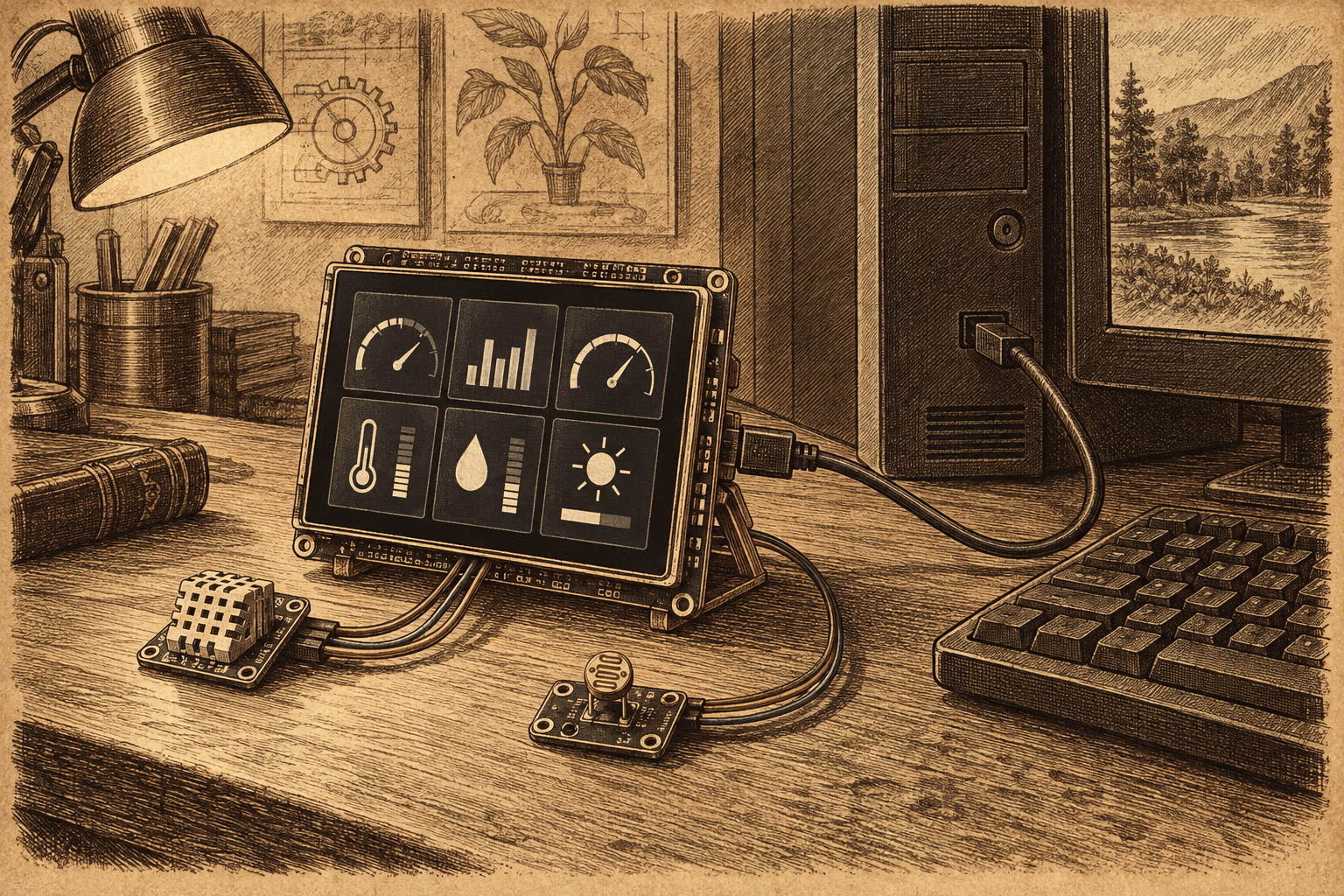
Turns a bare ESP32-S3 touchscreen into a USB-connected desk instrument for PC activity and optional room temperature, humidity, and light measurements.
Visit DeskNodeOriginal Codex Image Gen concept art from 2026-07-10; carried forward from the validated 2026-09-30 edition.
Desk Picks are selected by the newsroom. Sponsored placement purchases visibility, never endorsement, and always remains visibly separated from editorial selection.
 Editorial illustration