UniIntervene++ reported 89.67 percent success on five physical manipulation tasks while adapting how much help a learning policy received.
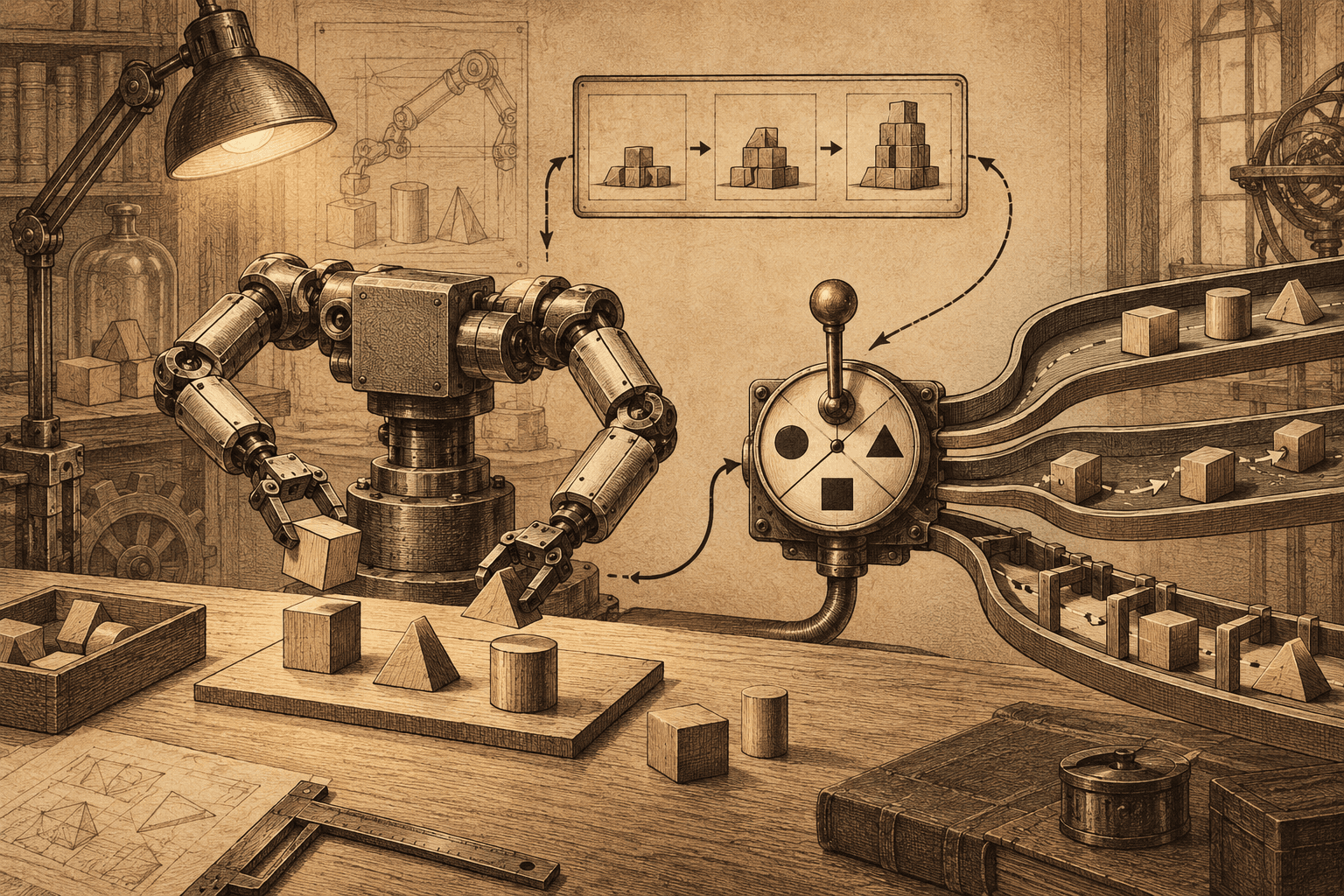
Editorial illustration
Concept illustration of adaptive control allocation and robot learning; not UniIntervene++ hardware, a reported experiment or documentary evidence. Original editorial illustration generated with built-in Codex Image Gen for The Machine Press on 2026-10-05 for the retroactive 2026-10-04 edition.
Online robot learning changes the need for assistance as a policy improves. UniIntervene++ treats autonomous control, trajectory correction and a structured CodePolicy as alternative behaviors in one decision process, learns their relative values online and periodically tests the robot without help. Assisted experience trains the main policy; its changing performance then reshapes the next intervention. Across five real-world manipulation tasks, the authors report 89.67 percent average success, at least six percentage points above tested baselines, with their human-intervention metric reduced to 0.77 percent. The work makes the handoff itself part of learning instead of relying on a fixed trigger. These are preprint results for the reported tasks, not a claim that arbitrary robots can operate without supervision.
Concept illustration of detector evaluation across different input formats; not a benchmark interface, attack trace or documentary evidence. Original editorial illustration generated with built-in Codex Image Gen for The Machine Press on 2026-10-05 for the retroactive 2026-10-04 edition.
A prompt-injection audit found that benchmark rankings transferred poorly when detectors screened the longer inputs an agent actually receives.
The study reconstructed benign tool outputs by replaying ground-truth calls from AgentDojo and tau-bench, then labeled injected versions through differential replay. It evaluated fifteen detectors and two task-aware model judges alongside BIPIA. At a one percent false-positive rate, the best BIPIA detector caught only two percent of AgentDojo injections; another detector caught 72 percent on AgentDojo but 15 percent on tau-bench. Public training data suggested that input form mattered: exposure to isolated attack strings did not establish detection inside a tool response. The authors recommend testing on an agent’s own outputs, reporting detection at low false-positive rates and auditing training overlap. This preprint tests particular detectors and benchmarks; it does not establish that every deployed screening system fails.
CERTID tests whether a reasoning model knows when observational data cannot identify the effect it is asked to compute.
A model can refuse a solvable causal query or confidently supply a formula for an effect that observational data cannot identify. CERTID certifies identifiability from the graph and query, then checks formulas against structural causal models with known interventional distributions. On 1,200 instances spanning four to fifty vertices, three tested frontier models showed a seventeen-fold difference in false claims on non-identifiable questions. Their overall accuracy did not summarize that risk. The preprint evaluates formal graph problems, not unrestricted real-world causal inference, but makes an unsupported answer distinguishable from an ordinary mistake.
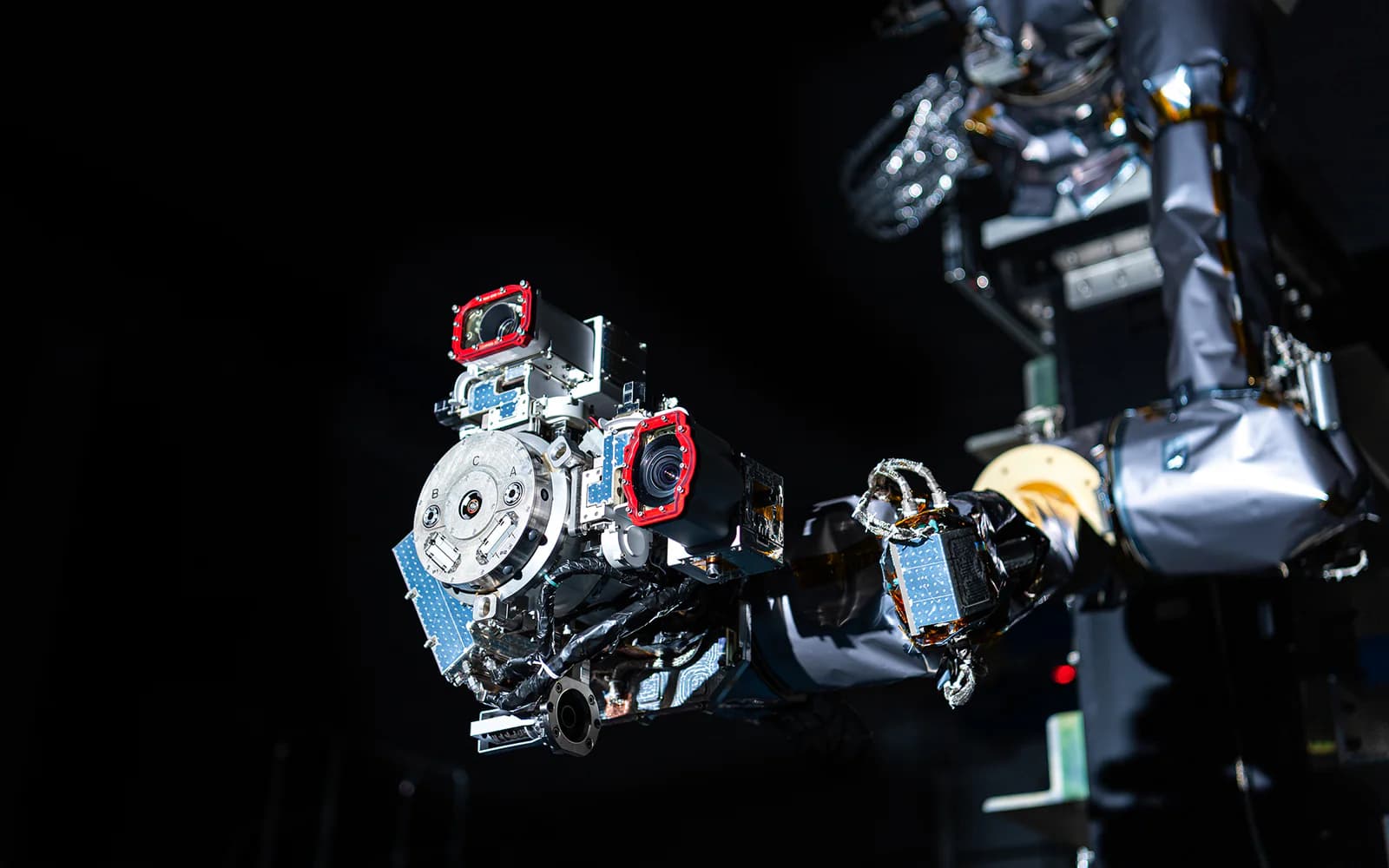
NASA OSAM-1 hardware used illustratively; it does not depict MobiAgent, Astribot S1, learned skills or reported trials. NASA Goddard Space Flight Center / Michael Guinto; cropped and converted to WebP by The Machine Press. Use does not imply NASA endorsement.
MobiAgent separates execution from a learning loop that discovers and refines reusable skills.
MobiAgent uses high-level planning and visual reflection to compose atomic skills during mobile manipulation, while a second loop segments and verifies deployment rollouts for further training. Specialized control experts share a visual-language backbone. The authors report a 22.5-percentage-point gain over π0.5-TA on BEHAVIOR-1K, with recycled experience improving RoboCasa success from 7.5 to 27.5 percent and Astribot S1 success from 32.5 to 57.5 percent. The reported recovery and learning gains are bounded by those evaluations.
RC-OPD uses local repairs of a model’s own failed reasoning instead of handing it an unrelated correct solution.
Reference-based distillation can teach a correct conclusion without fixing the mistake that produced a student’s failure. RC-OPD locates the earliest substantive error, builds a local correction and tests whether the student can continue from the repaired point. Successful repair chains supervise flawed segments while preserving valid progress. The preprint reports improvements across multiple datasets and model scales, but its abstract does not supply a single aggregate gain; the contribution is the tested diagnosis-and-repair procedure.
FinSkillBench separates procedural documents from executable tools in verifiable financial-agent tasks.
FinSkillBench contains 2,603 dated episodes across twelve subtasks with deterministic verifiers. A paired analysis across eight models found curated skill packages raised mean scores by 16.2 points, while skills generated within one episode added only half a point and used more tokens and turns. Testing resources separately, documents added 5.6 points and executable tools 19.5; combining them was subadditive. A second harness reproduced the direction while changing effect sizes. The authors frame the premium as a property of the full model, resources and harness, rather than proof that the underlying model acquired financial expertise.
W16A16 reports lower quantization error with comparable or better inference time and energy on Armv7E-M microcontrollers.
Lower precision does not automatically deliver the best implementation on every processor. The W16A16 study analyzes Armv7E-M instructions and evaluates sixteen-bit neural-network quantization for regression and classification. It reports roughly ten times lower quantization error than the tested eight-bit schemes while matching or improving measured inference time and energy. The finding is specific to its microcontroller architecture, models and kernels, rather than a universal argument for higher-precision edge inference.
Weave Forcing routes historical video memories separately for subjects and backgrounds without retraining the generator.
Interactive video needs to recombine earlier elements, not simply extend the last scene. Weave Forcing divides a prompt into semantic slots, retrieves references for characters and backgrounds separately, and masks compressed historical memories so unrelated content stays hidden. It also adjusts temporal offsets when reference coverage is incomplete. The authors report better cross-shot subject and background consistency with competitive visual quality and text alignment; the abstract gives no universal duration or consistency guarantee.
CC0 wafer-scale integrated-circuit rendering used illustratively; it does not depict Patch-to-Prune, a tested model or measured compute savings. Wikideas1 / Wikimedia Commons (CC0 1.0); cropped and converted to WebP by The Machine Press.
Patch-to-Prune bypasses selected visual computations while retaining sequence length, token order and pretrained weights.
Patch-to-Prune turns activation patching into an inference procedure. Validation-guided sweeps find decoder regions where fixed proxy activations can replace visual-token projection outputs within an accuracy tolerance. The method keeps token positions, attention masks and residual pathways intact. Across four Qwen2.5-VL and LLaVA models and seven multimodal benchmarks, the authors report about 94 percent of dense-model accuracy with 55 percent fewer FLOPs at a three percent tolerance setting. FLOP savings are an evaluated computation measure, not a promised wall-clock speedup on every device.
CORNAV combines architectural drawings, scene graphs and changing exclusion zones for navigation on active construction sites.
CORNAV aligns two-dimensional CAD plans with an open-vocabulary scene graph, translates project schedules into time-varying constraints and screens hazardous requests before planning. An A* planner enforces mandatory exclusion zones. In an office and a real construction site, the authors report task success rising from 13.0 to 72.2 percent over semantic retrieval alone, with schedule awareness eliminating hard-zone violations in those tests. The result supports construction-specific context in navigation; it is not general safety certification for changing worksites.
ECHO-k chooses additional modalities from internal representations when the eventual prediction task is unknown.
Collecting every available modality can be expensive or slow. ECHO-k uses a pretrained model’s internal representations as proxy targets for cross-modal information, then learns a policy that acquires measurements sequentially. The authors provide guarantees in a stylized linear setting and report improved budgeted downstream performance across several foundation-model backends against task-agnostic, label-free baselines. The theory’s restricted setting and the evaluated budgets matter; the work does not establish that omitted measurements are always dispensable.
I2CD predicts convex parts directly, skipping the mesh-repair pipeline before physics simulation and motion planning.
I2CD freezes a pretrained image-to-3D backbone and trains a lightweight head whose tokens emit convex polytopes. On 227 held-out objects, the authors report the highest volumetric overlap among eight compared pipelines and six to 37 times faster end-to-end processing. Four physics engines accepted its delivered geometry without post-processing. In a physical xArm7 experiment, it prepared a twenty-object scene in eleven seconds versus 328 for the strongest baseline, with 85 versus 90 successful picks in one hundred trials. Faster geometry preparation did not improve that measured execution success.
DriftTTS trains a few-step mel-spectrogram generator through distribution matching and its own intermediate rollouts.
DriftTTS avoids a pretrained generative teacher, distillation and adversarial discrimination. Its objective operates in a mel-domain feature space that includes a frozen masked-autoencoder trained on the same LJSpeech split. With four function evaluations, the authors report a 3.7 percent word-error rate versus Matcha-TTS’s 3.4 percent. A paired blind listening test gave mean scores of 4.18 and 3.96 respectively, with ground truth at 4.22. Those dataset-specific results support competitive synthesis under this setup, not universal voice quality or robustness.
Visualising AI concept art used illustratively; it does not show NAVA-WAM, robot demonstrations or experimental results. Tim West / Google DeepMind / Pexels; cropped, resized, metadata stripped, and converted to WebP by The Machine Press.
NAVA-WAM sends future-video supervision directly into a robot policy before training it on commanded demonstrations.
NAVA-WAM learns action-relevant priors from observation-only videos instead of first learning a separate latent-action model. Future-video supervision passes through joint attention to train the action branch; later, action-labeled robot demonstrations ground that branch for control. Asymmetric attention then enables action-only inference. The preprint reports stronger in-distribution and out-of-distribution results, label efficiency and real-robot generalization across its experiments, without providing one aggregate figure in the abstract. Observation-only pretraining supplements rather than eliminates the need for labeled robot data.
KungfuAthleteBot repairs video-derived motion and trains disturbance recovery inside the same control policy.
Video motion lacks forces and can contain floating, ground penetration and jitter. KungfuAthleteBot corrects reconstructed aerial trajectories and samples physically plausible training starts, allowing a policy to learn feasible actuation instead of rigidly copying an impossible reference. Disturbance rejection and fall recovery are trained with motion tracking in one policy. The authors report about 0.7-second recovery from falls on their humanoid and ablations supporting each component. This is a preprint result for the reported platform; it does not establish unrestricted athletic safety.
A controlled vision-language experiment separates corrupted internal signals from the answer a model freely generates.
On Qwen2.5-VL-7B-Instruct and two hundred held-out COCO images, a targeted perturbation could lower training loss for a chosen caption while free generation still produced the correct description. The study traces the disagreement through the decoder and reports that susceptible and resistant outcomes diverge there despite similar visual-encoder corruption. It also flags circularity in one probe estimate. The result concerns a particular model and attack setup, and argues for measuring generated behavior alongside internal proxies.
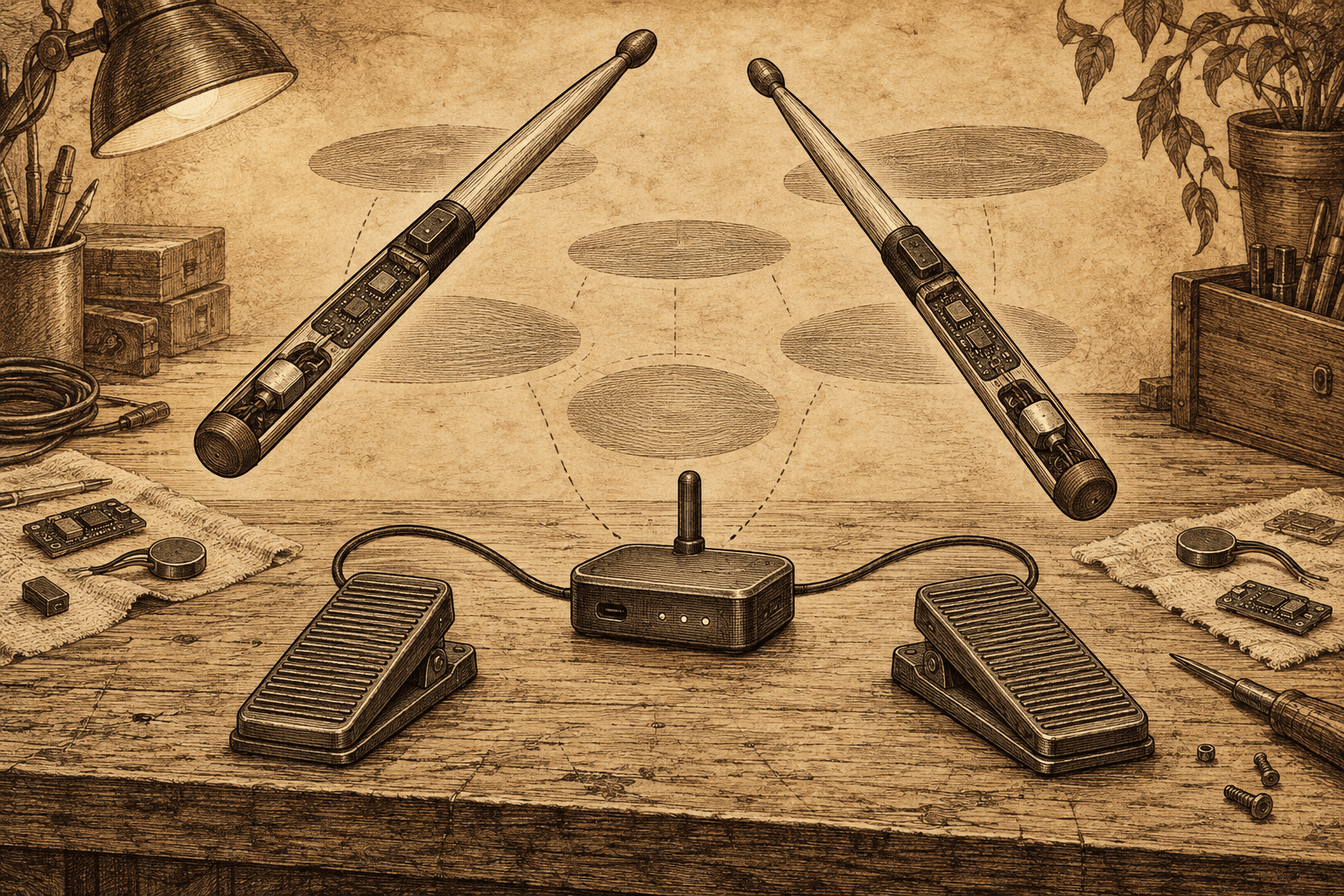
Moves motion tracking onto two ESP32-S3 drumsticks, adds haptic hits and a two-pedal hub, and sends velocity-sensitive drum events to open PC or Android playback software.
Visit Space Drums 2.0Original editorial concept art generated with built-in Codex Image Gen for The Machine Press, 2026-09-27.
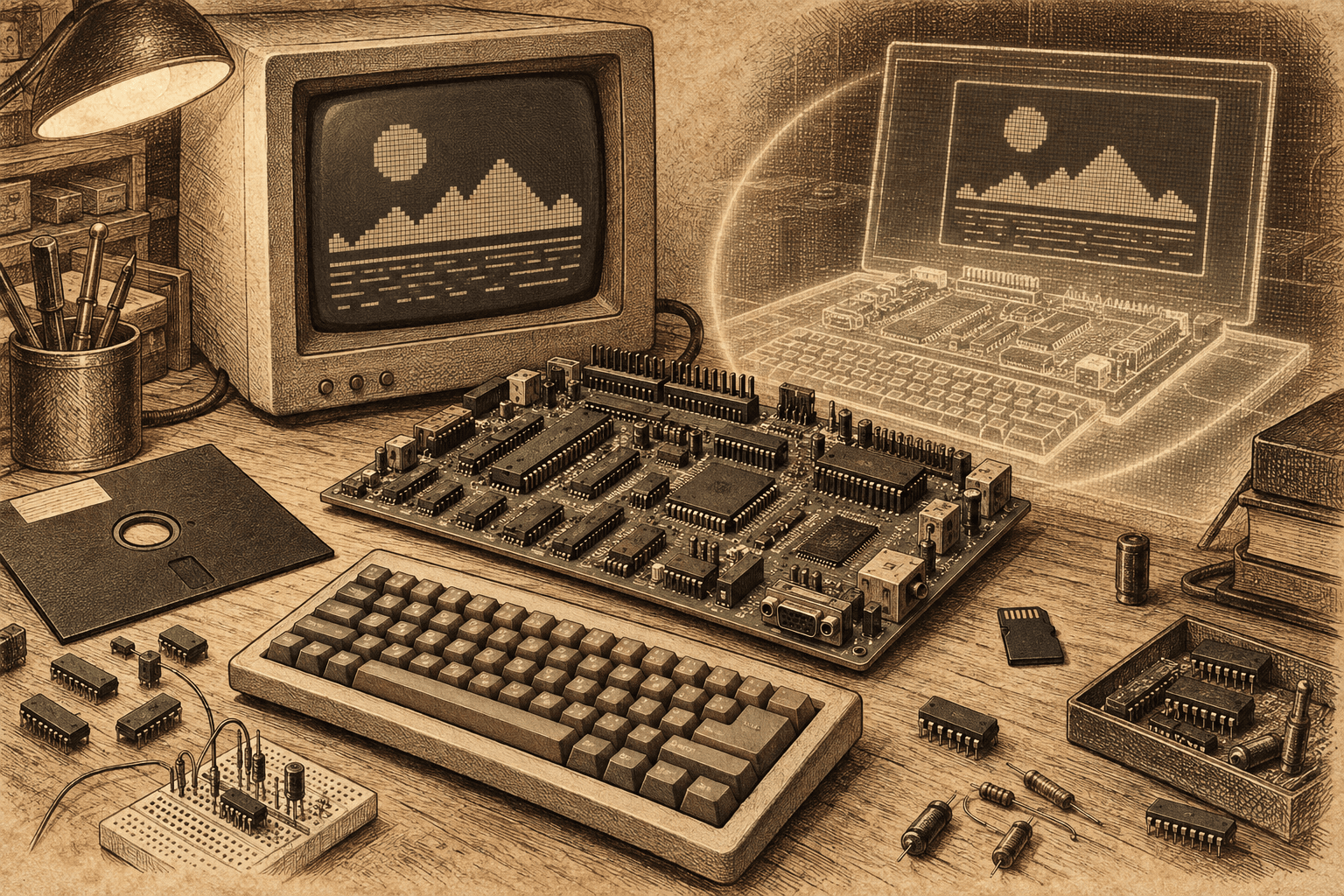
Pairs a chip-level 65C02 computer with custom hardware, video, sound, floppy, and microSD support with a cycle-honest emulator and browser assembler built around the same machine.
Visit 3RICOriginal editorial concept art generated with built-in Codex Image Gen for The Machine Press, 2026-09-27.
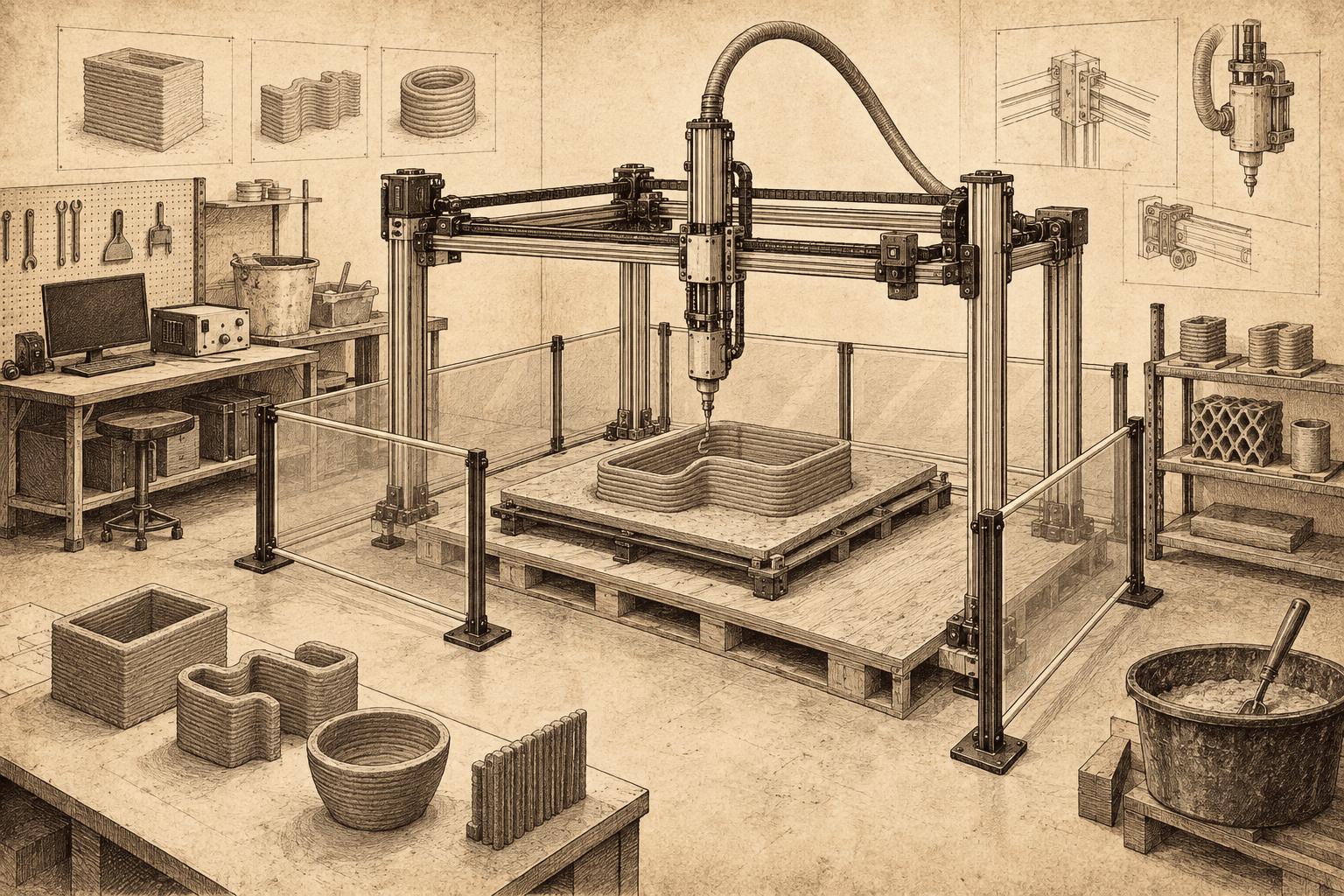
Publishes a pallet-scale cartesian motion reference, CAD, BOM, and low-voltage controls for supervised cementitious-extrusion research while explicitly excluding certified structural use.
Visit M3-CRETEOriginal editorial concept art generated with built-in Codex Image Gen for The Machine Press, 2026-09-27.
Turns a bare ESP32-S3 touchscreen into a USB-connected desk instrument for PC activity and optional room temperature, humidity, and light measurements.
Visit DeskNodeOriginal Codex Image Gen concept art from 2026-07-10; carried forward from the validated 2026-09-30 edition.
Desk Picks are selected by the newsroom. Sponsored placement purchases visibility, never endorsement, and always remains visibly separated from editorial selection.
 Editorial illustration