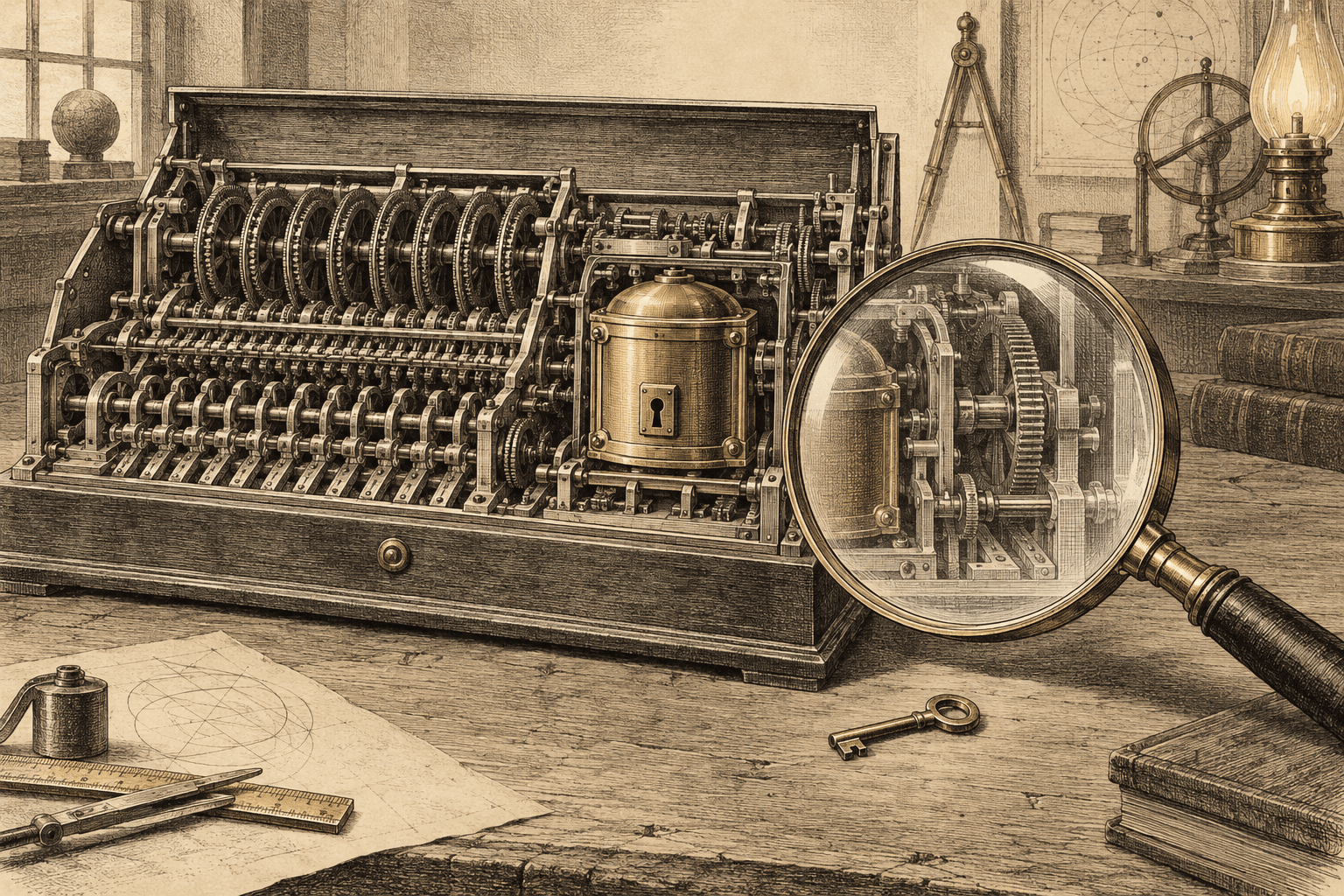
A cryptographic construction shows why eliciting a model’s worst behavior cannot guarantee that every capability has been found.
Editorial illustration
Concept illustration of an intentionally concealed model capability; not a model architecture, cryptographic scheme or documentary image. Original editorial illustration generated with built-in Codex Image Gen for The Machine Press, October 12, 2026 edition.
Capability audits assume a hidden skill can eventually be brought into view. A new preprint challenges that assumption with deliberately constructed models that keep an encrypted neural network inside their weights and activate it only with a secret trigger. Under the authors’ cryptographic assumptions, the concealed computation remains difficult to discover even when an auditor can inspect all the weights. The team implemented proof-of-concept models in PyTorch and tested several elicitation methods, including fine-tuning and latent adversarial training, on a small chemical-reaction prediction task. The hidden behavior resisted those methods. This is a constructed adversarial case, not evidence that ordinary deployed models contain such mechanisms. Its significance is narrower and sharper: a clean elicitation test cannot, by itself, establish the absence of an intentionally concealed capability. The authors released their models to support defensive research.
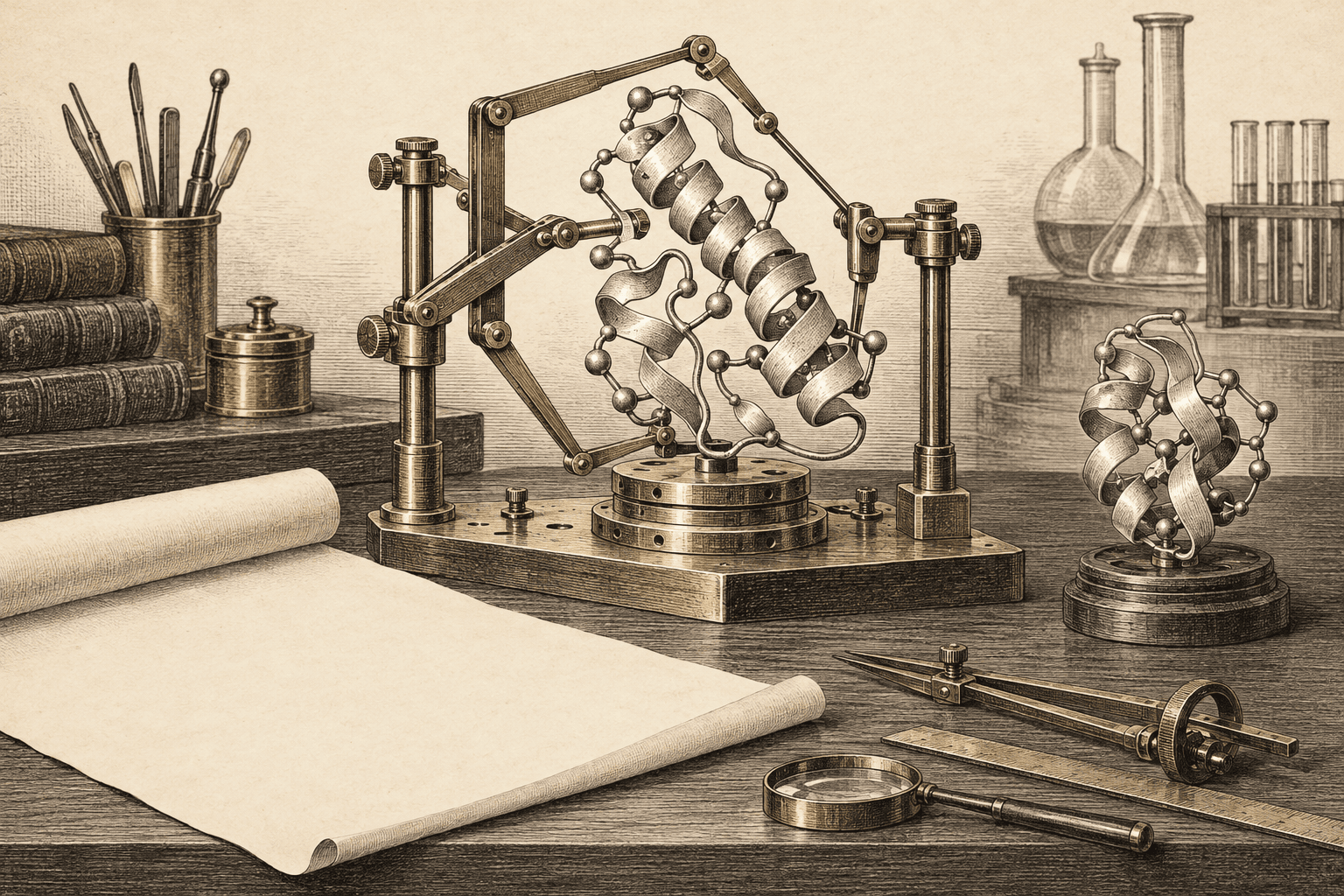
Concept illustration of language-guided protein design; not an actual protein structure, experimental apparatus or therapeutic result. Original editorial illustration generated with built-in Codex Image Gen for The Machine Press, October 12, 2026 edition.
Prompteina connects written design goals to all-atom structures, then tests a set of newly designed binders in the laboratory.
Protein designers usually need a different input representation for each constraint they want a model to honor. Prompteina makes natural language the interface to an all-atom structure generator. Its authors built a training collection of 1.8 million structures and more than 50 million captions describing global and residue-level properties. The model beat the evaluated baselines on 15 of 18 structural properties and at least 13 of 20 binder-design targets. The researchers also tested designs against GM2A, a target for which they report no previous de novo binders, and identified nine binders; the strongest had an apparent dissociation constant of 107 nanomolar. Those are bounded study results, not evidence of a treatment or a general ability to design any protein. The advance is an interface that can express a wider range of design objectives without requiring a separate handcrafted representation for every one.
A separate answer selector improved one factual dataset but still lost to silence on another.
Researchers asked whether reliable abstention should come from training the language model itself or from a separate component that checks its proposed answers. On Qwen3-14B, the learned selector improved threshold-averaged utility over the original model’s calibrated confidence filter. Under exact-match grading on TriviaQA, mean coverage rose from 20.2% to 30.9%, while the pooled error rate among scored answers fell from 23.0% to 14.5%. The tested reinforcement-learning changes did not produce consistent gains. On NQ-Open, the selector improved on the filter but still performed worse than always abstaining. A partial human-reviewed audit preserved the TriviaQA finding. The contrast matters for deploying a system that must decide whether it knows enough: selecting answers can help in a particular setting, but one dataset’s improvement does not establish reliable uncertainty handling elsewhere. The authors leave that broader problem unresolved.
NASA OSAM-1 hardware used illustratively; it does not depict Splat2Act, Stretch 3, a scanned room or the reported pickup trials. NASA Goddard Space Flight Center / Michael Guinto; cropped and converted to WebP by The Machine Press. Use does not imply NASA endorsement.
Splat2Act builds scene-specific practice from captured rooms and the user’s own objects.
A generalist manipulation policy recorded zero pickup success in the authors’ captured deployment scenes before adaptation. Splat2Act uses a phone scan and object images to build a digital twin, discover reachable placement surfaces and generate successful simulated demonstrations. Across 101 campus environments, the pipeline produced more than 68,000 demonstrations. The strongest personalized policy reached 62.5% aggregate pickup success in its target scene. On a real Stretch 3 robot, it achieved 63.9% on a 12-task subset. The result supports scene-specific adaptation from simulated practice; it does not establish reliable manipulation in arbitrary homes.
RATED combines semantic matching with feedback about whether an agent’s tools actually execute.
Tool retrieval often asks which API matches a request while ignoring whether that API is available. RATED adds a small contextual-bandit reranker that learns from execution feedback without retraining the main retriever. Its EcoAgent benchmark includes 5,172 tools and more than 210,000 query-tool pairs. In the authors’ severe-outage evaluation, fault selection fell from 86.2% to 2.9%; they report less than one millisecond of added latency over encode-only inference. These are benchmark results under specified outage conditions, but they make operational availability part of the selection problem.
Artisan tests how an articulated asset works, alongside how convincingly it looks.
A useful simulated cabinet needs more than a plausible surface. Artisan extends articulated 3D generation with multiple agents and physical-simulation feedback, checking collision-free motion, gravity stability, mass and materials. Its benchmark combines 100 reference assets, 50 stability prompts and 50 objects with reference masses. Against more than ten evaluated methods, the authors report competitive spatial fidelity alongside the lowest collision rates and highest stability rates. The paper’s target is a generated object that can function inside downstream tasks, rather than an attractive mesh whose mechanics were never tested.
The October 9 case report puts speed gains inside the customer’s existing response permissions.
Sophos reports that cases handled with agents built through OpenAI Daybreak average about 89 seconds, compared with roughly 38 minutes in its previous process. The company says AI now resolves 52% of managed detection and response cases end to end. Investigation agents gather context and threat intelligence, then plan and summarize recommended responses. Customer settings still determine whether Sophos only notifies, collaborates before action, or responds directly under authorization. These figures come from a vendor case report, rather than an independent comparative trial. The deployment claim is faster case handling within defined permissions, with exceptions handed to human judgment.
X-AgentRed searches service dependencies for risky combinations that a single-tool test can miss.
Personal agents can carry consequences from one service into another while fulfilling an ordinary request. X-AgentRed builds a graph of tool effects and execution preconditions, then uses feedback to explore and refine harmful cross-service paths. Across four frontier agentic models, its authors report 1.77 times the harmful-path rate of the STAC baseline and 2.99 times average tool coverage. This is an evaluation framework for discovering combinations of failures, not a count of incidents in production. The study argues that testing tools one at a time can leave their interactions underexplored.
CC0 wafer-scale integrated-circuit rendering used illustratively; it does not depict DualQuant hardware, an RTX 4090 or a measured inference result. Wikideas1 / Wikimedia Commons (CC0 1.0); cropped and converted to WebP by The Machine Press.
DualQuant derives activation scaling from the weight-reconstruction problem.
Activation quantization usually needs calibration examples even when compressing the weights does not. DualQuant uses scales obtained while minimizing weight-reconstruction error to rescale activations as well. It supports several low-bit formats, including MX and NVFP4, and the authors report matching or exceeding SmoothQuant accuracy across most tested models and formats. A packed four-bit weight-and-activation path for Llama-3.1-8B on an RTX 4090 achieved up to 2.61 times lower memory use and 2.46 times higher throughput than BF16. Those maxima belong to that evaluated implementation, rather than every model or accelerator.
Chronos puts capture and execution times inside the policy instead of hiding them in sequence order.
Fixed-rate robot policies can become brittle when sensors slow down or inference takes longer. Chronos Policy explicitly conditions on observation-capture times and desired action-execution times. The authors compare timestamp embeddings with time-aware rotary positional encoding and find the latter more robust. Training randomizes sensing and execution schedules, allowing asynchronous measurements without forcing them onto one fixed grid. Simulation and real-world experiments show improvements on dynamic and multisensory tasks, while preserving nominal performance on the evaluated quasi-static tasks. Physical time becomes part of the model’s input, rather than an assumption made outside it.
Coding-agent recovery benefited when progress lived in databases and running services.
Restarting a failed coding attempt can throw away useful work outside the repository. This study implements Go-Explore-style search over full Daytona sandbox snapshots, restoring intermediate states and branching from them. Its authors find that higher and more efficient solve rates mainly depend on progress in databases, services and other runtime state. The finding is conditional: a full machine snapshot is most valuable when a long task spans state that a code diff cannot reconstruct. It is not a claim that snapshot search improves every repository-only coding problem.
A link-following game tests retrieval across five Wikipedia languages and five literature datasets.
The Wikipedia Game requires reaching a target article using only links from the current page. Researchers used local Wikipedia and academic-citation graphs to compare language models, embedding methods, people and TF-IDF baselines without relying on third-party navigation APIs. No model significantly outperformed humans, although the best evaluated models achieved comparable success. Rankings changed across languages and subject areas. The authors provide graph-building and navigation code, making the test a reproducible way to examine information-finding skills rather than another open-ended chat demonstration.
ReplaySSM separates output computation from periodic checkpoint updates.
State-space models keep compact recurrent state, but moving that state on every decoding step can become expensive. ReplaySSM represents it with a checkpoint plus recent inputs, avoiding writes on most steps and making speculative rollback a buffer-pointer operation. Implemented in vLLM for Mamba-2 and Gated DeltaNet, it accelerated standard decoding by 1.20–1.47 times at batch size 256 across four hybrid models. On two models in the 120-billion-parameter class, speculative throughput was about 1.8 times the vLLM baseline. Separate checkpoint precisions also reduced the measured effects of quantization error.
Visualising AI concept art used illustratively; it is not an InstantFusion output, latent-space diagram or experimental result. Tim West / Google DeepMind / Pexels; cropped, resized, metadata stripped, and converted to WebP by The Machine Press.
InstantFusion links frozen generators through a learned common latent interface.
Independently trained image generators do not necessarily organize their internal states in identical ways. InstantFusion learns model-specific encoders and decoders that translate intermediate states through a shared space. Training aligns states from the same image at matched noise levels and synchronizes local denoising velocities. Once learned, the interface can switch between frozen generators without training a separate mapping for every model pair. The authors demonstrate uses in acceleration, preference composition and distillation. It is a proposed interoperability mechanism, with results limited to the generators and settings they evaluated.
BT-Agent pairs language-model decisions with locally checked behavior-tree skills.
BT-Agent runs a nine-billion-parameter model onboard a quadruped while predefined behavior-tree skills enforce execution conditions. In intervention tests, local checks stopped ongoing navigation before the language model made another decision; the agent could then retry or report the constraint. The study also introduces a 161-task benchmark, with 39 tasks evaluated in Habitat simulation. Its largest gains over the strongest Act/ReAct baseline were roughly ten percentage points at four billion parameters and five points at nine billion. Structured tool calls and useful failure feedback contributed most in the ablations.
SmolWAM compresses a pretrained policy’s inference path while retaining a future-scene head.
SmolWAM keeps a pretrained Cosmos Policy trunk but rebuilds the interface around single-frame visual latents, cached text, twelve transformer blocks and one rectified-flow step. The authors report 95.5% success across 400 LIBERO episodes, with 57-millisecond inference per sixteen-action chunk and 2.4 GiB of GPU memory. In their comparison it was eleven times faster than its teacher, with fewer operations and less memory, while still predicting scene motion. These are manipulation-benchmark results; the paper does not establish the same performance on every edge device or real-world task.
Independent builders turning improbable ideas into real things.
Four editorial selections
$7 for seven days
Paid work is clearly labeled
Placement is never endorsement
Original editorial concept art generated with built-in Codex Image Gen for The Machine Press, 2026-09-27; carried over because the 2026-10-04 handoff remains validation pending.
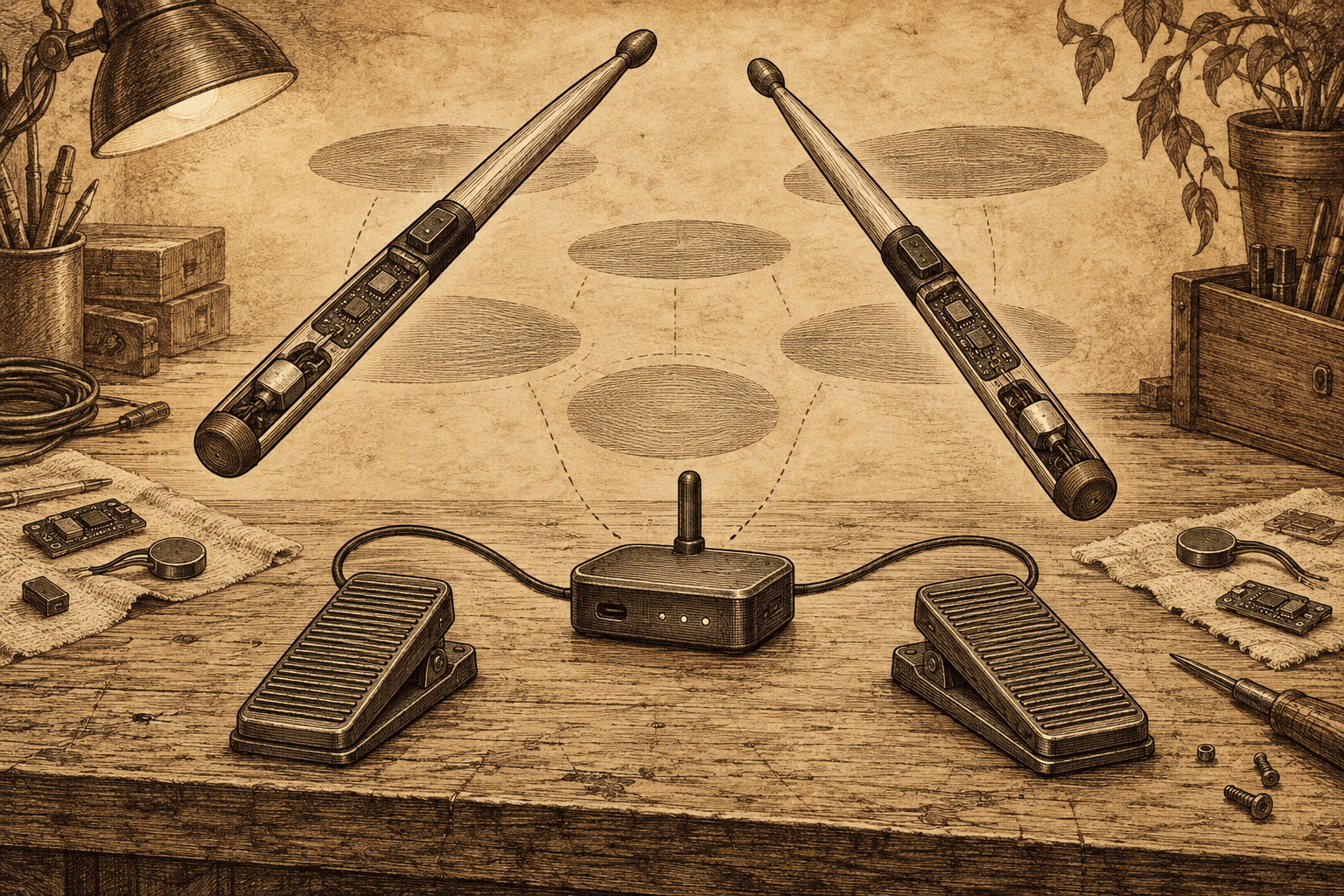
Moves motion tracking onto two ESP32-S3 drumsticks, adds haptic hits and a two-pedal hub, and sends velocity-sensitive drum events to open PC or Android playback software.
Visit Space Drums 2.0Original editorial concept art generated with built-in Codex Image Gen for The Machine Press, 2026-09-27; carried over because the 2026-10-04 handoff remains validation pending.
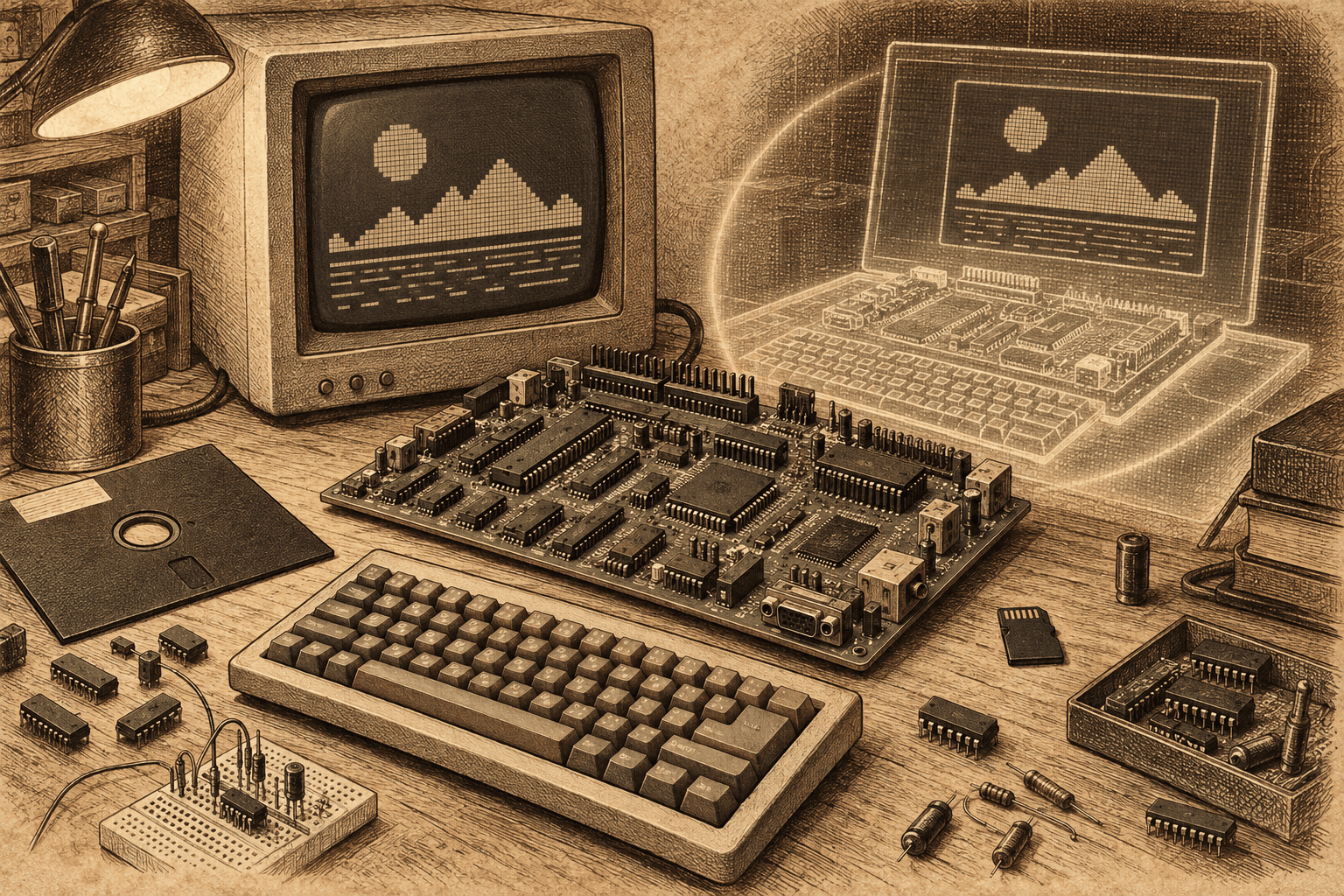
Pairs a chip-level 65C02 computer with custom hardware, video, sound, floppy, and microSD support with a cycle-honest emulator and browser assembler built around the same machine.
Visit 3RICOriginal editorial concept art generated with built-in Codex Image Gen for The Machine Press, 2026-09-27; carried over because the 2026-10-04 handoff remains validation pending.
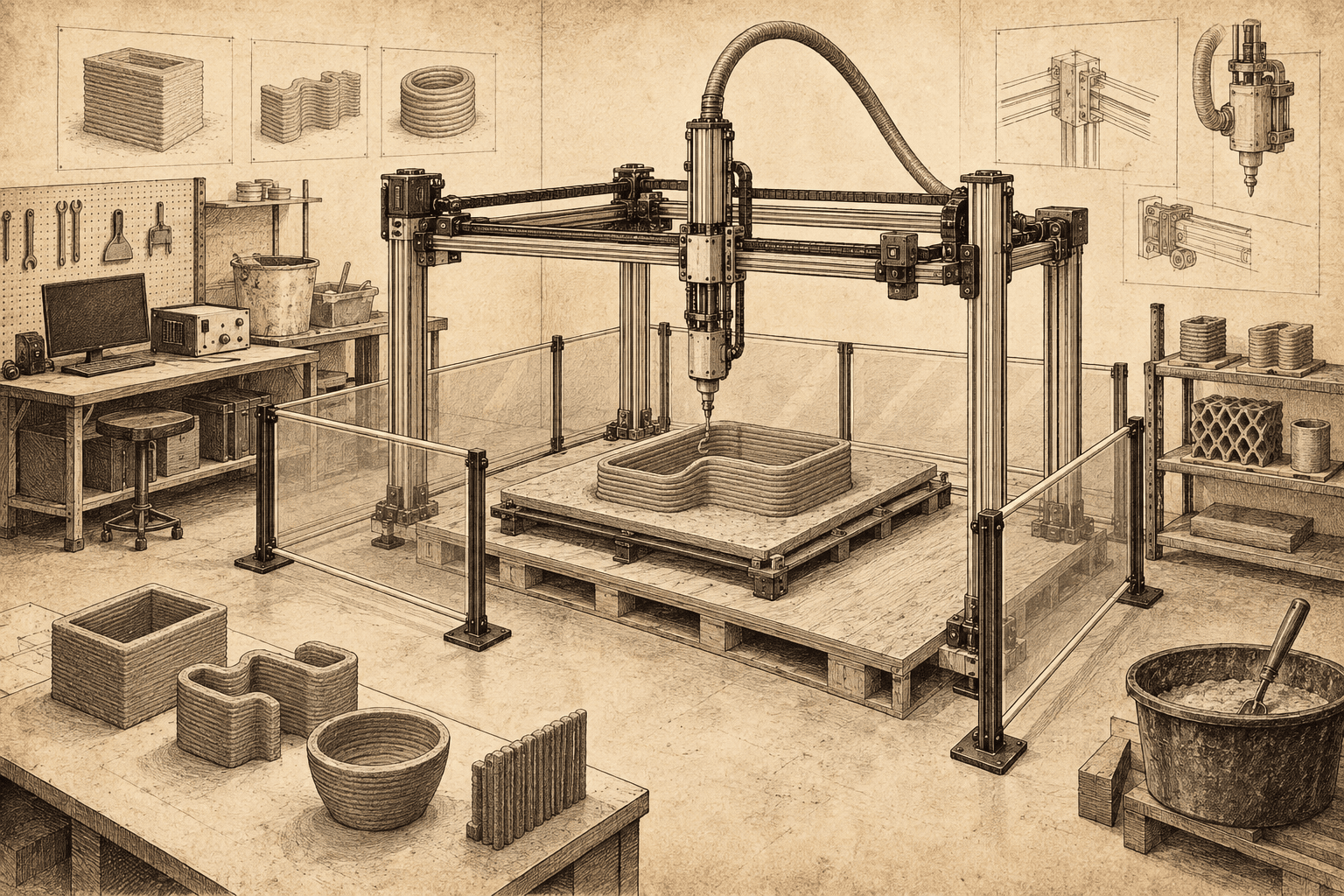
Publishes a pallet-scale cartesian motion reference, CAD, BOM, and low-voltage controls for supervised cementitious-extrusion research while explicitly excluding certified structural use.
Visit M3-CRETEOriginal editorial concept art generated with built-in Codex Image Gen for The Machine Press, 2026-09-27; carried over because the 2026-10-04 handoff remains validation pending.
Turns a bare ESP32-S3 touchscreen into a USB-connected desk instrument for PC activity and optional room temperature, humidity, and light measurements.
Visit DeskNodeOriginal Codex Image Gen concept art from 2026-07-10; carried forward from the validated 2026-10-03 edition.
Desk Picks are selected by the newsroom. Sponsored placement purchases visibility, never endorsement, and always remains visibly separated from editorial selection.
 Editorial illustration