PremiseSQL pairs 1,800 flawed requests with their valid originals and finds that text-to-SQL systems rarely challenge a bad premise by default.
Editorial illustration
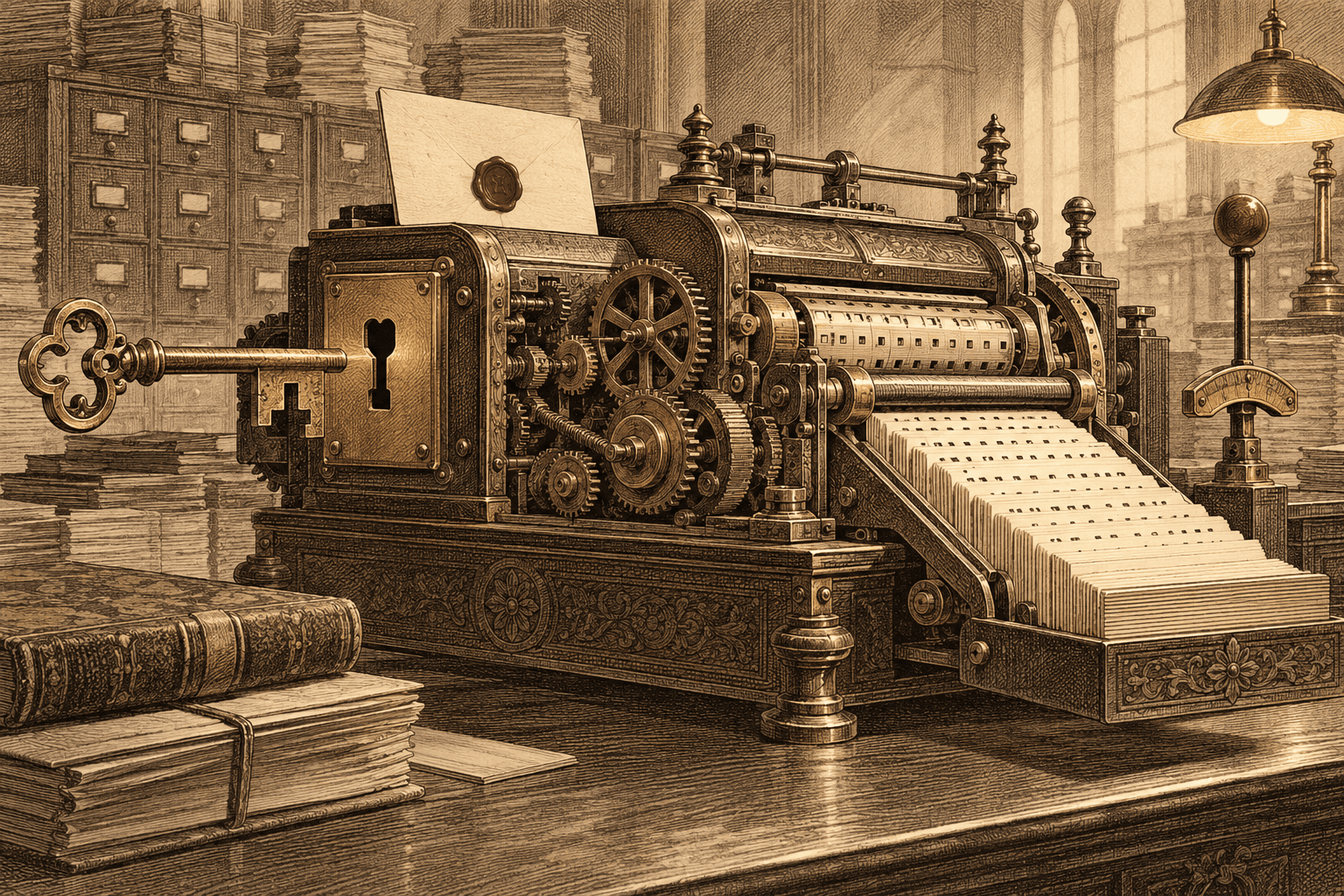
Concept illustration of a text-to-SQL system processing a flawed premise instead of abstaining; not a database interface, benchmark sample or deployed system. Original editorial illustration generated with built-in Codex Image Gen for The Machine Press, October 18, 2026 edition.
A database assistant can produce perfectly executable SQL for a question the database cannot truthfully answer. PremiseSQL tests whether text-to-SQL systems recognize that failure before writing the query. The benchmark pairs 1,800 flawed requests across four kinds of premise error with 1,800 valid originals, then evaluates models under three prompting settings. The authors report that frontier systems are strongly premise-trusting by default: they rarely critique a flawed request or abstain from generating misleading SQL. Prompts that explicitly encourage critique improve detection and refusal, but they also create a second failure mode—valid questions are more often mislabeled as invalid, and useful SQL is suppressed. The benchmark does not establish how often flawed premises occur in production databases, and its results depend on the tested schemas, models and prompts. Its sharper lesson is architectural: execution success is not the same as question validity. A reliable data assistant needs a gate that can inspect what the user assumes, preserve that judgment through query planning and still avoid turning healthy skepticism into blanket refusal.
Concept illustration of reasoning under a moving time budget; not a Realtime-Bench task, model interface or experiment screenshot. Original editorial illustration generated with built-in Codex Image Gen for The Machine Press, October 18, 2026 edition.
Realtime-Bench separates reasoning quality from serving delay and finds that more thought can help or hurt when every second changes the task.
An agent acting in a moving environment pays for every token with elapsed time. Realtime-Bench evaluates dynamic tasks in which delayed actions directly reduce success, rather than treating latency as a deployment detail outside the benchmark. Under its Wall Clock condition, where the environment advances during real inference, the best tested success rate reached 44 percent and the best Pass-to-the-third score reached 36 percent. A Paused Clock condition removes serving delay to expose the model's underlying task capability, while Token Clock advances simulated time according to generated token counts so temporal awareness can be studied apart from hardware speed. Across those views, the authors find that time costs—not only wrong decisions—block completion, and that higher reasoning effort has mixed effects under pressure. More deliberation can improve a choice while making the choice obsolete. The suite is a curated benchmark, not a complete model of robotics, games or live operations. Still, it supplies a missing measurement discipline: real-time agents must decide how much thinking the moment can afford, maintain perception while reasoning, and treat timely action as part of correctness rather than an optimization added later.
Across eleven models and seventy relations, linear readability before fine-tuning predicts whether a newly labeled relation generalizes.
A model may recall a fact without representing it in a form that supports new learning. The authors create arbitrary relabelings of known relations—such as mapping continents to animal words—fine-tune on a subset of subjects and test whether the new labels transfer to held-out subjects sharing the original answer. Across eleven language models and seventy relations, the linear readability of the original relation before fine-tuning predicted later generalization, with within-model correlations from 0.87 to 0.92. The association survived controls for recall accuracy, subject frequency and training-set structure. The study uses constructed relations, but it cleanly separates stored facts from representations that can be repurposed.
CC0 wafer-scale circuit rendering used illustratively; it does not depict SoftCache, a tested accelerator, a diffusion model or measured speedup. Wikideas1 / Wikimedia Commons (CC0 1.0); cropped and converted to WebP by The Machine Press.
SoftCache turns a diffusion model’s staleness headroom into adaptive step sizes instead of a binary refresh-or-reuse decision.
Caching can accelerate diffusion generation by reusing activations, but most methods treat the cache signal as a hard switch. SoftCache interprets the remaining headroom below a refresh threshold as an estimate of reuse error, then takes longer jumps when the cache is fresh and shorter steps as a refresh approaches. The method requires no training or per-backbone settings. On the authors’ FLUX image tests and HunyuanVideo and Wan2.1 video tests, reported speedups ranged from 3.5 to 6.9 times while leading all compared baselines on four fidelity metrics. Those are model- and benchmark-specific results, not a guarantee for every sampler or workload.
DK-VLM keeps semantic attention intact while a second kernel tracks 3D points, camera pose and reference-frame changes.
Spatial reasoning across camera views requires more than attaching reconstructed features to visual tokens. DK-VLM adds a geometric attention kernel that uses estimated 3D points and relative camera transformations, then learns a gate that combines it with the pretrained model’s semantic kernel. Reference-Frame Composition supervision teaches successive heading and turn updates. The 8-billion-parameter model posted the highest reported average across six compared spatial benchmarks, including 74.33 on VSI-Bench and 58.28 on ReVSI-32, while retaining general video understanding. The scores are author-reported and do not show that reconstructed geometry is always accurate.
Rubin and Keck observations track P/2026 N2 across 102 days, with activity consistent with prolonged or recurrent production.
P/2026 N2 follows an outer Main Belt orbit but displayed active morphology across perihelion in Rubin Observatory and Keck images spanning 102 days. Keck colors were consistent with nearly neutral B/C-complex reflectance, and geometry-corrected aperture brightness changed by only 0.07 plus or minus 0.07 magnitude between July 9 and October 7. A 5,000-particle integration kept a concentrated Main Belt core for 50 million years. The authors hypothesize that volatile sublimation, possibly water ice, sustains the activity. Archival 2021 imaging recovers the object, but cannot establish whether it was active then.
MirrorMoE suppresses unnecessary experts per token to recover exploration lost when shared experts flatten routing signals.
Fine-grained mixture-of-experts models offer many possible expert combinations, but shared experts can reduce variation in token representations and make the router explore less of that larger space. MirrorMoE addresses the mismatch by shrinking the useful search space rather than simply adding noise: it suppresses unnecessary experts for each token so the router can focus on plausible combinations. The authors report consistent performance improvements across tested model scales. The abstract does not quantify every gain or establish that shared experts are broadly harmful; the contribution is a diagnosis of how two common design choices can work against one another.
Population synthesis explains the low-signal “single” excess through detection geometry and orbital period without requiring a second planet population.
Kepler catalogued more one-transit systems than simple comparisons with multi-planet systems seemed to predict, including an excess of low-signal detections. ExoMOD simulations and the Kepler DR25 catalogue show how the survey itself can produce that pattern. Detecting several planets favors compact systems with shorter periods and stronger repeated signals; longer-period, lower-signal planets are therefore more likely to appear alone even when other planets exist but do not transit detectably. The authors argue that this geometry and period sensitivity can explain the low-SNR excess without invoking false positives or a distinct “Kepler dichotomy.” It is a population-model result, not confirmation of unseen planets around every single.
Generic laboratory-glassware file image used illustratively; it does not depict the proposed condensate apparatus, source mass, measurement or projected sensitivity. Rodolfo Clix / Pexels; cropped, resized, metadata stripped, and converted to WebP by The Machine Press.
A proposed rubidium-condensate comagnetometer targets proton interactions below the range of existing direct laboratory probes.
A single-domain rubidium-87 spinor condensate can place two co-located atomic manifolds in opposite magnetic precession while a hypothetical monopole-dipole interaction drives them in the same direction. Summing their angles suppresses ordinary field noise; the demonstrated starting system achieved 44 decibels of rejection. With an insulating source mass placed 50 micrometers away and planned upgrades, the authors project one-week sensitivity more than three orders below existing laboratory limits at a 100-micrometer range, with a projection-noise limit more than five orders lower. These are sensitivity projections grounded in prior apparatus, not a detection of a new boson.
A sim-trained policy protects the approach corridor, transfers to a UR10e without real-world fine-tuning and completes 86.1 percent of harvest attempts.
A robot can hit the target point and still damage a crop on the way in. PSA-PPO adds corridor-aware constraints, trajectory-history safety encoding and task-specific success criteria to a target-conditioned reaching policy trained entirely in Isaac Lab. On 150 scheduled physical targets, it reached 94.7 percent, beating three classical planners while reducing final-approach jerk. Integrated with RGB-D perception and an end effector, the system reached 94.4 percent of targets and completed 86.1 percent of 144 lettuce harvest attempts. The results come from a controlled hydroponic setup and do not establish commercial farm readiness.
A learned image-information score replaces line-of-sight visibility when orbital shadow and glare make a nominal view useless.
Spacecraft inspection planners often mark a component visible after a geometric line-of-sight check even when eclipse, self-shadowing or reflection leaves the image uninformative. This framework trains a classifier variational autoencoder on rendered component patches and uses latent variance as a continuous image-grounded information measure. In photorealistic simulation across multiple orbits, the planner produced mean brightness of 0.57, with 81.6 percent of observations above 0.25. Geometric baselines achieved 0.02 and 0.04 mean brightness. The evidence is simulated, but it shows why inspection coverage and usable imagery are different objectives.
KnowGPO aligns trajectories by acquired knowledge conditions instead of comparing noisy pages or internal states.
Deep-search agents receive many heterogeneous observations before a single final reward, which makes it hard to identify which query or page mattered. KnowGPO decomposes the answer into atomic knowledge conditions, represents each trajectory by the conditions it has satisfied and compares trajectories within the same knowledge state. Incremental knowledge gain becomes a process reward. Across Xbench, BrowseComp-ZH and GAIA, the authors report gains of 3.8 to 4.2 points over outcome-only and process-supervision baselines; their 8-billion-parameter model rivaled or exceeded most tested 32-billion-parameter open systems. The decomposition itself remains a dependency and potential source of error.
One view keeps absolute measurements; another removes scale and offset to expose temporal structure.
A single time-series representation forces every downstream question to inherit the same invariances. This model combines ordinary line plots with normalized delay embeddings: the first preserves values and axes, while the second removes positive rescaling and offsets to reveal structure. Dedicated visual encoders fuse both into a language model. On TSRBench, the dual-view system improved overall accuracy from 44.5 percent with line plots alone to 53.2 percent, above the strongest tested dedicated baseline at 36.7 percent. It also reported 89.9 percent on TSExam and 86.8 percent numerical accuracy on multivariate ChatTS alignment. Those benchmark gains do not guarantee operational forecasting accuracy.
NASA OSAM-1 hardware used illustratively; it does not depict Mem4Act, the evaluated robots, learned memory or reported manipulation tasks. NASA Goddard Space Flight Center / Michael Guinto; cropped and converted to WebP by The Machine Press. Use does not imply NASA endorsement.
Mem4Act supervises semantic and perceptual recall, then trains the action policy to depend on that bounded state.
Long-horizon robot policies can keep raw frames, compressed tokens or language summaries, but each choice either lengthens context or risks losing the detail needed later. Mem4Act aggregates history at multiple timescales, supervises memory through question answering and key-frame feature reconstruction, and uses memory-first training so the action policy cannot simply ignore the compressed state. The authors report success rates of 49.88 percent on RoboMME, 61.0 percent on RMBench and 81.5 percent across four real-world manipulation tasks. The evaluation is bounded to those tasks, yet it demonstrates a practical memory interface whose size does not grow with the episode.
A fast path decides whether execution is drifting; a slower path constructs an intervention only when needed.
Long tool-use and multi-agent runs can gradually move away from the original objective while continuing to spend resources. This steering agent watches execution and separates intervention into two decisions: a low-cost path determines whether drift warrants action, and a higher-cost path decides what corrective instruction to send. Joint reinforcement learning trains both. On information-seeking search tasks, the authors report better performance and efficiency for single- and multi-agent systems, plus transfer to unseen executors and out-of-domain work. The results do not establish reliability in arbitrary production agents, but they make intervention frequency a learned and controllable part of orchestration.
Grid-Bench executes every instruction, making the full final state—and each wrong cell—directly checkable.
Grid-Bench represents two-, three- and four-dimensional discrete worlds, applies eight families of operations and asks a language model to predict the complete state after a textual event history. Because a reference executor produces the answer, evaluation can measure both exact recovery and how many cells are wrong. Across six models, complete-state accuracy fell sharply with longer histories, and systems with similar exact-match scores sometimes differed substantially in partial correctness. Some models still recovered changes beyond copying the initial grid. The benchmark is synthetic by design, but it isolates compositional state tracking without relying on a subjective judge.
Independent builders turning improbable ideas into real things.
Four editorial selections
$7 for seven days
Paid work is clearly labeled
Placement is never endorsement
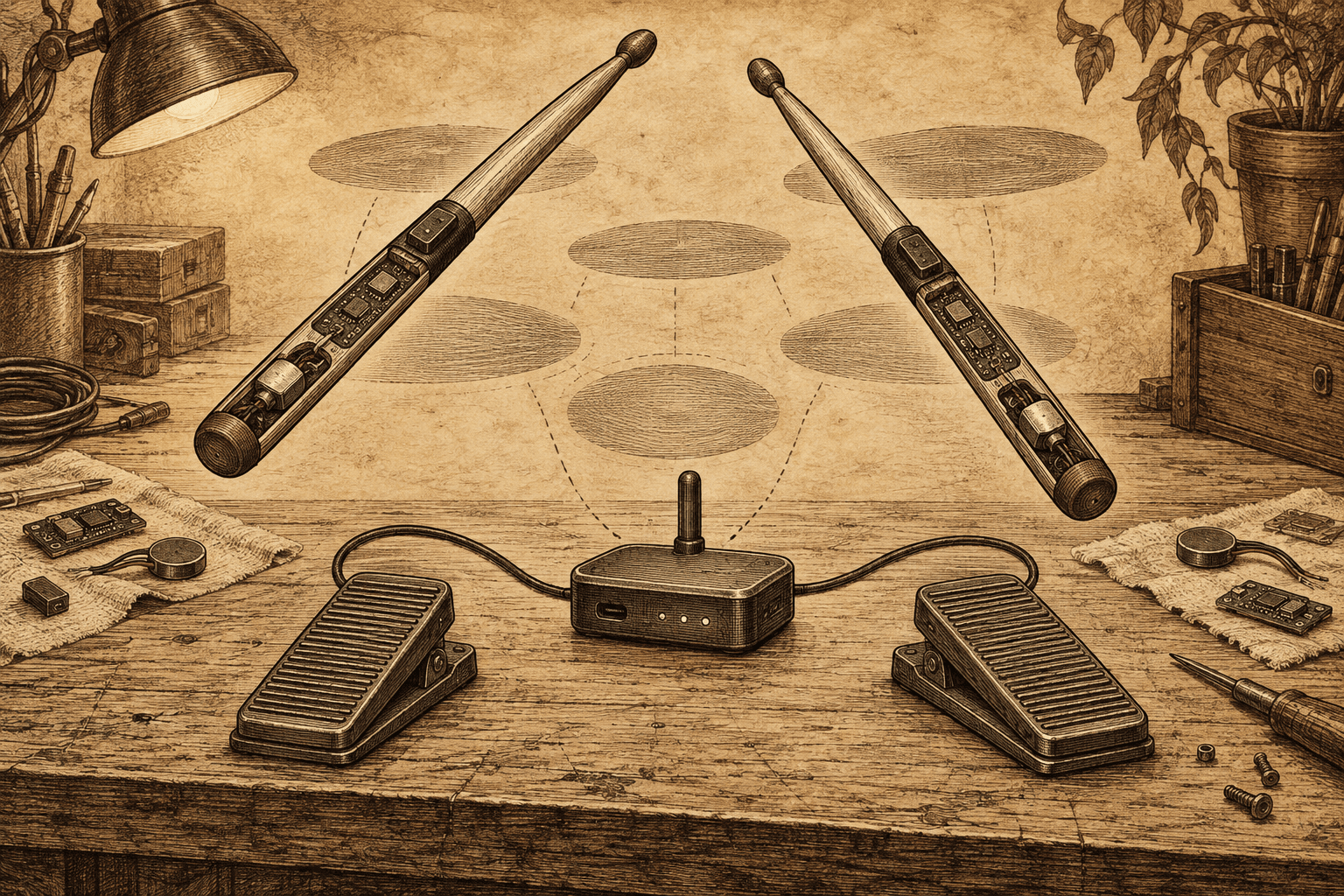
Original editorial concept art generated with built-in Codex Image Gen for The Machine Press, 2026-09-27; carried over because the October 4 handoff remains validation pending and no complete October 11 or October 18 handoff exists.
Moves motion tracking onto two ESP32-S3 drumsticks, adds haptic hits and a two-pedal hub, and sends velocity-sensitive drum events to open PC or Android playback software.
Visit Space Drums 2.0Original editorial concept art generated with built-in Codex Image Gen for The Machine Press, 2026-09-27; carried over because the October 4 handoff remains validation pending and no complete October 11 or October 18 handoff exists.
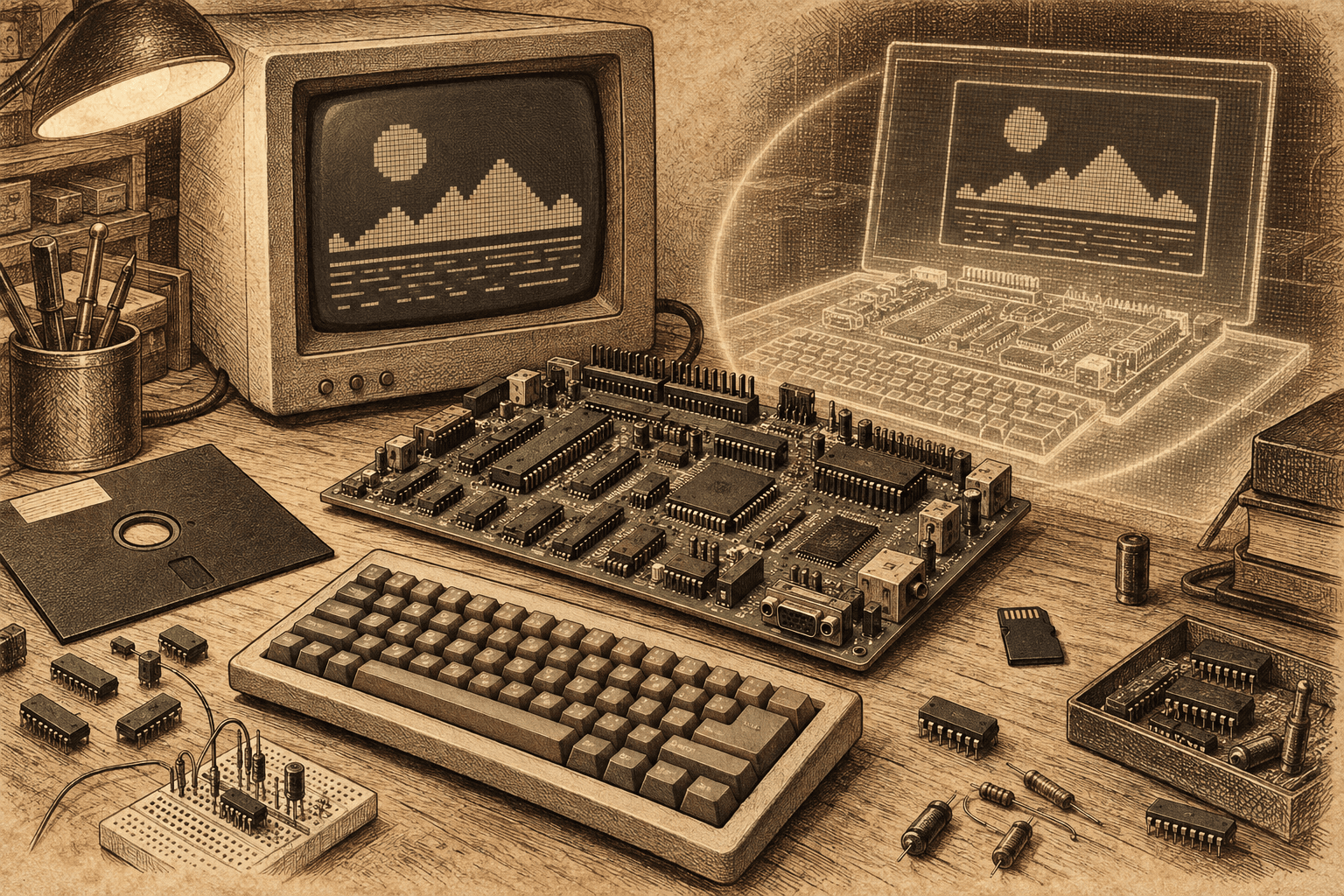
Pairs a chip-level 65C02 computer with custom hardware, video, sound, floppy, and microSD support with a cycle-honest emulator and browser assembler built around the same machine.
Visit 3RICOriginal editorial concept art generated with built-in Codex Image Gen for The Machine Press, 2026-09-27; carried over because the October 4 handoff remains validation pending and no complete October 11 or October 18 handoff exists.
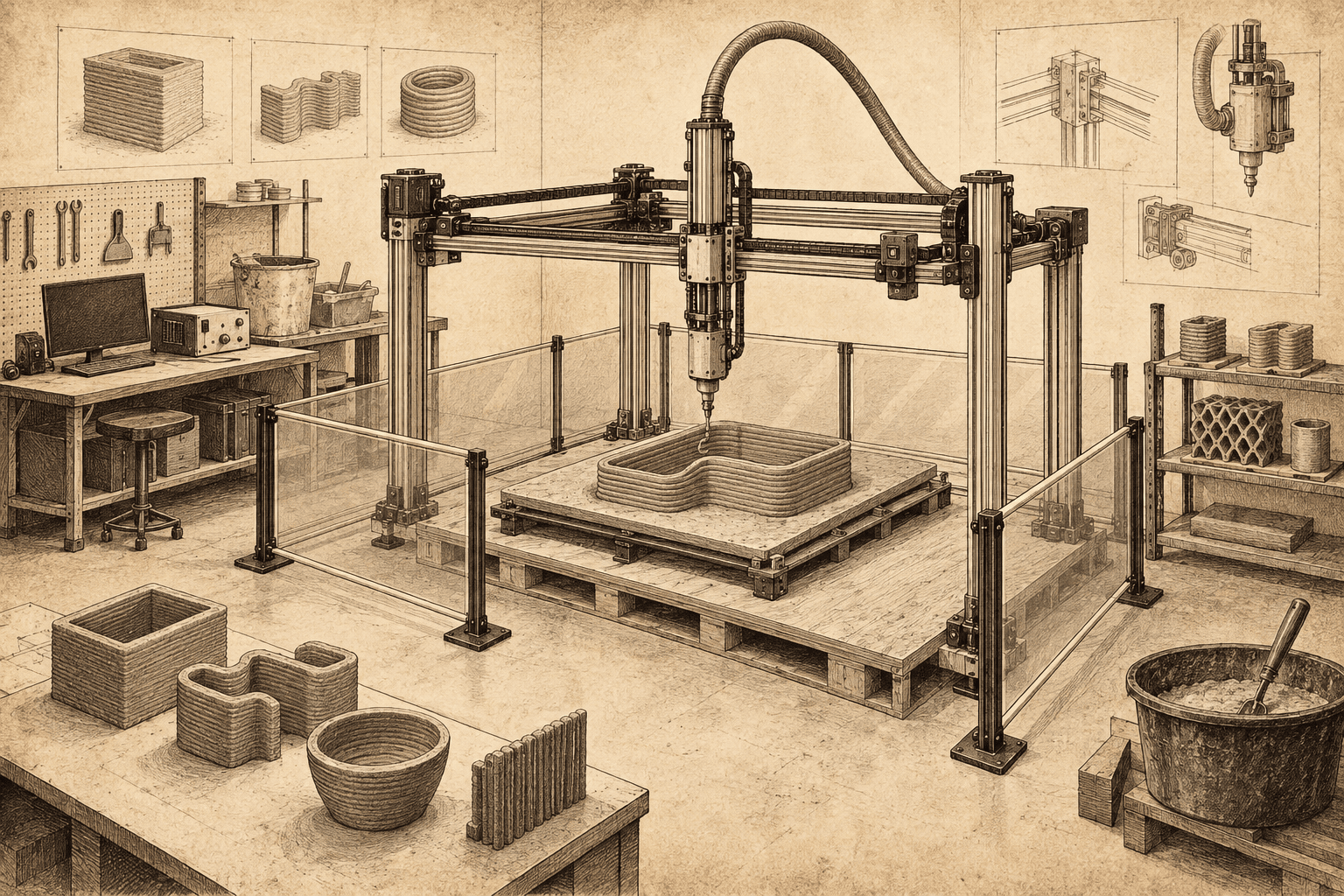
Publishes a pallet-scale cartesian motion reference, CAD, BOM, and low-voltage controls for supervised cementitious-extrusion research while explicitly excluding certified structural use.
Visit M3-CRETEOriginal editorial concept art generated with built-in Codex Image Gen for The Machine Press, 2026-09-27; carried over because the October 4 handoff remains validation pending and no complete October 11 or October 18 handoff exists.
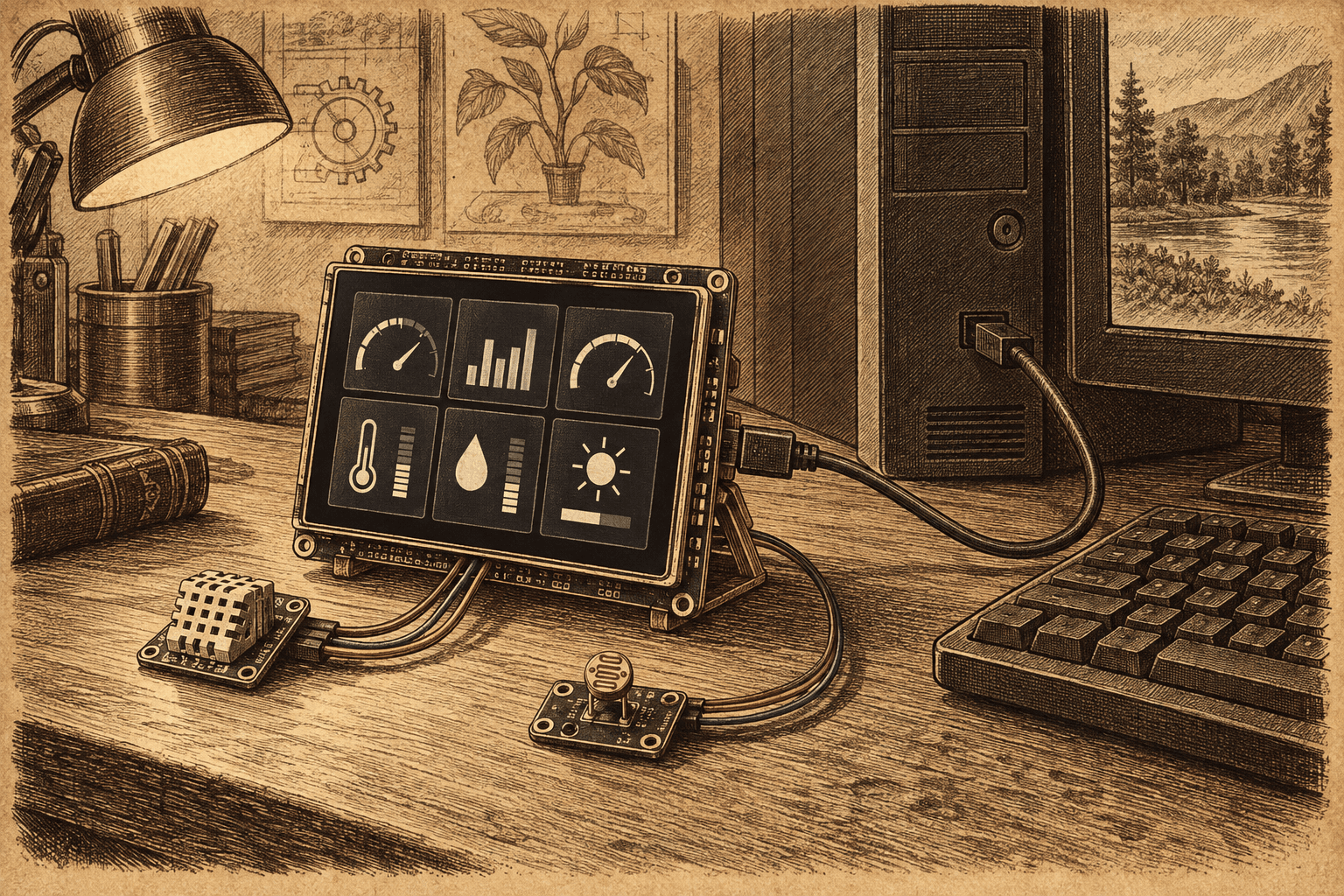
Turns a bare ESP32-S3 touchscreen into a USB-connected desk instrument for PC activity and optional room temperature, humidity, and light measurements.
Visit DeskNodeOriginal Codex Image Gen concept art from 2026-07-10; carried forward from the validated 2026-10-03 edition.
Desk Picks are selected by the newsroom. Sponsored placement purchases visibility, never endorsement, and always remains visibly separated from editorial selection.
 Editorial illustration