Every multi-reader panel improved chest X-ray severity prediction over the no-gaze baseline, while no individual reader reached significance on the main endpoint.
Editorial illustration
Editorial concept illustration of pooled radiologist attention; the panel is synthetic and is not a patient image, diagnostic interface or study result. Generated with built-in Codex Image Gen for The Machine Press.
GazeRIB asks whether radiologists' visual attention can supervise a model more reliably when it is pooled across readers. Eight experts repeatedly read the same 80 chest X-rays; the study compared individual readers with three-, five- and eight-reader panels across seven architectures and ten seeds, then evaluated 910 models on a separate 2,897-image cohort. Every panel improved macro F1 by 5.33 to 7.47 percentage points over the no-gaze baseline, while no individual reader reached significance on that endpoint. Three readers captured 73 to 80 percent of the eight-reader gain across macro F1, ROC-AUC and precision-recall area. External transfer was mixed: panels improved ROC-AUC on SIIM-FISABIO-RSNA, but not on MIMIC-Eye. The result supports panel composition as an experimental variable, not a claim that gaze guidance will transfer to every clinical setting.
Editorial concept illustration of an evolving control harness around a frozen robot policy; it is not a benchmark interface or documentary laboratory image. Generated with built-in Codex Image Gen for The Machine Press.
RoboArchitect let a coding model revise the control harness around a frozen robot policy, raising reported success from 9.7 to 43.3 percent on unseen scenes.
A robot policy does not act alone: surrounding control code decides when to query it, call a vision tool or command the arm directly. RoboArchitect automates the design of that harness. A coding model watches rollouts, diagnoses failures and iteratively revises the controller around an unchanged policy; evaluation then moves to held-out scenes and tasks. Across the reported benchmarks and policies, average success rose from 9.7 to 43.3 percent on unseen scenes and from 12.7 to 40.2 percent on unseen tasks. The evolved harnesses discovered tactics such as lifting a jammed arm clear, approaching around obstacles and retaining useful grasp depths in persistent memory. The evidence is benchmark-based, and it does not establish that unconstrained self-modification is safe or robust on arbitrary hardware.
Retrievals could mistake an Earth analog for an oxygen-dominated atmosphere unless near-infrared oxygen-pair absorption remained in the model and observing band.
Reflected-light spectra can reveal oxygen on an Earth-sized exoplanet, but oxygen alone does not identify biology and retrievals can confuse composition with clouds, surface brightness and gravity. Simulations with the ExoReL retrieval framework found that omitting oxygen-oxygen collision-induced absorption allowed a modern Earth analog to be fit as an incorrect oxygen-dominated atmosphere. Including the O4 bands recovered the nitrogen-dominated, oxygen-rich solution without a tight mass prior. Under the authors' robustness rule, both tested observing configurations needed signal-to-noise of roughly 20 at 0.75 micrometers; ending near-infrared coverage at 1.4 instead of about 1.7 micrometers prevented recovery across the explored range. These are simulated retrieval requirements, not an observation of an exoplanet atmosphere.
Conceptual Visualising AI artwork used illustratively; it is not LARC, a latent-state map, generated output or benchmark result. Novoto Studio / Google DeepMind / Pexels; cropped, resized, metadata stripped, and converted to WebP by The Machine Press.
LARC replaces token-level image reasoning with continuous hidden-state reasoning and reports a seven-point GenEval gain over BAGEL.
Unified multimodal models often reason in discrete language tokens before generating in a continuous image space. LARC treats that modality mismatch as the bottleneck. Its curriculum first converts token reasoning into continuous latent reasoning, then an information-gain reinforcement-learning stage continues without ground-truth reasoning traces. Across the reported text-to-image evaluations, the method improved generation quality, prompt following and compositional fidelity; on GenEval it beat BAGEL by seven percentage points and showed gains from additional test-time computation. Those are benchmark results from the authors, not evidence that the hidden reasoning is human-readable or causally faithful.
Flide flattens branching decision requests into one execution stream and reports answers as much as 9.5 times faster than vLLM and SGLang.
Decision models repeatedly evaluate branches that share a long prefix, but generation-oriented engines either recompute that prefix or alter output probabilities. Flide separates the logical request tree from its physical execution. ForkAttention uses GPU-resident indices across standard attention and recurrent Gated DeltaNet layers so each branch is equivalent, in exact arithmetic, to an isolated pass. The engine also resumes expanding histories from earlier checkpoints. On the reported public models and workloads, Flide answered queries up to 9.5 times faster than vLLM and SGLang while staying closest to a float32 reference in total-variation distance. The speedup is workload-specific and does not imply the same gain for ordinary free-form generation.
Latent Sparse Attention clusters keys in a learned hierarchy and reports a 72.4-times layer-level prefill speedup over full attention at ten million tokens.
Sparse attention still struggles when its indexer either touches every key or loses accuracy at extreme context lengths. Latent Sparse Attention clusters keys hierarchically in a learned latent space and lets each query score clusters instead of all keys. A distilled version can retrofit pretrained models; a native version learns from next-token loss. On the reported GLM-5.3-FLASH test at ten million tokens, one layer ran 22.7 times faster in prefill than the model's original sparse attention and 72.4 times faster than full attention, with similar task accuracy; decode gains were 4.6 and 42.5 times respectively. These are layer-level results, not end-to-end application latency guarantees.
ID-WM separates high-level reachability from low-level inverse dynamics and reports a 135 percent gain over single-level world-model control.
Long-horizon world-model planning accumulates errors when one model must choose distant goals and exact actions at once. ID-WM divides the problem: a high-level model samples feasible state transitions, while a low-level world model solves the inverse dynamics needed to realize each transition. That lets the system assemble new plans from short behavioral segments without committing early to rigid macro-actions. Across three navigation and manipulation suites, the authors report a 38.5 percent improvement over policy and diffusion-based planners and a 135 percent gain over single-level world-model model-predictive control in complex unseen configurations. The scope is the tested suites; physical deployment and safety are not established by the abstract.
Dittany preserves validated intermediate contributions while repairing unmet conditions, reaching 84.76 percent task accuracy across 9,000 tasks.
A multi-agent run can fail its final requirement even when several intermediate results remain useful. Dittany derives expected contributions and acceptance conditions from the task and method specifications, links them in a contribution graph, and checks which outputs still satisfy their role. It then attempts action-level correction when available inputs suffice or graph-level recovery when dependencies must change. Across 30 applications, six frameworks and 9,000 tasks, the paper reports 88.28 percent failure-detection precision, 79.18 percent recall and 84.76 percent task accuracy—26.74 points above native execution and 21.28 above the strongest tested recovery baseline. Deployment token use remained 17.92 percent above native execution.
The National Archives server room, used as generic distributed-systems file imagery; it is not a DP-SGD deployment, traffic trace or tested server. The National Archives (UK), via Wikimedia Commons, CC BY 3.0; cropped and converted to WebP by The Machine Press.
A randomized dummy-point mechanism protects variable batch counts even when observers can see traffic and systems must truncate oversized batches.
Privacy amplification for DP-SGD often assumes that random batch sizes stay secret. In distributed systems, an aggregator or traffic observer may see those counts, while memory limits may force oversized batches to be truncated—both conditions can weaken the guarantee. The proposed mechanism adds a random number of dummy points so the visible count is privatized while the real batch can still be truncated. The analysis covers Poisson sampling and random allocation and uses subsampling to reduce the expected dummy overhead below direct non-negative-noise protection of sensitivity-one counts. For truncated Poisson batches, the authors report a better privacy-efficiency tradeoff than recent direct accounting. The result is a mechanism and analysis, not an audit of a deployed DP system.
ReLift treats dense monocular 3D tracking as geometric correction and completion instead of relearning correspondence, depth and occlusion together.
Strong pretrained 2D trackers and geometry models can already lift video points into 3D, but their trajectories inherit correspondence mistakes, depth errors and occluder depth during gaps. ReLift focuses 4D supervision on repairing those trajectories. Its feed-forward corrector alternates attention along and across tracks, preserves reliable observations, fixes corrupted positions and completes missing motion. Because it trains on geometric trajectories with simulated lifting errors, it can work across upstream trackers and geometry providers without retraining. On WorldTrack, the paper reports state-of-the-art mean accuracy, improving the strongest baselines by 2.1 APD overall and 3.0 on dynamic points. Those gains depend on the reported benchmark and input components.
Blending an AI ensemble with a physics-based ensemble improved UK temperature and wind forecasts most when the systems made complementary mistakes.
Forecast centers blend multiple ensemble systems because diversity can improve probabilistic skill. This study pairs the ensemble version of AIFS-CRPS with the Met Office's convection-permitting MOGREPS-UK and examines UK site temperature and wind speed. The combined forecasts improved overall skill across locations, lead times and exceedance thresholds, particularly when the component models had different error characteristics. Decomposing continuous ranked probability score showed that both model skill and diversity mattered: MOGREPS-UK paired better with either AIFS-CRPS or IFS than IFS paired with AIFS-CRPS, whose errors were less diverse. Calibration before and after blending improved accuracy further. The conclusion concerns the tested forecasts and region, not every AI-physics ensemble.
A harmonized study compares the mix—not the rate—of automated-driving crashes with human baselines and finds two differences robust to its reporting assumptions.
Most automated-driving operators do not publish a usable exposure denominator, so this study avoids crash-rate claims and asks whether the composition of crash types differs. It harmonizes 2,450 NHTSA Standing General Order incidents, with 828 inside the 2021–2024 human-comparator window, and uses a schema-constrained language model to map narratives into the federal CRSS taxonomy. Turn-across-path and single-vehicle crashes were under-represented among automated-driving crashes under every tested reportability, towing, weighting and driverless definition. The author also flags operator-specific driverless coding, fleet-recovery effects on towing and an occupancy confound. Because exposure is absent, the analysis cannot establish whether automated systems crash more or less often overall.
Time-resolved photoemission directly observed a Dirac gap that appeared with circularly polarized driving and vanished with the optical field.
Circularly polarized light has long been predicted to break time-reversal symmetry in graphene and open a topological gap at the Dirac point. The reported time- and angle-resolved photoemission experiment observes that gap directly in monolayer graphene: it appears with the optical field and only under circular polarization. Paired with Floquet theory, the authors identify the feature with a light-induced Haldane mass and infer the associated Berry curvature and Chern topology. The experiment establishes an ultrafast route to dynamically altering symmetry and topology in the tested material and conditions; it does not yet amount to a general-purpose topological device.
NASA OSAM-1 servicing hardware used as generic robotics file imagery; it is not the ROOF humanoid, recovery scene, training platform or experiment. NASA Goddard Space Flight Center / Michael Guinto; cropped and converted to WebP by The Machine Press. Use does not imply NASA endorsement.
ROOF rewards a robot for reducing overlap with an overhead obstacle before standing, lifting simulated recovery from 18.9 to 88.5 percent in one setting.
A humanoid trapped beneath furniture cannot simply execute a standard stand-up motion; it must create clearance while building stable support. ROOF supplies contact-supported geometric guidance that rewards reducing robot-obstacle overlap without prescribing an escape path, then combines it with a learned motion prior and posture-aware support and joint-stall costs. In simulation beneath lift-only plates, recovery reached 88.5 percent versus 18.9 percent without the geometric guidance; beneath freely moving randomized plates it reached 98.6 percent. A Unitree G1 recovered in 95 of 150 attempts across seven real obstacle scenes. The real-world success rate also shows the remaining gap, and the policy was tested on one hardware platform.
Experiments and theory link the wavelength and arm length of three-way fold networks to dried-film thickness with the same five-eighths power law.
Solvent extraction and drying can turn a pinned viscoelastic film or gel into a repeating network of three-armed folds. The study attributes the pattern to compression in a stiffening, diffusively thickening surface skin above a drained underlayer. Both fold wavelength and arm length scaled with dried-film thickness to the five-eighths power and depended only weakly on elastic modulus. The folds met at 120-degree junctions on a triangular lattice, forming an open honeycomb network. Because they absorbed less than 0.1 percent of stored compressive strain, the authors point to elastocapillary arrest rather than bulk strain release as the limit on their amplitude. The mechanism is specific to the tested soft-film systems.
Random quasi-phase matching in strontium tetraborate produced continuous-wave 148.4-nanometer light, with output rising from 1.9 to 5.7 nanowatts under temperature optimization.
Driving the thorium-229 isomer transition in a solid-state nuclear clock requires continuous-wave light near 148.4 nanometers. The reported source frequency-doubles 296.8-nanometer light in strontium tetraborate using random quasi-phase matching, then separates and measures the harmonic with a purpose-built prism spectrometer. Output reached 1.9 nanowatts at room temperature and 5.7 nanowatts at the optimum crystal temperature. The conversion response showed several closely spaced maxima between 30 and 50 degrees Celsius, so a small temperature change could move the source from a peak to a minimum. The work demonstrates and characterizes the source; it does not report a completed clock.
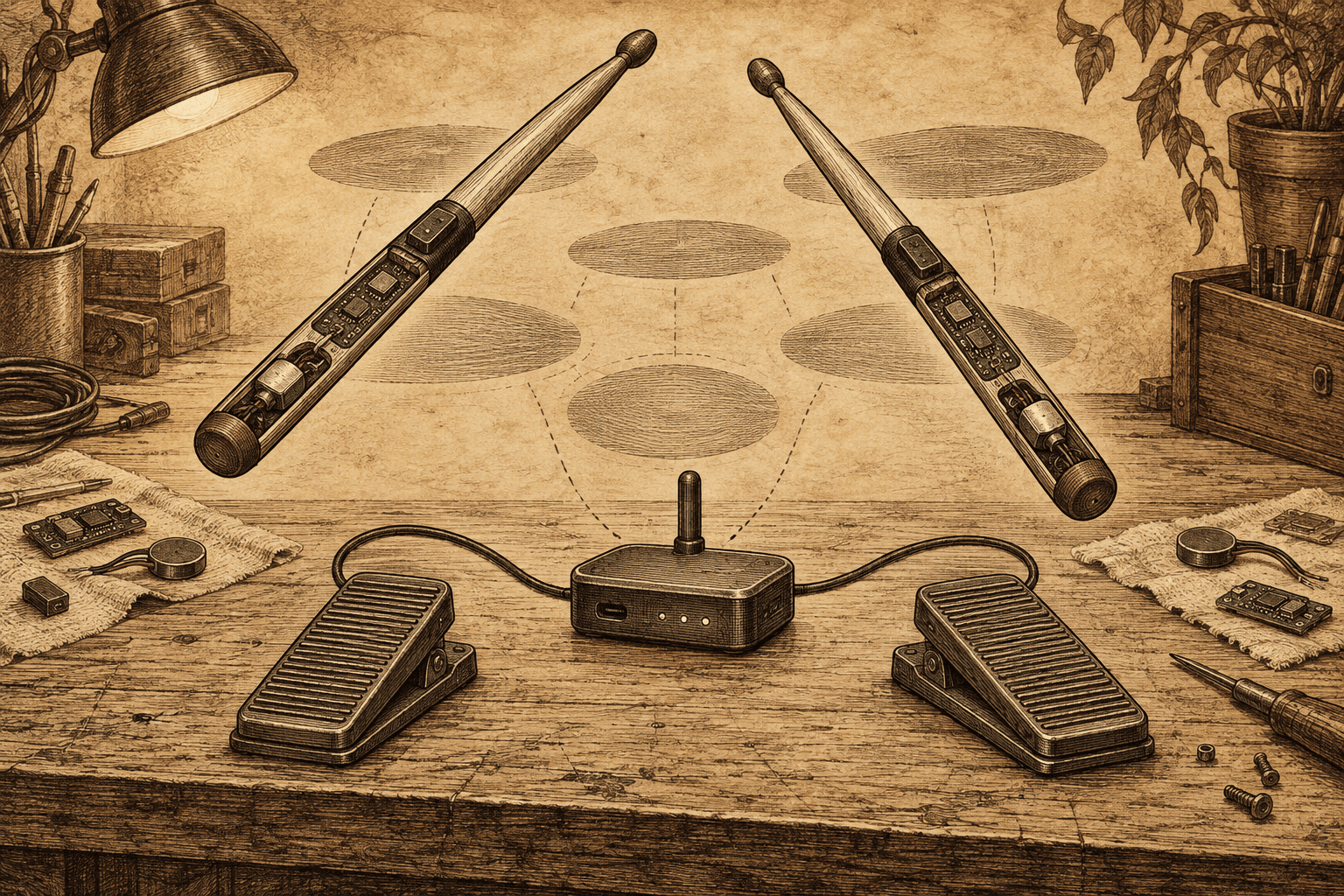
Moves motion tracking onto two ESP32-S3 drumsticks, adds haptic hits and a two-pedal hub, and sends velocity-sensitive drum events to open PC or Android playback software.
Visit Space Drums 2.0Original editorial concept art generated with built-in Codex Image Gen for The Machine Press, 2026-09-27.
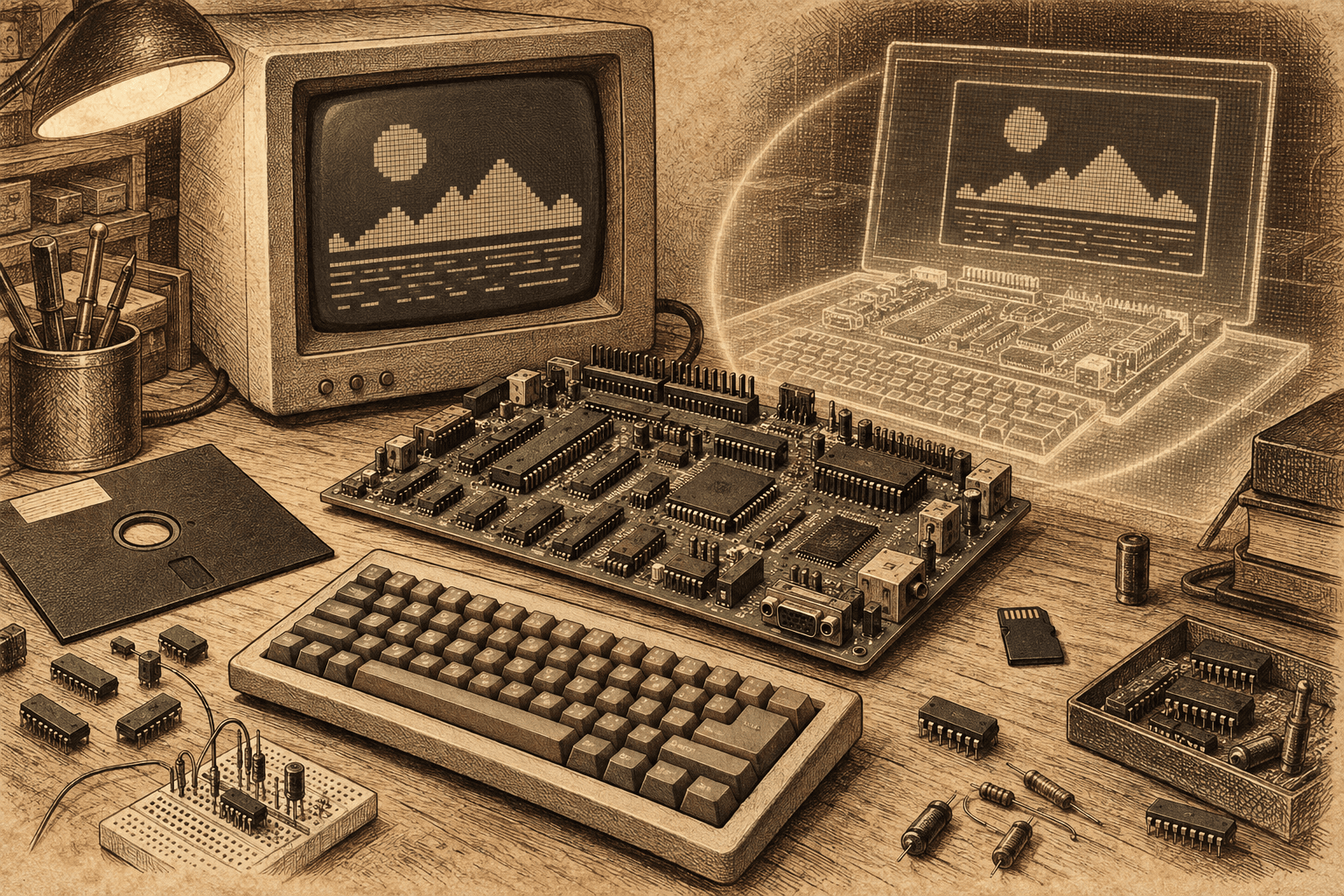
Pairs a chip-level 65C02 computer with custom hardware, video, sound, floppy, and microSD support with a cycle-honest emulator and browser assembler built around the same machine.
Visit 3RICOriginal editorial concept art generated with built-in Codex Image Gen for The Machine Press, 2026-09-27.
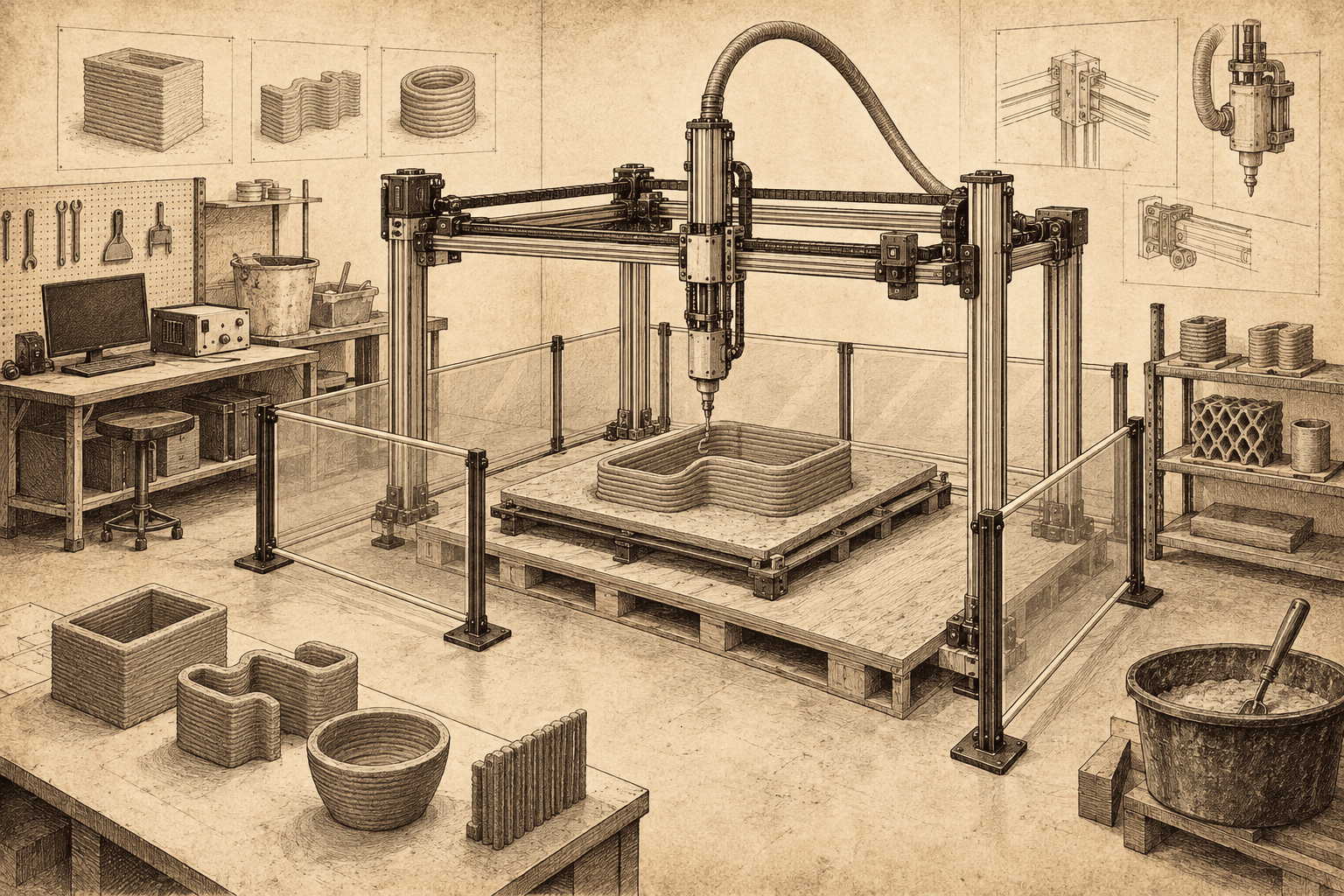
Publishes a pallet-scale cartesian motion reference, CAD, BOM, and low-voltage controls for supervised cementitious-extrusion research while explicitly excluding certified structural use.
Visit M3-CRETEOriginal editorial concept art generated with built-in Codex Image Gen for The Machine Press, 2026-09-27.
Turns a bare ESP32-S3 touchscreen into a USB-connected desk instrument for PC activity and optional room temperature, humidity, and light measurements.
Visit DeskNodeOriginal Codex Image Gen concept art from 2026-07-10; carried forward from the validated 2026-09-26 edition.
Desk Picks are selected by the newsroom. Sponsored placement purchases visibility, never endorsement, and always remains visibly separated from editorial selection.
 Editorial illustration