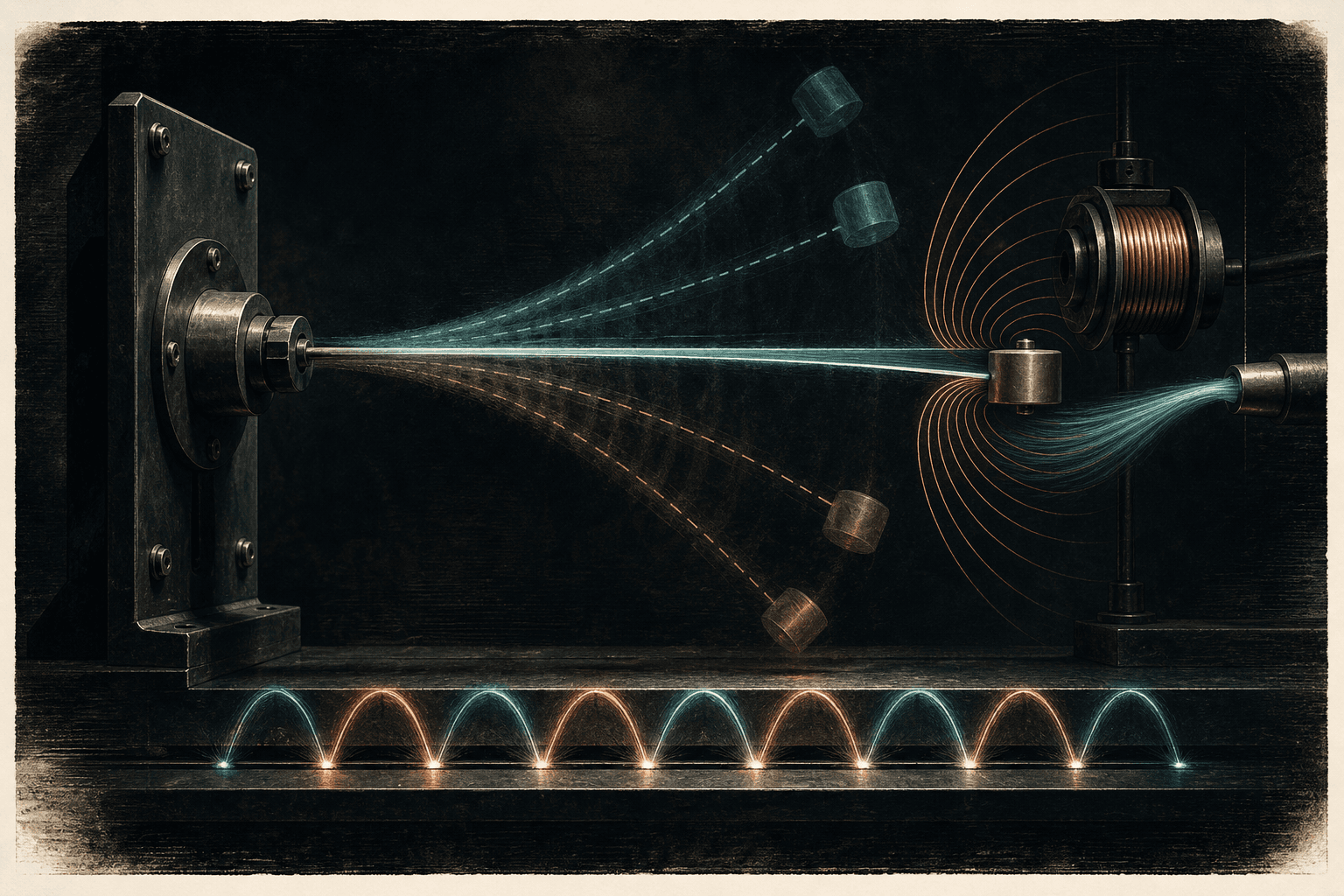
A simple beam stayed still when two destabilizing forces alternated inside a narrow timing window—without sensors or software correcting the motion.
Editorial illustration
Original conceptual illustration of timed switching between two unstable mechanical behaviors; it is not a research figure or documentary image. Original editorial illustration generated with built-in Codex Image Gen for The Machine Press.
NYU Tandon and Stony Brook researchers first developed a theory for stabilizing a linear mechanical system by switching between two different instabilities, then tested it on a thin plastic beam with a tip weight. A magnetic coil created a saddle-like instability while a fan fed a growing oscillation. Neither condition was stable alone, yet alternating them every roughly 218 to 238 milliseconds held the beam nearly still because the switching steered motion toward a shrinking direction before it could run away. The laboratory result is a design principle, not a sensor-free robot already in service, but it suggests some machines and metamaterials may be stabilized by timing their physics instead of continuously computing corrections.
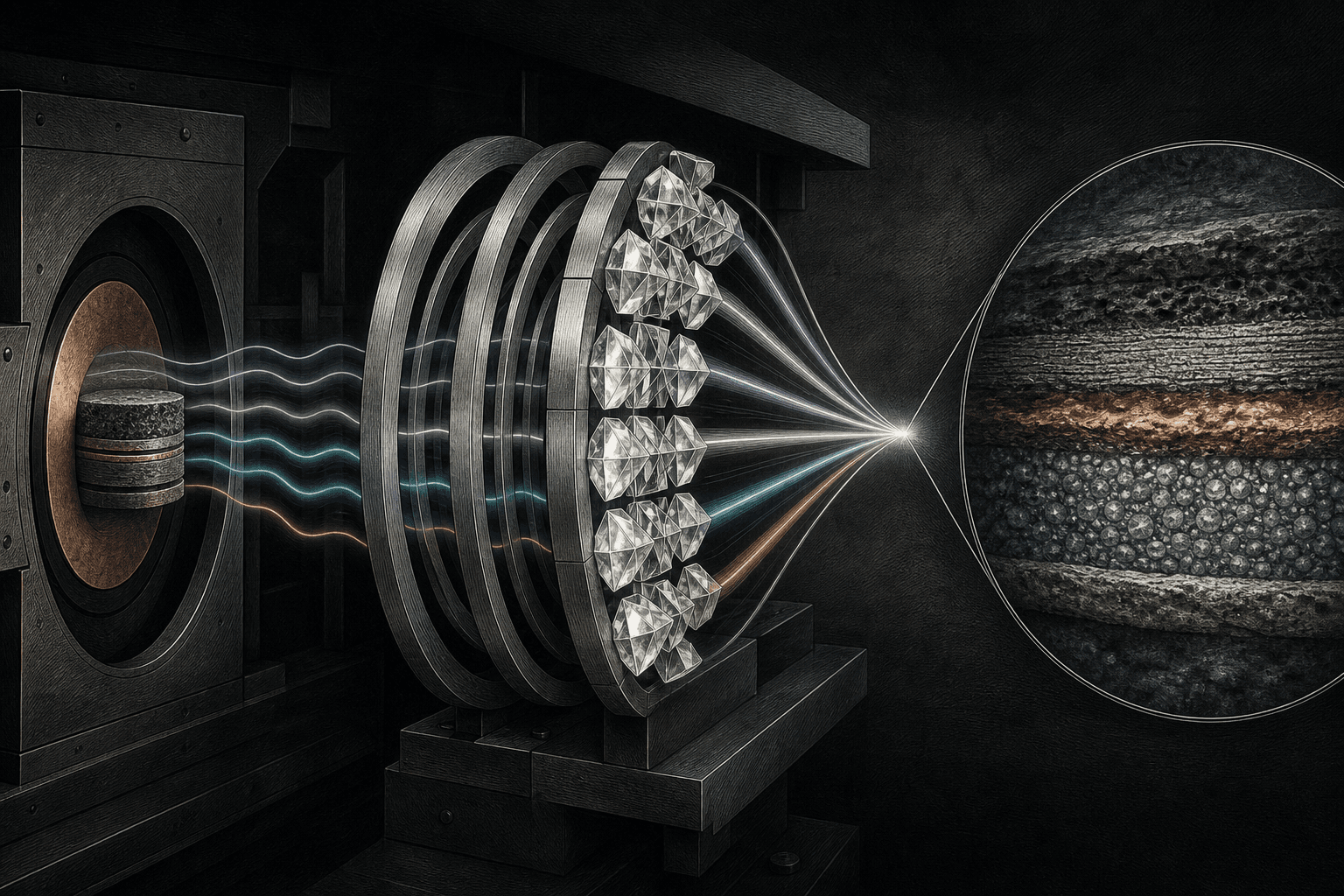
Original conceptual illustration of an achromatic neutron-imaging lens; it is not the PSI apparatus, a research figure, or documentary evidence. Original editorial illustration generated with built-in Codex Image Gen for The Machine Press.
PSI researchers combined nickel diffraction rings and diamond refractive structures to focus a broad neutron spectrum into one sharp, magnified image.
Neutron imaging can see hydrogen and lithium through dense metal, but its weak interaction with matter has also made neutron beams difficult to focus. Paul Scherrer Institute researchers built an achromatic lens that uses concentric nickel rings for diffraction and precisely shaped diamond elements for refraction, bringing multiple neutron wavelengths to the same focal point. In tests, the system resolved details below 20 micrometers and magnified a lithium-ion battery electrode assembly sevenfold while the sample sat six meters from the detector. Longer beamlines may be needed to exploit greater magnification, but the demonstrated lens opens a path to watching processes inside bulky furnaces, cryostats, pressure cells, engines, and batteries.
An expedition captured the first detailed 3D imagery of Terra Nova, the vessel Robert Falcon Scott later used for his Antarctic expedition.
A Royal Canadian Geographical Society expedition working with Woods Hole Oceanographic Institution used Voyis optical systems to record detailed imagery of Terra Nova on the seafloor. The ship is historically associated with Robert Falcon Scott and later sank off Greenland in 1943. The new survey creates a high-resolution three-dimensional record without raising or disturbing the wreck. It is an archaeological documentation event, not evidence about the ship's final voyage beyond what the expedition observed.
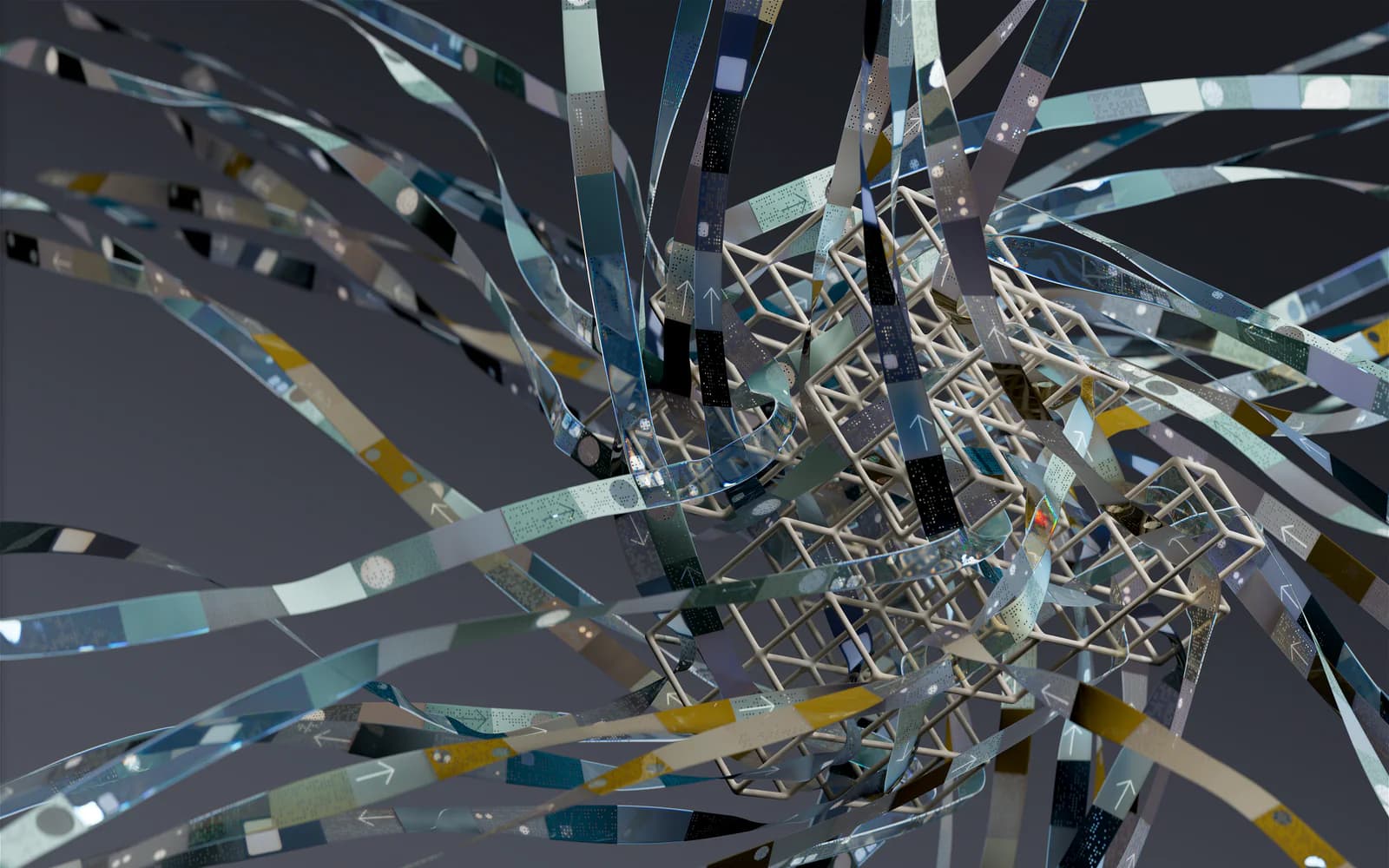
Conceptual Visualising AI illustration; it is not a SyMerge architecture diagram, benchmark result, or documentary image. Tim West / Google DeepMind / Pexels; cropped, resized, metadata stripped, and converted to WebP by The Machine Press.
SyMerge coordinates a task-specific layer and uses expert-guided self-labeling to combine independently trained models without full retraining.
A Sungkyunkwan University and NAVER AI Lab team presented SyMerge at ICML 2026 as a method for merging models with different expertise. The framework tunes the mixing ratio of a task-specific layer and uses existing models as experts to label new data, aiming to turn task interference into complementary performance. The team reports tests across image classification, dense prediction, and language processing, including models with different pretrained origins. Those performance claims come from the research team and conference work; this is not evidence that arbitrary production models can be merged safely.
A 235-patient single-cell atlas found immune ecotypes linked to tumor burden, survival, and response beyond disease stage alone.
MD Anderson researchers analyzed bone-marrow samples spanning precursor conditions, newly diagnosed multiple myeloma, and relapsed disease. Their atlas identified five immune microenvironment ecotypes, including patterns marked by immune surveillance, cytotoxic activity, inflammation, stress, or sparse infiltration. Some advanced-disease ecotypes were already visible in precursor conditions, and several correlated with survival or immunotherapy response. Larger studies must still validate whether the patterns can guide routine treatment decisions.
Mouse experiments traced an interferon-powered signal from a distant infection site to the blood-brain barrier within hours.
Rockefeller University researchers found that viral RNA detected far from the brain can trigger an interferon signaling network at the blood-brain barrier. In mouse models, even virus-associated molecules introduced in a foot were enough to prime the barrier within hours, before a neuroinvasive virus could arrive. The response protected against West Nile virus and other causes of neuroinflammation in the experiments. The work maps an early-warning mechanism in animals; it does not establish a new human treatment.
FINICI flips negative fluorescent biosensor signals into readable positive images, exposing enzyme activity in tiny regions of living cells.
University of Illinois Chicago researchers developed FINICI to solve a blind spot in fluorescent biosensors that go dark when they detect activity. The method reverses that optical readout without requiring scientists to redesign the sensor from scratch. Tests mapped bursts of Src kinase at the cell membrane, cGMP clusters, and Syk activity near immune-cell scaffolding. The technique may help researchers see why a drug signal works in one cellular neighborhood and fails in another, but it remains a research imaging method.
Comparative anatomy points to massive middle-ear bones and a controllable ear-canal muscle as keys to long-range seismic hearing.
Researchers compared elephant and human middle-ear anatomy to explain how elephants perceive ground vibrations through their feet, skeleton, skull, and inner ear. The study found that elephants have unusually large, heavy middle-ear structures suited to bone conduction and a muscle that can seal the ear canal, reducing airborne competition. The mechanism may help explain seismic communication over distances of 10 kilometers or more. It is an anatomical and experimental account, not proof that every field signal travels that far under all ground conditions.
Illustrative laboratory-glassware file image; it does not depict the USC datasets, macrophages, or an experiment in the report. Rodolfo Clix / Pexels; cropped, resized, metadata stripped, and converted to WebP by The Machine Press.
A cross-tissue meta-analysis found shared and organ-specific aging signatures in macrophages, with differences by tissue and sex.
USC researchers combined public sequencing data from dozens of studies to compare macrophage aging across tissues and between sexes. The resulting map separates common transcriptional changes from signatures that depend on the organ niche, providing a scale no single experiment could easily reach. Because macrophages help coordinate repair, inflammation, and defense, the resource may guide work on immune health in later life. The analysis identifies associations in existing datasets rather than a therapy that reverses cellular aging.
Researchers adapted human cancer-genomics tools to characterize tumors in tuatara and compare vulnerability across the tree of life.
A team led by Nottingham and Birmingham researchers analyzed tumors from tuatara, a reptile lineage with distinctive cancer susceptibility, using software originally built for human cancer genomes. The work identified genetic signatures that can be compared with both cancer-prone and cancer-resistant species. Its value is comparative: evolutionary differences may expose mechanisms hidden by studying humans alone. The findings do not translate directly into a human diagnostic or treatment.
A two-ocean comparison detected particles in 92 percent of sampled hydrothermal-vent snails and mussels.
KRIBB and KIOST researchers analyzed snails and mussels collected at hydrothermal vents in the North Fiji Basin and Central Indian Ridge, both more than 2,000 meters deep. They reported microplastics in 92 percent of animals, averaging 3.42 particles per individual, with feeding strategy shaping where particles accumulated. Weight-normalized concentrations in the Indian Ocean specimens reached as much as 14.7 times the southwestern Pacific level. The study documents sampled animals at two sites; it should not be read as a complete census of the deep ocean.
Cell experiments found that blocking neuronal nitric oxide synthase could resensitize temozolomide-resistant glioblastoma models.
Hebrew University researchers tested a neuronal nitric oxide synthase inhibitor against glioblastoma cells that had become resistant to temozolomide. The experimental approach targeted a survival pathway associated with drug resistance and restored treatment sensitivity in the reported cell models. The result identifies a candidate combination strategy for further study. It remains preclinical work in cells and does not show safety or benefit in patients.
KIMM researchers used a dielectric spray inside a battery pack to suppress heat buildup and reduce thermal-runaway risk during fast charging.
A Korea Institute of Machinery and Materials team developed a spray-based immersion cooling system that directs dielectric liquid toward lithium-ion battery cells. The reported tests focus on carrying heat away during high-rate charging and limiting the conditions that can propagate thermal runaway. Spray delivery may use less cooling fluid than flooding an entire pack while still targeting hot regions. The work is a research prototype and does not establish field reliability or certification for a commercial vehicle pack.
Illustrative generic processor-pin photograph; it does not show the KIMS coating, test samples, or a named component. Pixabay / Pexels; cropped, resized, metadata stripped, and converted to WebP by The Machine Press.
A KIMS process disperses PTFE nanoparticles in an acidic silver bath to increase hardness and wear resistance while lowering friction.
Korea Institute of Materials Science researchers reported an Ag-PTFE composite plating method built around a cyanide-free acidic bath. By stabilizing PTFE nanoparticles in the silver coating, the team combined higher hardness, lower friction, and greater wear resistance than conventional silver plating in its tests. The target applications include connectors, relays, and repeated electrical contacts. Those prospective uses still require component-level qualification; the announcement describes a materials process, not a deployed product.
The VLA detected polarized radio afterglow and Faraday rotation from a gamma-ray burst for the first time.
Astronomers using the NSF Very Large Array measured polarized centimeter-wave radio light from GRB 260310A and found its polarization angle changed with wavelength. That Faraday rotation encodes the magnetized material crossed by the light and had not previously been detected in a gamma-ray burst. The inferred field was too strong to be explained by the Milky Way or intergalactic space alone, pointing instead to a dense ionized region around the exploded star. One unusually bright nearby burst does not establish that every gamma-ray burst has the same environment.
VLASS completed observations after nearly a decade, creating a high-resolution, wide-area record of the dynamic radio sky.
The National Radio Astronomy Observatory announced completion of observing for the Very Large Array Sky Survey, which ran from September 2017 through February 2026. Repeated passes across most of the sky visible to the array were designed to combine wide coverage with enough resolution to identify changing and transient radio sources. The data set supports follow-up work across astronomy rather than a single discovery. Completion of observations is a milestone; calibration, analysis, and scientific use continue.
Reach readers curious about what people are building. One manually reviewed placement stays active for seven days and remains separate from Desk Picks.
Manual launch intake; automated checkout is not live yet. Payment buys placement, never endorsement, and every submission is reviewed before publication.
Desk Picks are selected by the newsroom. Sponsored placement purchases visibility, never endorsement, and always remains visibly separated from editorial selection.
 Editorial illustration