robotics
Two Failures Find One Stable Rhythm
A simple beam stayed still when two destabilizing forces alternated inside a narrow timing window—without sensors or software correcting the motion.
Summary
A simple beam stayed still when two destabilizing forces alternated inside a narrow timing window—without sensors or software correcting the motion.
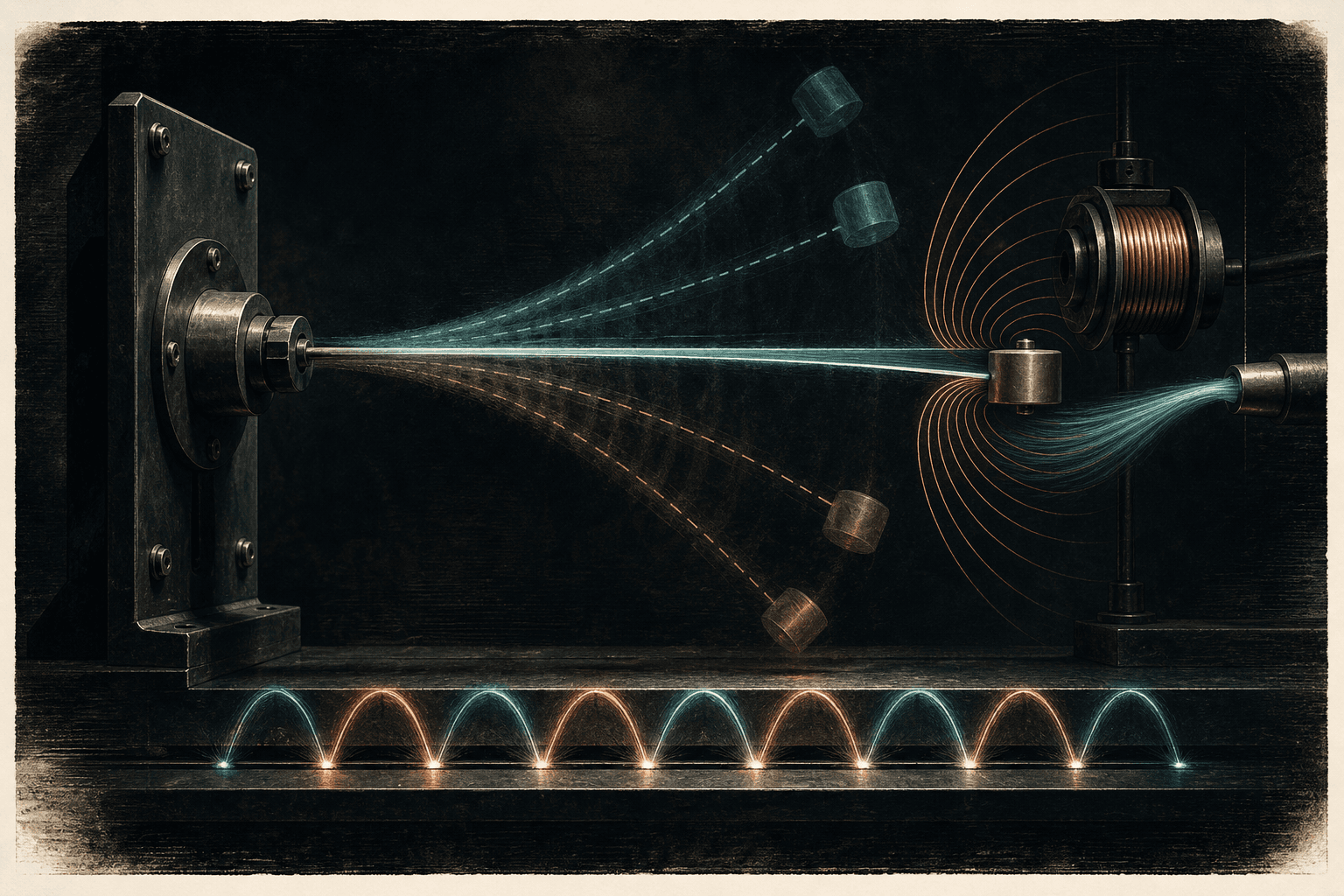
NYU Tandon and Stony Brook researchers first developed a theory for stabilizing a linear mechanical system by switching between two different instabilities, then tested it on a thin plastic beam with a tip weight. A magnetic coil created a saddle-like instability while a fan fed a growing oscillation. Neither condition was stable alone, yet alternating them every roughly 218 to 238 milliseconds held the beam nearly still because the switching steered motion toward a shrinking direction before it could run away. The laboratory result is a design principle, not a sensor-free robot already in service, but it suggests some machines and metamaterials may be stabilized by timing their physics instead of continuously computing corrections.
Why it matters
A simple beam stayed still when two destabilizing forces alternated inside a narrow timing window—without sensors or software correcting the motion.
Limits and context
- The laboratory result is a design principle, not a sensor-free robot already in service, but it suggests some machines and metamaterials may be stabilized by timing their physics instead of continuously computing corrections.
Key claims
A simple beam stayed still when two destabilizing forces alternated inside a narrow timing window—without sensors or software correcting the motion.
Qualification: The laboratory result is a design principle, not a sensor-free robot already in service, but it suggests some machines and metamaterials may be stabilized by timing their physics instead of continuously computing corrections.
Evidence: source-2026-07-15-001
Sources
- NYU Tandon via Newswise: Could physics replace the computer keeping your robot upright?NYU Tandon via Newswise · secondary reporting
Corrections
No corrections have been recorded for this story.