A NASA-led analysis of more than a million near-Earth measurements found atmospheric currents kept strengthening as the solar wind intensified.
Editorial illustration
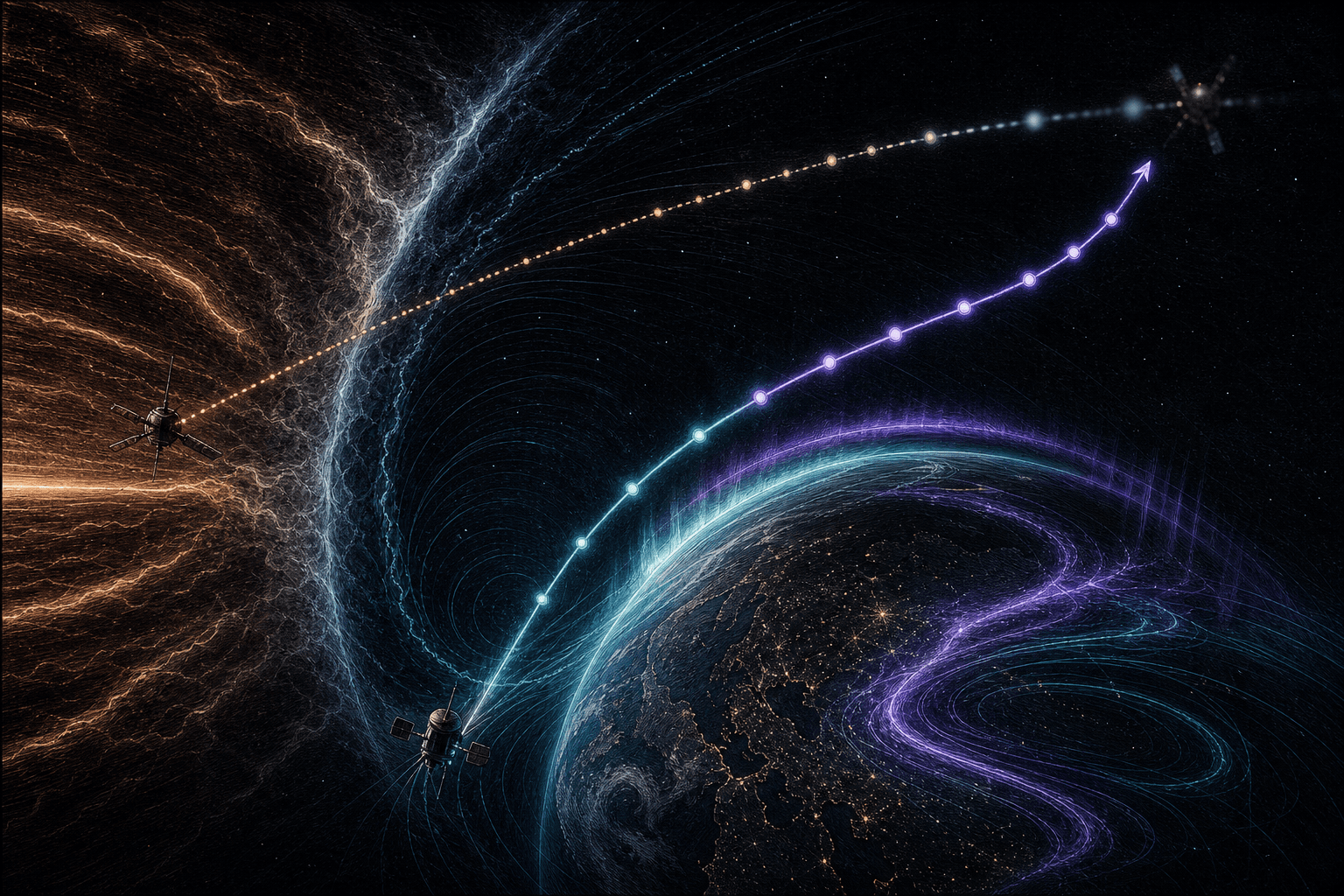
Original conceptual illustration of measurement uncertainty and increasing upper-atmosphere currents during stronger solar wind; it is not a NASA figure or documentary image. Original editorial illustration generated with built-in Codex Image Gen for The Machine Press.
Researchers have long described a saturation point beyond which stronger solar wind appeared unable to drive proportionally stronger electric currents in Earth's upper atmosphere. A NASA-led team argues that the plateau is an artifact of comparing Earth's response with solar-wind readings taken roughly a million miles upstream, where uncertainty grows before the same plasma reaches the magnetosphere. When the researchers analyzed more than a million measurements collected closer to Earth by missions including MMS and THEMIS, the current response remained approximately linear at the strongest observed inputs. The result does not predict a particular blackout or prove that no physical limit exists, but it removes a reassuring ceiling from a widely used picture of space-weather risk and makes better observations of extreme storms more urgent.
Original conceptual illustration of Raman sensing through colored glass; it is not the research apparatus, a product, or documentary evidence. Original editorial illustration generated with built-in Codex Image Gen for The Machine Press.
Wavefront shaping and wavelength modulation pulled methanol's Raman fingerprint through colored glass at concentrations below safety limits.
Researchers at the University of St Andrews and Adelaide University combined two optical techniques to detect methanol inside unopened spirit bottles. Wavefront shaping directs light through the container more effectively, while small wavelength changes help separate the liquid's Raman-scattering fingerprint from fluorescence and interference produced by colored glass. The team reports detection at concentrations about ten times below internationally recognized safety limits, without sampling or unsealing the bottle. The published laboratory method is not yet a customs-counter instrument or consumer detector, but the same non-invasive approach could be adapted for counterfeit alcohol screening, wine authentication, food-quality checks, and identification of hazardous liquids inside sealed packaging.
GitHub added new token detectors, a webhook category field, expanded push protection, and enterprise-level public-leak summaries.
GitHub's July 15 secret-scanning update added detectors for APIclub and Resend tokens and made VolcEngine keys blocked by push protection by default where secret scanning is enabled. A new secret_category field distinguishes provider and custom patterns from generic and AI-detected secrets in webhook payloads. Public-monitoring alert lists now summarize leak attribution, enterprise member counts, and verified domains before teams open individual alerts. The changes improve routing and situational context; they do not remove the need to revoke exposed credentials or investigate the underlying repository history.
Conceptual Visualising AI illustration; it does not depict ConlangCrafter, a generated language, its interface, or a benchmark result. Novoto Studio / Google DeepMind / Pexels; cropped, resized, metadata stripped, and converted to WebP by The Machine Press.
ConlangCrafter uses language models to construct new vocabularies and grammatical systems while testing how unusual their structures can become.
Researchers introduced ConlangCrafter as a tool for generating constructed languages rather than translating or imitating existing ones. The system uses large language models to propose phonology, morphology, syntax, and vocabulary, then organizes those pieces into a coherent language specification. Its research value is partly diagnostic: generated languages can test whether models truly manipulate linguistic rules or merely reproduce common patterns from their training data. The tool can aid creative work and linguistic experiments, but its outputs remain machine-generated designs rather than naturally evolved languages or evidence of human community use.
Beta Pictoris d emerged from carbon-monoxide absorption lines inside a bright debris disk where ordinary imaging had struggled.
NASA's James Webb Space Telescope found a third giant planet in the Beta Pictoris system by identifying the chemical fingerprint of its atmosphere. NIRSpec data showed carbon-monoxide absorption lines where researchers expected smooth scattered light from dust; the signal's motion and alignment matched an orbiting world, and later MIRI observations detected water vapor and methane. The planet is estimated to be at least twice Jupiter's mass and to orbit about 30 astronomical units from its star. It is the first directly imaged planet discovered primarily through moderate-resolution spectroscopy, demonstrating a way to find worlds hidden in bright, dusty environments.
Perseverance found a 75-meter stack of breccias, pulverized dust, and glassy beads built by repeated asteroid strikes before Jezero Crater formed.
On the rim beyond Jezero Crater, NASA's Perseverance rover examined layered rocks in a unit called the Broom Point member. Six rock types alternate through a roughly 75-meter sequence, including fragment-rich breccias and fine pulverized material. Gas-bubble cavities show that some fragments were once molten, while abundant dark glassy beads point to asteroid impacts rather than ordinary volcanism as the main builder. The terrain is likely more than 3.9 billion years old. Because Mars lacks plate tectonics that continually recycle crust, the stack preserves an impact record from an era largely erased on Earth.
A first-in-human phase 1 study found durable mutation-targeted immune responses in people at elevated pancreatic-cancer risk.
Johns Hopkins researchers tested mKRAS-VAX in 20 people who had hereditary risk for pancreatic cancer and an abnormality visible on pancreatic imaging. The peptide vaccine targets six common KRAS mutations found in most pancreatic cancers and many precursor lesions. Investigators reported that it was safe in this small phase 1 group and generated durable immune responses intended to recognize mutation-bearing cells before invasive cancer develops. The study establishes feasibility and immune activity, not cancer prevention; larger and longer trials are needed to determine whether vaccination reduces diagnoses or mortality.
Illustrative laboratory-glassware file image; it does not depict AML cells, T cells, MD Anderson, or an experiment in the report. Rodolfo Clix / Pexels; cropped, resized, metadata stripped, and converted to WebP by The Machine Press.
MD Anderson researchers identified an attack route against acute myeloid leukemia that does not require conventional target markers.
Researchers at MD Anderson reported a previously unknown way that T cells can eliminate acute myeloid leukemia cells even when the cancer evades the recognition markers normally used to guide an immune attack. The marker-independent route may help explain why AML can remain sensitive to some immune-based therapies despite its capacity to hide from conventional targeting. The finding supplies a mechanism and possible design direction for future immunotherapies; it is not yet a treatment protocol or evidence that the pathway works uniformly across patients.
Genetic, anatomical, and acoustic evidence confirmed Colobus congoensis, a small-range species separated from its closest relative for millions of years.
Researchers combined genetic data, museum anatomy, field observations, vocal recordings, and local ecological knowledge to describe Colobus congoensis, known locally as likweli. Its closest known relative lives more than 1,200 kilometers away, and the lineages appear to have diverged four to five million years ago. Between 2018 and 2022, teams recorded 114 sightings across an estimated range of only 1,700 square kilometers near Lomami National Park. Hunting pressure, habitat loss, and the restricted range led researchers to propose an Endangered classification. Formal description expands the primate record while underscoring how little time conservation may have.
An analysis of 110,000 submissions found institution, geography, author identity, and research topic strongly shaped publication odds.
A University of Colorado Boulder-led team analyzed more than 110,000 manuscript submissions made over five years to elite science journals. Authors from prestigious universities were more than three times as likely to be published as researchers from lesser-known institutions. Authors based in China were substantially less likely to succeed, and the analysis also found disadvantages associated with Chinese-sounding names and with work on politics, economics, gender, and other social subjects. Observational data cannot reveal every editorial reason behind an individual decision, but the scale makes journal selection itself visible as a source of inequality in the scientific record.
Sandia's compact optical sensor tracks intense magnetic fields through light rotation in rare-earth garnet.
Sandia National Laboratories researchers are developing rare-earth garnet crystals as magnetic-field sensors for fusion and pulsed-power experiments. A laser passes through the crystal, and the field rotates the light's polarization; measuring that rotation provides a reading without placing a conventional electrical probe inside the harshest part of an experiment. The team has also reduced the size of the supporting optics, a practical step toward use where space and survivability are limited. The work is a diagnostic technology under development, not evidence of a new fusion-energy gain or reactor milestone.
Staged technology file image; it is not a face-recognition system, study interface, participant record, or operational security console. Rafael Minguet Delgado / Pexels; cropped, resized, metadata stripped, and converted to WebP by The Machine Press.
A comparison with 4,000 participants found accuracy shifted with the viewer's race, the face's race, and individual recognition skill.
University of Notre Dame researchers compared commercial and open-source face-recognition systems with judgments from 4,000 people. Humans and algorithms often agreed about which faces looked similar, but accuracy depended heavily on the race of the participant, the race of the face being viewed, and the person's natural face-recognition ability. The work does not make proprietary systems transparent or establish fairness in deployment. It shows that benchmark averages can conceal structured differences in how both people and machines make identity-adjacent comparisons.
St. Jude researchers found spontaneous sub-compartments that hold late-stage building blocks together inside the nucleolus.
The nucleolus is a liquid-like organelle where cells assemble ribosomes, but its internal organization is more layered than the familiar three-compartment model. St. Jude researchers found smaller sub-compartments inside the granular component, where RNA and assembly proteins concentrate with SURF6 and NPM1 to keep late-stage ribosome parts in place. The structures form spontaneously through molecular interactions rather than membranes. Mapping that organization may help explain diseases marked by excessive ribosome production, including some cancers, though the study itself identifies cell biology rather than a therapeutic target ready for use.
A computational model represents fibroblast barriers and treatment combinations to predict response in hepatocellular carcinoma.
Johns Hopkins researchers built a computational model of hepatocellular carcinoma to simulate how tumors respond to a combination of immunotherapy and a growth-signal-blocking targeted drug. The model represents spatial features including fibroblasts that can form physical barriers between T cells and cancer cells, then tests doses and combinations in silico. Its purpose is to identify response patterns quickly enough to inform treatment research where real tumors may progress too fast for repeated trial and error. The published method is a prediction framework, not a clinically validated digital twin for making individual treatment decisions.
A self-compliant adhesive hydrogel maintained electrical contact through motion, sweat, oily skin, fatigue, and water loss.
Researchers developed PPGA-Al, a soft hydrogel interface designed to sit between wearable electrodes and moving skin. The material combines a flexible polymer network, gelatin, silver nanowires, ions, and reversible molecular bonds so it can remain adhesive and conductive without becoming rigid or drying quickly. Tests captured ECG, EMG, and EEG signals under conditions including motion, perspiration, and oily skin. The work addresses a persistent interface problem in long-term monitoring, but the reported material is a research platform rather than a cleared medical wearable.
Cross-calibration reconciled decades of energetic-electron readings that had differed by orders of magnitude between spacecraft.
Particle detectors aboard GPS satellites have monitored relativistic electrons in Earth's outer radiation belt since the late 1990s, but instrument-to-instrument differences made the constellation difficult to use as one continuous record. Researchers systematically cross-calibrated measurements from 25 satellites, correcting discrepancies that could reach orders of magnitude in low-flux conditions. The resulting dataset spans two solar cycles and turns navigation infrastructure into a long-duration observatory for radiation-belt changes that can damage satellites through internal charging and discharge. Calibration improves consistency; it does not eliminate every uncertainty in extreme space-weather conditions.
Reach readers curious about what people are building. One manually reviewed placement stays active for seven days and remains separate from Desk Picks.
Manual launch intake; automated checkout is not live yet. Payment buys placement, never endorsement, and every submission is reviewed before publication.
Desk Picks are selected by the newsroom. Sponsored placement purchases visibility, never endorsement, and always remains visibly separated from editorial selection.
 Editorial illustration