research
The Laser Reads the Bottle Without Opening It
Wavefront shaping and wavelength modulation pulled methanol's Raman fingerprint through colored glass at concentrations below safety limits.
Summary
Wavefront shaping and wavelength modulation pulled methanol's Raman fingerprint through colored glass at concentrations below safety limits.
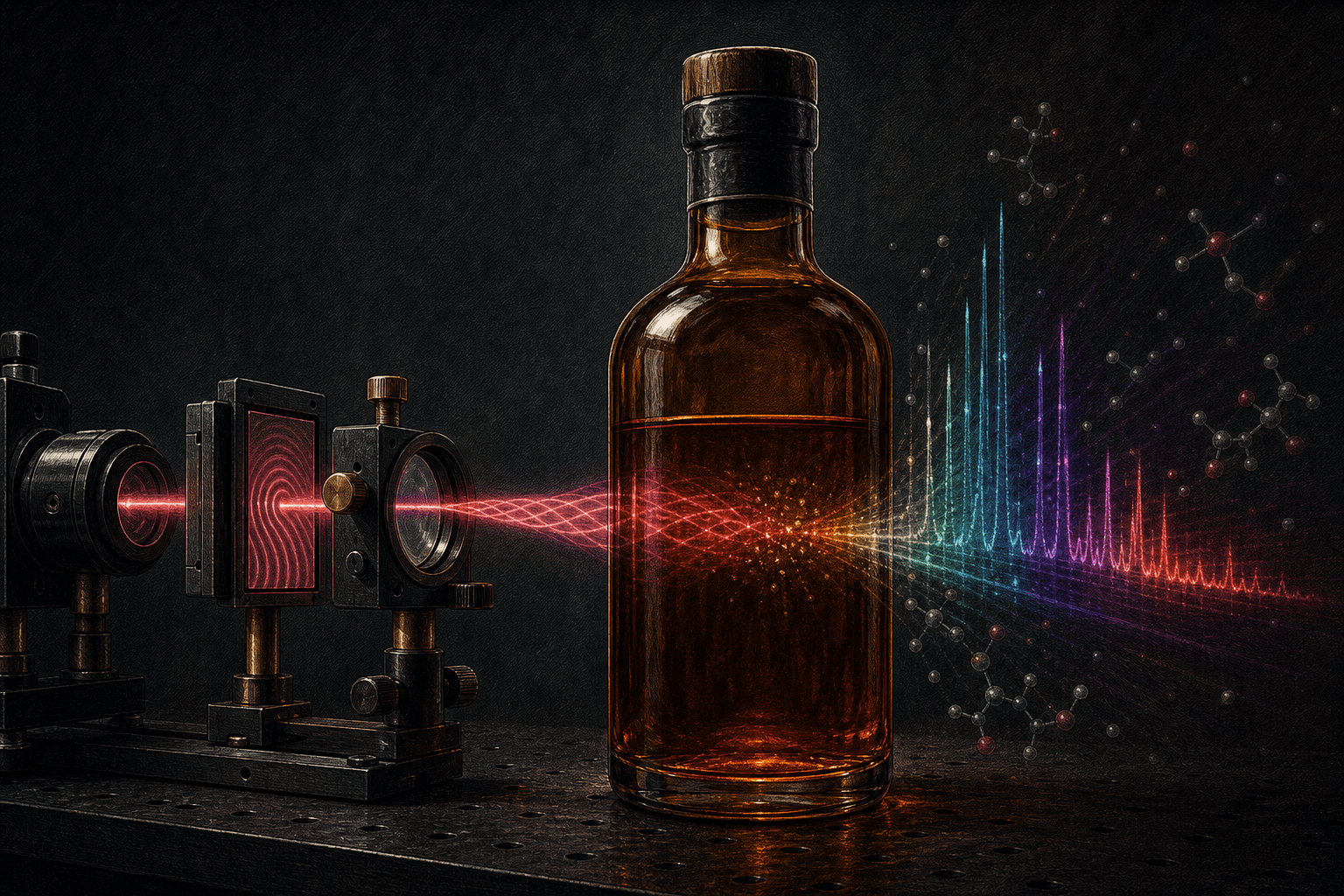
Researchers at the University of St Andrews and Adelaide University combined two optical techniques to detect methanol inside unopened spirit bottles. Wavefront shaping directs light through the container more effectively, while small wavelength changes help separate the liquid's Raman-scattering fingerprint from fluorescence and interference produced by colored glass. The team reports detection at concentrations about ten times below internationally recognized safety limits, without sampling or unsealing the bottle. The published laboratory method is not yet a customs-counter instrument or consumer detector, but the same non-invasive approach could be adapted for counterfeit alcohol screening, wine authentication, food-quality checks, and identification of hazardous liquids inside sealed packaging.
Why it matters
Wavefront shaping and wavelength modulation pulled methanol's Raman fingerprint through colored glass at concentrations below safety limits.
Limits and context
- The published laboratory method is not yet a customs-counter instrument or consumer detector, but the same non-invasive approach could be adapted for counterfeit alcohol screening, wine authentication, food-quality checks, and identification of hazardous liquids inside sealed packaging.
Key claims
Wavefront shaping and wavelength modulation pulled methanol's Raman fingerprint through colored glass at concentrations below safety limits.
Qualification: The published laboratory method is not yet a customs-counter instrument or consumer detector, but the same non-invasive approach could be adapted for counterfeit alcohol screening, wine authentication, food-quality checks, and identification of hazardous liquids inside sealed packaging.
Evidence: source-2026-07-16-002
Sources
- Adelaide University via Newswise: New laser technology could help stop deadly fake alcoholAdelaide University via Newswise · official announcement
Corrections
No corrections have been recorded for this story.