Researchers found a common Bluetooth key in dealer-installed KARR/SWDS systems; owners must use the app to install a July 20 patch.
Editorial illustration
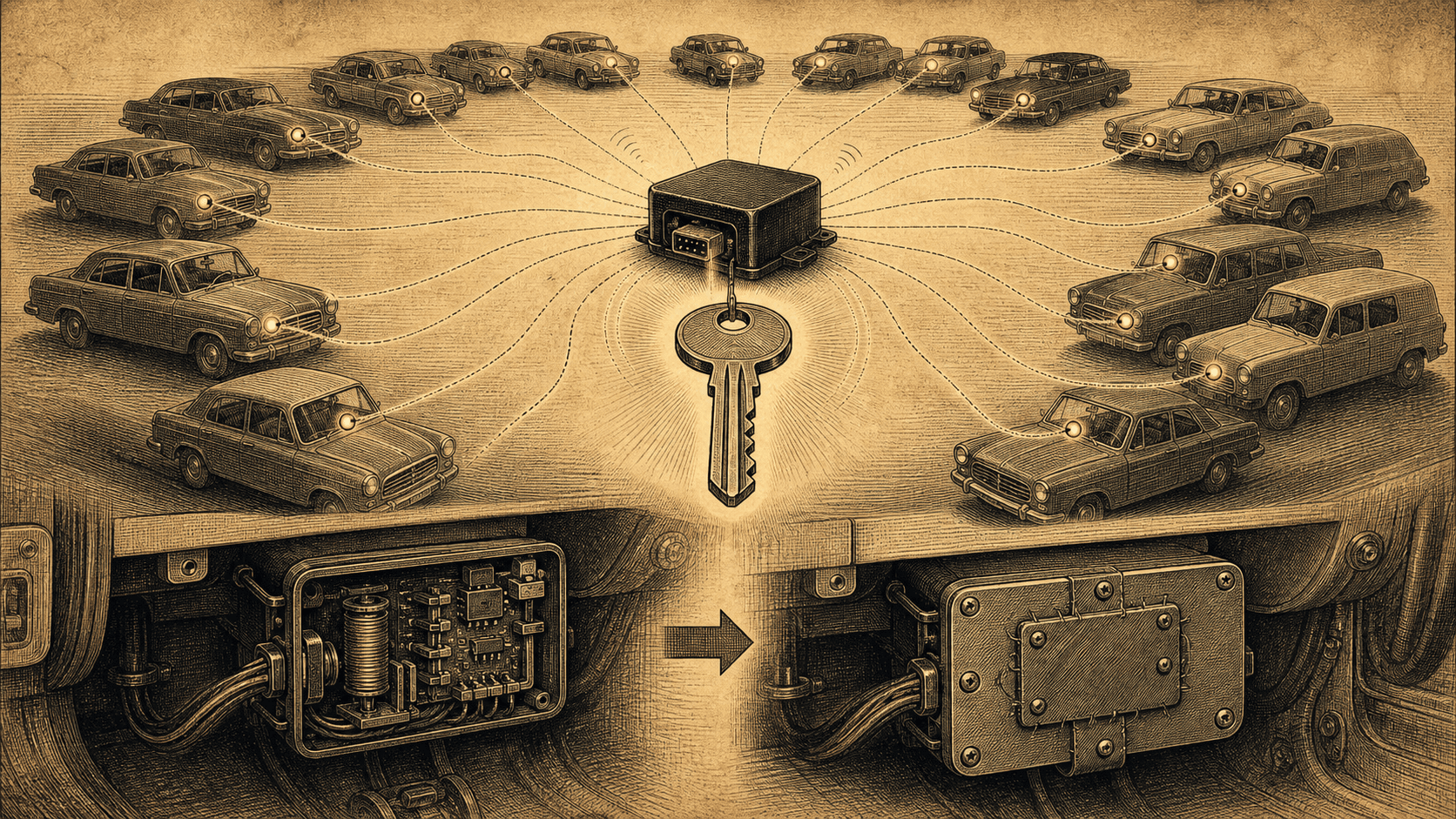
Conceptual illustration of a shared-key vehicle-security flaw and a repair path; not a real vehicle, device, dealership, exploit, or documentary scene. Original editorial illustration generated with built-in Codex Image Gen for The Machine Press, 2026-07-22.
UC San Diego researchers say dealer-installed KARR/SWDS devices left at least 2.2 million vehicles vulnerable because every unit relied on the same cryptographic key. From within roughly five yards, an attacker who possessed that key could unlock doors or immobilize an engine; separate tools would still be needed to start and steal a vehicle. Manufacturer Acrisure released a firmware patch July 20, but owners must install it through the KARR app. The team disclosed the flaws to manufacturers, vendors, and the National Highway Traffic Safety Administration and withheld exploit details.
Respectful conceptual reconstruction of repeated grass burning at Cloggs Cave; not documentary evidence or a depiction of a specific GunaiKurnai ceremony. Original editorial illustration generated with built-in Codex Image Gen for The Machine Press, 2026-07-22.
Phytoliths at Cloggs Cave indicate that GunaiKurnai people repeatedly carried selected grasses underground for ritual burning since the last Ice Age.
Researchers working with the GunaiKurnai Land and Waters Aboriginal Corporation analyzed microscopic silica bodies preserved in sediments at Cloggs Cave in southeastern Australia. The phytolith record indicates that people brought grasses into the cave and burned them there across roughly 25,000 years, supporting oral and ethnographic accounts of the cave as a place for ritual practice rather than ordinary habitation. The finding tracks continuity through plant remains; it does not reconstruct any specific ceremony or erase the authority of GunaiKurnai knowledge about the site.
A new paper argues that Western companion dogs dominate behavior research and limit claims about the species.
An international team reviewing canine-behavior research found that study samples concentrate around North American and European universities, affluent owners, and trained companion breeds. Free-ranging dogs, working dogs, and populations in the Global South remain underrepresented. The authors propose large cross-country collaborations such as ManyDogs to standardize methods and broaden samples. This is a critique and research agenda, not proof that prior findings are invalid.
Generic rendered integrated-circuit illustration; not the reported spin transistor, quantum microscope image, device sample, or measurement. Wikideas1 / Wikimedia Commons (CC0 1.0); cropped and converted to WebP by The Machine Press.
A scanning quantum sensor exposed the charge regime behind a device that combines magnetic memory with semiconductor logic.
A Boston College-led team used a scanning quantum sensor to image a van der Waals spin transistor during switching. The device operated in a space-charge-limited regime and reached an electrical on/off ratio reported at one million percent and a magnetic ratio of 3,000 percent. The laboratory result points toward logic and nonvolatile memory in one component, but it is not yet a production processor.
KIMM says its optimization platform and 300-kilowatt solar heat-pump system have operated at a Korean food plant for more than 18 months.
The Korea Institute of Machinery and Materials developed iTOP, a platform for comparing site-specific industrial heat configurations, and SoHProtes, a solar heat-pump system designed to supply higher-temperature process heat. A 300-kilowatt installation at a food-processing plant in Gimpo has run for more than a year and a half, according to the institute. The field demonstration establishes operating experience; it does not by itself show that every industrial process can replace fossil boilers economically.
An imitation-learning system reproduced expert navigation through the crowded Seto Inland Sea more closely than a conventional objective-driven model.
Osaka Metropolitan University researchers trained an autonomous-navigation model on maneuvers performed by the Kobe University training vessel Fukae-Maru. In simulations of the narrow, traffic-heavy Seto Inland Sea, the learned routes more closely followed experienced captains than routes from a conventional optimization approach. The work demonstrates a training strategy in evaluated scenarios, not permission for unsupervised commercial operation.
A Bayesian localization method reduced the cost of neural-network quantum Monte Carlo while keeping test errors within the authors' acceptable range.
JAIST and ByteDance Seed researchers combined neural networks with a Bayesian localization of a pseudo-Hamiltonian to approximate electron-level material behavior. Tests reported in Nature Computational Science kept prediction errors within the study's acceptable range while lowering computational cost enough to consider larger systems. The result is a method benchmark, not a discovered material or a universal replacement for first-principles simulation.
A review of 138 studies puts production, storage, infrastructure, standards, and airport coordination on the critical path.
An Adelaide University-led review synthesized 138 studies published from 2015 through 2025 on green hydrogen for aviation. It concludes that hydrogen can eliminate direct carbon dioxide emissions during flight when produced renewably, but commercial deployment still depends on production cost, storage, airport infrastructure, safety standards, and coordinated policy. This is a research map and priority list, not evidence that hydrogen airliners are ready for routine service.
Generic laboratory glassware; not a participant, pregnancy sample, artery image, Swedish registry, or study result. Rodolfo Clix / Pexels; cropped, resized, metadata stripped, and converted to WebP by The Machine Press.
A Swedish cohort of more than two million women links adverse pregnancy outcomes with higher long-term peripheral artery disease risk.
UTHealth Houston researchers analyzed more than two million Swedish women who delivered single babies between 1973 and 2015. Preterm delivery, preeclampsia, gestational diabetes, and other adverse pregnancy outcomes were associated with increased later risk of peripheral artery disease. The observational design identifies long-term risk markers and opportunities for follow-up; it does not show that a complication directly causes artery disease in an individual patient.
Children's Hospital Los Angeles researchers built a predictor for chronic immune thrombocytopenia risk after diagnosis.
A Children's Hospital Los Angeles team developed a clinical model intended to estimate which children with immune thrombocytopenia are more likely to progress to chronic disease. The tool is designed to support earlier monitoring and more individualized follow-up. It remains a prediction model that requires clinical judgment and validation; it does not determine a child's outcome or replace care decisions.
A small Rutgers pilot detected estrogen-like mycotoxins in all participants and associated higher exposure with more corn and grain consumption.
Rutgers researchers detected zearalenone-related mycoestrogens in every participant in a pilot study of pregnant people and found higher measured exposure among those reporting more corn and grain products. Zearalenone is produced by Fusarium fungi, can enter meat and dairy through feed, and survives processing. Because the study was small and observational, it establishes an exposure signal—not clinical harm, population prevalence, or advice to avoid staple foods.
An analysis across cancers found the largest male-female proteome divergence in lung adenocarcinoma.
Sanford Burnham Prebys researchers compared protein levels in tumor samples from male and female patients across available cancer datasets. Lung cancers, especially adenocarcinoma, showed more sex-associated protein differences than other studied tumor types, while five other cancers showed moderate differences. The study motivates more representative tumor-protein sequencing and hypothesis testing; it does not establish sex-specific treatments.
Generic optical-fiber pattern; not the electron-lighthouse device, its laser fields, a semiconductor sample, or measured current. Atlantic Ambience / Pexels; cropped, resized, metadata stripped, and converted to WebP by The Machine Press.
A semiconductor device steers current without an applied electric field by rotating the polarization of phase-coherent light.
University of Michigan researchers built a semiconductor device in which two colors of light drive competing quantum absorption paths. By rotating the optical fields' polarization, the team directed a narrow electron current like a lighthouse beam without applying an electric field. The Physical Review Letters result demonstrates a previously predicted effect and may inform sensing or communications research, but it is not a finished optical-electronic product.
Stony Brook researchers documented the rare tick-borne infection on Long Island, extending concern beyond its central-U.S. history.
A Stony Brook Medicine-led team confirmed New York State's first reported Bourbon virus case on Long Island. The rare illness is transmitted by lone star ticks and can resemble other tick-borne infections, but there is no vaccine or specific treatment. One case does not establish widespread local circulation; it is a diagnostic and surveillance warning as the tick's range and season expand.
Chandra, Webb, VLT, and ALMA observations link a neighboring jet to turbulence around a galaxy 11.7 billion light-years away.
Astronomers combined X-ray, infrared, optical, and radio observations of MQN01 J004131.9-493704, nicknamed the red potato. The galaxy sits in a dense early-universe intersection, yet forms fewer stars than its gas supply suggests. The team reports evidence that a jet from a neighboring supermassive black hole keeps surrounding gas turbulent and suppresses star formation. The mechanism is an interpretation of multi-observatory data, not a directly filmed interaction.
A CHI study explores AI-generated homeschool plans that reflect family culture while leaving instructional control with caregivers.
A Notre Dame co-authored CHI study worked with homeschooling families on an AI system for adapting lesson plans to children's needs, schedules, heritage, and cultural norms. The design treats parents as reflective partners who review and shape material rather than passive recipients of generated curricula. The research offers a participatory design direction; it does not establish learning gains or endorse unsupervised AI instruction.
Desk Picks are selected by the newsroom. Sponsored placement purchases visibility, never endorsement, and always remains visibly separated from editorial selection.
 Editorial illustration