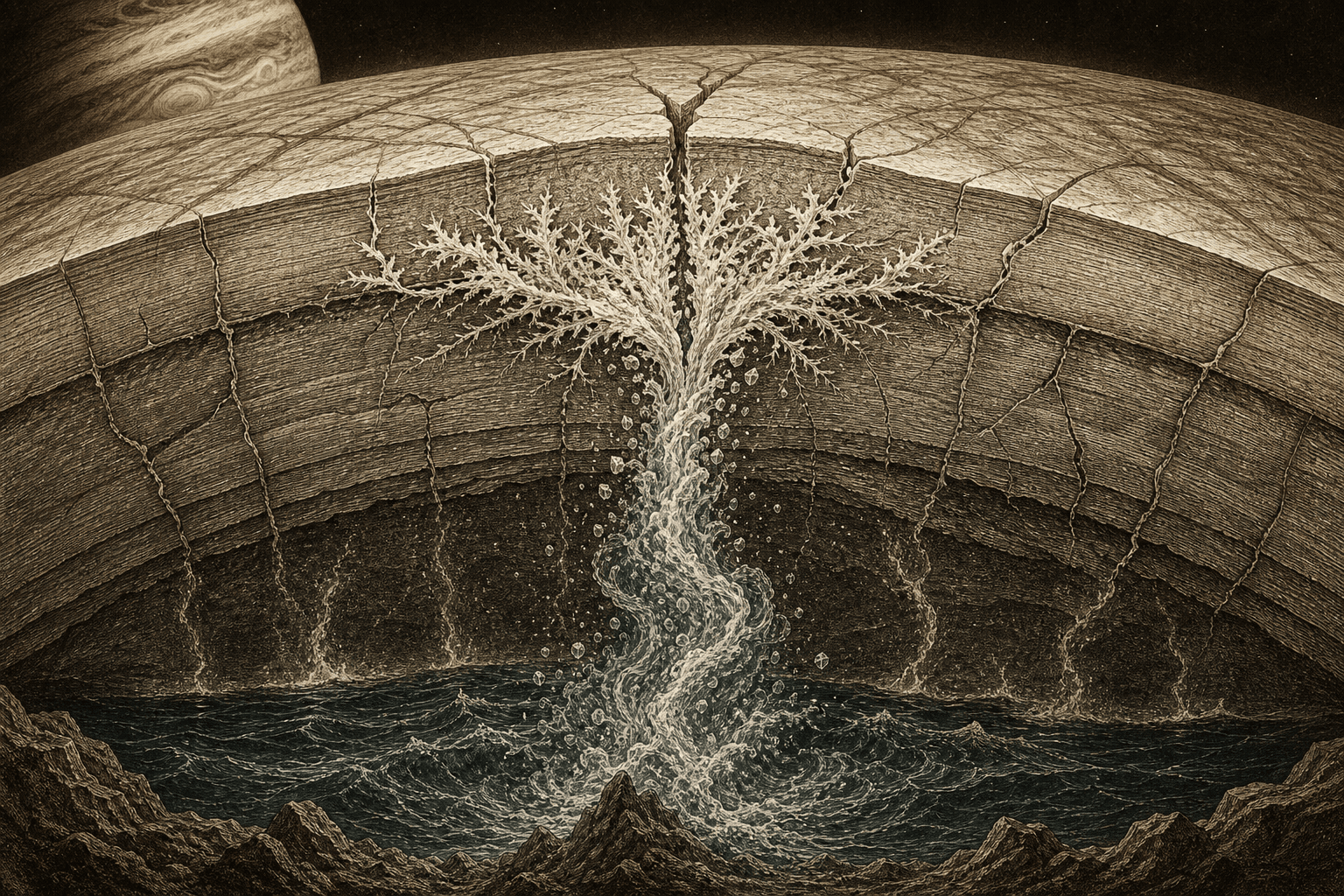
New simulations suggest turbulent water rising from the moon's deep ocean would rapidly form ice crystals and clog narrow fractures.
Editorial illustration
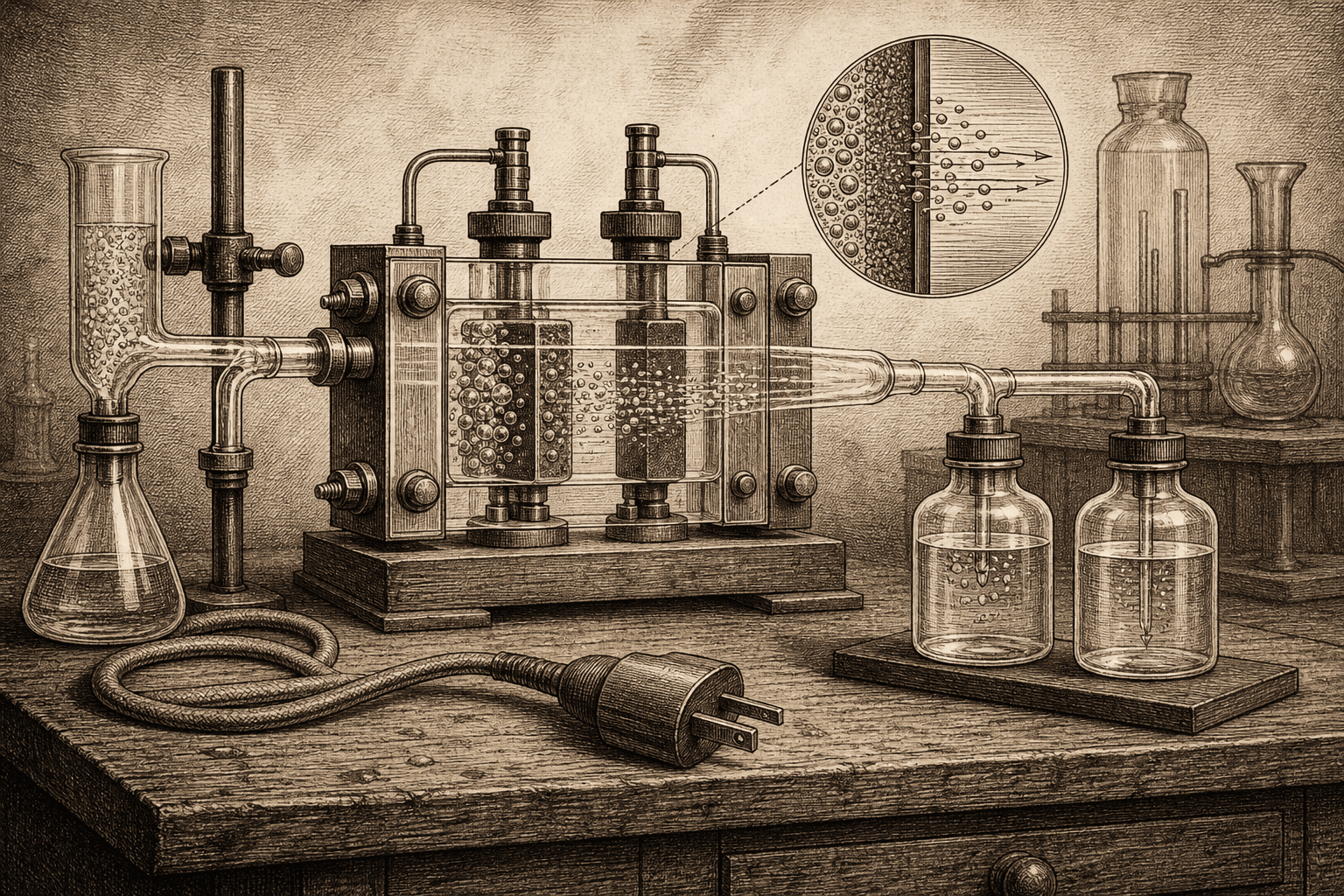
Conceptual illustration of modeled turbulent ascent and frazil-ice blockage inside Europa's shell; not spacecraft imagery, a direct view of the ocean, or evidence that a shallow reservoir exists. Original editorial illustration generated with built-in Codex Image Gen for The Machine Press, 2026-07-24.
Rutgers-led simulations add turbulence and frazil-ice formation to a long-debated route through Europa's ice shell. Water forced upward from the deep ocean would mix against cold fracture walls, supercool, and seed crystals that can block narrow cracks within hours. Wider fractures remain possible only under demanding conditions, so a shallow reservoir may have melted locally instead of sampling the ocean below. Europa Clipper and JUICE can test the shell's structure, but the model does not show that any reservoir exists.
Conceptual illustration of a laboratory galvanic flow system; not the reported apparatus, a commercial plant, or evidence of zero total lifecycle energy use. Original editorial illustration generated with built-in Codex Image Gen for The Machine Press, 2026-07-24.
A flow-controlled galvanic cell cleared microbubbles from its electrodes and sustained industrial-level production without an external power supply.
A Sungkyunkwan University-led team built a membrane-electrode assembly in which a spontaneous galvanic reaction makes hydrogen peroxide, hydrogen, and furoic acid. High-speed imaging showed that furfural lowered surface tension and crowded electrodes with microbubbles; controlling electrolyte flow swept them away and raised current density about threefold. The optimized laboratory system reached 331 milliamps per square centimeter and about 90% peroxide selectivity without applied external voltage. Those measurements are promising engineering results, not proof of commercial scale or zero energy across an entire production chain.
A six-month study linked ?career wisdom? with later meaning, satisfaction, and engagement, without claiming a perfect-job formula.
Researchers followed 995 employed U.S. adults across three surveys spaced about three months apart. People who initially scored higher on a 20-item measure of making thoughtful career decisions under uncertainty later reported more meaningful work; that meaning predicted greater job satisfaction and engagement at the final survey. The observational sequence cannot prove that the mindset caused the outcomes, and the link with overall life satisfaction was weaker.
Simulations identified a molybdenum-and-vacancy defect in zinc oxide with properties suited to spin readout and quantum light.
Researchers computationally screened point defects in zinc oxide and identified a molybdenum atom beside a missing oxygen as a promising spin-qubit design. Their first-principles calculations predict sharp visible emission, a spin coherence time near four milliseconds, and the ingredients for single-shot readout. Zinc oxide is compatible with established semiconductor growth, but the work is a theoretical design: the defect still must be fabricated and measured.
Polymerizing indocyanine green shielded its light-emitting structure and slowed photobleaching in laboratory and mouse tests.
Korea Research Institute of Chemical Technology researchers linked molecules of the approved near-infrared dye indocyanine green into a polymer backbone. Under continuous 785-nanometer illumination, conventional dye fell to about 40% intensity within 50 seconds; KR-NIR-P retained about 66% after 200 seconds. Cell, spheroid, and mouse experiments supported further study for image-guided surgery, but the new polymer is not yet an approved clinical dye.
Generic coastal-heritage file image; not a Glo-CoH map, a damage forecast, or evidence about a listed site. Belli Kins / Pexels; cropped, resized, metadata stripped, and converted to WebP by The Machine Press.
The Glo-CoH dataset locates coastal World Heritage sites so climate and conservation studies can work from one reproducible base.
An international team assembled Glo-CoH, a global dataset connecting UNESCO World Heritage properties to coastlines. The map includes landmarks and ecosystems ranging from Rapa Nui to parts of the Great Wall and St. Petersburg, giving researchers a common base for sea-level and biodiversity-risk assessments. Publication in Scientific Data makes the method and dataset inspectable; it is a map of exposure, not a forecast that every listed site will be damaged.
A literary analysis of Alan Turing?s ?Pryce?s Buoy? finds a playful, sexually frank voice absent from the familiar isolated-genius narrative.
Cambridge researcher Sarah Dillon studied a little-known, unpublished short story held in the Turing archive. Her analysis places its comic, queer, and literary voice alongside Turing?s scientific life and argues that the surviving text complicates a biography often reduced to codebreaking, persecution, and isolation. The research interprets one unfinished work rather than revealing a complete private self; the archive text remains copyrighted and is not reproduced here.
A single-cell atlas linked noncoding risk regions to regulatory changes across the healthy and failing human heart.
UC San Diego-led researchers integrated gene activity, chromatin accessibility, and three-dimensional genome organization in more than 750,000 cells from 36 human hearts. They mapped 12 major cardiac cell types and found heart failure associated with more fibroblasts and immune cells, fewer cardiomyocytes, and cell-specific regulatory shifts. The atlas proposes targets and causal pathways for testing; it is a resource for discovery, not a therapy.
Abstract neural-network file image; not an operating room, patient data, the Frame-to-Outcome model, or evidence of a recovery prediction. Novoto Studio / Google DeepMind / Pexels; cropped, resized, metadata stripped, and converted to WebP by The Machine Press.
Frame-to-Outcome learned from operative video to connect nerve-sparing gestures with recovery after prostate surgery.
Cedars-Sinai researchers trained an AI system on annotated video from 294 robot-assisted prostate surgeries performed by 23 surgeons at four centers, then tested it on 29 more procedures. The model analyzed gesture patterns during nerve-sparing work and produced outcome predictions close to expert reviewers while reducing manual review. The small test set and retrospective videos limit the claim: this is a research feedback tool, not an autonomous surgeon or guaranteed prognosis.
Generic laboratory glassware file image; not the bicyclobutane compounds, a patient sample, mouse study, approved medicine, or study result. Rodolfo Clix / Pexels; cropped, resized, metadata stripped, and converted to WebP by The Machine Press.
A bicyclobutane group preserved tumor-target binding while reducing unintended protein reactions in preclinical tests.
Moffitt Cancer Center researchers designed a strained bicyclobutane chemical group that preferentially reacts with cysteine, then swapped it into existing covalent-drug scaffolds. A redesigned version of dacomitinib retained target activity, bound fewer unintended proteins, and controlled human lung tumors in mice about as well as the approved drug, with improved exposure and no obvious study toxicity. These are laboratory and animal results; human safety and benefit have not been established.
A diverse health-system study measured what it takes to recruit people by genotype for deeper psychiatric assessment.
Mount Sinai researchers invited 892 BioMe participants to follow-up studies: 335 carried rare copy-number variants linked to neurodevelopmental risk, 217 had schizophrenia without those variants, and 340 were controls. Eighteen percent responded and 8% completed detailed assessments, which revealed traits missed in routine records. The result is an operational benchmark for recall-by-genotype research, not a diagnostic program or evidence that a variant determines an individual outcome.
Landsat measurements extended river-temperature comparisons from a handful of sites to wide U.S. coverage.
Virginia Tech researchers used thermal infrared satellite imagery to compare surface temperatures upstream and downstream of more than 250 large U.S. dams from 2013 through 2024. Temperature differences appeared in 71% of observations, with direction and size varying by dam and season. Because Landsat resolution limited the sample to wide rivers, the method does not describe every dam, but it gives water managers a scalable way to see temperature as more than a leftover operating condition.
Deuterium-loaded foils produced an unexpected low-energy reaction plateau, opening a route to study materials-driven fusion.
UC Davis and Berkeley Lab researchers fired deuterium ions into palladium and titanium foils prepared by different loading methods. Below 2.5 kiloelectronvolts, some samples showed fusion rates vastly above the bare-reaction expectation, forming an unexpected plateau that depended on the material environment. Electrons and defects may partly screen repulsion, but the mechanism is unresolved. The experiment concerns low-energy reaction physics and possible neutron sources, not a demonstrated power reactor.
An IL-1? inflammatory cascade recruited neutrophils whose extracellular traps weakened later treatment in ovarian-cancer models.
Wistar researchers compared tumors before and after chemotherapy and found higher interleukin-1 beta, especially in poor responders. In engineered mouse models, disrupting IL-1? signaling improved tumor shrinkage; laboratory work traced a path through neutrophil recruitment, T-cell exhaustion, and web-like extracellular traps that reduced drug effectiveness. Patient samples echoed parts of that pattern, but blocking the pathway remains a therapeutic hypothesis, not an established treatment.
A national database study found use had doubled since 2010 but remained uncommon alongside treatment.
American Cancer Society researchers analyzed 67,706 U.S. patients ages 18 to 39 with stage IV solid tumors or poor-prognosis high-grade brain tumors. Recorded palliative-care use rose from 9.3% in 2010 to 18.3% in 2023; during 2021?2023, 17.1% received it while undergoing cancer treatment. Database coding cannot capture every service or explain every barrier, but the gap supports earlier, more consistent integration of symptom and decision support.
The ABCD cohort traces how alcohol, cannabis, nicotine, and combinations emerge from late childhood into the mid-teens.
UC San Diego researchers analyzed repeated assessments from 11,880 participants in the national ABCD study. By age 16, 38% reported lifetime use of at least one substance; nearly 15% reported two or more. Boys reported more use before 12, while girls reported higher alcohol, cannabis, and nicotine use beginning around 13. Self-report and an ongoing cohort limit causal conclusions, but the weighted estimates provide a current benchmark for prevention and brain-development research.
Desk Picks are selected by the newsroom. Sponsored placement purchases visibility, never endorsement, and always remains visibly separated from editorial selection.
 Editorial illustration