research
Europa's Shortcut Freezes Itself Shut
New simulations suggest turbulent water rising from the moon's deep ocean would rapidly form ice crystals and clog narrow fractures.
Summary
New simulations suggest turbulent water rising from the moon's deep ocean would rapidly form ice crystals and clog narrow fractures.
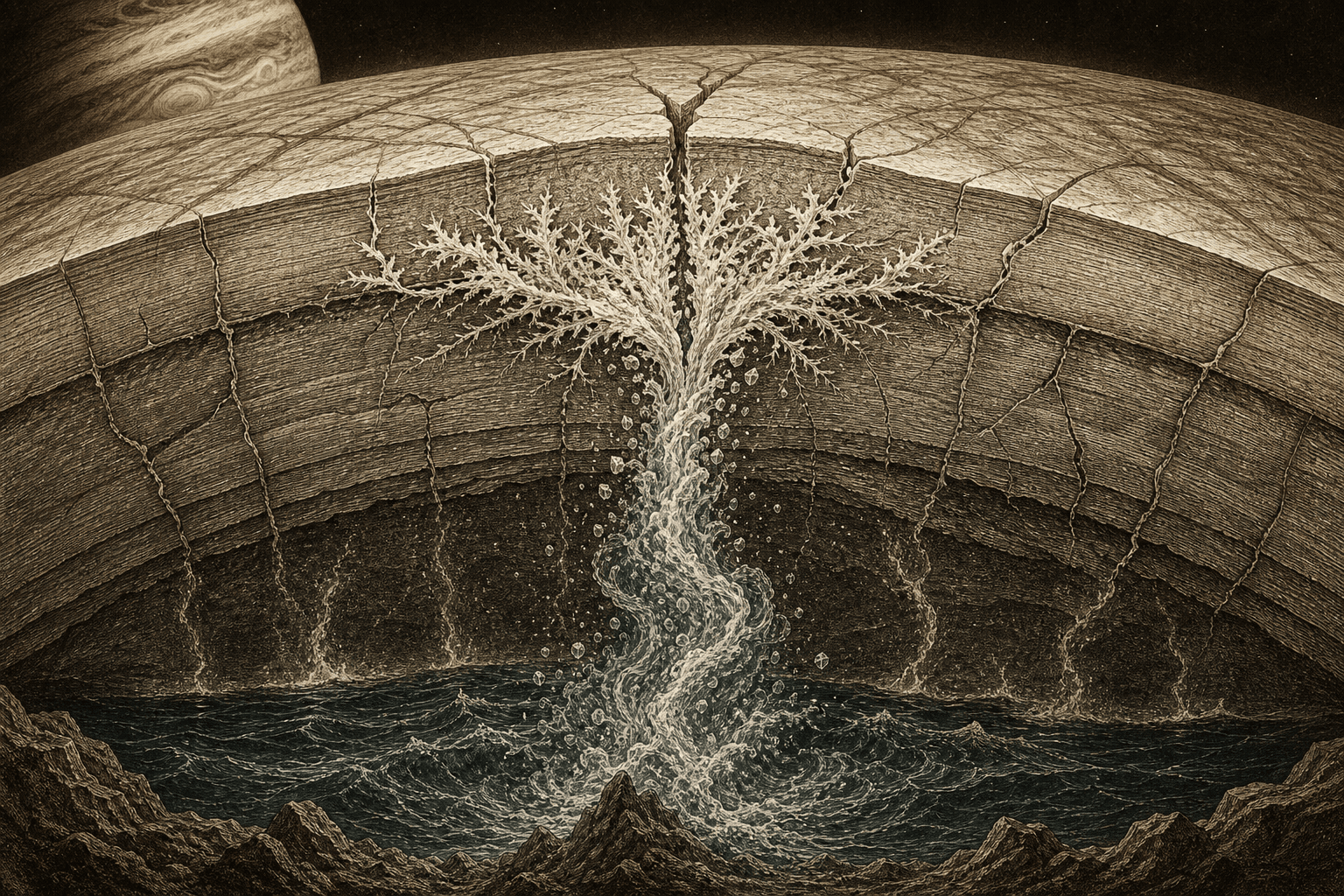
Rutgers-led simulations add turbulence and frazil-ice formation to a long-debated route through Europa's ice shell. Water forced upward from the deep ocean would mix against cold fracture walls, supercool, and seed crystals that can block narrow cracks within hours. Wider fractures remain possible only under demanding conditions, so a shallow reservoir may have melted locally instead of sampling the ocean below. Europa Clipper and JUICE can test the shell's structure, but the model does not show that any reservoir exists.
Why it matters
New simulations suggest turbulent water rising from the moon's deep ocean would rapidly form ice crystals and clog narrow fractures.
Limits and context
- Wider fractures remain possible only under demanding conditions, so a shallow reservoir may have melted locally instead of sampling the ocean below.
- Europa Clipper and JUICE can test the shell's structure, but the model does not show that any reservoir exists.
Key claims
New simulations suggest turbulent water rising from the moon's deep ocean would rapidly form ice crystals and clog narrow fractures.
Qualification: Wider fractures remain possible only under demanding conditions, so a shallow reservoir may have melted locally instead of sampling the ocean below.
Evidence: source-2026-07-24-001
Sources
- Rutgers University via Newswise: Europa's ocean shortcutRutgers University via Newswise · official announcement
Corrections
No corrections have been recorded for this story.