Structured laser light distinguished mirror-image camphor molecules through the number of charged fragments they produced.
Editorial illustration
Editorial concept art about structured light and molecular handedness; it is not the reported apparatus, a chemical diagram or experimental evidence. Original editorial concept art generated with built-in Codex Image Gen for The Machine Press, 2026-07-27.
Researchers at TIFR Hyderabad, IIT Bombay and IIT Hyderabad shaped ultrashort laser pulses so the light carried both spin and orbital twist, then aimed the pulses at isolated R- and S-camphor molecules. The resulting ion counts changed with the match between the beam's handedness and the molecule's handedness, allowing the two mirror forms to be distinguished without measuring fragment angles. The Science Advances experiment offers a simpler gas-phase readout of chirality; it does not yet establish a routine pharmaceutical assay or show that every chiral molecule will respond the same way.
Editorial concept art of simultaneous work and refrigeration in a photonic quantum experiment; it is not a commercial device or perpetual-motion claim. Original editorial concept art generated with built-in Codex Image Gen for The Machine Press, 2026-07-27.
A photonic proof of principle used quantum-ordered thermal processes to produce work while refrigerating another system.
Researchers from Qufu Normal University, the University of Hong Kong and the University of Palermo demonstrated an anomalous heat flow in which a quantum system absorbed heat from colder reservoirs. They used the effect in a photonic quantum Otto cycle that generated useful work and cooling at the same time. The Physical Review Letters result confirms the predicted behavior on an optical platform and also shows that the effect is not an exclusive signature of indefinite causal order. It remains a small proof of principle, not a commercial refrigerator or a way around thermodynamic accounting.
A new framework defines how rare molecules can reorganize whole biological communities far beyond their abundance.
A Trends in Ecology & Evolution article proposes four tests for a keystone molecule: it must be rare, exert a large effect, influence more than one target and resist easy substitution. The framework draws on sea-slug alderenes that reorganize mudflat communities across several animal phyla and on serotonin and ectoine that reshape a stressed plant's root microbiome. It is a research agenda built from recent examples, not proof that every ecosystem has one master chemical.
Generic laboratory file image; it does not show the reported mice, DNA damage, tumors, institution, experiments or results. Rodolfo Clix / Pexels; cropped, resized, metadata stripped, and converted to WebP by The Machine Press.
Controlled mouse experiments found that inherited genetic background redirected how tumors began and evolved after the same initiating damage.
A University of Cambridge-led team exposed mice with different inherited genetic backgrounds to the same cancer-initiating DNA damage and tracked the tumors that followed. The Nature study found that germline variation changed both cancer risk and the evolutionary route tumors took, providing direct experimental evidence that acquired mutations do not act on a blank genetic canvas. The work was done in mice and does not yet predict an individual person's cancer trajectory; the generic glassware image is illustrative.
Simulations link a cavity in young Jupiter's moon-forming disk to the survival of several large satellites, while Saturn lacked the same refuge.
Researchers in Japan and China modeled the thermal and magnetic evolution of young Jupiter and Saturn, their circumplanetary disks and the migration of forming moons. Their Nature Astronomy simulations suggest Jupiter's stronger early magnetic field opened an inner cavity that trapped and preserved Io, Europa and Ganymede, while Saturn's weaker field left inward-migrating moons without a comparable safe zone. The model offers one coherent explanation for the two systems; it is not a direct observation of their formation.
Two Danish field studies recovered local animal DNA from airborne particles and refined a low-cost biodiversity sampling method.
University of Copenhagen researchers hung fan-driven filter boxes in three Danish nature areas and sequenced the animal DNA collected from the air. Across the two studies, the method detected dozens of local bird and mammal species, including European bison, owls and white-tailed eagles, while tests of filters, airflow, storage and sampling time improved reliability. The researchers still need to determine how far and how long airborne DNA travels, so a detection indicates local presence rather than an exact animal location.
A synthesis across satellites and carbon models found Northern Eurasia's uptake concentrated in productive western and southern forests.
A University of Tsukuba-led analysis combined satellite records, data products, atmospheric inversions, vegetation models and Earth-system models to estimate that Northern Eurasian ecosystems absorb about 0.47 plus or minus 0.20 billion tonnes of carbon per year. The strongest uptake occurred in more productive western and southern forests, not in the cold northeastern regions warming fastest, where winter warming, low productivity and fire constrain gains. The estimate varies across methods and does not guarantee that the sink will persist.
A Snake-game experiment found that people reprioritized the nearest remembered target after an interruption, but only one item remained strongly active.
Fifty adults played a modified Snake game while remembering one, two or four hidden apple locations. When a surprise grape forced a detour, participants shifted priority toward the apple nearest their new position, showing that working memory can rapidly reallocate resources after a plan changes. At higher loads, that flexibility weakened, and post-distraction reliance narrowed to one item regardless of how many locations were stored. The study describes a constrained laboratory task, not every form of real-world distraction.
Abstract optical file image; it does not show PSR J0435+3233, gamma rays, Fermi data, a telescope image or a measured result. Atlantic Ambience / Pexels; cropped, resized, metadata stripped, and converted to WebP by The Machine Press.
Seventeen years of Fermi data revealed phase-linked gamma emission from an unusually powerful, inefficient millisecond pulsar.
Astronomers analyzing 17.7 years of Fermi Large Area Telescope observations detected gamma-ray pulsations aligned with the 3.2-millisecond spin of PSR J0435+3233, a binary pulsar roughly 3,900 light-years away. Despite extraordinary spin-down power, the inferred gamma-ray efficiency is extremely low, giving researchers a new case for testing particle acceleration and beam geometry. The result is reported in an arXiv preprint and has not yet completed journal peer review; the fiber-optic image is only a signal metaphor.
Emergency excavations at Caculo Cabaça documented fifteenth-century stone structures, Angola's oldest dated burials and its only known ancient cremation.
Archaeologists racing a hydroelectric reservoir recorded 117 clusters of stone structures at Caculo Cabaça and excavated 65 before inundation. Radiocarbon dates place some burials in the early 1400s, before Portuguese arrival, and one burned urn held cremated skull and tooth fragments unlike any prior Angolan find. Seated burials and domestic artifacts complicate simple assumptions about status. The reservoir will erase much of the site, though related structures survive beyond the flood zone.
An Alaska field experiment linked raised flight costs to earlier, longer migration, better next-year breeding and lower return rates.
Researchers altered the breeding-season energy burden of black-legged kittiwakes by supplementing food, clipping selected feathers or leaving birds as controls, then tracked them across years. High-cost birds fledged fewer chicks immediately, departed earlier and migrated farther; those longer migrations predicted greater breeding success the next year, but only 67% returned, compared with 83% of controls and 90% of fed birds. The experiment supports an energetic trade-off in one colony rather than a universal seabird rule.
Population modeling and comparative observations show how alternating environments can preserve toxin production that constant conditions would erase.
Institute of Science Tokyo researchers modeled a yeast strategy in which starvation-adapted cells release toxins that kill genetically identical late arrivals. Constant abundance or constant starvation let cheaters or sensitive cells win, but long nutrient-rich periods alternating with shorter starvation episodes removed each rival in turn and stabilized toxin production. Comparisons across distant yeast lineages fit the ecological prediction. The work explains a possible evolutionary mechanism; it does not establish the exact history of every species.
Conceptual neuroscience file image; it is not a child, participant scan, measured brain structure, growth record or study result. Novoto Studio / Google DeepMind / Pexels; cropped, resized, metadata stripped, and converted to WebP by The Machine Press.
A study of very-low-birth-weight children associated poor growth recovery after prematurity with structural differences at age two.
University of Granada researchers followed children who had experienced extrauterine growth restriction after very-low-birth-weight premature birth. Those who did not achieve adequate catch-up growth by age two showed persistent structural differences in frontal regions involved in emotional regulation, reinforcing the case for nutrition and growth monitoring beyond neonatal care. The observational association does not prove that weight gain alone caused the brain differences; the conceptual brain image is not a participant scan.
Danish registry data link early respiratory illness in younger siblings to later health, education and earnings differences.
Northwestern University researchers used Danish records covering first- and second-born siblings from 1981 through 2017. Younger siblings were two to three times more likely to be hospitalized for respiratory illness in their first months, and controlling for that exposure cut the estimated later-born earnings penalty roughly in half. The analysis also linked early illness with chronic respiratory and mental-health outcomes. Registry evidence supports a biological pathway but cannot guarantee the same effect size in other health systems.
Widened nerve openings and developmental defects in La Brea fossils suggest tumors and possible late-population inbreeding.
Researchers examined 3,722 Smilodon vertebrae representing at least 849 adults from the La Brea Tar Pits. Three bones had smoothly widened foramina consistent with spinal nerve tumors, alongside numerous developmental abnormalities. The apparent tumor prevalence far exceeds that in modern people and animals, leading the team to propose inbreeding as one possible explanation and pain-impaired scavenging as another. Without ancient DNA or soft tissue, both interpretations remain hypotheses rather than diagnoses.
California's six-month marine heat wave is shifting forage fish, amplifying harmful algae and changing where large animals appear.
NOAA scientists told AFP that California surface waters are running roughly three to four degrees Celsius above normal after about six months of marine heat. Anchovies and sardines are moving deeper or north, whale and dolphin sightings have fallen in some areas, and warm conditions favor domoic-acid blooms that can poison marine mammals. Juvenile white sharks have also appeared nearer shore. The observations describe a developing regional event, not a census of every species or a forecast of exact losses.
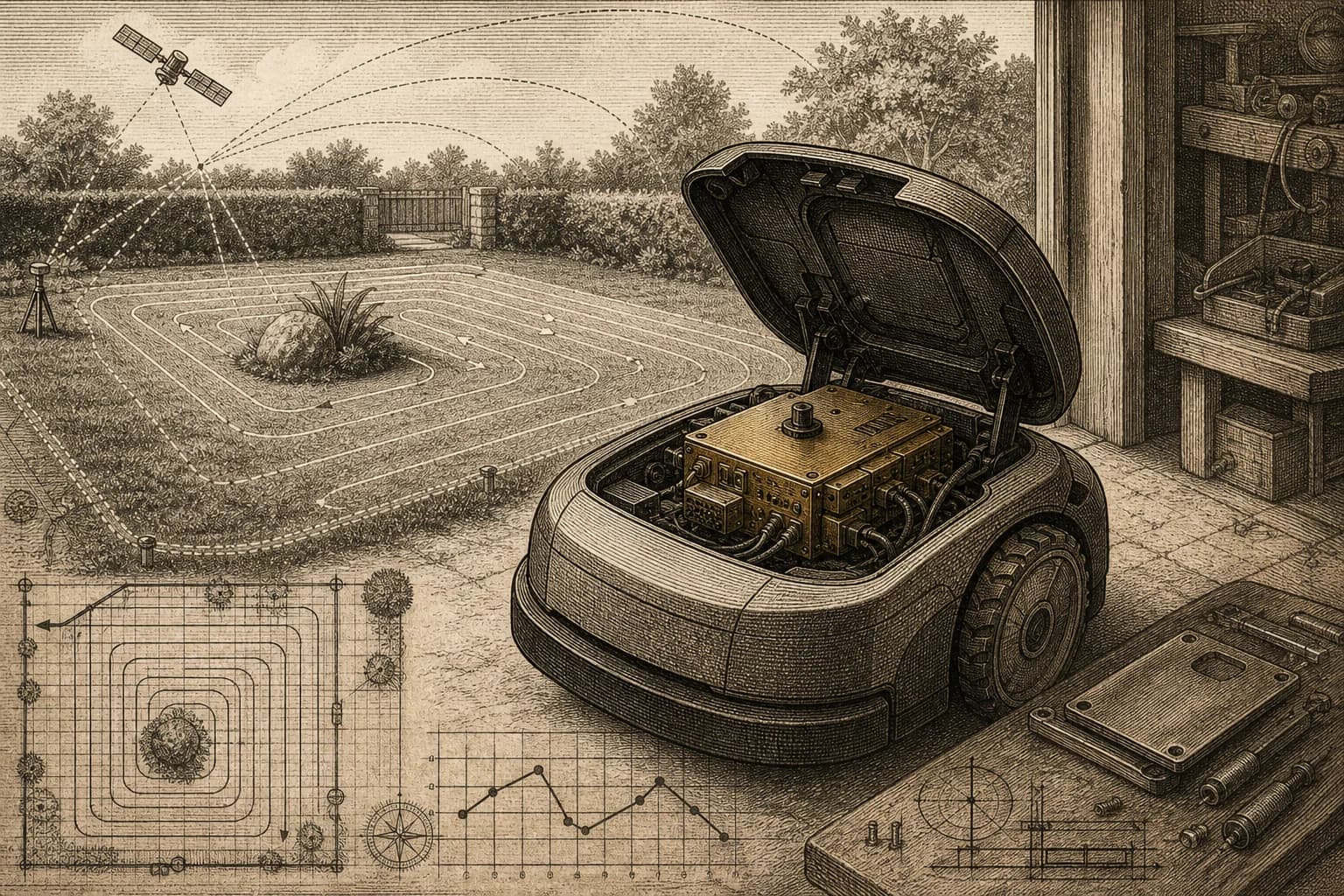
Replaces the controller in compatible low-cost robot mowers with custom open hardware and software for mapped, GPS-guided mowing without a perimeter wire.
Visit OpenMowerOriginal editorial concept art generated with built-in Codex Image Gen for The Machine Press, 2026-07-26.
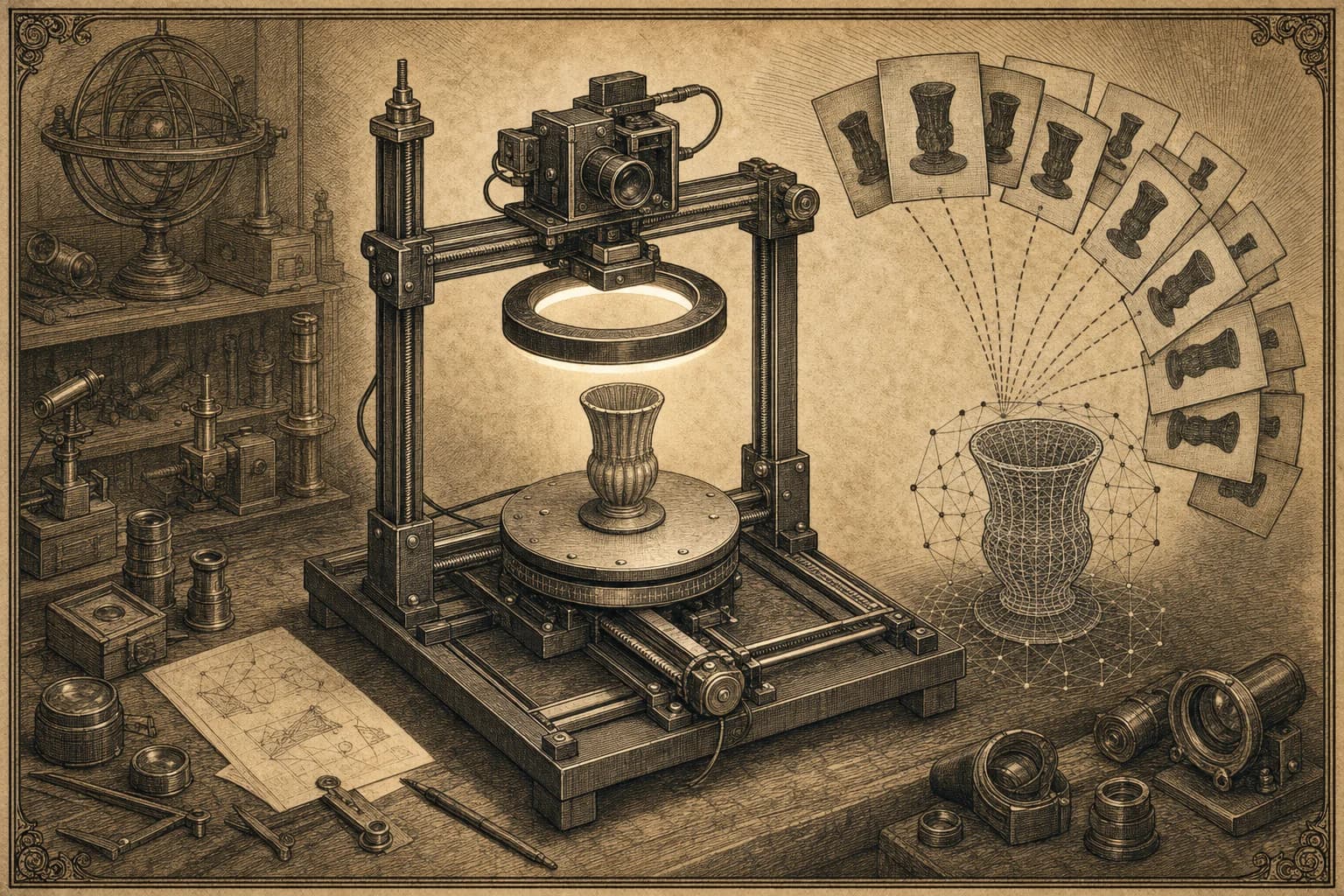
Automates repeatable photogrammetry with a Raspberry Pi-controlled camera, motors, and modular printable rigs that feed many views into a 3D reconstruction.
Visit OpenScanOriginal editorial concept art generated with built-in Codex Image Gen for The Machine Press, 2026-07-26.
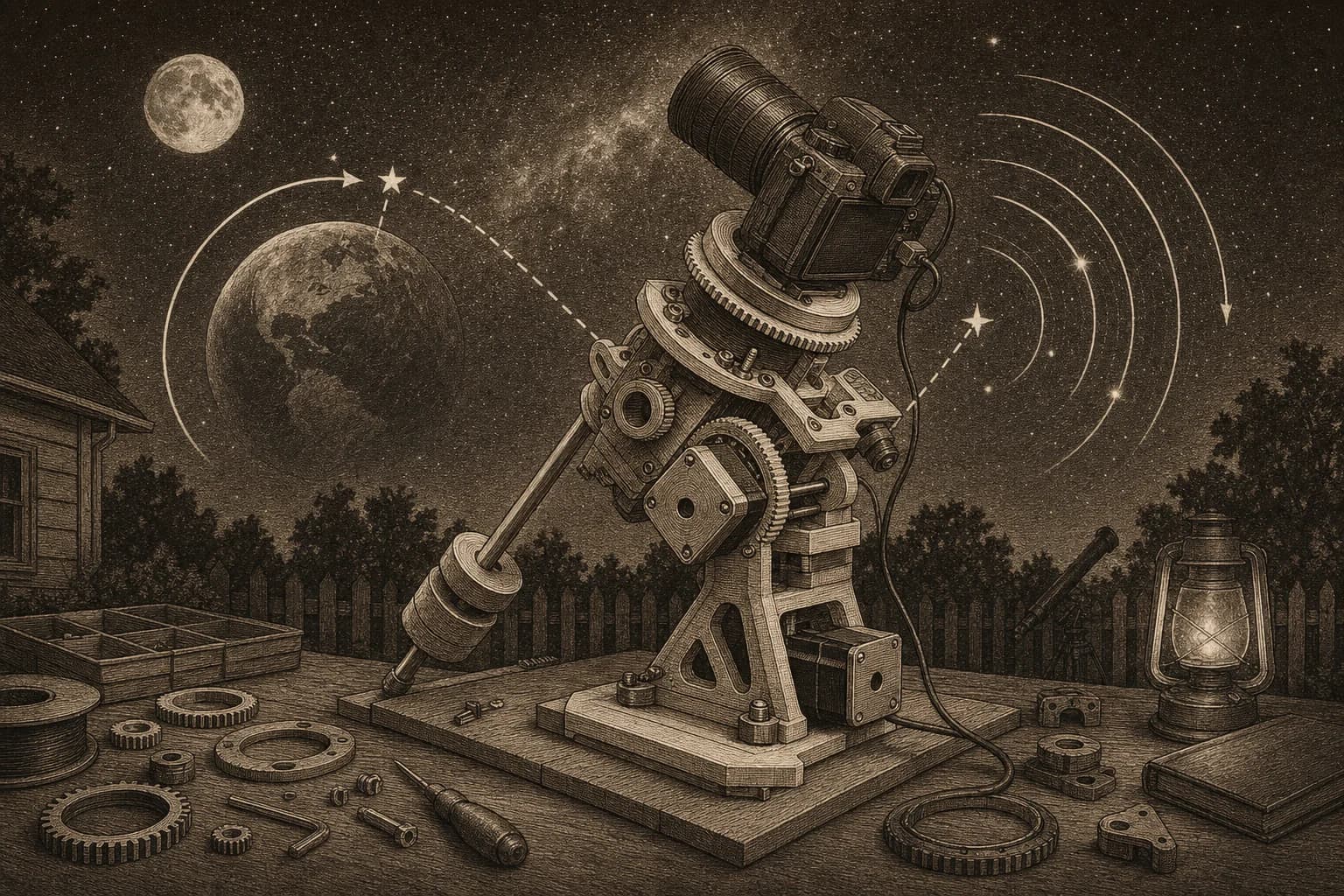
Builds an equatorial camera mount from affordable 3D-printed parts and stepper motors so the camera counters Earth's rotation for long-exposure astrophotography.
Visit OpenAstroTrackerOriginal Codex Image Gen concept art from 2026-07-10; carried forward from the validated 2026-07-25 edition.
Desk Picks are selected by the newsroom. Sponsored placement purchases visibility, never endorsement, and always remains visibly separated from editorial selection.
 Editorial illustration