research
The Molecule Answered the Twist
Structured laser light distinguished mirror-image camphor molecules through the number of charged fragments they produced.
Summary
Structured laser light distinguished mirror-image camphor molecules through the number of charged fragments they produced.
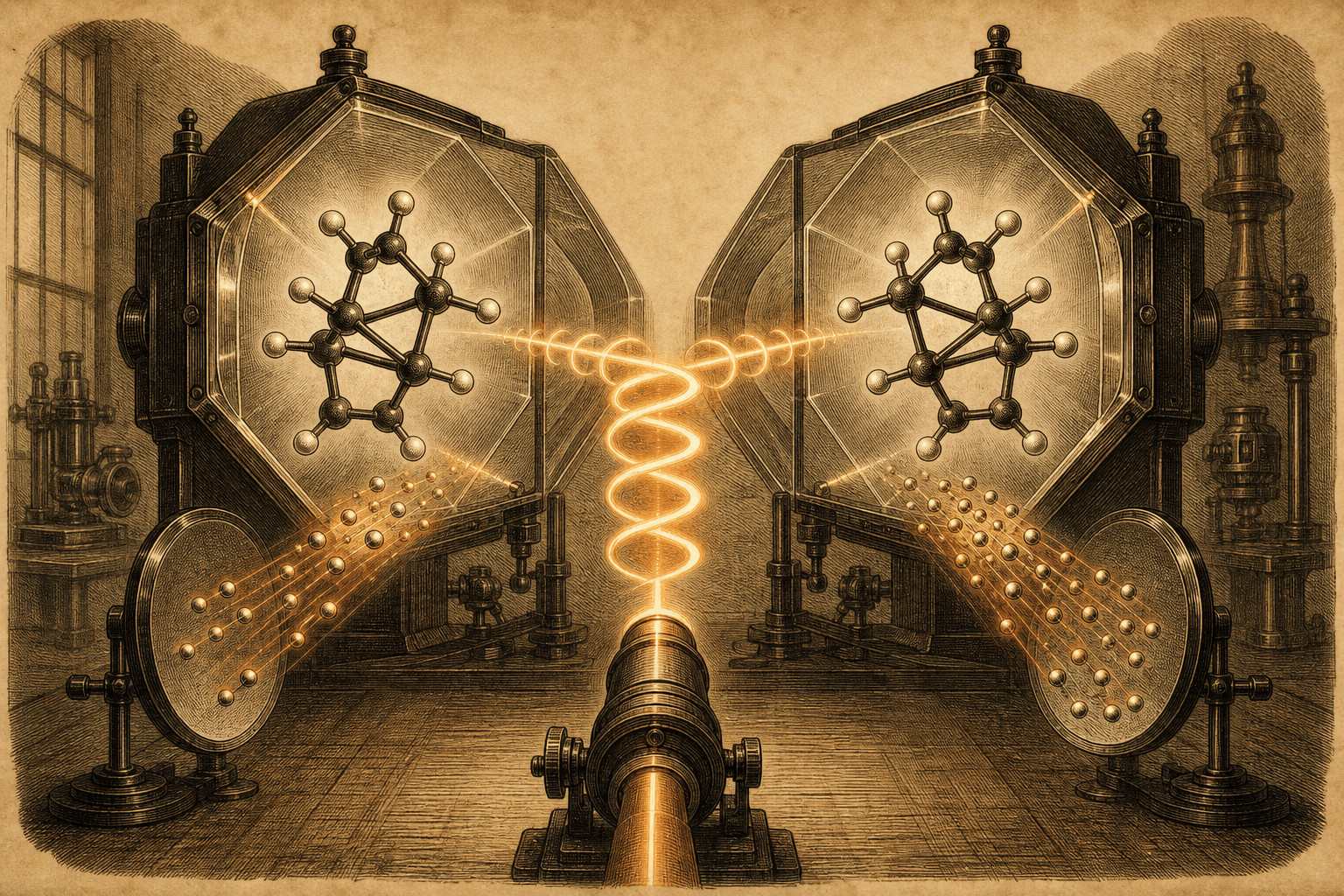
Researchers at TIFR Hyderabad, IIT Bombay and IIT Hyderabad shaped ultrashort laser pulses so the light carried both spin and orbital twist, then aimed the pulses at isolated R- and S-camphor molecules. The resulting ion counts changed with the match between the beam's handedness and the molecule's handedness, allowing the two mirror forms to be distinguished without measuring fragment angles. The Science Advances experiment offers a simpler gas-phase readout of chirality; it does not yet establish a routine pharmaceutical assay or show that every chiral molecule will respond the same way.
Why it matters
Structured laser light distinguished mirror-image camphor molecules through the number of charged fragments they produced.
Limits and context
- The Science Advances experiment offers a simpler gas-phase readout of chirality; it does not yet establish a routine pharmaceutical assay or show that every chiral molecule will respond the same way.
Key claims
Structured laser light distinguished mirror-image camphor molecules through the number of charged fragments they produced.
Qualification: The Science Advances experiment offers a simpler gas-phase readout of chirality; it does not yet establish a routine pharmaceutical assay or show that every chiral molecule will respond the same way.
Evidence: source-2026-07-27-001
Sources
- Tata Institute of Fundamental Research via Phys.org: Twisted light and molecular handednessTata Institute of Fundamental Research via Phys.org · official announcement
Corrections
No corrections have been recorded for this story.