Heating silicon-nitride membranes in ultrahigh vacuum cut the dominant surface loss and pushed intrinsic coherence sharply upward.
Editorial illustration
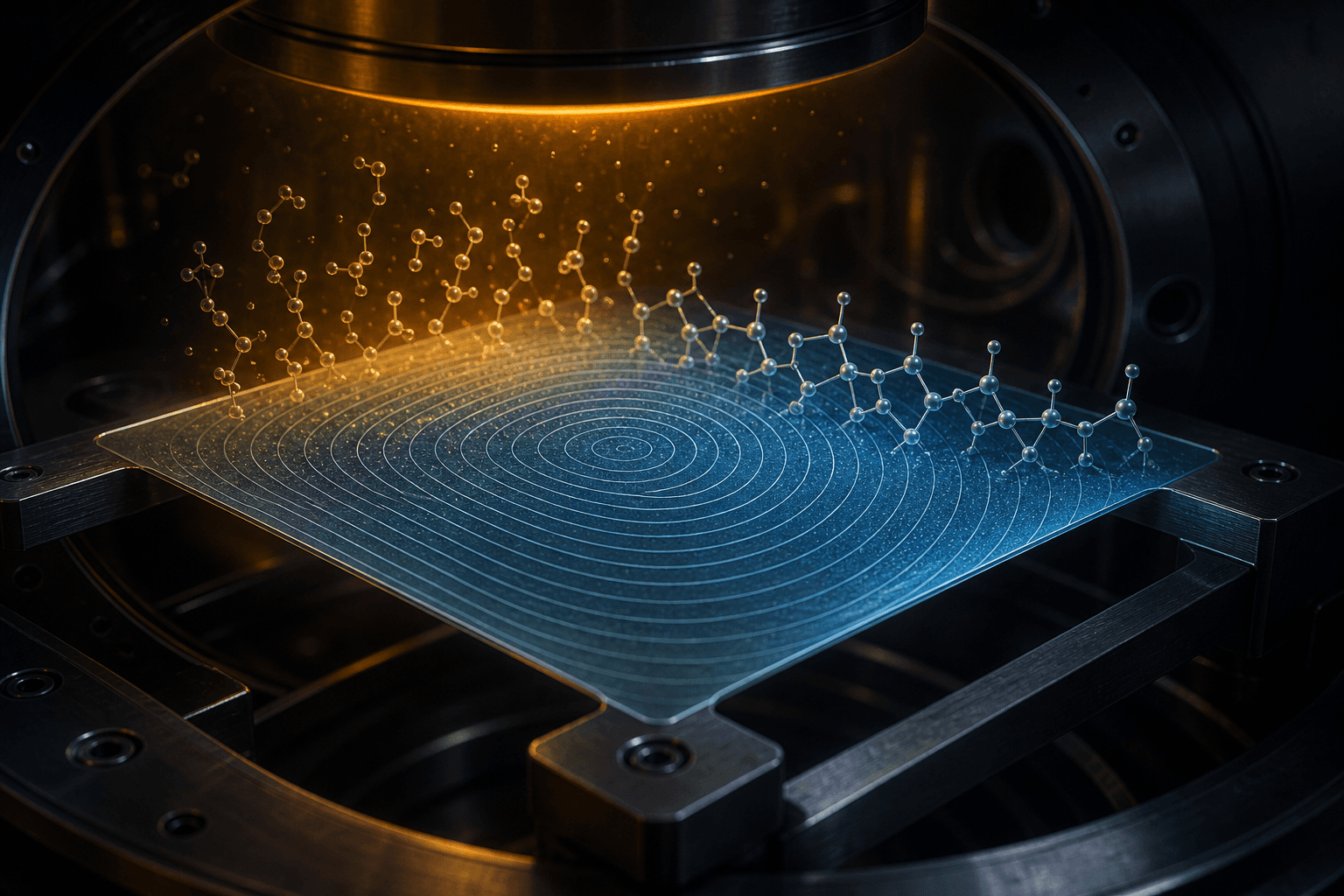
Conceptual illustration: ultrahigh-vacuum heat treatment changed surface chemistry and reduced measured loss in silicon-nitride resonators. Original editorial concept art generated with built-in Codex Image Gen for The Machine Press, 2026-08-09.
Researchers report that annealing silicon-nitride membrane resonators at 1,000 degrees Celsius increased intrinsic quality factor by as much as twentyfold, reduced surface loss eightfold and increased tensile stress. Spectroscopy and in-situ surface analysis linked the change to silanol groups condensing into siloxane bridges; controlled humidity reversed both quality factor and stress, supporting a surface-chemistry mechanism. These are author-reported preprint results on laboratory resonators, not a demonstrated commercial quantum device.
Conceptual illustration: a newly identified intermediate-mass stripped star has a Wolf-Rayet-like wind in a short-period binary. Original editorial concept art generated with built-in Codex Image Gen for The Machine Press, 2026-08-09.
A 5.94-day binary exposes an intermediate-mass helium core with emission and mass loss more typical of a classical Wolf-Rayet star.
Using the SDSS-V Milky Way Mapper and follow-up modeling, astronomers identify a hot, helium-rich stripped companion with an inferred mass of 3.2 to 5.8 solar masses orbiting a rapidly rotating O-type star every 5.94 days. The short, nearly circular orbit and spun-up companion point to earlier mass transfer; the authors argue the stripped star is caught in a brief inflated phase that makes it easier to see. Its inferred wind resembles those of more massive classical Wolf-Rayet stars, though the team cautions that selecting strong emission systems biases the sample.
A live simulator answered causal wastewater questions nearly perfectly, while a small retriever transferred better between plants.
A frozen language model was grounded three ways in an interpretable wastewater simulator. The authors report 99.5 percent on 198 causal questions using a live simulator oracle, versus 79 percent for structured parameter injection and 75.8 percent for a 110-million-parameter retriever; after transfer to a different plant, that retriever reached 88 percent and was the only tested method to handle intervention questions. These are benchmark results on simulator-grounded questions, not instructions for operating a real treatment plant.
Illustrative developer-workstation file image; it does not show CLARA, TCGA data, cancer records, query interpretations or reported results. Dhirendra Singh Dhami / Pexels; cropped, resized, metadata stripped, and converted to WebP by The Machine Press.
CLARA executes competing interpretations of cancer-genomics queries and interrupts only when their numerical answers materially diverge.
On 330 executable mutation-prevalence contrasts across eight TCGA cohorts, CLARA labeled 115 interpretation pairs as result-sensitive and 215 as stable. In a separate 120-question language stress test, the authors report that it caught all 60 consequential ambiguities while needlessly requesting clarification on 13 stable cases. The work demonstrates a safety-burden trade-off in this bounded benchmark; it does not validate free-form clinical advice.
Frozen probes recovered nearly all promoter performance but exposed much larger access gaps for splice sites and some regulatory tasks.
A unified comparison of five genomic language models found that frozen features recovered 95 to 100 percent of fine-tuned performance on promoter tasks, while average splice-site recovery fell to 60 to 88 percent. Layer probes and sequence perturbations suggested that some local biological signal exists inside the models but is not reliably accessible through final pooled embeddings. The result is a representation-accessibility audit, not evidence that any one model understands genomic function generally.
A local fluctuation-based pruning rule preserved trained recurrent-network behavior better than magnitude pruning.
Researchers tested noise-prune on task-trained recurrent neural networks and report that it preserved performance while removing connections, outperforming magnitude-only pruning and matching or exceeding a nonlocal second-order method. Sampling connections by estimated importance and rescaling those retained were both necessary, although the best rescaling was smaller than theory predicted. Biological plausibility here refers to locality of the rule, not proof that brains prune this way.
Curriculum multiple shooting stabilized training across twelve noisy and partially observed dynamical-system benchmarks.
Curriculum multiple shooting begins with short trajectory segments and progressively lengthens them while fitting neural, universal and mechanistic differential equations. Across twelve simulated and real-data benchmarks, the authors report faster, more stable convergence and top-tier generalization against existing strategies, including sparse, noisy and partially observed settings. The findings concern benchmarked model fitting and do not establish a universal optimizer for every dynamical system.
Extreme uncertainty growth in simulated turbulence was tied to localized strain, but average-looking fields offered no stable warning.
Direct numerical simulations of three-dimensional turbulence were used to estimate the chance of rare, extreme growth in uncertainty energy from strain, vorticity and vortex deformation. The analysis confirms strain rate as an important driver, yet finds that when strain and vorticity sit near their spatial averages, those fields alone cannot support a stable probabilistic forecast. This is a simulation-based predictability result, not a weather-forecasting system.
Illustrative laboratory-glassware file image; it does not show the molecules, fingerprints, datasets or reported comparisons. Rodolfo Clix / Pexels; cropped, resized, metadata stripped, and converted to WebP by The Machine Press.
Graph-Laplacian fingerprints distinguish structures with identical two-dimensional connectivity without pairwise comparison.
The proposed fingerprint treats a molecule as a complete three-dimensional weighted graph and compresses the graph Laplacian's eigenvalues into a fixed-length descriptor. The authors report that it separates stereoisomers and conformers that conventional two-dimensional fingerprints conflate, while remaining inexpensive enough for large chemical searches and performing competitively across several chemistry datasets. Results are computational benchmarks, not measured molecular properties.
In microfluidic coflows, confinement created a shear maximum that seeded the first bead-on-a-string instability.
Experiments with a shear-thinning viscoelastic liquid in a rectangular microchannel mapped stable coflow, squeezing, dripping and jetting regimes. Elasticity delayed capillary breakup, while wall-induced nonuniform shear along an inclined filament selected where the first bead-on-a-string instability appeared. Scaling arguments predicted key sizes and lengths to the correct order, giving a coupled wall-shear-elasticity picture rather than classical thinning alone.
Inverse rendering compensated for scattering in dense bioresins and preserved small channel geometry.
A tomographic volumetric bioprinting system used physically based inverse rendering to optimize projected light through cell-laden hydrogels. The authors report printing 500-micrometer vascular channels at 20 million cells per milliliter and, with refractive-index matching, operating at 41 million cells per milliliter. These are preprint demonstrations of print fidelity in bioresin, not evidence of functional tissue or clinical readiness.
Message passing replaced handpicked collective variables in a model that recovered a symmetry-breaking phase transition.
Self-Consistent Ultra-Coarse-Graining assigns hidden molecular states from the model's own interactions through graph message passing instead of user-designed collective variables. On a four-particle test system, the method captured collective switching and reproduced a temperature-driven transition despite training at one temperature. The study is a methodological demonstration on a controlled model, not yet a general biomolecular simulator.
An open multiphysics model put tritium accumulation near flow stagnation zones and made numerical stabilization the dominant uncertainty.
OpenMC, OpenFOAM and FESTIM were coupled to model neutron, fluid, heat and isotope transport in an ARC-class molten-salt breeding blanket. Under a zero-concentration inlet assumption, the steady-state calculation produced about 243 milligrams of tritium and roughly 30 minutes to steady throughput; accumulation localized in stagnation regions and fell in turbulent zones. Sensitivity was driven mainly by the numerical stabilization scheme, so the figures are model outputs, not reactor measurements.
Conceptual Visualising AI file image about machine learning; it does not show GraphRAG, retrieval graphs, citations, judges or benchmark results. Novoto Studio / Google DeepMind / Pexels; cropped, resized, metadata stripped, and converted to WebP by The Machine Press.
GraphRAG over-cited across corpora, while the damage to answer faithfulness depended on what those extra passages contained.
Across 4,440 main experiments, 600 cross-corpus runs and 1,200 paired judgments, GraphRAG returned 11 to 15 source IDs per answer with low citation precision in each tested configuration. Faithfulness fell across hops in a typed aviation-requirements corpus but rose on Wikipedia chains because extra passages were still topically useful; even the same judge changed verdicts often when retrieval state changed. The authors argue that architecture claims need tests across embedders, corpora and judges.
A fifteen-core survey found long cyanopolyynes and sulfur-bearing chains before stars or planets had formed.
Using the Yebes 40-meter telescope, astronomers detected several carbon-chain species in at least ten of fifteen starless and prestellar cores in Perseus, including HC7N in four. Isotopic variants and abundance ratios varied with density, temperature and proximity to protostellar activity. The survey maps a potential chemical reservoir for later disks and planets, but does not show that any detected molecule became biological material.
A low-redshift search found possible analogues are extremely rare, and most candidates still admit other explanations.
Starting from SDSS broad-line objects below redshift 0.35, researchers found nine whose spectral energy distributions resemble the compact high-redshift sources called Little Red Dots—0.08 percent of the parent sample. One previously known analogue reappeared, one new object showed the full set of hallmarks, and six may have alternative explanations. The work supplies cheaper nearby targets while underscoring that spectral resemblance does not settle what distant Little Red Dots are.
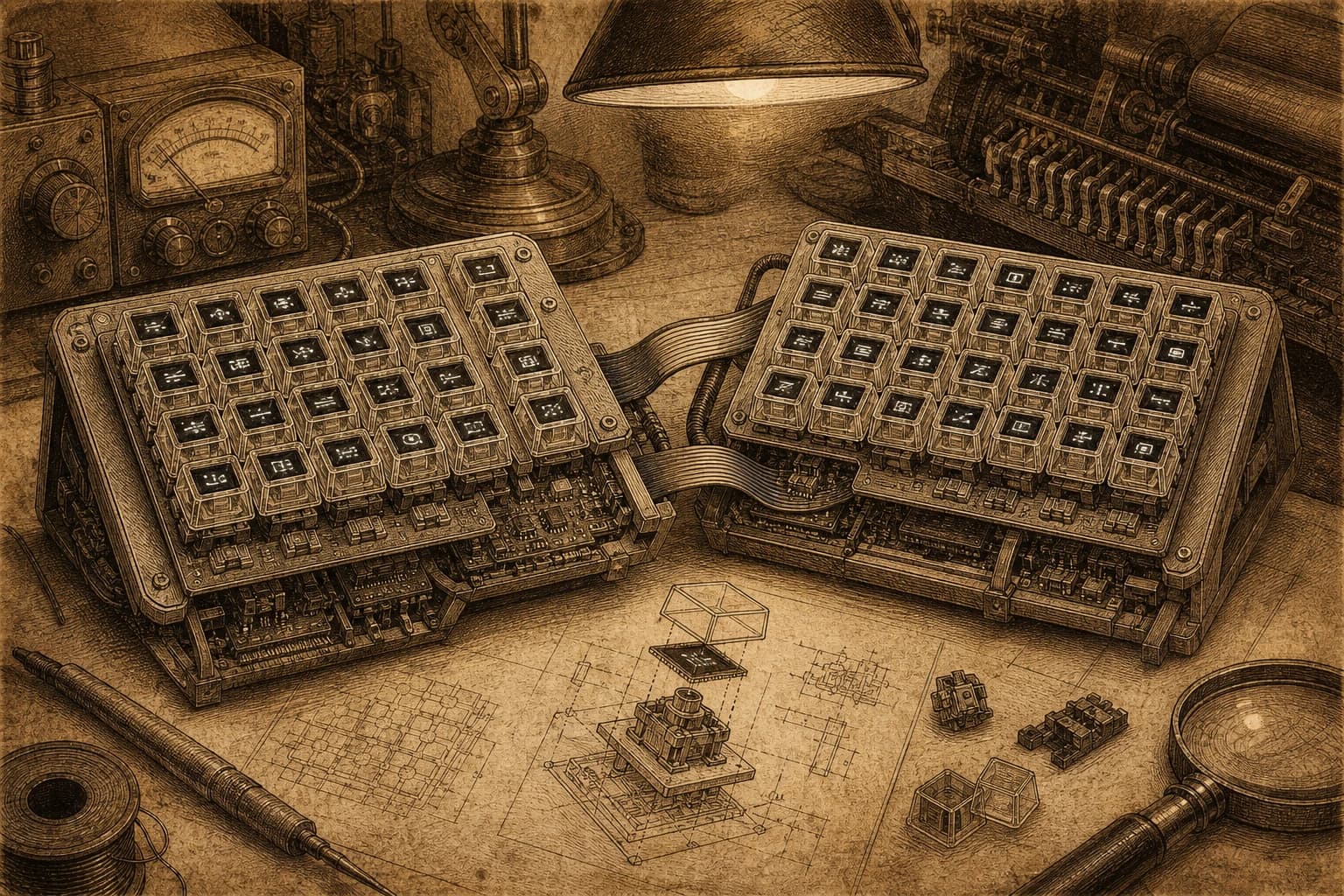
Splits 72 mechanical keys between two halves and puts a tiny OLED beneath each transparent keycap so displayed legends can change with layouts and languages.
Visit PolyKybdOriginal editorial concept art generated with built-in Codex Image Gen for The Machine Press, 2026-08-09.
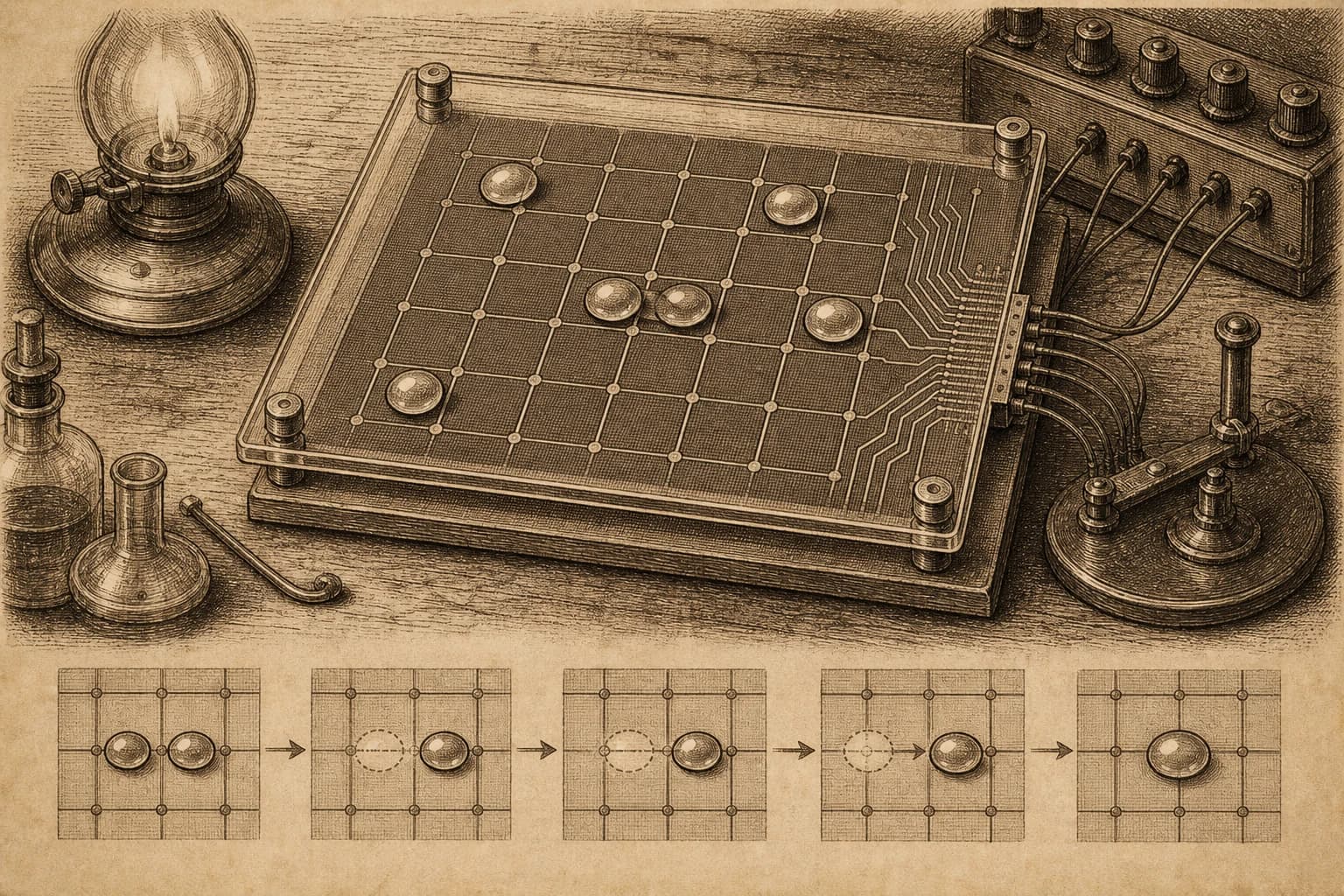
Moves and combines small liquid droplets across an addressable electrode grid, providing an open tabletop platform for digital microfluidics experiments.
Visit OpenDropOriginal editorial concept art generated with built-in Codex Image Gen for The Machine Press, 2026-08-09.
Runs video samples and shaders on a Raspberry Pi Zero, exposes four knob or control-voltage inputs, and can pass compatible external capture through visual effects.
Visit recurBOYOriginal editorial concept art generated with built-in Codex Image Gen for The Machine Press, 2026-08-09.
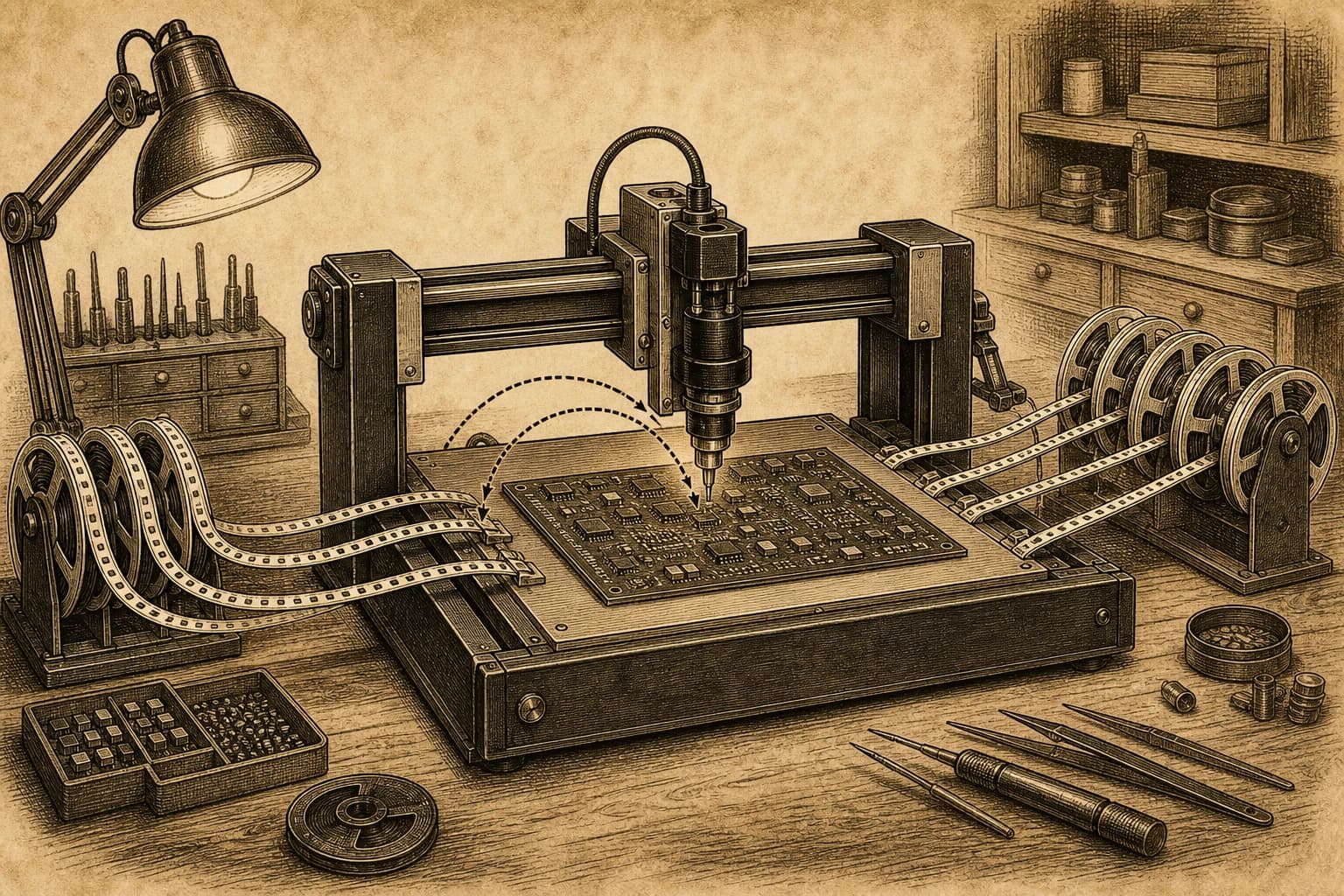
Uses a desktop gantry, placement head, and component feeders to assemble electronic parts onto circuit boards; its primary repository says machines run in active production.
Visit LumenPnPOriginal Codex Image Gen concept art from 2026-07-10; carried forward from the validated 2026-08-08 edition.
Desk Picks are selected by the newsroom. Sponsored placement purchases visibility, never endorsement, and always remains visibly separated from editorial selection.
 Editorial illustration