research
The Surface Stopped Stealing the Ring
Heating silicon-nitride membranes in ultrahigh vacuum cut the dominant surface loss and pushed intrinsic coherence sharply upward.
Summary
Heating silicon-nitride membranes in ultrahigh vacuum cut the dominant surface loss and pushed intrinsic coherence sharply upward.
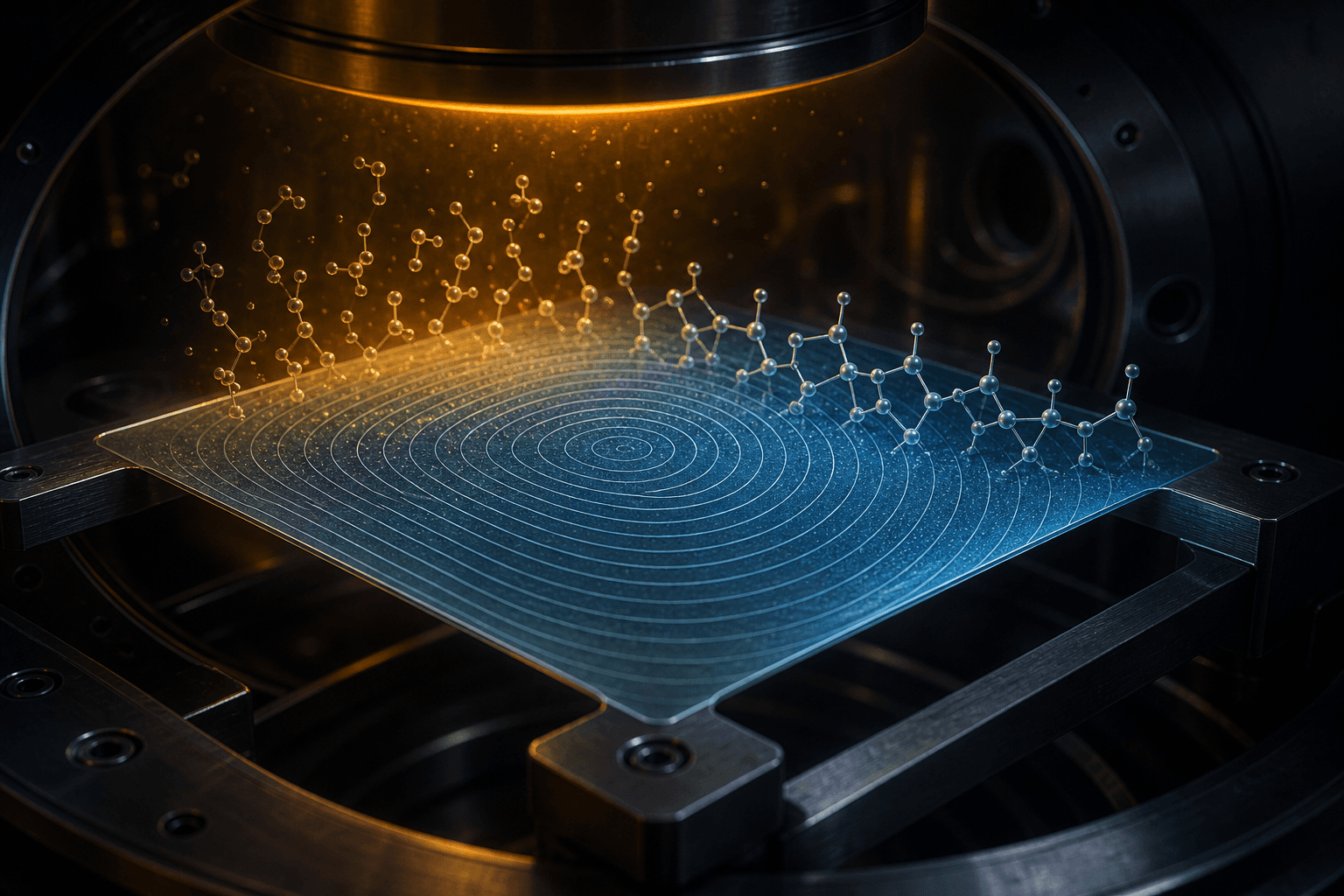
Researchers report that annealing silicon-nitride membrane resonators at 1,000 degrees Celsius increased intrinsic quality factor by as much as twentyfold, reduced surface loss eightfold and increased tensile stress. Spectroscopy and in-situ surface analysis linked the change to silanol groups condensing into siloxane bridges; controlled humidity reversed both quality factor and stress, supporting a surface-chemistry mechanism. These are author-reported preprint results on laboratory resonators, not a demonstrated commercial quantum device.
Why it matters
Heating silicon-nitride membranes in ultrahigh vacuum cut the dominant surface loss and pushed intrinsic coherence sharply upward.
Limits and context
- These are author-reported preprint results on laboratory resonators, not a demonstrated commercial quantum device.
Key claims
Heating silicon-nitride membranes in ultrahigh vacuum cut the dominant surface loss and pushed intrinsic coherence sharply upward.
Qualification: These are author-reported preprint results on laboratory resonators, not a demonstrated commercial quantum device.
Evidence: source-2026-08-09-001
Sources
- arXiv preprint 2608.05252arXiv · primary research
Corrections
No corrections have been recorded for this story.