JWST mapped molecular-hydrogen outflows from five embedded protostars and found hotter, faster gas narrowing toward the jet axis.
Editorial illustration
Conceptual illustration: JWST spectroscopy traced layered molecular-hydrogen winds around five young protostars; this is not an observation image. Original editorial concept art generated with built-in Codex Image Gen for The Machine Press, 2026-08-11.
Using NIRSpec and MIRI integral-field spectroscopy, the IPA team traced molecular-hydrogen emission across five envelope-dominated protostars spanning 0.2 to 10,000 solar luminosities. Higher-excitation lines were more collimated and faster, while wind velocity scaled with host luminosity. Four systems filled their outflow cavities without strong limb brightening, and one showed tentative rotation consistent with a launch radius near four astronomical units. The accepted ApJ study argues that magnetohydrodynamic disk-wind models can explain the layered pattern.
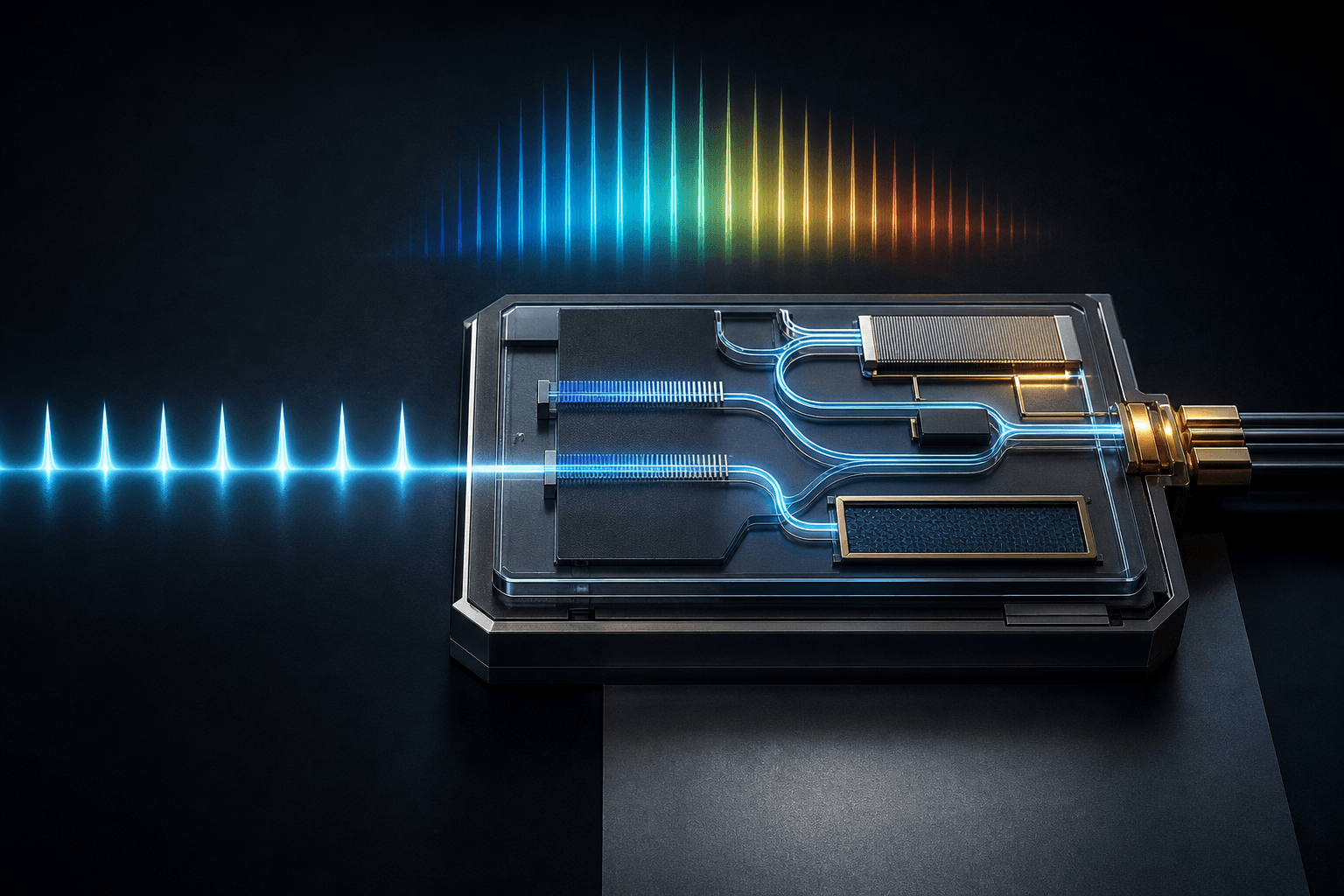
Conceptual illustration: a hybrid-integrated photonic module generated stable femtosecond pulse trains; device geometry is illustrative. Original editorial concept art generated with built-in Codex Image Gen for The Machine Press, 2026-08-11.
A dispersion-managed photonic circuit produced stable 300-femtosecond pulses at repetition rates previously elusive for integrated sources.
Researchers combined erbium-implanted silicon-nitride gain waveguides, integrated chirped Bragg gratings and a semiconductor saturable-absorber mirror in a self-starting mode-locked laser. The device generated pulses as short as 300 femtoseconds at 0.5 to 1.2 gigahertz, with thresholds down to 27.3 milliwatts. Co-packaging it with a telecom pump diode yielded an electrical-in, optical-out module. The authors report comb-line stability exceeding commercial fiber lasers by two orders of magnitude; field performance remains to be established beyond this preprint demonstration.
Flight data confirmed some predicted detector artifacts, changed others and revealed effects the laboratory had missed.
The SPHEREx team catalogs low-level optical and electronic artifacts in first-survey images from six HAWAII-2RG detectors, including cosmic-ray signatures, crosstalk and unresponsive pixels. Some in-flight behavior matched laboratory expectations; other effects differed or appeared unexpectedly. Documenting those signatures lets the science pipeline mitigate false structure before all-sky spectroscopy is interpreted. The report is an instrument-calibration study, not a new astronomical discovery from the affected pixels.
Illustrative infrastructure file image; it does not show GENCO, Hydro-Québec, training data, a modeled grid or reported results. Robert So / Pexels; cropped, resized, metadata stripped, and converted to WebP by The Machine Press.
GENCO uses one physically corrective neural architecture for power flow, optimal power flow and state estimation.
GENCO shares a network representation across three steady-state transmission-grid tasks, while a new GridFM framework standardizes synthetic data generation and training. On the authors' benchmarks it reached up to 30-fold speedups over Newton-Raphson power flow and up to 85-fold over IPOPT optimal power flow. Tests also included Hydro-Québec SCADA data. Those are author-reported evaluations; utilities would still need independent safety, stability and domain validation.
SHE turns failed agent trajectories into targeted revisions of prompts, rules, memory and tool policy.
Safety Harness Evolution divides an agent harness into four accountable artifacts, diagnoses rollout failures and applies localized boundary changes only after safety-versus-utility checks. On Agent-SafetyBench, the authors report a 3.1-fold reduction in attack success compared with a static SafeHarness, alongside improved benign utility. They also report transfer to held-out risks and other agent models. The evidence is benchmark-based preprint work, not a production security guarantee.
ArchAgent v2 evolved a three-level cache prefetcher while enforcing hardware-size limits during search.
The framework breaks a huge microarchitecture search into cache levels, evolving and freezing each in sequence, while feeding real-time hardware-size estimates back into candidate selection. Under the fourth Data Prefetching Championship rules, its design posted a 3.8 percent geometric-mean IPC speedup over baseline and edged the prior hand-designed winner by 0.3 percent. Multi-core search remains constrained by slow simulation, and the result is a competition-style evaluation rather than fabricated silicon.
A Gemini-based multi-agent system was rated against physicians across 100 simulated primary-care video consultations.
In a randomized OSCE study with 30 primary-care physicians, 15 patient actors and 100 scenarios, evaluators rated AMIE Video on par with or better than physicians for history-taking, diagnosis, management and visual observation. Patient actors preferred its explanations, while physicians retained an advantage in rapport and partnership. The system still struggled with anatomical precision, subtle affect and fast motion. This controlled simulation does not establish clinical safety or authorize unsupervised care.
A position paper recasts autonomous experimentation as greybox fuzzing with dense progress signals.
The authors argue that generate-and-rank research agents waste scarce feedback because they score completed experiments without steering the next intervention. Their alternative treats each experiment like a fuzzing run: execute a candidate, expose a cheap signal of epistemic coverage, then mutate the next attempt toward unexplored mechanisms. The paper offers a design framework rather than a validated autonomous scientist, and final scientific claims would still require conventional evidence and human scrutiny.
Conceptual Visualising AI file image; it does not depict pollutants, monitoring stations, AirFlow forecasts or public-health results. Novoto Studio / Google DeepMind / Pexels; cropped, resized, metadata stripped, and converted to WebP by The Machine Press.
AirFlow separates slow context from rapid changes instead of forcing every air-quality channel through one temporal backbone.
AirFlow uses pollutant-aware normalization and dual temporal streams on station observations, aiming to preserve long context while tracking fast concentration changes. The authors position the method against shared-latent forecasting systems that blur channel-specific periodicity and distribution shifts. Reported tests support the architecture's forecasting gains, but the preprint does not turn a model forecast into a public-health determination; local agencies and measured conditions remain authoritative.
MDA combines LLM-proposed mechanisms with Bayesian inference and value-of-information experiment selection.
The Model Discovery Agent proposes candidate causal structures, estimates their parameters and posterior probabilities, and chooses interventions expected to discriminate among them. Sequential Monte Carlo and simulation-based inference provide the numerical machinery; the language model supplies structural hypotheses. The goal is to learn mechanistic world models from fewer experiments. It remains a preprint framework: a plausible mechanism proposed efficiently is not the same as a confirmed causal explanation.
A frozen multimodal model describes the target, then a separate matcher chooses among layout-aware candidates.
The proposed regression-free pipeline separates semantic interpretation from precise localization. A frozen multimodal model expands an instruction into a structured visual description, while a grounding model matches that description against layout-prior candidates using only text-versus-icon labels. By avoiding direct coordinate generation, the authors aim to suppress hallucinated click locations without costly end-to-end fine-tuning. Reported benchmark gains remain preprint results and do not eliminate interface ambiguity or unsafe actions.
Illustrative developer-workstation file image; it does not show ElasticBack, a poisoned skill, an attack trace or a compromised system. Dhirendra Singh Dhami / Pexels; cropped, resized, metadata stripped, and converted to WebP by The Machine Press.
ElasticBack hides a malicious rule in one agent skill and activates it only when a benign-looking trigger also appears.
The attack couples a trigger in the user query with a rule planted inside an installed skill, so ordinary testing can leave the payload dormant. That conditional behavior targets an emerging supply chain of on-demand instruction bundles and resources. The paper describes an offensive evaluation intended to expose a defense gap; it does not show a named ecosystem compromise. Skill provenance, least privilege, content review and runtime monitoring remain necessary controls.
ATLAS builds a patient-specific conflict graph before revising a complex medication plan.
ATLAS structures guideline evidence as a medication-safety graph, asks targeted questions about missing conditions and geriatric risks, then distills relevant relations into a patient-specific conflict graph. A risk-first multi-agent policy screens contraindications, cautions, monitoring needs and alternatives. The accompanying GeriMedBench tests interactive information gathering and plan revision. This is preprint benchmark work, not medical advice, prescribing authority or evidence of improved outcomes in real patients.
Panoramic video and spatial audio support questions about a source's identity, direction, distance and motion.
ST-OmniQA pairs 40,000 panoramic videos with synchronized first-order Ambisonics audio and supplies 400,000 questions across recognition, direction, distance and trajectory tasks. The accompanying ST-Omni-R1 system integrates spatial-audio representations with panoramic vision. The authors report 77.83 percent average semantic accuracy versus 37.28 percent for their strongest evaluated baseline. Those numbers describe this new benchmark, not general real-world listening or surveillance capability.
CADEngBench scores editable geometry, manufacturing checks, joints and structural response—not just visual resemblance.
One track contains 300 parametric parts used for 600 creation and editing tasks, with boundary-representation validity, design-for-manufacturing checks, perturbations and matched finite-element analysis. A second track tests 150 body pairs for joint retrieval, exact geometry grounding, frame prediction and kinematic verification. The benchmark addresses a practical gap in generative CAD evaluation, though success on its declared simulations does not certify a design for manufacture or safety-critical use.
P3 develops code and a machine-checkable correctness argument from one shared plan.
Verified code generation often writes a program first and then struggles to prove it, creating brittle repair loops. P3 instead derives a unified program-and-proof plan from the formal specification, then elaborates implementation and proof scaffolding together. The authors report improved results on formal-programming tasks, but the workflow remains model- and benchmark-dependent. A verifier can check the encoded specification; it cannot guarantee that the specification captured every real requirement.
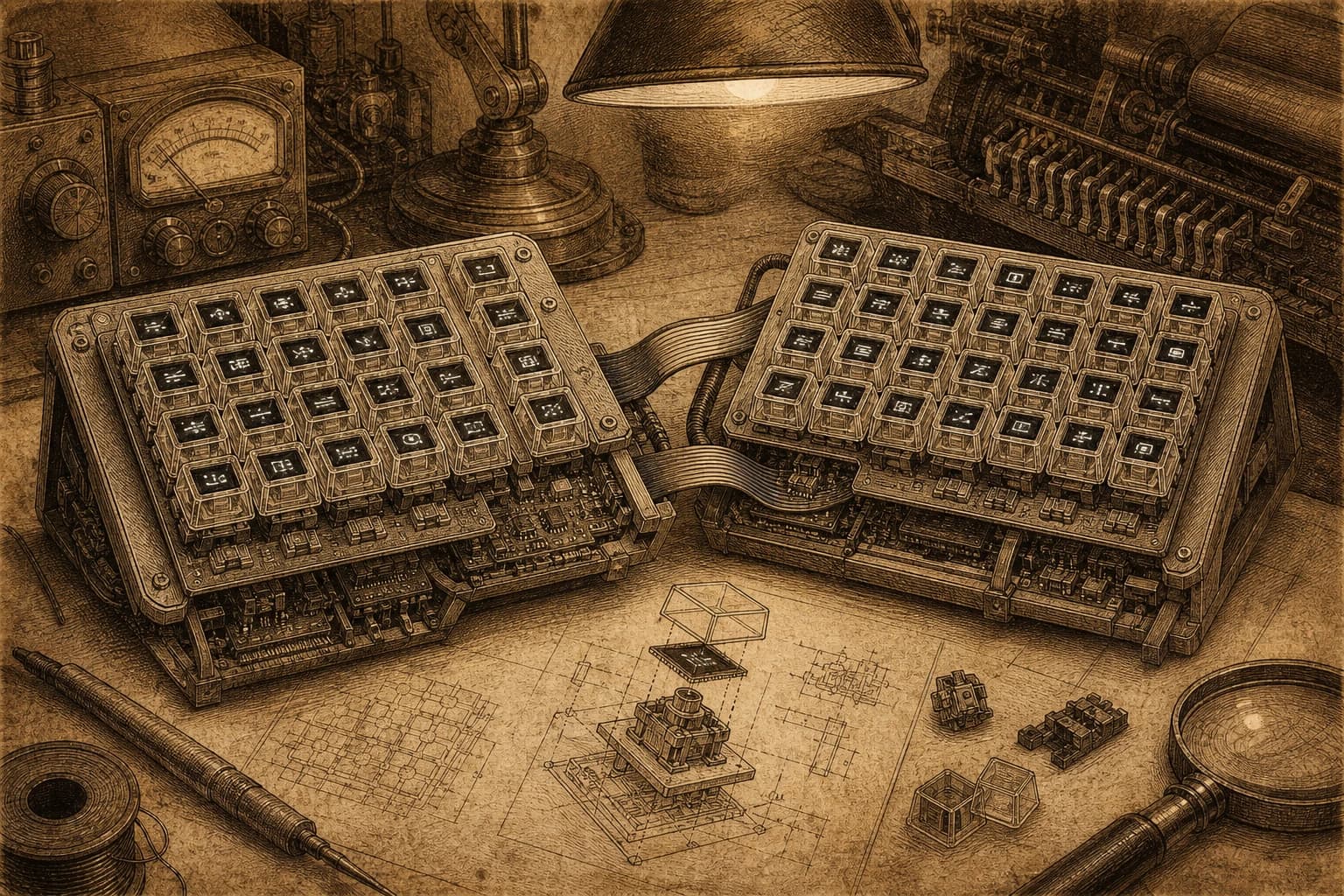
Splits 72 mechanical keys between two halves and puts a tiny OLED beneath each transparent keycap so displayed legends can change with layouts and languages.
Visit PolyKybdOriginal editorial concept art generated with built-in Codex Image Gen for The Machine Press, 2026-08-09.
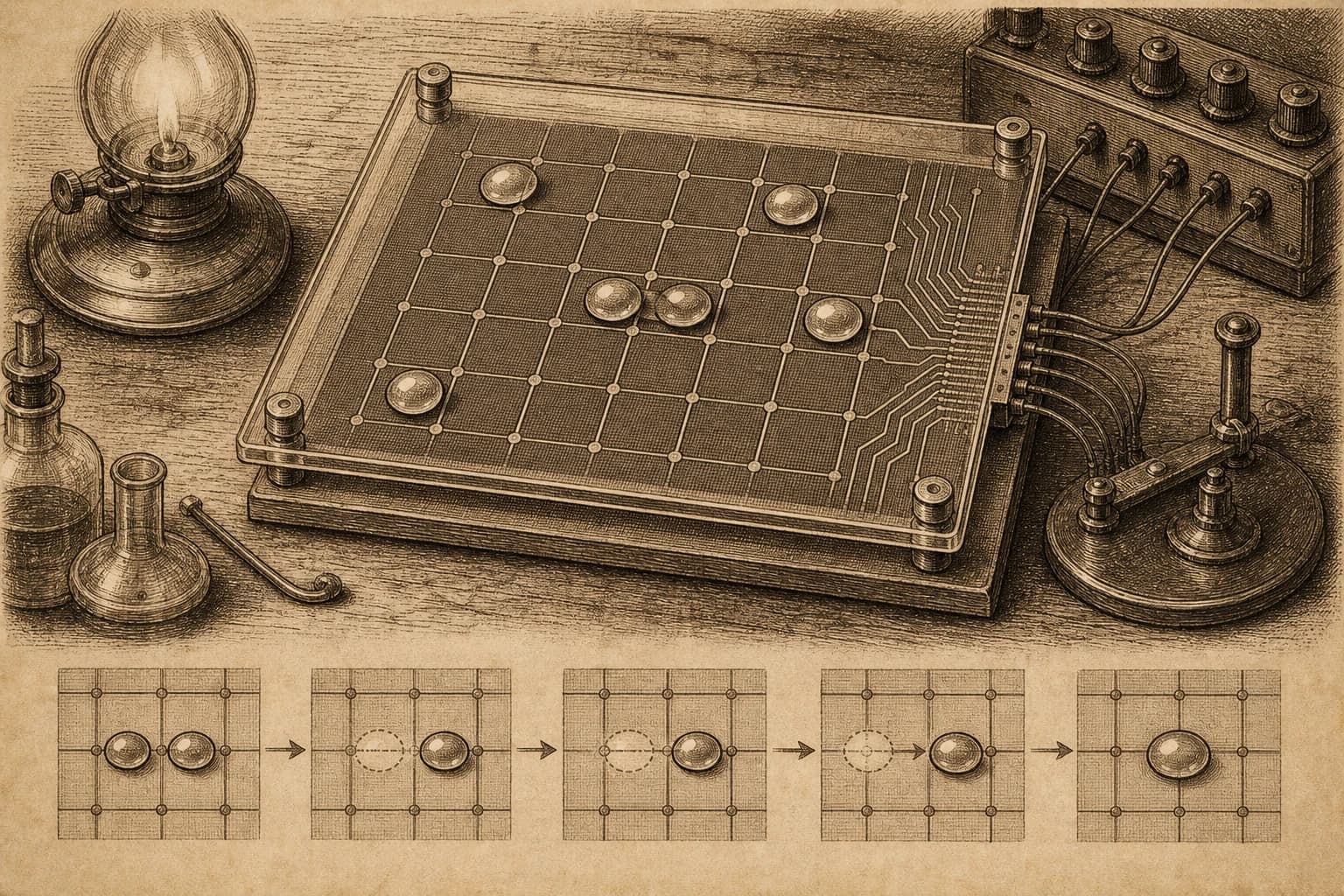
Moves and combines small liquid droplets across an addressable electrode grid, providing an open tabletop platform for digital microfluidics experiments.
Visit OpenDropOriginal editorial concept art generated with built-in Codex Image Gen for The Machine Press, 2026-08-09.
Runs video samples and shaders on a Raspberry Pi Zero, exposes four knob or control-voltage inputs, and can pass compatible external capture through visual effects.
Visit recurBOYOriginal editorial concept art generated with built-in Codex Image Gen for The Machine Press, 2026-08-09.
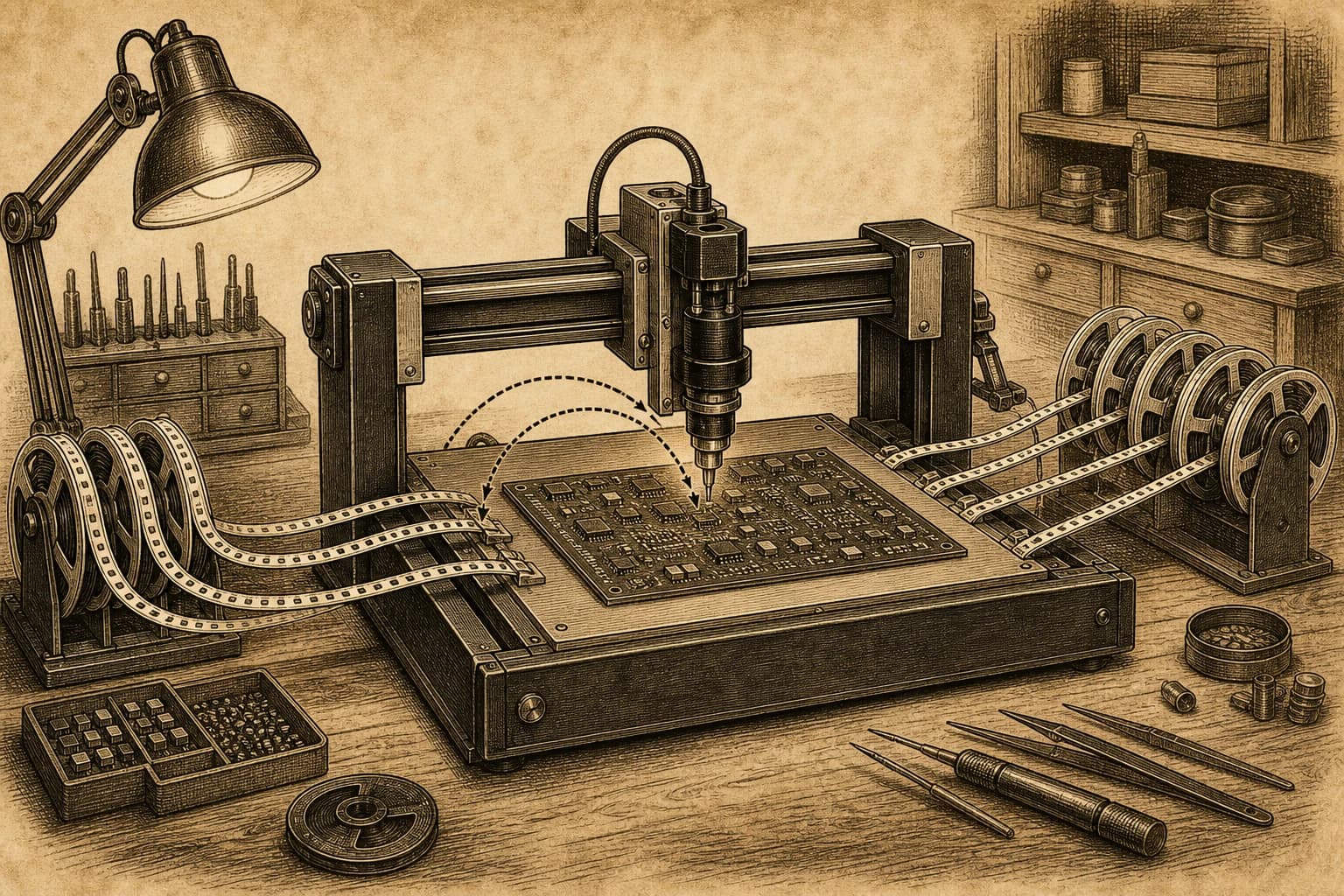
Uses a desktop gantry, placement head, and component feeders to assemble electronic parts onto circuit boards; its primary repository says machines run in active production.
Visit LumenPnPOriginal Codex Image Gen concept art from 2026-07-10; carried forward from the validated 2026-08-08 edition.
Desk Picks are selected by the newsroom. Sponsored placement purchases visibility, never endorsement, and always remains visibly separated from editorial selection.
 Editorial illustration