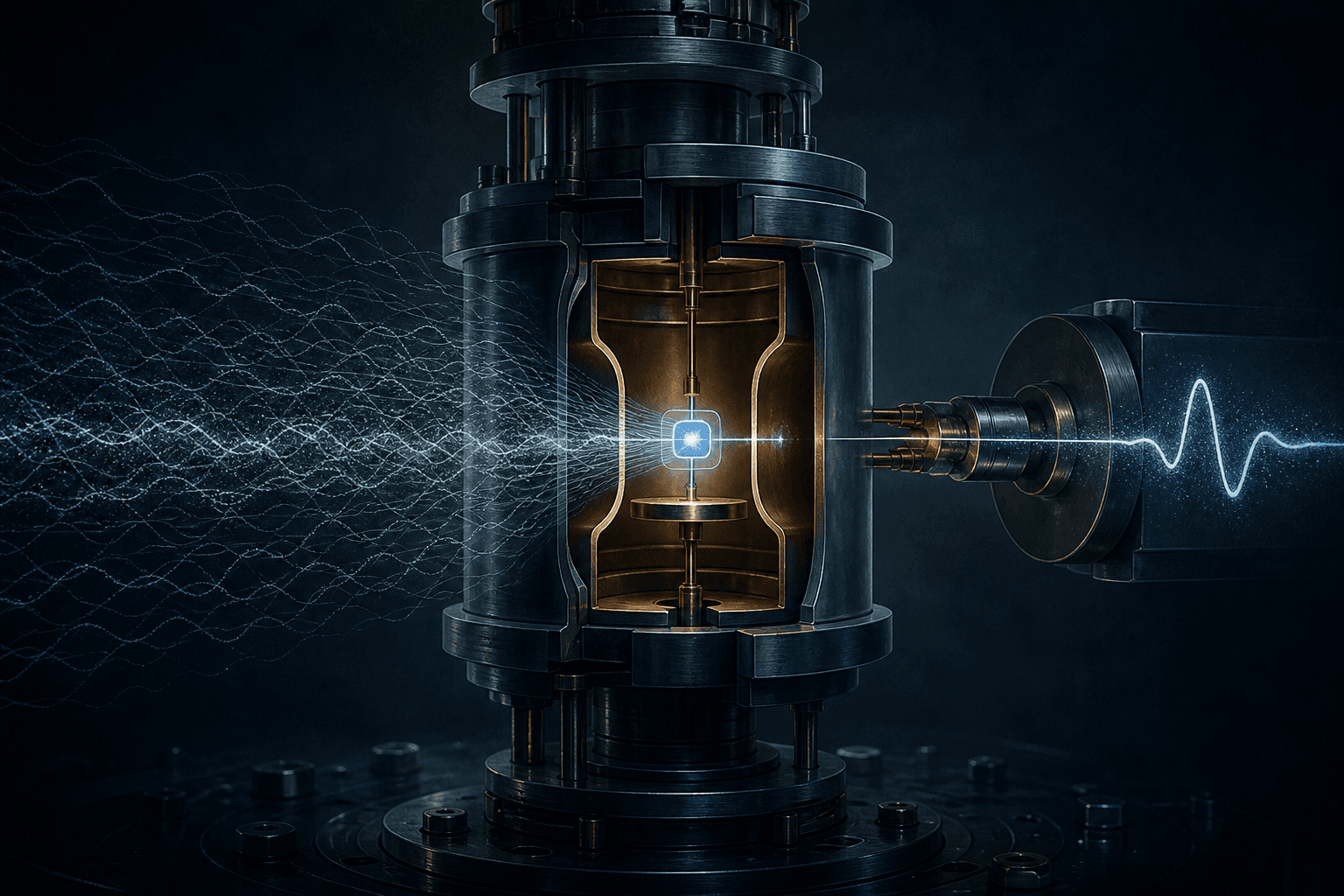
A controllable qubit coupled to an otherwise conventional sensor produced a certified exponential advantage for learning features of classical signals.
Editorial illustration
Conceptual illustration: a superconducting cavity-qubit experiment demonstrated a large measurement advantage for specified classical-signal learning tasks; the apparatus is not shown literally. Original editorial concept art generated with built-in Codex Image Gen for The Machine Press, 2026-08-14.
The researchers develop quantum feature sensing: algorithms that turn a defined sensing objective and experimental constraints into lower bounds, optimal protocols and a certificate of quantum advantage. In a superconducting cavity-qubit experiment, they report a ten-millionfold reduction in measurements for learning Fourier amplitudes and time-varying signals. Simulations also show large gains for weak-signal dark-matter searches and wireless tasks. The demonstrated advantage applies to the specified feature-learning problems and apparatus; it is not a universal speedup for every sensor or data-analysis workload.
Conceptual illustration: InSPECtor compares generated instruction behavior with hardware references; no specific vendor processor or literal test output is depicted. Original editorial concept art generated with built-in Codex Image Gen for The Machine Press, 2026-08-14.
A differential-testing system generated instruction cases from SLEIGH definitions, then checked emulator behavior against hardware references across five architectures.
InSPECtor treats processor specifications as security-critical software rather than unquestioned ground truth. It enumerates decodable instruction forms from open SLEIGH specifications, generates targeted machine states and compares decoding and emulation with physical hardware references. Across x86-64, AArch64, ARM/Thumb, RISC-V and MSP430, the authors report more than 38,920 discrepancies that resolved into 125 unique bugs with proposed fixes, including decoding, semantic and cross-vendor inconsistencies. The results concern the tested open specifications and reference systems; they do not mean that every discrepancy is a hardware defect.
BoardroomAI routes human interventions through a typed decision graph, preserving unaffected work and abstaining when repaired context is insufficient.
The prototype represents evidence, assumptions, constraints, claims, objections, alternatives, risks and decisions as a dependency graph. A human intervention compiler updates that graph and selectively reactivates specialists. Across 600 synthetic decision-DAG changes, propagation matched exhaustive impact calculation while inspecting 14.59 percent of nodes. In a 12-case pilot it preserved every gold-unaffected node, produced six valid updated decisions and abstained on six others. All results are synthetic and prototype-level, as the authors state.
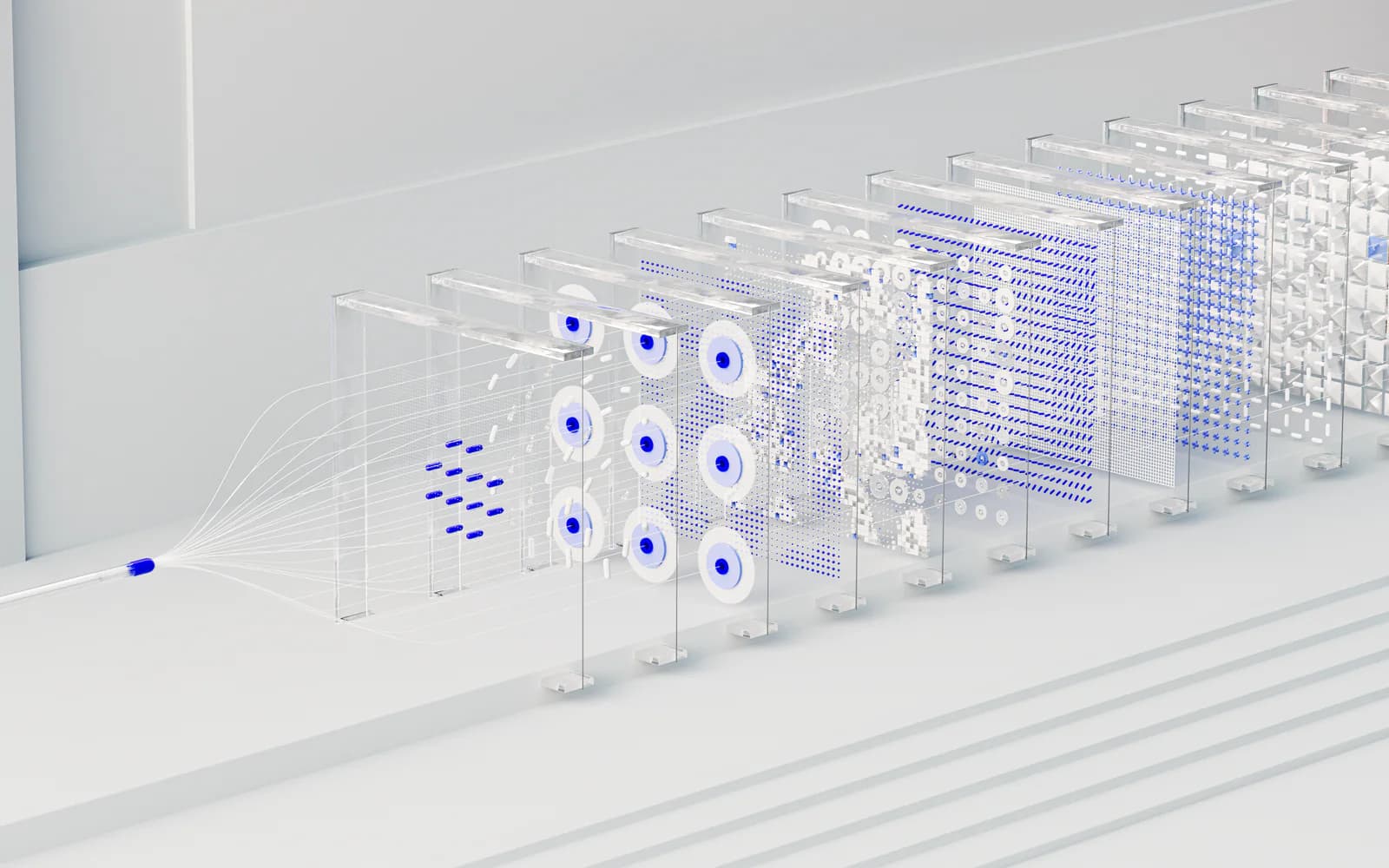
Conceptual Visualising AI file image inspired by neural networks; it does not show LOPD, latent tokens, model trajectories or reported benchmark results. Novoto Studio / Google DeepMind / Pexels; cropped, resized, metadata stripped, and converted to WebP by The Machine Press.
Latent on-policy self-distillation made the teacher's private context learnable and used less than thirty percent of two comparison methods' rollout budgets.
LOPD retrieves relevant experiences, compresses them into continuous latent tokens for a privileged self-teacher and supplies dense token-level supervision along the student's own trajectories. On agentic tool-use and code-generation tasks, the authors report gains over reinforcement learning with verifiable rewards and several self-distillation baselines. Ablations attribute the improvement to learning the privileged context instead of prescribing answers, feedback or skills. The evidence is benchmark performance, not a demonstration of autonomous open-ended self-improvement.
GCache optimized reuse against final generation quality instead of trusting local similarity at each diffusion step.
The method models how cached approximation errors propagate through a denoising trajectory, then searches for a reuse policy whose weighting aligns with final visual loss. On Wan2.1 video generation, the authors report a 2.17-times speedup while lowering LPIPS from 0.1095 to 0.0316 relative to the compared cache policy. Results across image and video models favor the global-impact strategy. Those gains depend on the tested models, schedules and quality measures rather than guaranteeing the same tradeoff for every diffusion deployment.
A unified annotation scheme and structure-aware loss represented intact limbs, residual limbs and varied prostheses without forcing one anatomy onto all bodies.
ProPose addresses a benchmark bias toward able-bodied subjects by giving biological limbs, mechanical prostheses and physical absences one topological representation. A real-to-synthetic expansion pipeline adds scarce prosthetic cases, while ProLoss enforces dependencies within each limb so independent keypoint predictions do not hallucinate joints on mechanical structures. Reported classification accuracy for long-tail prosthetic joints improves by two to six percentage points without reducing coordinate localization. The work is a pose-estimation benchmark and model objective, not a clinical assessment system.
Eleven world models struggled to turn egocentric human demonstrations into robot videos with consistent embodiments, contacts and completed tasks.
H2R-Bench pairs a human demonstration with target robot constraints and source-grounded annotations for goals, action events, functional contacts and object responses. Across six manipulation families and two robot embodiments, even leading video generators often failed embodiment consistency, functional interaction or task execution. The benchmark separates those failures from general video quality, exposing why visually plausible clips are not automatically useful robot-training data. It evaluates generated videos; it does not show that the models safely control physical robots.
Graph-aware retrieval produced threat-hunting plans that relied on more durable attacker behavior than vector retrieval did.
The experiment feeds the same incident reports and generation instructions to a knowledge-graph retrieval system and a conventional vector-retrieval system. After every IP address, domain and file hash in an APT28 report was rotated, the GraphRAG plan retained all of its detections while the comparison retained 29 percent. Nine reports from four vendors showed the same directional pattern toward harder-to-evade techniques. Prompt wording still mattered substantially, and this study evaluates generated hunting plans rather than proving operational detection performance in every security environment.
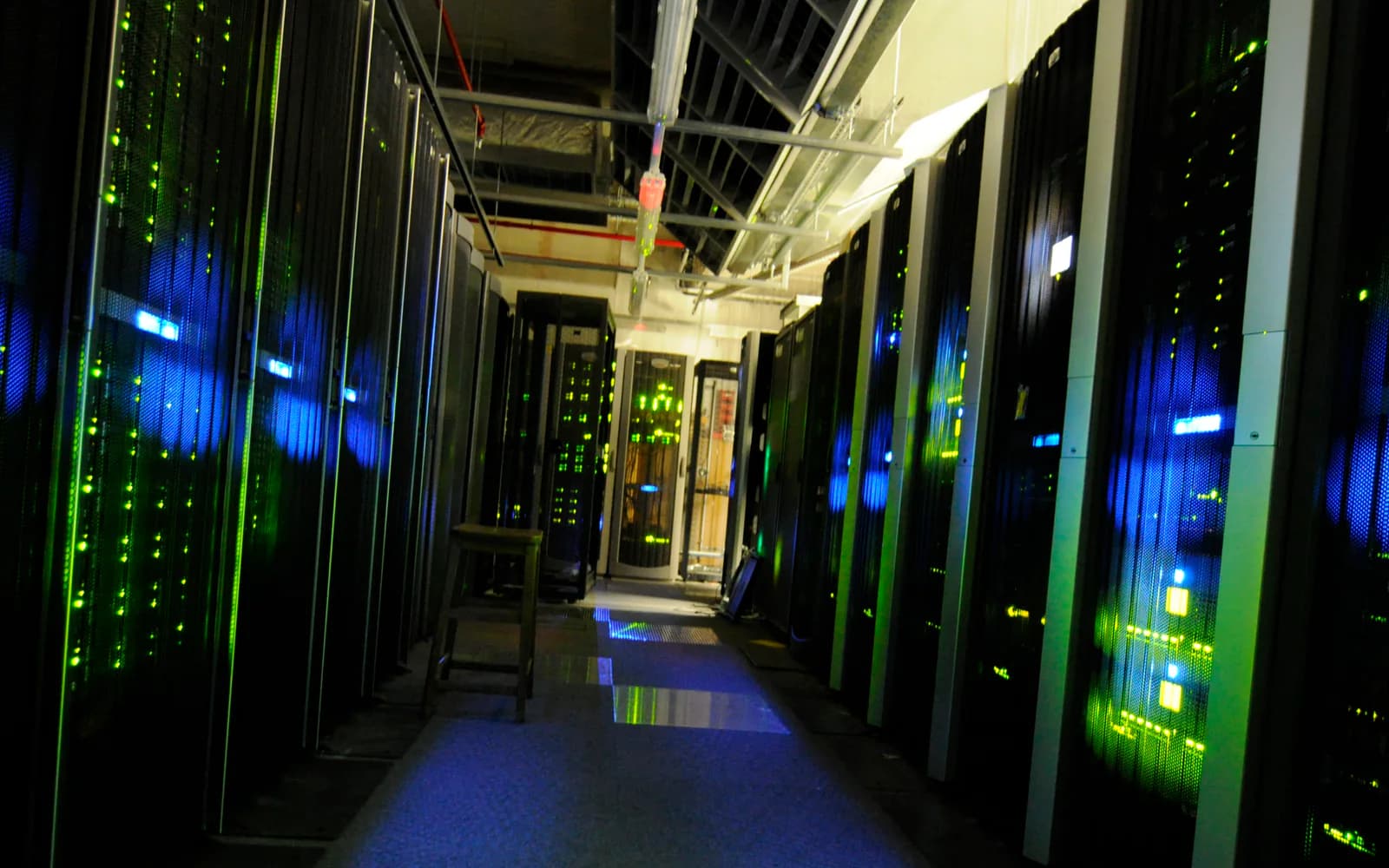
Illustrative file image of a server room at The National Archives; it does not show the tested GPUs, SGLang, TEMPO or reported measurements. The National Archives (UK), via Wikimedia Commons, CC BY 3.0; cropped and converted to WebP by The Machine Press.
TEMPO models expert serving as memory-bound below one token threshold and compute-bound above it, then dispatches for the actual batch regime.
Measurements on two data-center GPU generations show that balancing token counts alone misses a regime change: small expert loads pay mainly for weight streaming, while larger loads pay for padded matrix-multiplication tiles. TEMPO solves a fixed-charge makespan problem outside the critical path and integrates with SGLang. On Qwen3-235B in the predicted win region, throughput rose four to six percent and p99 latency fell about 15.6 percent; a communication-bound DeepSeek-V3 case did not improve, matching the authors' phase diagram rather than a universal-win claim.
VALG tracks theorem scope, proof dependencies and formulation changes so a weaker result cannot silently masquerade as the original target.
The open-source system maintains a typed proof-dependency graph, reviews local proofs in order and routes failures to derivation repair, graph repair or an explicitly related theorem variant. Across nine subproblems from five COLT 2026 open problems, two runs produced internally finalized theorem candidates matching the source briefs; the rest yielded special cases, conditional results or restricted methods. The study demonstrates disciplined bookkeeping and candidate generation, not independent confirmation that the finalized theorems are correct or publishable.
Uniform Herding reselects bounded class exemplars in the model's current representation instead of freezing yesterday's geometry.
On a ten-task CIFAR-100 protocol with a 2,000-example active budget, the method reports 44.00 percent final average accuracy and 17.22 percent forgetting, compared with 42.33 percent and 24.87 percent for iCaRL. Removing distillation increased forgetting, while changes to the active budget mattered more than the retrieval budget. Because the end-to-end comparison changes more than exemplar refresh alone, the paper explicitly limits its causal claim to the tested protocol.
A non-invasive multispectral sensor separated calcium-carbide treatment from safer ripening methods while estimating progress and shelf life.
The study measures mangoes and bananas at 18 visible-to-near-infrared wavelengths and combines spectral ratios with temperature and humidity. XGBoost models reached 95 percent overall accuracy for mangoes with 0.67 recall on the carbide class, and 81 percent accuracy for bananas with 0.74 carbide recall. The method also estimates ripening progression and remaining shelf life. These are controlled-sample results; misses remain substantial enough that the prototype is not a standalone food-safety guarantee.
Distributed speculative decoding cut verifier calls by 76 percent in the reported tests without changing the larger model's accepted output.
SPADE places a small draft model on the edge and asks a cloud model to verify candidate tokens in parallel. Accepted tokens stay local to the draft path, while rejected ones trigger correction, shifting much of the computation away from repeated cloud generation. Across SpecBench and CNN/DailyMail tasks, the authors report 76 percent fewer cloud-model calls with no accuracy loss relative to using the full model throughout. Network conditions, privacy implications and provider pricing were not established as universal advantages by the benchmark.
Illustrative developer-workstation file image; it does not show Coins, Rocq specifications, HumanEval cases or proof obligations. Dhirendra Singh Dhami / Pexels; cropped, resized, metadata stripped, and converted to WebP by The Machine Press.
Coins evaluates generated Rocq specifications on trusted concrete cases so proof difficulty is less easily mistaken for specification quality.
Formal-specification benchmarks often require proving an implementation conforms or showing two specifications are semantically equivalent, which can turn a hard proof into an ambiguous model failure. Coins instead instantiates candidate specifications on curated HumanEval cases and generates concrete proof obligations whose successful discharge is strong evidence. The large-scale study finds specification synthesis remains difficult and model scaling alone does not resolve the measurement problem. The framework improves evaluation fidelity; it does not certify arbitrary generated specifications.
Semantic radiance fields combine reconstructed appearance, geometry and class identity for training spatial-reasoning agents.
The proposed simulator lifts two-dimensional segmentations from vision models into a three-dimensional radiance field built from posed RGB captures. A single representation can render new views while answering semantic and free-space queries, addressing the realism gap of synthetic environments and the annotation gap of reconstructed ones. An orchard apple-reaching task illustrates how rendering, ground truth and occupancy could feed a physics engine. It is an architecture and example application, not a reported large-scale robot-training deployment.
A conditional flow-matching generator produced controllable market trajectories with fewer solver evaluations than a matched diffusion baseline.
FlowLOB trains on several Hong Kong Exchange symbols at three sampling frequencies and represents prices relative to ticks so the generator can transfer to an unseen instrument. Under matched data, architecture and training budget, flow matching reached its best reported quality with ten ODE steps; diffusion required more evaluations to approach it. Most distributional metrics improved at the two finer frequencies, and counterfactual controls transferred to the held-out symbol. Synthetic realism does not establish trading profitability or faithful behavior during every market regime.
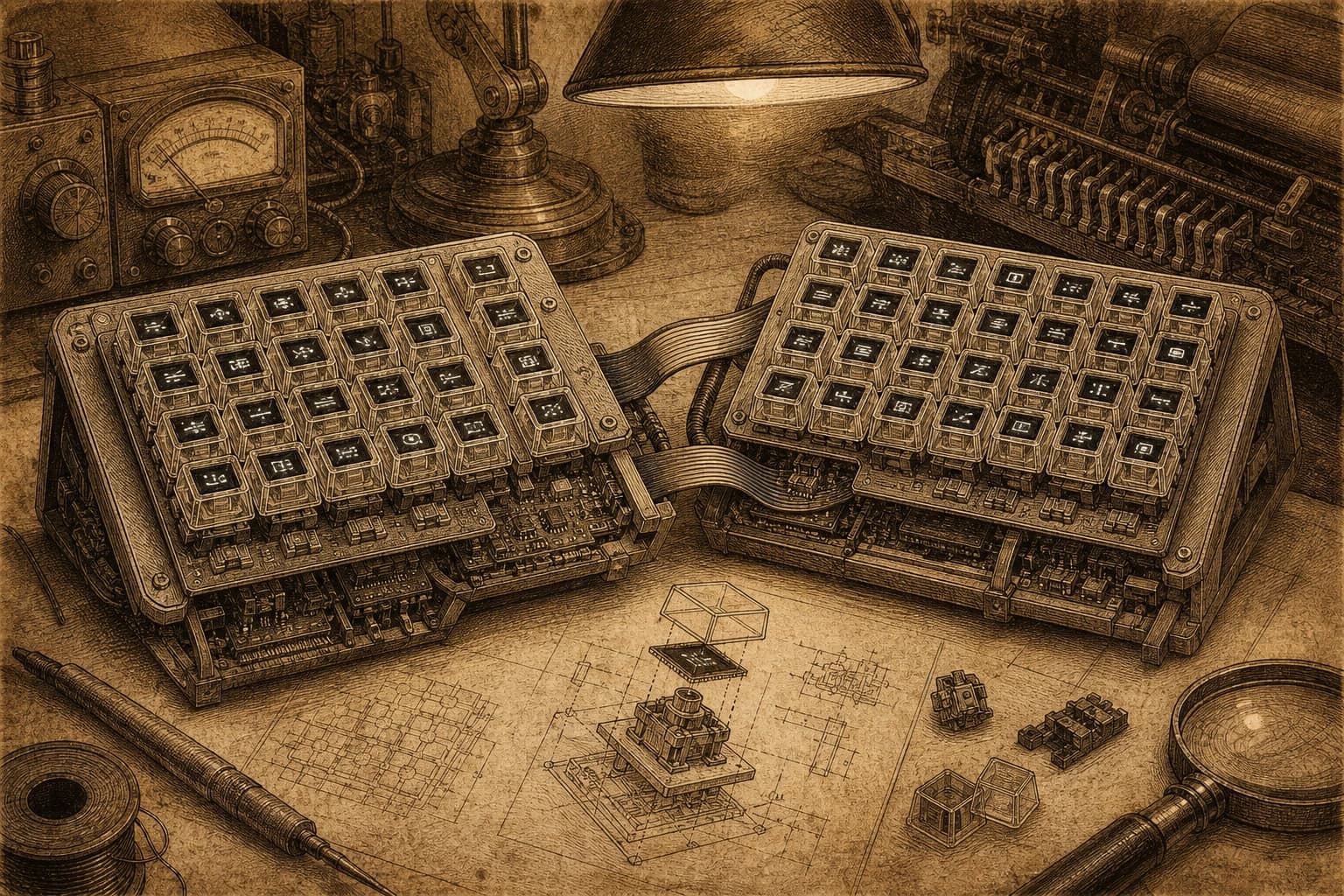
Splits 72 mechanical keys between two halves and puts a tiny OLED beneath each transparent keycap so displayed legends can change with layouts and languages.
Visit PolyKybdOriginal editorial concept art generated with built-in Codex Image Gen for The Machine Press, 2026-08-09.
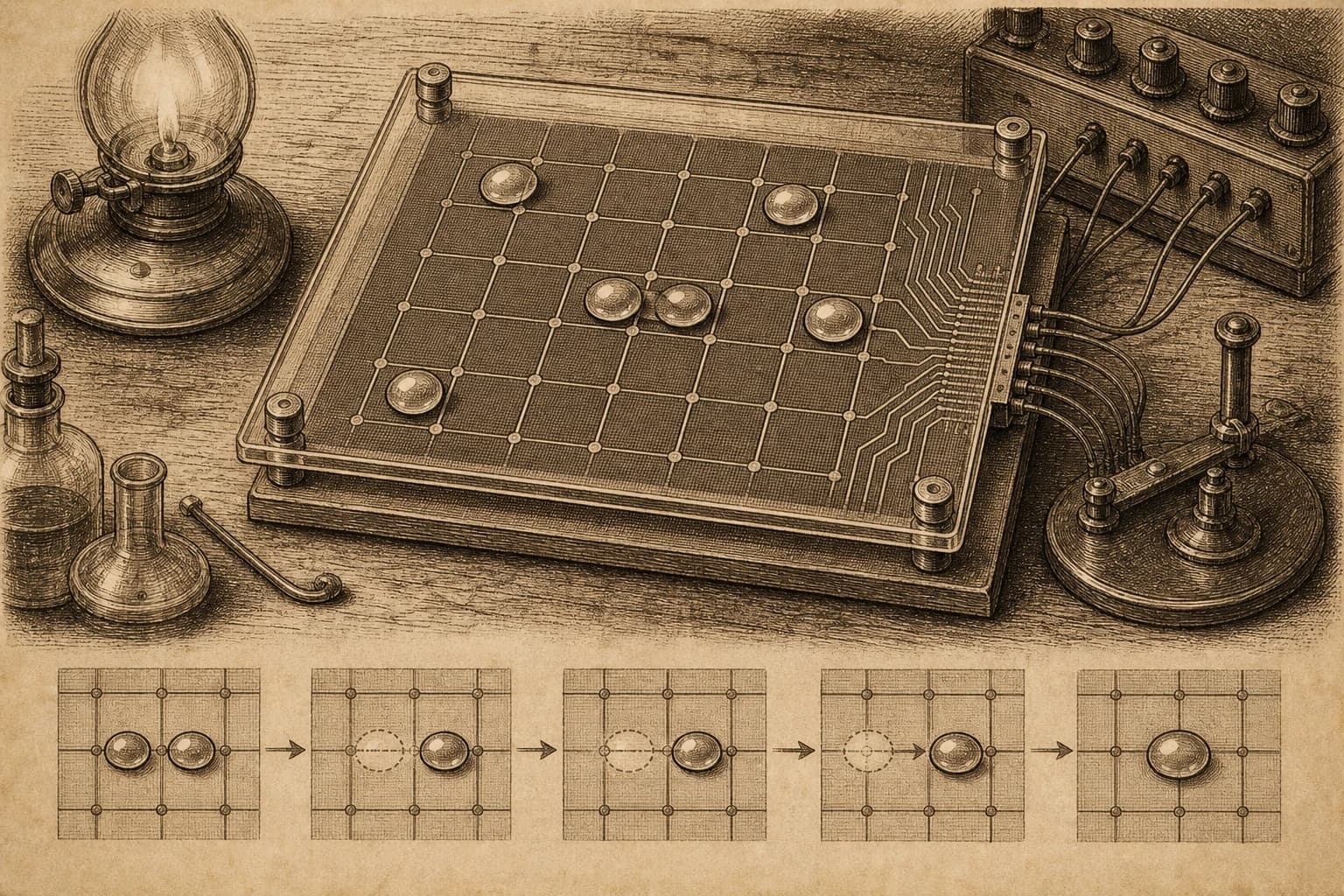
Moves and combines small liquid droplets across an addressable electrode grid, providing an open tabletop platform for digital microfluidics experiments.
Visit OpenDropOriginal editorial concept art generated with built-in Codex Image Gen for The Machine Press, 2026-08-09.
Runs video samples and shaders on a Raspberry Pi Zero, exposes four knob or control-voltage inputs, and can pass compatible external capture through visual effects.
Visit recurBOYOriginal editorial concept art generated with built-in Codex Image Gen for The Machine Press, 2026-08-09.
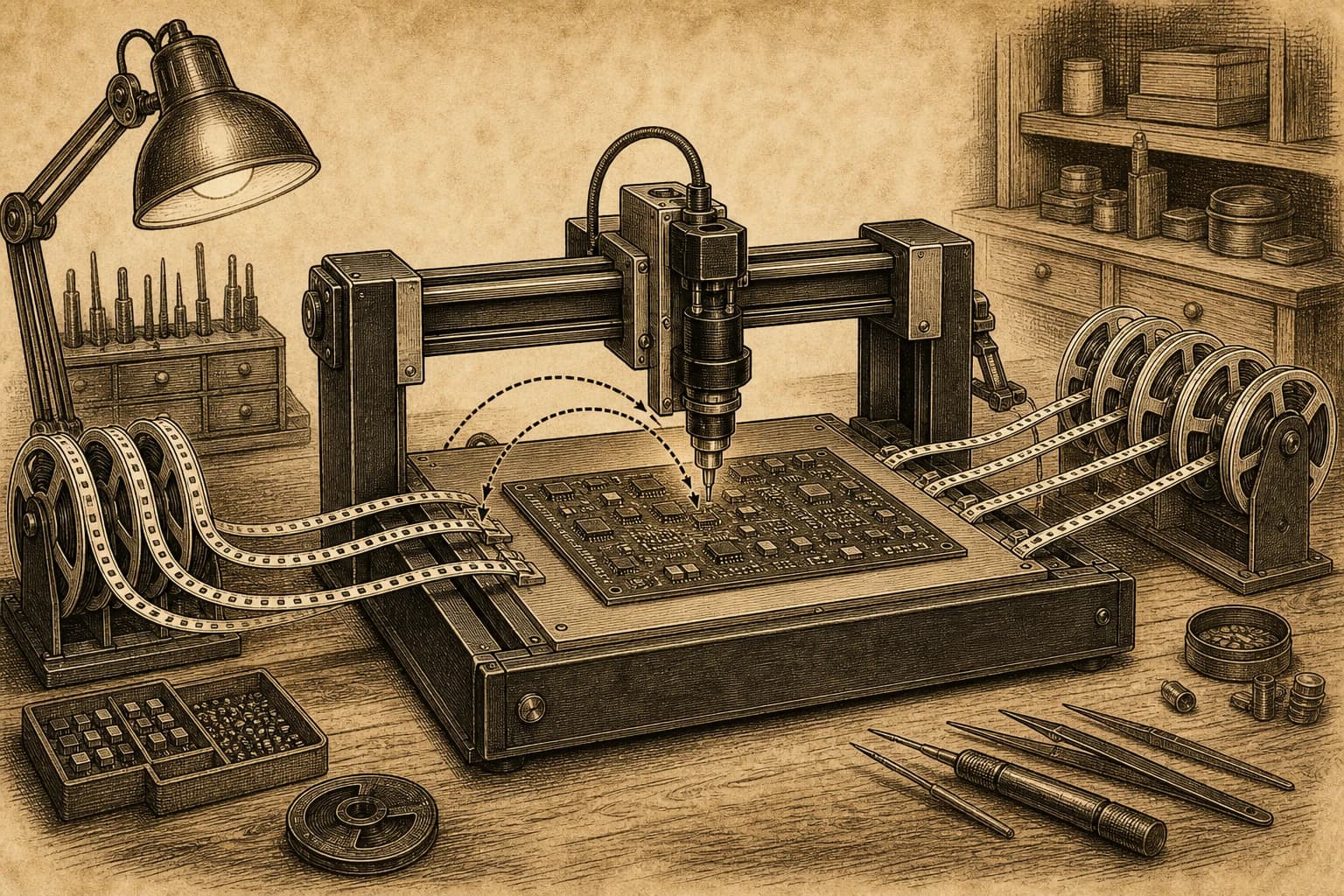
Uses a desktop gantry, placement head, and component feeders to assemble electronic parts onto circuit boards; its primary repository says machines run in active production.
Visit LumenPnPOriginal Codex Image Gen concept art from 2026-07-10; carried forward from the validated 2026-08-08 edition.
Desk Picks are selected by the newsroom. Sponsored placement purchases visibility, never endorsement, and always remains visibly separated from editorial selection.
 Editorial illustration