An executable world model cleared 179 of 183 hidden-rule levels after every prediction mismatch became a counterexample for repair.
Editorial illustration
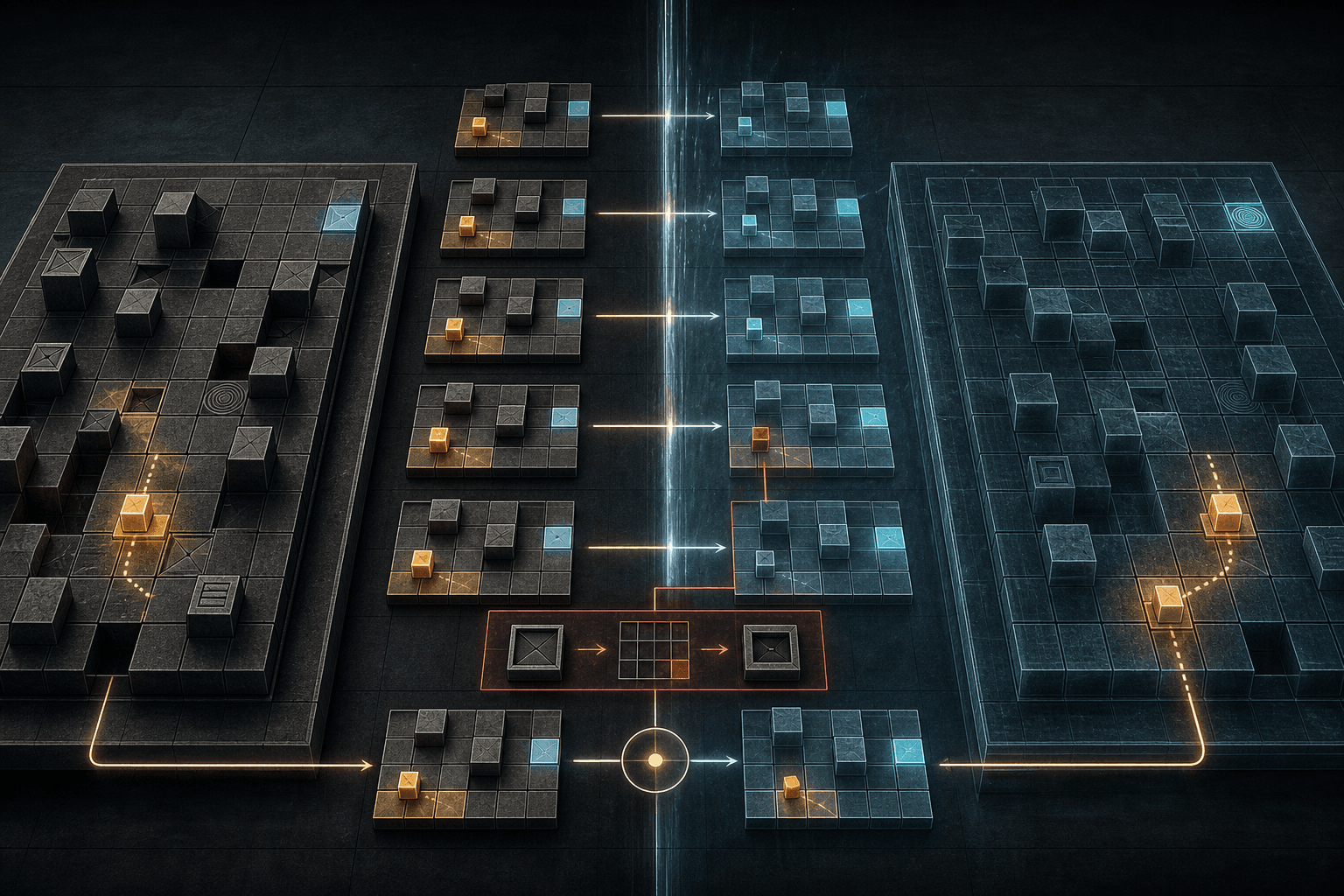
Conceptual illustration: a test-time digital twin replayed every observed transition and used mismatches as counterexamples before the agent acted again; this is not a benchmark screenshot. Original editorial concept art generated with built-in Codex Image Gen for The Machine Press, 2026-08-17.
Twin made a coding agent earn each real action by first reproducing every transition it had already observed inside an executable test-time world model. When the model predicted a result that the environment contradicted, the mismatch became a counterexample and the agent repaired the twin before continuing. Across the reported ARC-AGI-3 runs, the system cleared 179 of 183 levels and inferred the goal before receiving a reward on 156 of the levels it cleared.
The same base model scored 7.8 percent when playing directly, 61.1 with an off-the-shelf harness and 93.3 with the twin-world harness across 25 games. Those figures come from one benchmark family whose grid-game prior is unusually amenable to executable modeling; they do not establish a general recipe for unconstrained physical environments. The sharper result is procedural: prediction errors were not merely logged—they blocked action until the accumulated history could be replayed.
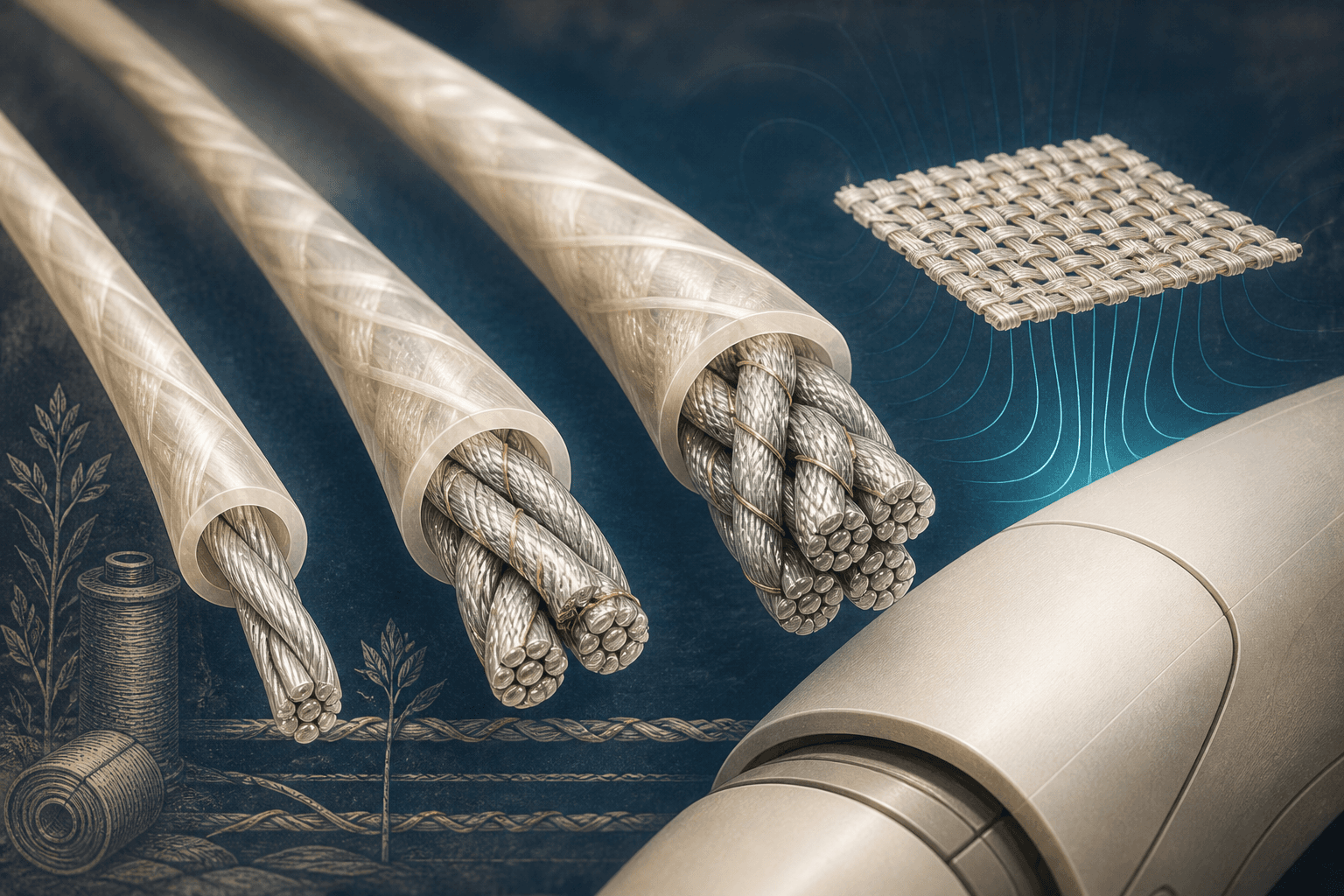
Conceptual illustration: changing twisted-yarn architecture tuned pressure and proximity sensing in the reported textile platform; this is not a photograph of the prototype. Original editorial concept art generated with built-in Codex Image Gen for The Machine Press, 2026-08-17.
Twisting one, two or four coated conductive layers traded proximity range for strength and pressure sensitivity in a textile robotic skin.
The sensor begins as silver-coated yarn wrapped in a flexible polymer, then changes behavior when the yarns are twisted into one-, two- and four-layer architectures. In the reported measurements, more layers increased maximum load, elongation and pressure sensitivity; the four-layer design reached 0.1331 per megapascal at 100 kilohertz, stayed stable through 15,000 cycles and showed little thermal drift from 25 to 90 degrees Celsius.
The trade-off ran in the opposite direction for proximity: the reported detection range narrowed from 60 millimeters for one layer to 40 millimeters for four. A small textile array mapped contact, and a robotic-arm integration reacted to touch and proximity with 403-millisecond end-to-end latency. The work is a laboratory characterization of one materials platform, not evidence of general-purpose synthetic skin, but it makes the yarn architecture itself a practical design variable.
A theory of cross-session continuation separates exact recall from preserving the distribution needed by the next task.
The authors model handover as transfer of task-relative in-context learning state and derive when a fixed-length record can be sufficient. Their proposed three-part record stores decisions and constraints exactly, summarizes repeated evidence only with task-justified statistics, and retains original observations whose effect those statistics cannot preserve. The guarantees hold under stated statistical conditions; they are a design framework, not a universal compression recipe for arbitrary conversations.
Illustrative Pexels CSS code-screen file image; it does not show PACE-Bench, the tested agents, simulator code or adaptation results. Pixabay / Pexels; cropped, resized, metadata stripped, and converted to WebP by The Machine Press.
PACE-Bench mutates a simulator after a code-driven design succeeds, forcing agents to redesign mechanisms rather than tune yesterday’s parameters.
Across 144 source-to-target pairs in six physics domains, the interface and goal stayed fixed while the target environment changed underneath the design. Ten self-evolving methods remained far from saturation: Reflexion with Qwen3-14B solved 35.9 percent overall, and GPT-5.5 solved 66.7 percent of the statics subset under the full budget. Simulator-grounded reflection beat unverified revision, while memory often anchored agents to obsolete designs.
A multi-agent report system paired text, tables and images with a claims auto-revision stage and measured citation gains over baselines.
Wyvern assembles multimodal technical reports and then revisits claims against supporting references. In the authors’ human study, its figures were judged more informative than a recent baseline in 87 percent of cases, and reports were rated more useful than three alternatives in 63 to 100 percent of comparisons. Automatic evaluation reported gains of up to 2.3 times in citation recall and 1.6 times in precision; these are framework-specific results, not a guarantee that automated reports are factually complete.
A 17,886-video crisis benchmark found no detector family that generalized consistently across generators and social dissemination.
RA-Bench anchors 16,056 generated clips to 1,830 real videos across ten crisis-risk categories, then tests traditional detectors, zero-shot multimodal models and fine-tuned systems. None of the three detector families generalized consistently. The clips that misled human viewers were also hard for automated detectors, and dissemination through social platforms made detection harder, underscoring that a single detector score is not a durable authenticity guarantee.
YOPO reconstructed the pre-steering residual stream so a frozen model could improve reasoning without blinding its own abstention signal.
Writing a steering intervention into the residual stream changed the very signal used to decide whether evidence was sufficient. YOPO trained a small reconstructor on paired clean and steered states, then read the fixed sufficiency direction from that reconstruction. On reported Qwen2.5 backbones it combined answering, steering and abstention in one pass and outperformed the two-pass reference, though the authors also found and disclosed a surface artifact in one benchmark construction.
A Bayesian stopping rule removed 57 to 97 percent of planned trials in illustrative evaluations while preserving the overall conclusion.
Optstop treats evaluation as sequential measurement instead of assigning every item the same fixed number of trials. It keeps uncertain items eligible, stops when estimates are precise or stable, and becomes more cautious near zero performance where rare successes matter. Across nine validation settings in an illustrative 200-item, ten-epoch evaluation, it removed 57 to 97 percent of planned trials; realized savings depend on the benchmark and stopping target.
Illustrative Pexels data-center file image; the facility is unidentified and does not depict the servers, edge nodes, costs or case study in the paper. Brett Sayles / Pexels; cropped, resized, metadata stripped, and converted to WebP by The Machine Press.
A decomposition strategy made nonlinear placement across cloud and edge nodes scale better and beat a simple heuristic by 10 percent on average.
The formulation balances monetary cost and execution time while allowing node attributes to remain distributed rather than centrally known. The authors decompose the nonlinear integer program so large workflows can be placed across heterogeneous server and edge resources. A case study reported a mean 10 percent improvement over a simple heuristic; the result is evidence for the optimization strategy, not a universal cloud-cost reduction.
GhostPoint trains a predictor to hallucinate latent neighborhood features beyond measured LiDAR returns, improving sparse-scan 3D detection.
Most self-supervised LiDAR objectives supervise only visible returns, even though object detection must reason through occlusion and missing structure. GhostPoint dilates discovered instances into local neighborhoods and trains observed voxels against teacher-encoder targets while unobserved voxels follow teacher-predictor hallucinations. Reported nuScenes and Waymo tests improved downstream detection, especially with sparse scans and limited labels; the hallucinations are learned representations, not reconstructed ground truth.
A training-free clamp selected safety-specific neurons under false-discovery control, then triggered the model’s learned refusal only when needed.
Tripwire identifies neurons associated with harmful inputs while filtering for utility specificity, then clamps them to harmful-conditional activations through a detector-gated intervention or an equivalent offline bias edit. Across four aligned models and four attacks, the paper reports average attack success no higher than 2.0 percent with MT-Bench utility drops of 0.5 to 5.3 percent. Those benchmark results do not establish immunity to unseen attacks, but they show a narrower intervention footprint.
Fourteen models remained susceptible to anchoring when an initial value arrived through a credible pathway.
AnchorBench varies both the route by which an anchor appears and whether the number is relevant. The authors report that plausible anchors generally moved judgments more than irrelevant ones, stronger pathways amplified the effect, and distance from the evidence-supported answer weakened it. Even frontier models above 95 percent accuracy without an anchor were not reliably robust, separating baseline competence from resistance to contextual bias.
New lower bounds ruled out horizon-independent regret and a matching algorithm cut finite-action dimension dependence from quadratic to linear.
The analysis proves minimax lower bounds for quantum multi-armed and finite-action linear bandits, showing that regret cannot become independent of the time horizon in the studied oracle model. A design-based elimination algorithm then matches the finite-action linear lower bound up to polylogarithmic factors when the action set is polynomial in dimension. The result is theoretical progress inside a specified quantum-query model, not a near-term hardware speed claim.
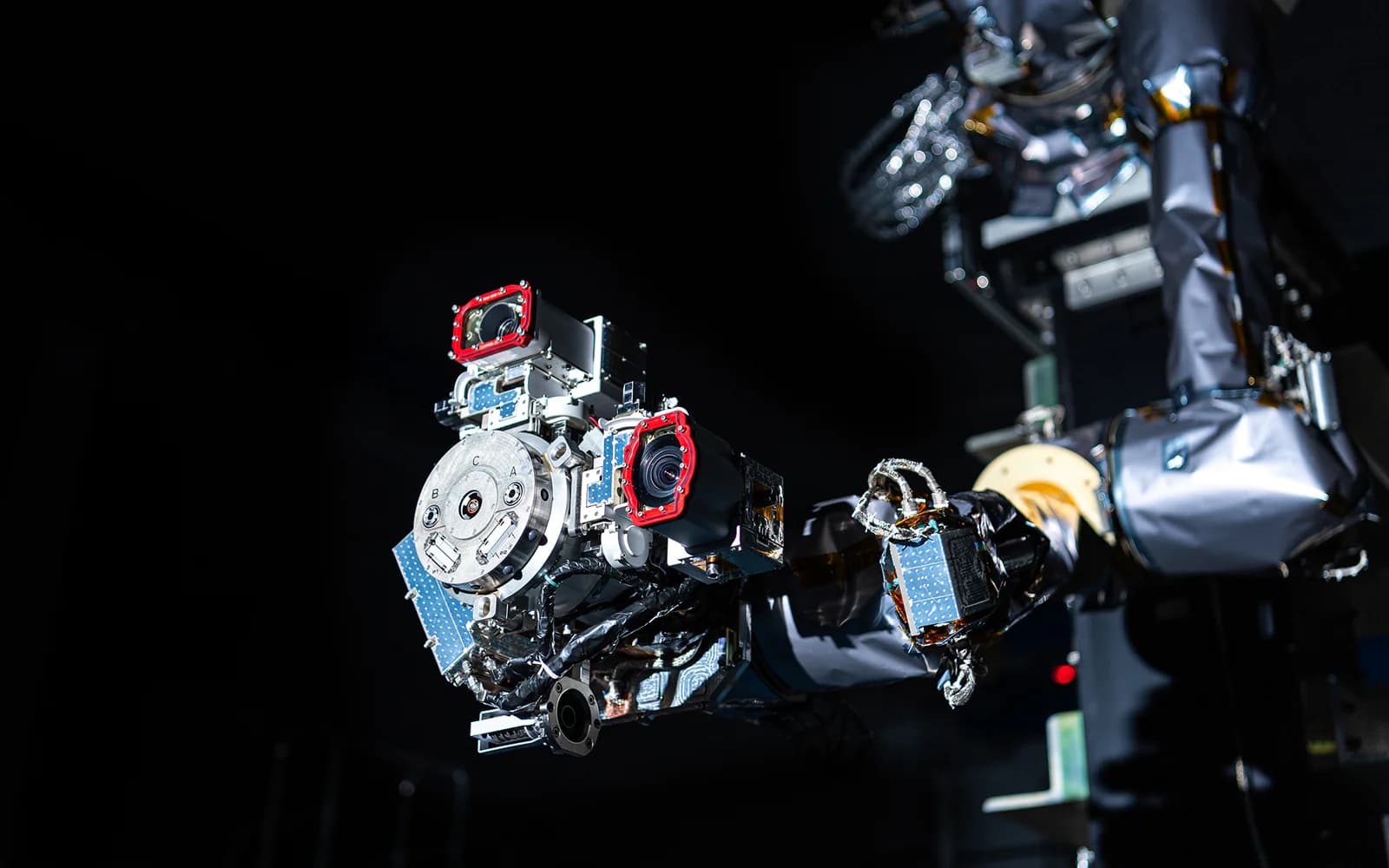
NASA OSAM-1 file image used only as generic robotics context; it does not depict a Mars rover, the simulated planner or an operational mission, and use does not imply NASA endorsement. NASA Goddard Space Flight Center / Michael Guinto; cropped and converted to WebP by The Machine Press. Use does not imply NASA endorsement.
Expected free energy let a simulated explorer map uncertainty and seek high-value regions under a hard travel budget.
The planner maintains a Gaussian-process belief over an unknown information field and chooses continuous trajectories that trade map improvement against reaching valuable regions. Across multiple simulated realizations, the expected-free-energy objective outperformed information-only baselines under the same path-length constraints. The authors frame Mars water prospecting as an example; the work demonstrates a planning principle in simulation, not an operational planetary mission.
An analyze-experiment-resituate workflow increased artists’ reported agency compared with direct style transfer.
Built from interviews with ten professional digital artists, AER separates reference interpretation, controlled experimentation and reflection on how an emerging style may be received. A controlled study with 16 artists found more agency and reflection than a direct style-transfer workflow, followed by a two-week field study with four artists. The small studies support a design direction, not a universal effect across creative practice.
Subtle color and contrast changes shifted sentiment and visual-question answers even when the rendered words stayed the same.
Stealth Visual Prompts alter the styling of text rendered as an image without changing its words. Across the reported experiments, coloring positive words green moved sentiment predictions in a positive direction and sometimes obscured negative content; reducing contrast increased reliance on salient visual cues and produced more wrong answers. The study shows a presentation-layer vulnerability in tested vision-language models, not a claim that every model maps green to approval.
Four independently verified builder projects from the active August 16–22 cycle, plus one disclosed house-example sponsored slot and one placement CTA. Weekly images are carried over from the validated Sunday handoff.
Four editorial selections
$7 for seven days
Paid work is clearly labeled
Placement is never endorsement
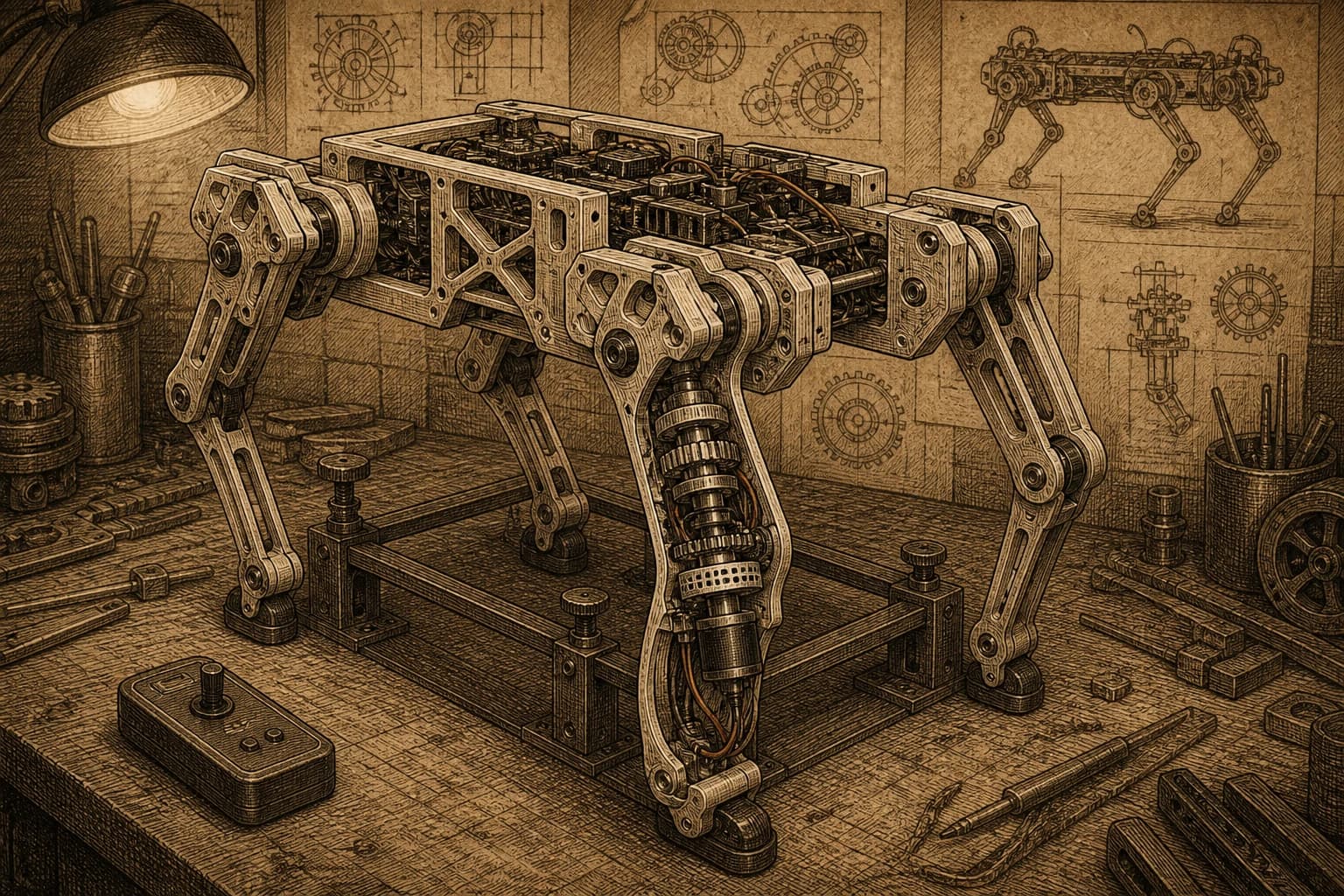
Original editorial concept art generated with built-in Codex Image Gen for The Machine Press, 2026-08-16.
Supplies CAD, code, and a bill of materials for a PLA-printed quadruped with motor-driven joints, closed-loop controls, and an inverse-kinematics walking mode.
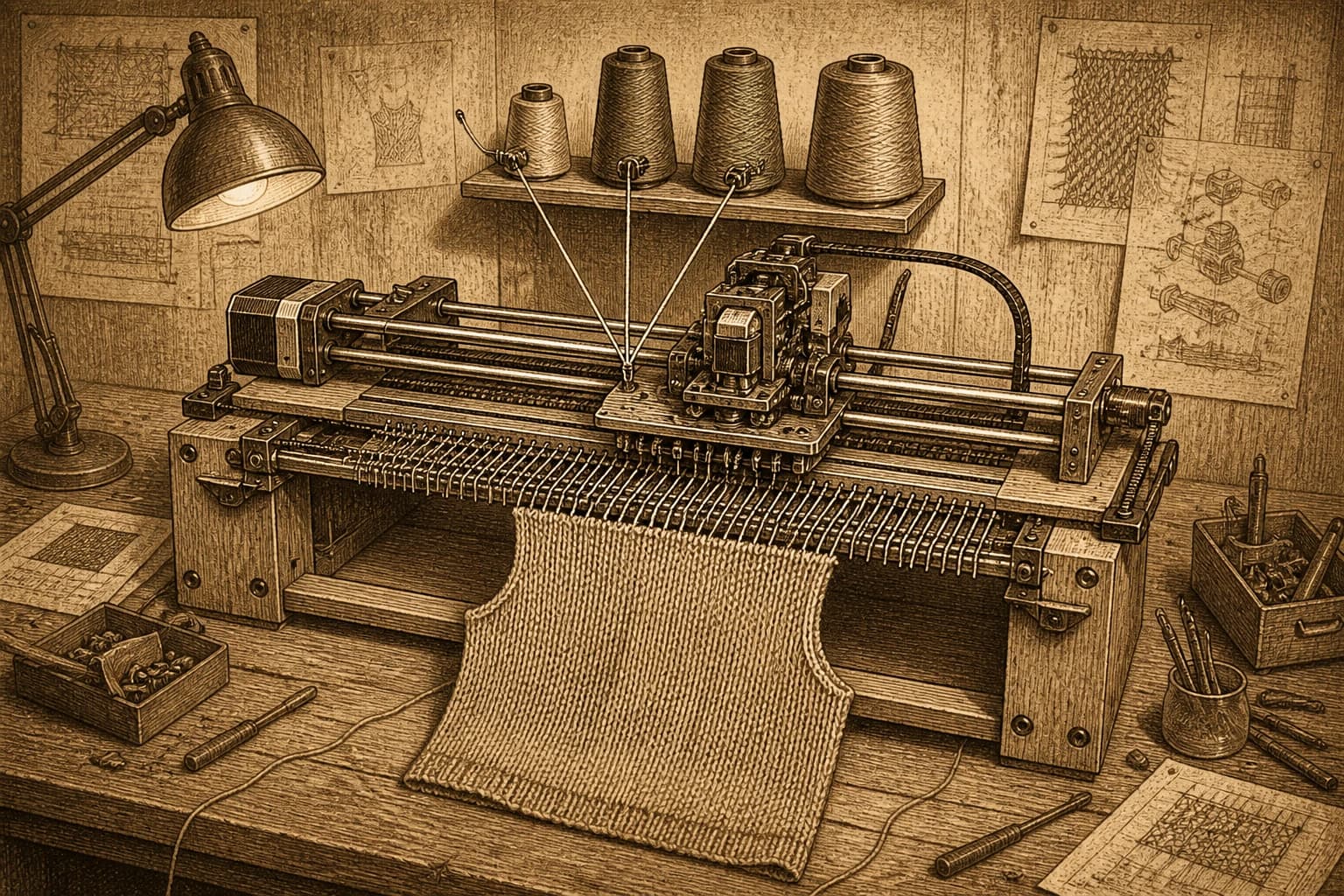
Visit openDogV3Original editorial concept art generated with built-in Codex Image Gen for The Machine Press, 2026-08-16.
Aims to turn digital garment files into knitted pieces on an open-source machine; its smaller Wally120 design is easier to assemble, but the project remains early beta hardware.
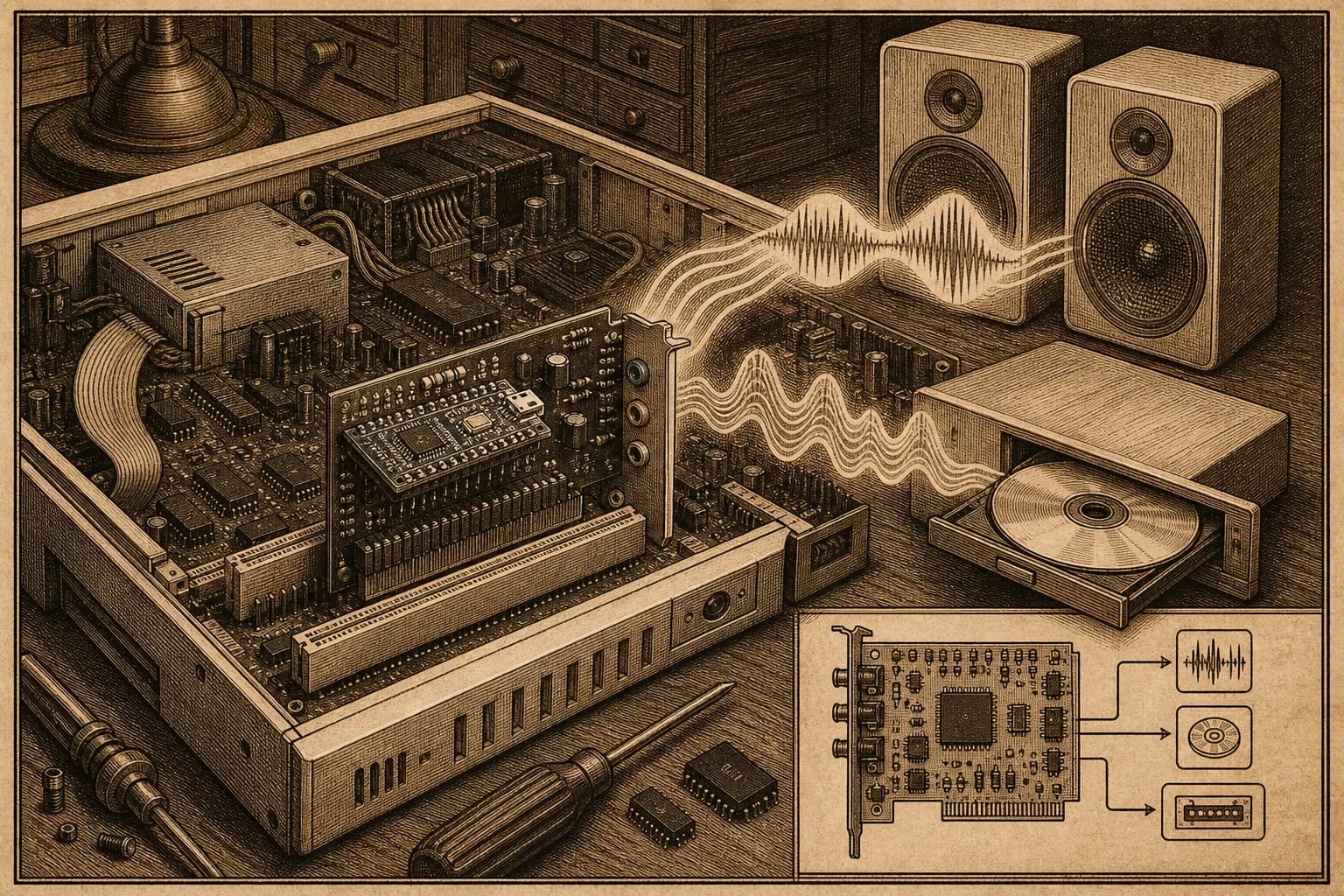
Visit OpenKnitOriginal editorial concept art generated with built-in Codex Image Gen for The Machine Press, 2026-08-16.
Uses an RP2040 microcontroller to emulate several ISA sound cards and a period CD-ROM interface for retro PCs, with open hardware files and assembled cards available.
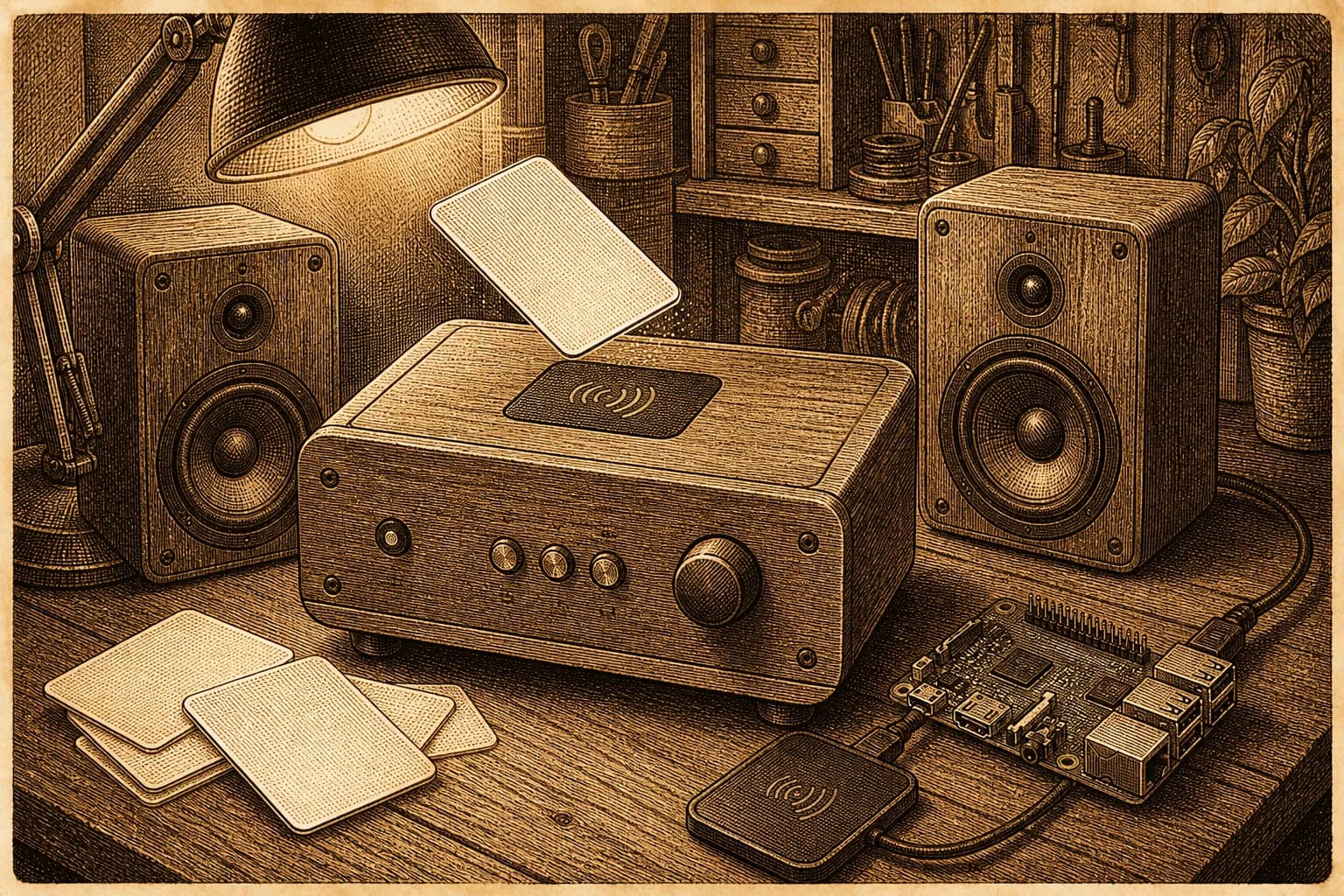
Visit PicoGUSOriginal editorial concept art generated with built-in Codex Image Gen for The Machine Press, 2026-08-16.
Turns RFID cards into selectors for local audio, playlists, podcasts, and web streams on a Raspberry Pi, with USB-reader setups and optional physical controls.
Visit PhonieboxOriginal Codex Image Gen concept art from 2026-07-10; carried forward from the validated 2026-08-15 edition.
Desk Picks are selected by the newsroom. Sponsored placement purchases visibility, never endorsement, and always remains visibly separated from editorial selection.
 Editorial illustration