robotics
The Yarn Became the Sensor Dial
Twisting one, two or four coated conductive layers traded proximity range for strength and pressure sensitivity in a textile robotic skin.
Summary
Twisting one, two or four coated conductive layers traded proximity range for strength and pressure sensitivity in a textile robotic skin.
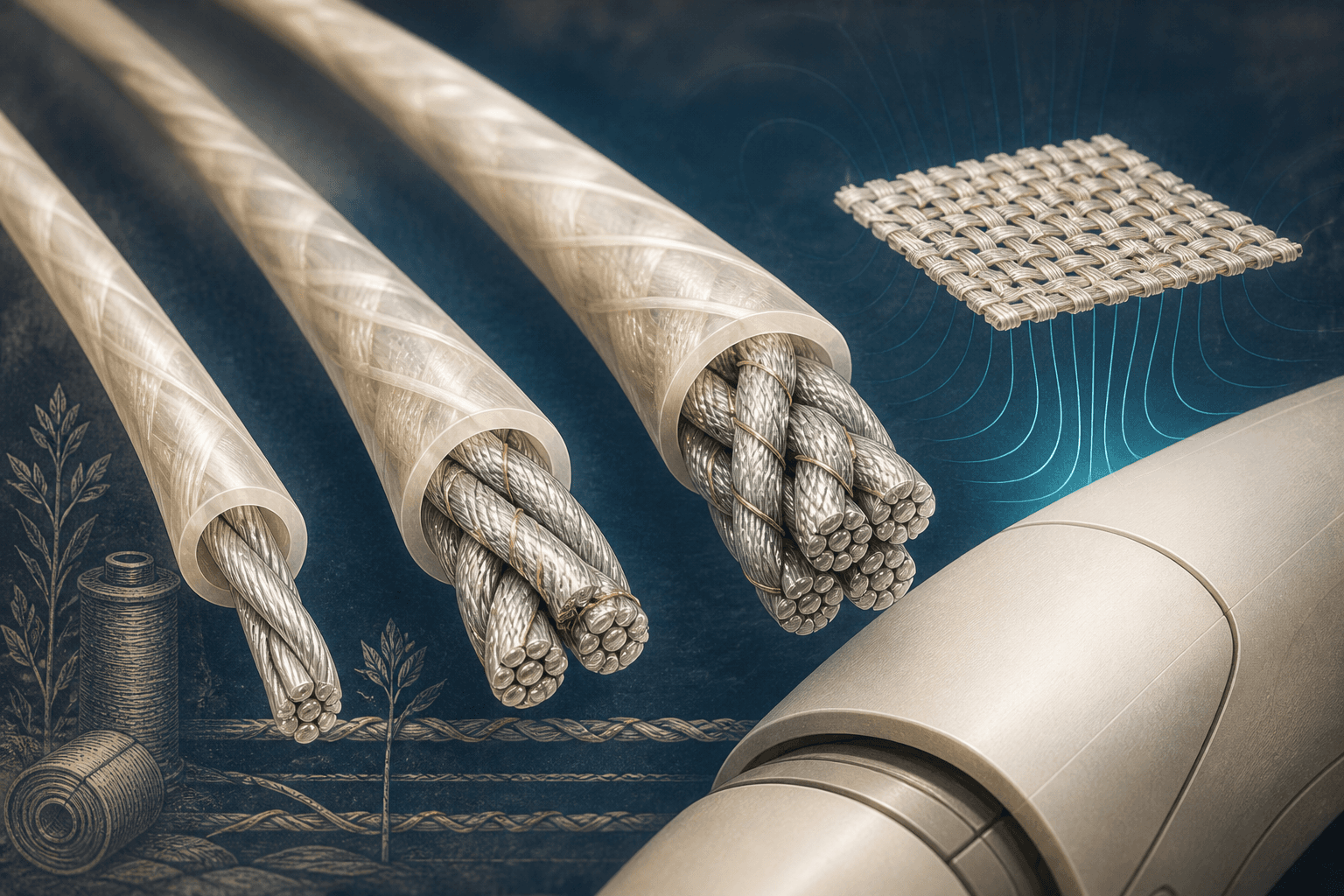
The sensor begins as silver-coated yarn wrapped in a flexible polymer, then changes behavior when the yarns are twisted into one-, two- and four-layer architectures. In the reported measurements, more layers increased maximum load, elongation and pressure sensitivity; the four-layer design reached 0.1331 per megapascal at 100 kilohertz, stayed stable through 15,000 cycles and showed little thermal drift from 25 to 90 degrees Celsius.
The trade-off ran in the opposite direction for proximity: the reported detection range narrowed from 60 millimeters for one layer to 40 millimeters for four. A small textile array mapped contact, and a robotic-arm integration reacted to touch and proximity with 403-millisecond end-to-end latency. The work is a laboratory characterization of one materials platform, not evidence of general-purpose synthetic skin, but it makes the yarn architecture itself a practical design variable.
Why it matters
Twisting one, two or four coated conductive layers traded proximity range for strength and pressure sensitivity in a textile robotic skin.
Limits and context
- The work is a laboratory characterization of one materials platform, not evidence of general-purpose synthetic skin, but it makes the yarn architecture itself a practical design variable.
Key claims
Twisting one, two or four coated conductive layers traded proximity range for strength and pressure sensitivity in a textile robotic skin.
Qualification: The work is a laboratory characterization of one materials platform, not evidence of general-purpose synthetic skin, but it makes the yarn architecture itself a practical design variable.
Evidence: source-2026-08-17-002
Sources
- arXiv preprint 2608.14406arXiv · primary research
Corrections
No corrections have been recorded for this story.