Researchers amplified remote timing signals to leak a co-tenant JWT at up to 12 bits per second before Cloudflare deployed stronger isolation.
Editorial illustration
Conceptual illustration: researchers demonstrated a remote timing side channel in a shared edge runtime and documented coordinated mitigations; this is not an exploit interface or live incident image. Original editorial concept art generated with built-in Codex Image Gen for The Machine Press, 2026-08-19.
The attack targeted the production security boundary used by Cloudflare Workers, where language-level isolation and restricted timers are intended to constrain co-located tenants. The researchers combined microarchitectural amplification with remote timing sources, reporting a Spectre-based extraction of a JWT token at up to 12 bits per second with 99.16 percent accuracy—orders of magnitude above the 2-bits-per-minute comparison they cite.
The paper also records a coordinated mitigation, not an unpatched disclosure. Cloudflare integrated the V8 Sandbox, improved its Dynamic Process Isolation detection, and deployed hardware-assisted memory-protection keys to separate tenant heaps. The result is evidence about one studied production architecture and attack path; it is not a claim that every edge runtime shares the flaw or that the disclosed route remains open.
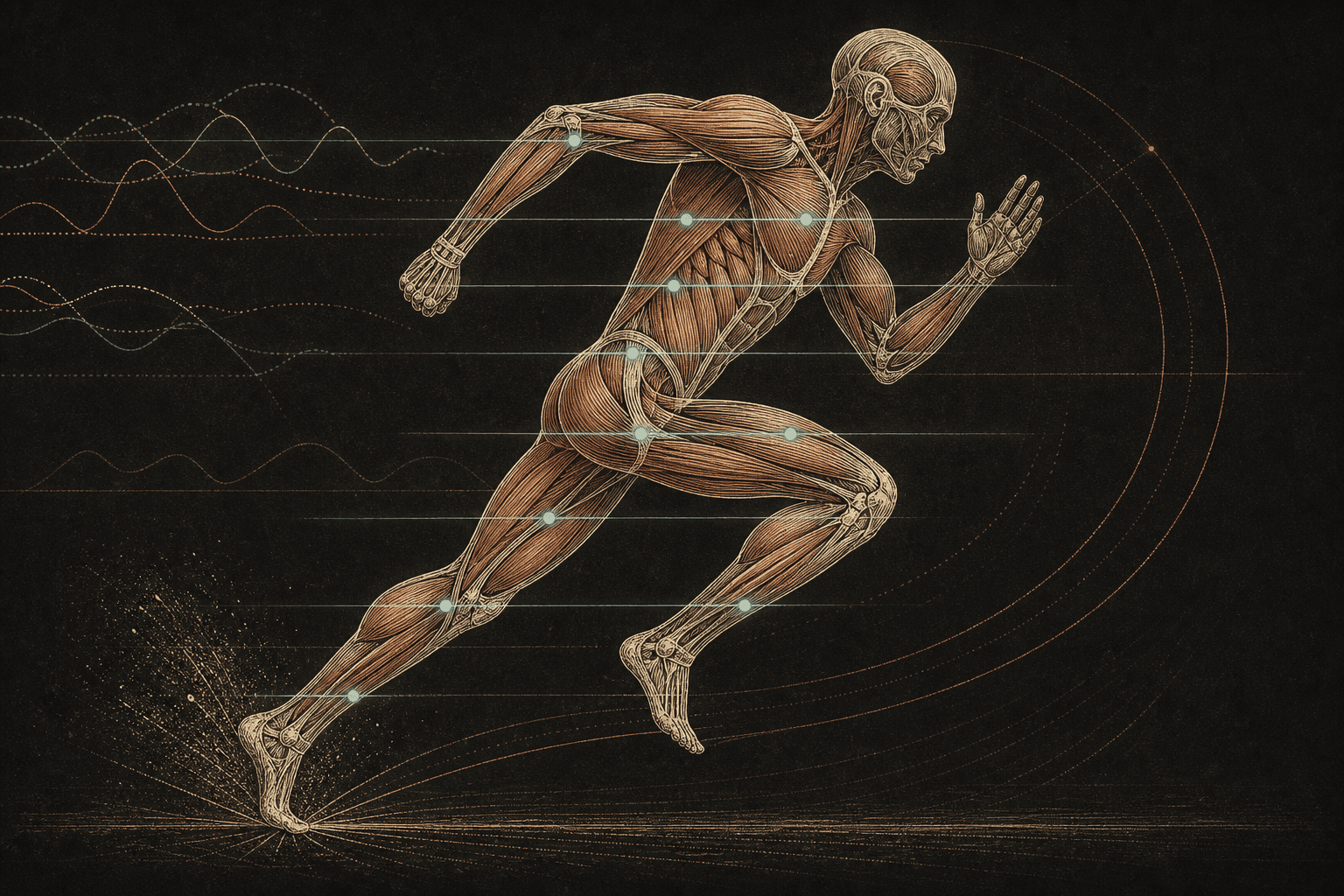
Conceptual illustration: a physiology-inspired controller learned sprinting in musculoskeletal simulation; the paper does not report clinical validation or a commercial system. Original editorial concept art generated with built-in Codex Image Gen for The Machine Press, 2026-08-19.
A physiology-inspired controller held per-muscle threshold lengths across gait phases and trained a simulated skeleton to sprint with a minimal reward.
A muscle-actuated skeleton has far more control variables than a conventional rigid-body character, making reinforcement-learning exploration slow and unstable. The proposed lambda-hold controller reduces that burden by setting an equilibrium-point threshold length for each muscle and holding it over part of the gait cycle; a stretch-reflex rule then turns those thresholds into muscle excitation without requiring the policy to issue every low-level command.
The authors report that this controller learned human-like sprinting within an hour of training using only a minimal task reward. The work connects an engineering control scheme to the equilibrium-point hypothesis, intermittent control and optimal feedback control, but it remains predictive musculoskeletal simulation. It does not establish a clinical model of human movement or prove that the learned controller matches biological motor control in people.
Renesis converts ordinary netlists into verified energy-recovery circuits and rejects rewrites that worsen either reported energy table.
The open-source synthesis tool tracks switching, erasure and observability while mapping a logically reversible result to one of eight adiabatic circuit families. Every transformation is equivalence-checked and must improve at least one cost table without worsening the other. Fifteen of nineteen held-out circuits improved, with a best-arm median energy of 0.91 times the default. The accounting is circuit-level and technology-specific, not a claim that logical reversibility alone removes thermodynamic cost.
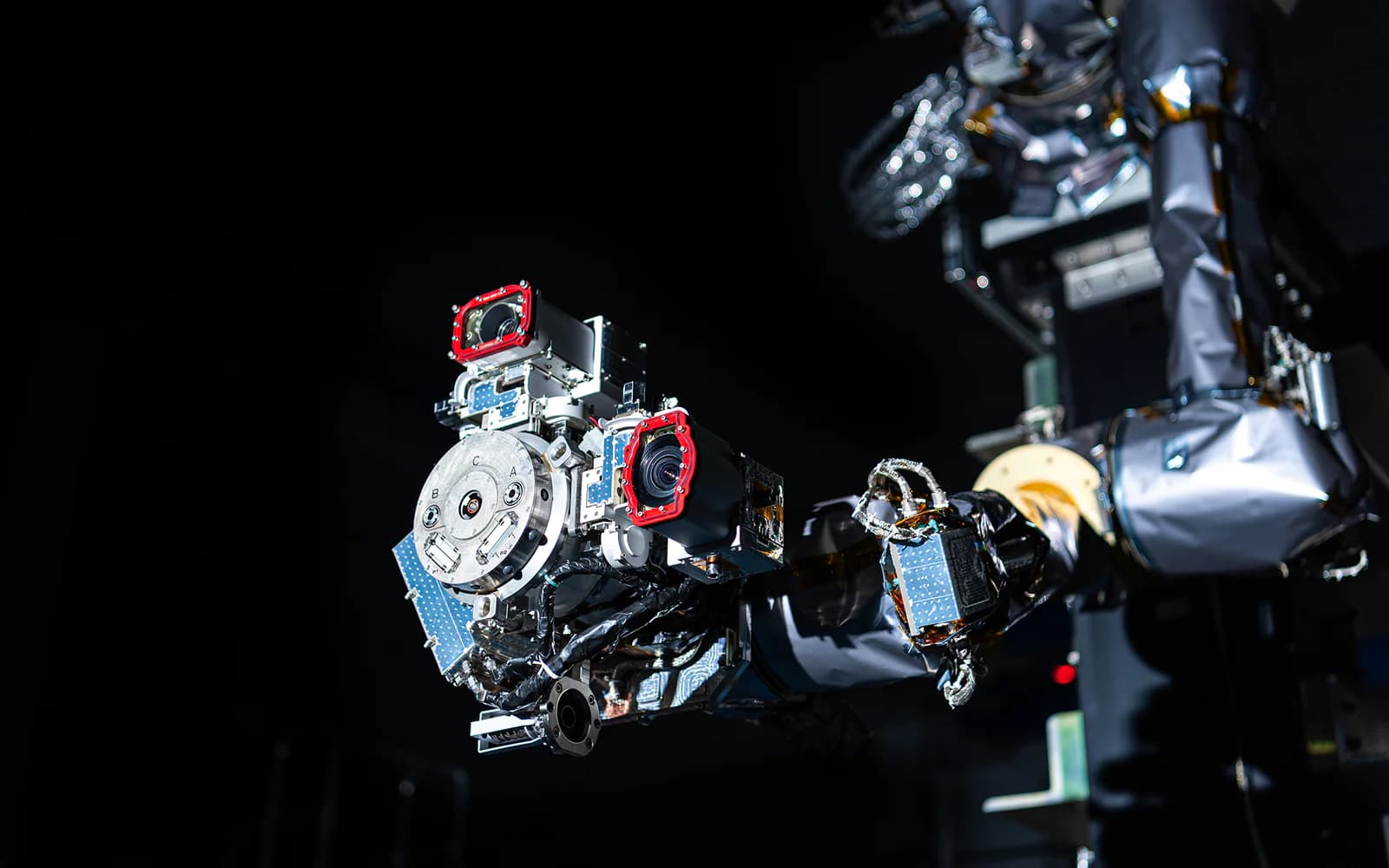
NASA OSAM-1 file image used only as generic manipulation context; it does not depict FetchMan, the Unitree G1, the benchmark or reported results, and use does not imply NASA endorsement. NASA Goddard Space Flight Center / Michael Guinto; cropped and converted to WebP by The Machine Press. Use does not imply NASA endorsement.
Reinforcement learning pushed a cloned policy past its synthetic-data ceiling and transferred a reach-and-pick skill to a real humanoid.
FetchMan begins with synthetic demonstrations across more than 150,000 scenes, then refines the cloned policy with Flow-GRPO and a sparse reward. The authors report 73.3 percent zero-shot success when a Unitree G1 walked toward and grasped a single target in unseen real scenes. The result supports the sim-to-real recipe for one reach-and-pick policy; it does not establish general household manipulation.
Institution-specific prompting found locally meaningful protected-health identifiers and exposed 227 omissions in the reference annotations.
Across 100 pediatric-oncology notes containing 5,322 annotated PHI spans, the best prompted LLM exceeded two purpose-built de-identification systems in the authors’ comparison. Naming institution-specific categories recovered 48 of 61 misses, and re-annotation confirmed 227 additional PHI spans surfaced by model outputs. No tested multi-agent setup beat the calibrated single pass, and the result belongs to one hospital dataset rather than a universal de-identification guarantee.
J-Miner turned internal signals into named concepts and compact executable rules that reproduced up to 98.3 percent of model decisions.
J-Miner aggregates vocabulary-aligned signals across layers and token positions, then learns explicit rules from the classifier’s own outputs. Across the reported tasks, those rules were 6.0 to 29.5 percentage points more faithful than equally compact word-based rules. Lightweight students with about one twenty-fourth the parameters retained 99.8 percent of mean source accuracy, showing a route to inspectable reuse without proving that every mined concept is causally decisive.
PANDA used zero-knowledge proofs to certify robustness and fairness properties while keeping model parameters private.
Built on CROWN’s linear-relaxation bounds, PANDA produces proofs that reveal a claimed property without exposing the model weights. The authors report generating a local-robustness proof for networks above 2.9 million parameters in five minutes and verifying it in ten seconds—four orders of magnitude larger than prior compared systems. These are system benchmarks for supported guarantees, not evidence that a certified model is safe or fair outside the stated property and threat model.
A bounded research workflow combined an EHR prior, medical search and code dictionaries before ranking next-encounter diagnoses.
ICD-Deepresearch predicts diagnosis codes that may appear at a future visit, where no source can reveal the answer in advance. It expands candidates from an EHR foundation model, adds a separate direct forecast, validates exact code semantics and writes rationales only after selection. Patient-averaged precision remained about 25 percent, while recall reached 35.09 percent on MIMIC-III and 48.32 percent on MIMIC-IV; physicians nevertheless rated its retrieved documents more useful than the standalone research comparisons.
Illustrative Pexels file image of the New York Stock Exchange building; it does not depict the paper’s datasets, forecasts, market sessions or institutional endorsement. Arpan Parikh / Pexels; cropped, resized, metadata stripped, and converted to WebP by The Machine Press.
A regime-aware conformal method traded sharpness for more dependable coverage across 48 inflation, macroeconomic, energy and market series.
DRACP combines weighting for shifts and local regimes with an online controller that adjusts the target significance level. It was not the narrowest method: a strongly adaptive comparator produced intervals about 20 percent tighter. DRACP instead came closest to nominal 90 percent coverage at 0.890, never fell below 0.80 on any series and undercovered on 10 of 48 series versus 20 for that tighter comparator. The study frames reliability as an explicit cost in forecast width.
SentryBus maps where I2C manipulation may remain observable—and where a host-side monitor loses the ability to distinguish it.
The proposed monitor uses transaction timing, read and write sequences, transfer lengths, address behavior and raw-data transitions from the host-facing sensor bus. A dual-sided testbed established timing and capture limits, including a low-cost analyzer that could silently truncate data. Controlled attack trials are still outstanding and the authors claim no detection rate, making the negative boundary result as important as the proposed feature set.
Structured narratives turned disagreements between GNSS and independent vehicle sensing into a five-class spoofing detector.
The framework converts two independently derived driving states into text-like structured narratives and feeds them to a small language model. Across no-attack, overshoot, stopped, turn-by-turn and wrong-turn cases, the authors report 96.99 percent average accuracy and 97.18 percent F1, with lower latency and memory than their fine-tuned LLM comparisons. Tests on geographically unseen Clemson field data support transfer within the study, not universal resilience to adversarial driving conditions.
A bounded inference-time attention bias shifted planned trajectories toward a highlighted traffic actor without retraining the model.
The experiment added a pre-softmax bias to detector-localized visual tokens in 50 synthetic lane-change scenarios. Trajectory displacement increased with the bias, reaching about 17 centimeters on average and up to roughly 140 centimeters laterally. The reasoning text did not change because the mask never reached that pathway, and the steering tended to move toward the attended actor rather than encode a safe target behavior—an important limit on treating attention control as safety control.
OV3D-Bench separated localization from semantics and found that small prompt changes could collapse open-vocabulary 3D detection.
Across seven indoor and outdoor datasets, the benchmark removed per-image category oracles and scored localization, semantic robustness and transfer separately. Detectors often placed a box correctly but chose an adjacent label; one model’s AP fell from 18.6 to 5.4 when its prompt expanded from “car” to a detailed photographic phrase. The study also found a target-aware protocol inflated another model’s ScanNet result by 1.9 times, suggesting geometry is ahead of open-vocabulary semantics.
Conceptual Visualising AI file image used as a generic learning motif; it does not depict the reach-avoid PDE, studied systems, safe sets or reported results. Novoto Studio / Google DeepMind / Pexels; cropped, resized, metadata stripped, and converted to WebP by The Machine Press.
A scheduled method let reinforcement learning shape the value function before progressively enforcing the governing reach-avoid PDE.
High-dimensional reach-avoid analysis is difficult for grid solvers, while physics-informed networks may settle in poor residual minima and reinforcement learning may violate the governing equation. The proposed schedule starts with temporal-difference actor-critic learning, then adds PDE and boundary losses gradually. Two case studies reached accuracy comparable to successfully trained PINNs while mitigating their reported failure mode; the paper does not yet establish scaling across broad safety-critical systems.
A leakage-free decodability score predicted when selecting an answer from internal signals would beat majority voting.
CASE trains a linear gate on answer-token hidden states and chooses the highest-ranked sample. Its decodability measure predicted the gain over voting with a reported correlation of 0.75; across general and medical models, selection improved medium-difficulty accuracy by up to 19 points and hard questions by 16.8 points. A conventional probe looked strong only because question identity leaked across evaluation groups, underscoring that the criterion must itself be tested without leakage.
PROBE turns visual question answering into an active task where a robot must reveal occluded objects before deciding.
PROBE-Bench contains 150 simulated tabletop tasks across six question types, with picking and pushing tools that change the scene between observations. Agentic tool use outperformed perception-only baselines by 8.0 percent on average, and distilled open-weight agents gained another 11.5 percent over their off-the-shelf agent baselines. The authors also report real-tabletop transfer, but the benchmark remains a bounded step toward robots that can answer questions about hidden household state.
Four independently verified builder projects from the active August 16–22 cycle, plus one disclosed house-example sponsored slot and one placement CTA. Weekly images are carried over from the validated Sunday handoff.
Four editorial selections
$7 for seven days
Paid work is clearly labeled
Placement is never endorsement
Original editorial concept art generated with built-in Codex Image Gen for The Machine Press, 2026-08-16.
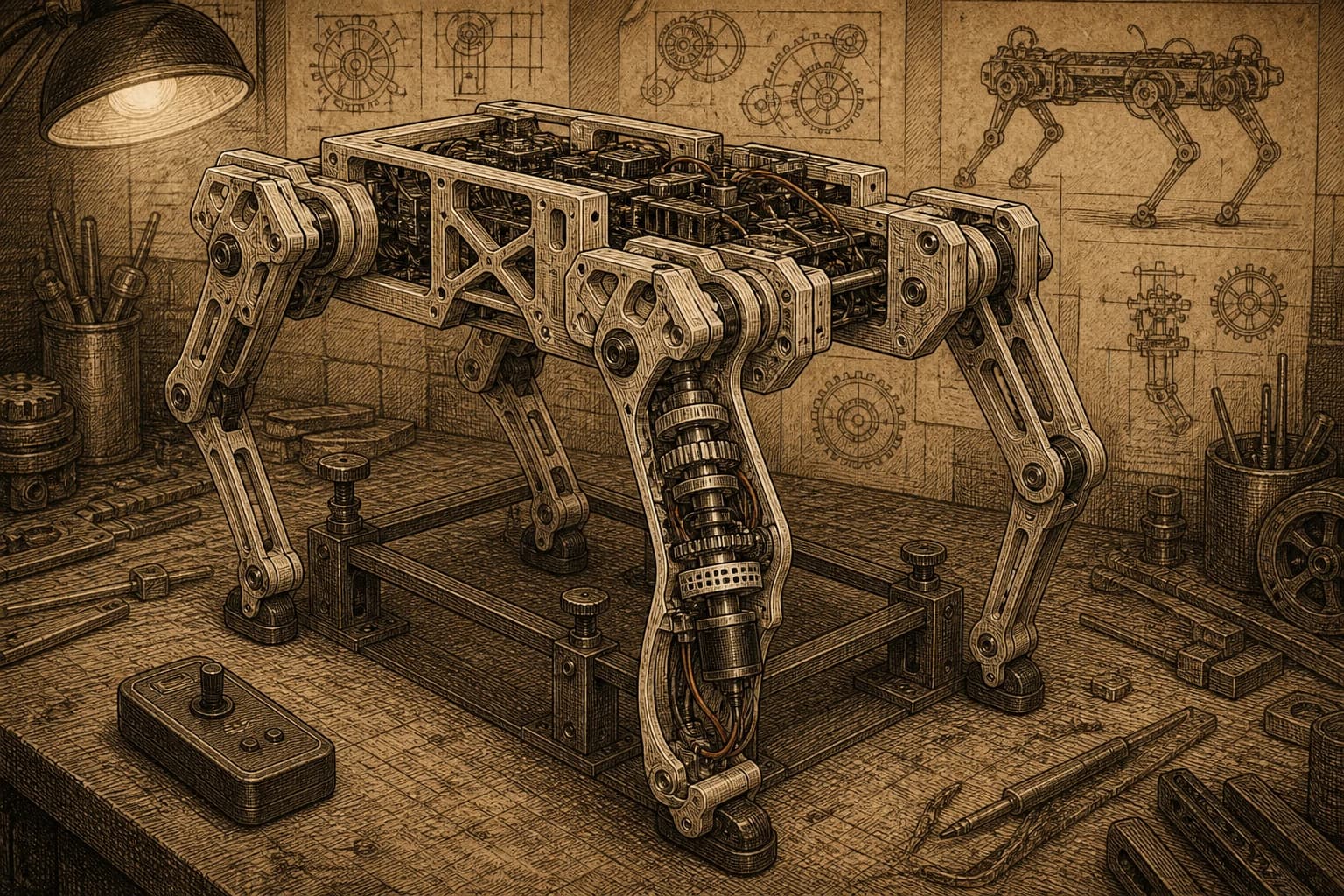
Supplies CAD, code, and a bill of materials for a PLA-printed quadruped with motor-driven joints, closed-loop controls, and an inverse-kinematics walking mode.
Visit openDogV3Original editorial concept art generated with built-in Codex Image Gen for The Machine Press, 2026-08-16.
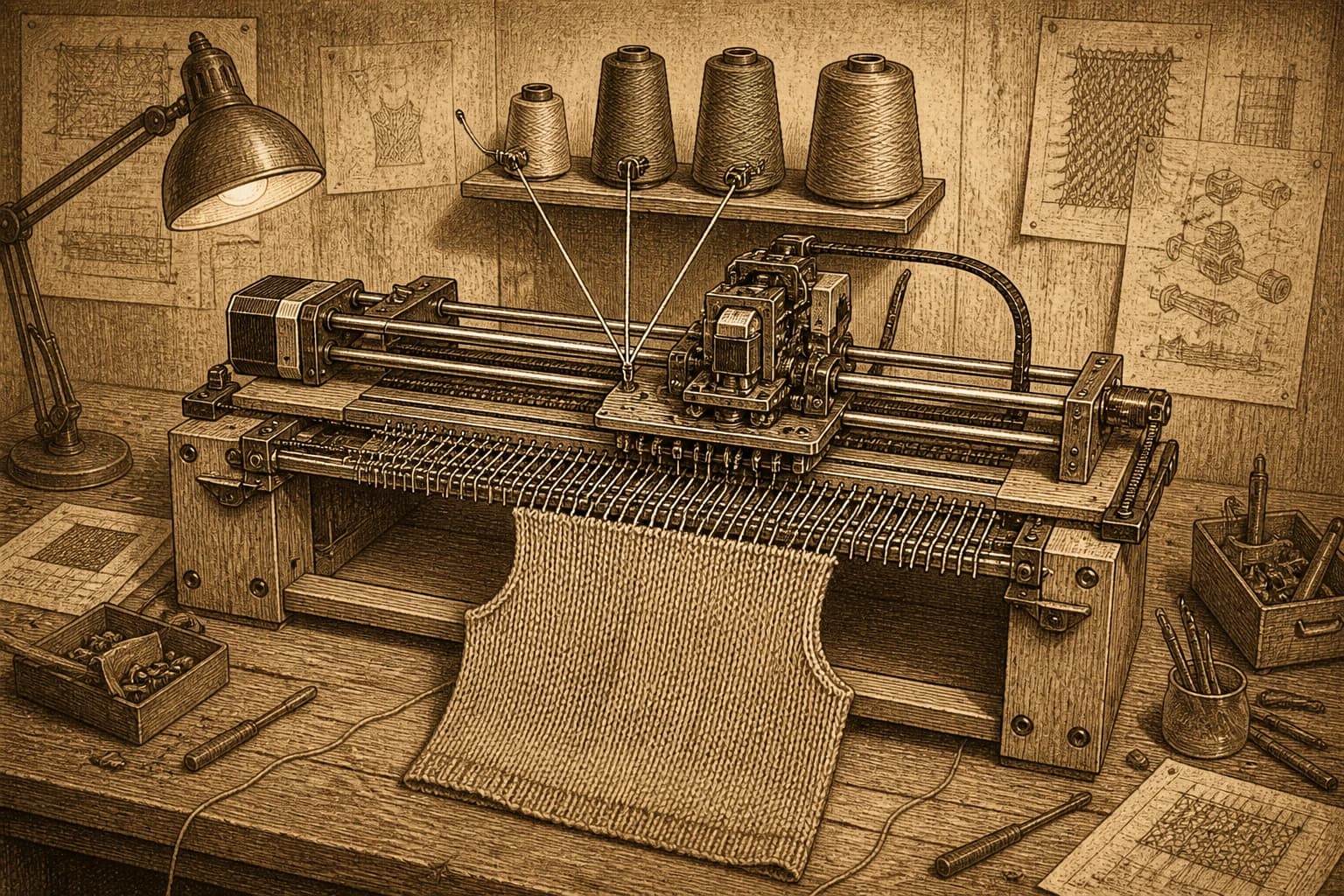
Aims to turn digital garment files into knitted pieces on an open-source machine; its smaller Wally120 design is easier to assemble, but the project remains early beta hardware.
Visit OpenKnitOriginal editorial concept art generated with built-in Codex Image Gen for The Machine Press, 2026-08-16.
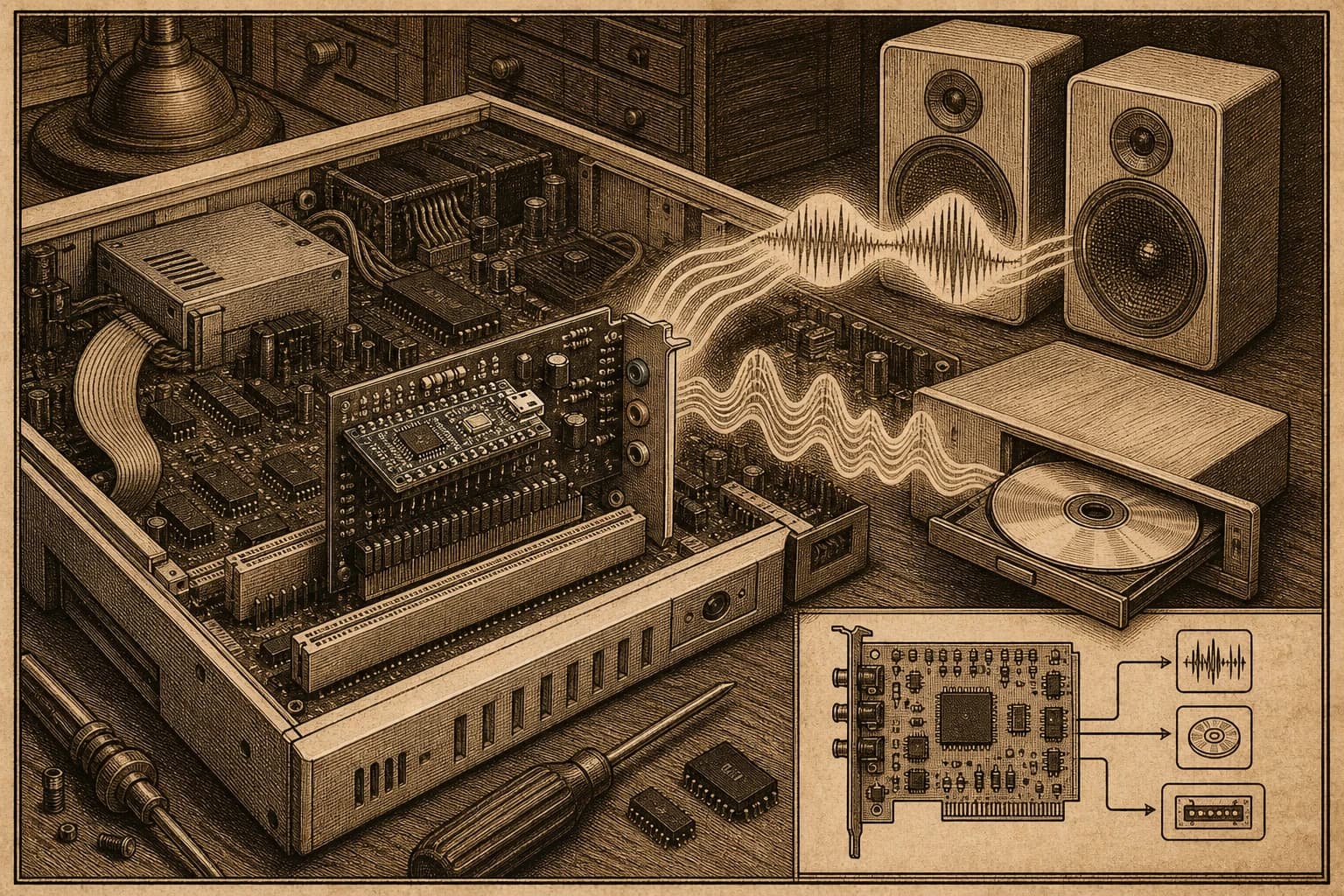
Uses an RP2040 microcontroller to emulate several ISA sound cards and a period CD-ROM interface for retro PCs, with open hardware files and assembled cards available.
Visit PicoGUSOriginal editorial concept art generated with built-in Codex Image Gen for The Machine Press, 2026-08-16.
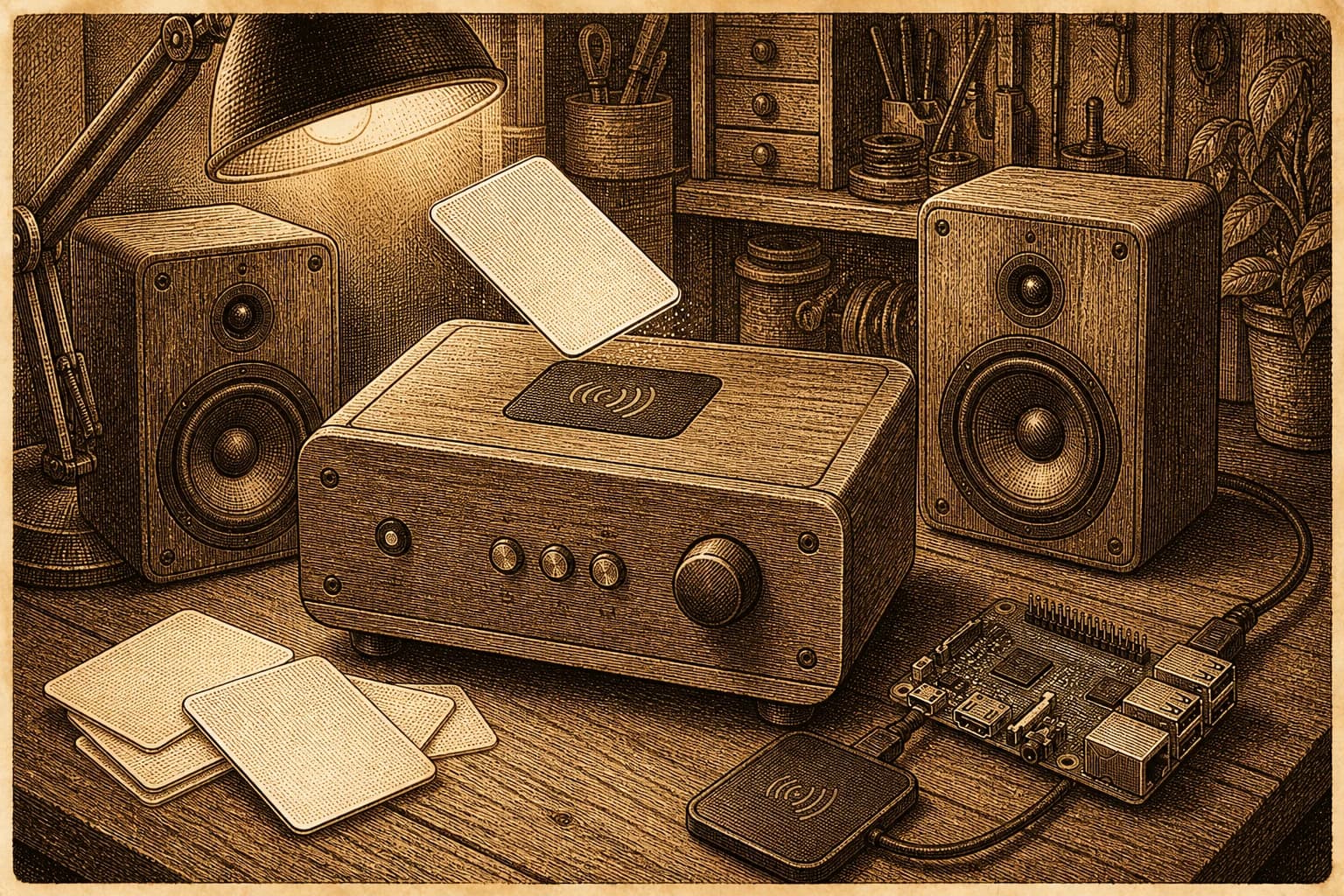
Turns RFID cards into selectors for local audio, playlists, podcasts, and web streams on a Raspberry Pi, with USB-reader setups and optional physical controls.
Visit PhonieboxOriginal Codex Image Gen concept art from 2026-07-10; carried forward from the validated 2026-08-15 edition.
Desk Picks are selected by the newsroom. Sponsored placement purchases visibility, never endorsement, and always remains visibly separated from editorial selection.
 Editorial illustration