robotics
The Muscles Learned to Sprint by Holding Still
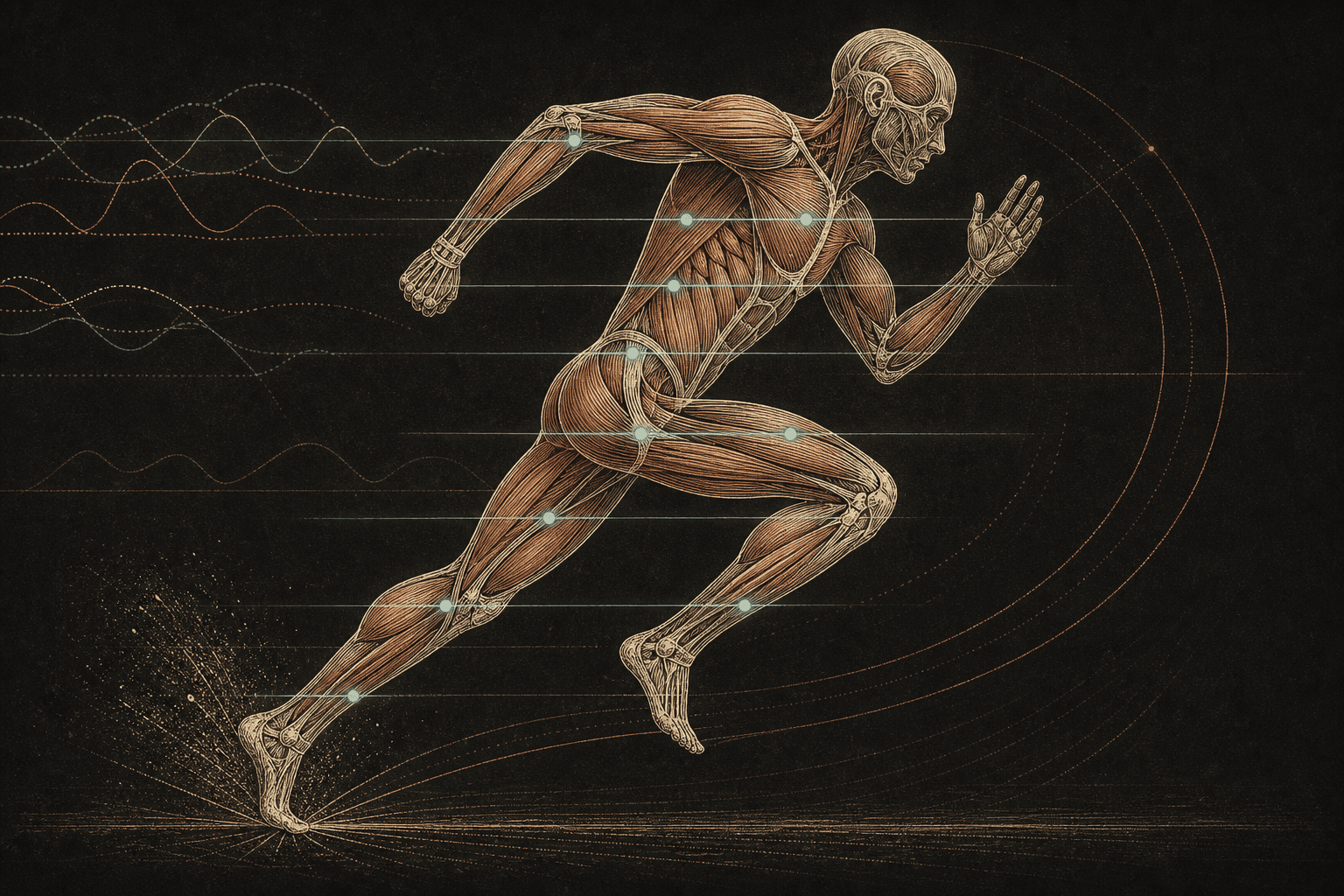
A physiology-inspired controller held per-muscle threshold lengths across gait phases and trained a simulated skeleton to sprint with a minimal reward.
Summary
A physiology-inspired controller held per-muscle threshold lengths across gait phases and trained a simulated skeleton to sprint with a minimal reward.
A muscle-actuated skeleton has far more control variables than a conventional rigid-body character, making reinforcement-learning exploration slow and unstable. The proposed lambda-hold controller reduces that burden by setting an equilibrium-point threshold length for each muscle and holding it over part of the gait cycle; a stretch-reflex rule then turns those thresholds into muscle excitation without requiring the policy to issue every low-level command.
The authors report that this controller learned human-like sprinting within an hour of training using only a minimal task reward. The work connects an engineering control scheme to the equilibrium-point hypothesis, intermittent control and optimal feedback control, but it remains predictive musculoskeletal simulation. It does not establish a clinical model of human movement or prove that the learned controller matches biological motor control in people.
Why it matters
A physiology-inspired controller held per-muscle threshold lengths across gait phases and trained a simulated skeleton to sprint with a minimal reward.
Limits and context
- The authors report that this controller learned human-like sprinting within an hour of training using only a minimal task reward.
- It does not establish a clinical model of human movement or prove that the learned controller matches biological motor control in people.
Key claims
A physiology-inspired controller held per-muscle threshold lengths across gait phases and trained a simulated skeleton to sprint with a minimal reward.
Qualification: The authors report that this controller learned human-like sprinting within an hour of training using only a minimal task reward.
Evidence: source-2026-08-19-002
Sources
- arXiv preprint 2608.17030arXiv · primary research
Corrections
No corrections have been recorded for this story.