Lazy model-image pulling cut cold startup to about 17 seconds, then hid cache exhaustion from every visible health check for more than three minutes.
Editorial illustration
Conceptual illustration: lazy model-image pulling shortened visible startup while deferred reads and finite cache pressure created hidden failure states in the reported measurements. Original editorial concept art generated with built-in Codex Image Gen for The Machine Press, 2026-08-21.
Lazy container-image pulling promises to mount an AI model immediately and fetch its contents only when read. In measurements spanning artifacts from 2 to 140 gigabytes, eStargz and AWS SOCI made cold time-to-first-prediction nearly independent of image size: 16.9 to 17.6 seconds, versus 24.5 to 573 seconds for eager pulls. But the cost moved rather than disappeared. Reading a full 14-gigabyte model through the lazy mount took 105.3 seconds, slower than the 72.4-second eager pull it replaced.
The sharper result was operational. Sustained legitimate reads exhausted the snapshotter's finite node cache, and already-running pods began losing access to model files. At the first failure stage, one instrumented pod passed every Kubernetes-visible and application-level check for 196 seconds while the snapshotter logged real errors. Under heavier pressure, 67 to 94 percent of model files failed; restarting the daemon left stale file handles inside a pod still marked Running. The measurements expose a monitoring and capacity-planning hazard, not a claim that every lazy-pulling deployment will fail.
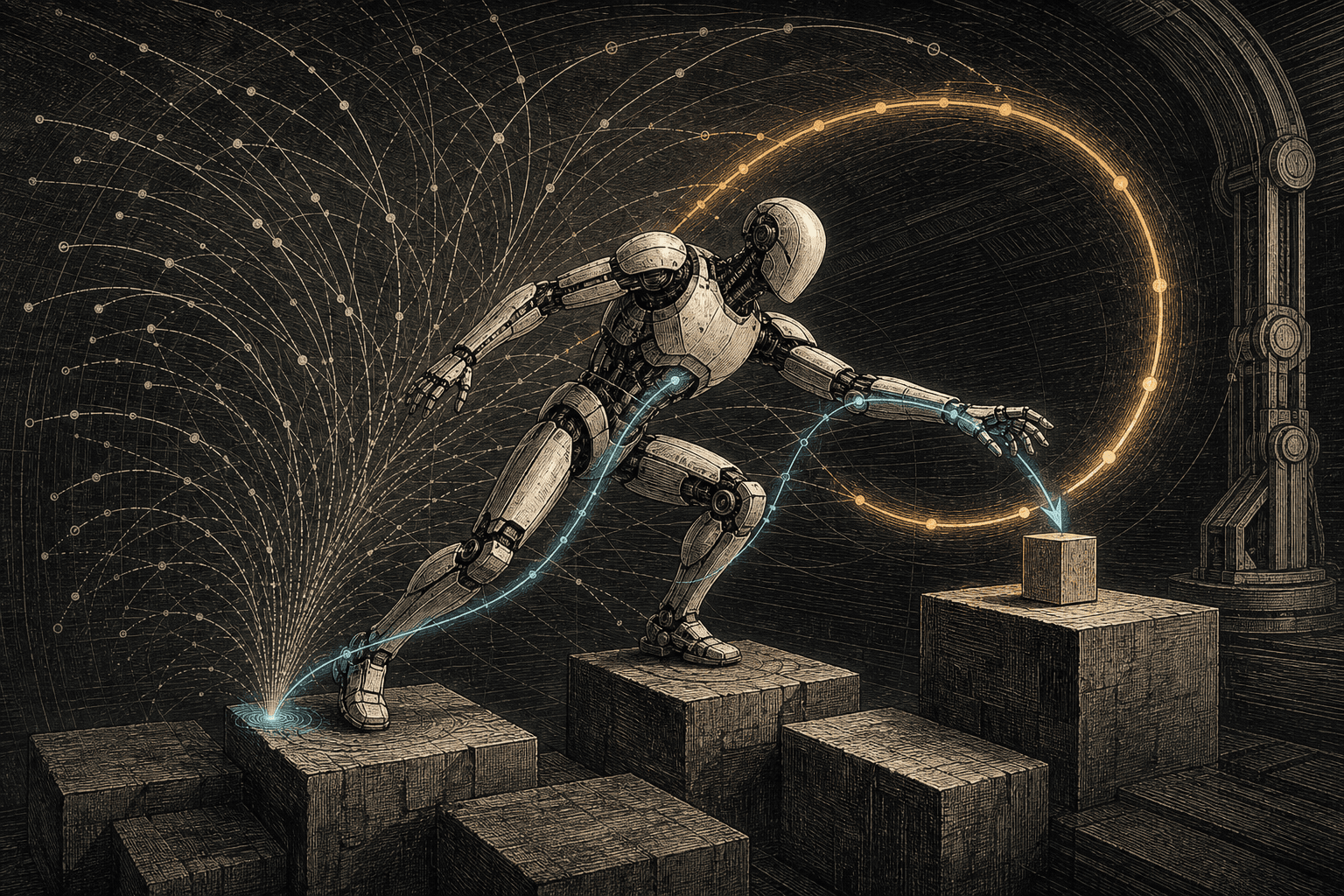
Conceptual illustration: hybrid feedback sampling balanced broad motion proposals with stabilizing feedback in the paper’s tested control tasks. Original editorial concept art generated with built-in Codex Image Gen for The Machine Press, 2026-08-21.
A hybrid model-predictive controller combined global motion search with an optimized feedback policy and handled unstable humanoid tasks in real-world tests.
Sampling-based model-predictive control can search many possible action sequences in parallel, but its sample needs grow rapidly with planning horizon on high-dimensional, open-loop unstable systems. Feedback Sampling MPC starts from a different proposal distribution: actions are sampled through an optimized feedback policy, then a hybrid design balances local stabilization against global exploration according to the system and compute budget.
The authors prove faster convergence than standard MPPI and better optimality than feedback sampling alone under their assumptions. In contact-rich humanoid locomotion, loco-manipulation and dexterous-manipulation tasks, the method handled unstable cases where conventional sampling struggled and outperformed feedback-only policies. They also report real-world humanoid locomotion and manipulation demonstrations. Those experiments show a practical control strategy on tested platforms; they do not establish general-purpose autonomy or safety outside the reported tasks.
A deterministic algorithm counted linear extensions of arbitrary partial orders in O*(1.89^n) time.
A linear extension orders every element of a partial order without violating its constraints. The new algorithm splits the problem by chain structure and, near an antichain, records only the first comparable element above each selected element before using a compressed dynamic program. Its O*(1.89^n) bound beats the long-standing 2^n general barrier and addresses a question posed in 2013. The result is theoretical, with a verification script supplied as an ancillary artifact.
NASA OSAM-1 file image used only as generic robotics context; it does not depict SCAPE, the tested robots, simulations or results, and use does not imply NASA endorsement. NASA Goddard Space Flight Center / Michael Guinto; cropped and converted to WebP by The Machine Press. Use does not imply NASA endorsement.
SCAPE predicted scenario-specific real-world policy performance from limited paired trials and large simulation runs.
SCAPE corrects simulation labels for sim-to-real bias, then uses conformal prediction to estimate real-world policy performance for particular deployment scenarios. In autonomous-driving and quadruped studies, the authors report lower scenario-level error than neural and aggregate baselines, narrower calibrated intervals and better out-of-distribution behavior. A physical Unitree Go2 test supports the evaluation method on one platform; it does not certify a policy for unrestricted deployment.
A Bayesian model placed longitudinal brain images on a continuous Alzheimer’s disease trajectory with explicit uncertainty.
Disease Continuum Positioning integrates longitudinal diffusion-tensor imaging with weak clinical supervision to produce a probabilistic Disease Continuum Score. On the ADNI cohort, the authors report stronger performance than comparison progression methods, longitudinal consistency and predictive value for future conversion. The result is retrospective modeling on a research cohort, not a clinical diagnosis or validation for individual care.
A preliminary longitudinal study found statistically lower diversity across open-ended model outputs over successive releases.
The study compares responses from three years of language-model releases on real open-ended prompts and the Alternate Uses Task. Sentence-embedding analysis finds a statistically significant decline in output diversity over time, suggesting convergence in creative substance even as model capability changes. The authors frame this as preliminary evidence: similarity metrics do not exhaust creativity, and the result does not prove that every model or human-AI workflow is becoming less original.
EventTime fused market history with breach metadata to estimate short-term abnormal losses after disclosures.
EventTime combines long-horizon market context, immediate pre-event behavior and event metadata, with contrastive learning designed for sparse, heterogeneous shocks. The accompanying SECURE dataset aligns cybersecurity incidents with stock-market series and structured plus model-derived features. Across the authors’ tests it outperformed time-series and event-aware baselines, but it estimates associations in historical data rather than guaranteeing a tradable forecast or causal loss figure.
SAM-TD compiled temporal constraints into stream-based robot planning without fixing every geometric object in advance.
Stream-based task-and-motion planners generate poses, grasps and trajectories during search, which makes conventional temporal-logic compilation difficult. SAM-TD embeds automaton guards in action schemas and shares a validity token across automata so branches violating ordering, invariance or liveness requirements are pruned. The authors demonstrate the approach in three PDDLStream environments and report competitive discrete-benchmark performance; this is planner-level validation, not a real-world safety guarantee.
Illustrative developer-workstation file image; it does not depict LLM-Detector, generated scoring code, the benchmark datasets or results. Dhirendra Singh Dhami / Pexels; cropped, resized, metadata stripped, and converted to WebP by The Machine Press.
An in-context pipeline turned normal-state summaries into executable scoring logic and beat tested baselines across 24 datasets.
LLM-Detector summarizes normal tabular data into statistics, causal dependencies and prototypes, then asks a language model to generate a scoring engine for deviation, structural inconsistency and density. The authors compare it with 15 baselines across 24 mixed and continuous datasets and report consistent gains without model fine-tuning. The evidence is benchmark-based; generated scoring code still needs review, security controls and domain validation.
A threshold-pruned reliability model represented full, reduced and zero HBM bandwidth while retaining far less state.
The proposed framework treats each high-bandwidth-memory service unit as multistate rather than simply working or failed. On a 14-unit incommensurate benchmark, its threshold-pruned traversal visited essentially the same state space as a comparison dynamic program but retained 17 entries instead of 412,121 probability states at central demand. A shared-stress model also showed that ignoring dependence could overstate reliability by 8.73 percentage points. These are exact model calculations, not field failure measurements.
A semantic-block model reduced task context by about 71 percent, while execution tests exposed a 14.4-point variability floor.
The work defines specification determinacy as agreement among all conforming implementations and encodes specifications as blocks, dependencies, owned rules, decision points and open questions. In an Oracle-to-PostgreSQL migration case, dependency closures reduced mean per-task context by about 71 percent and covered 85.5 percent of the study’s construct taxonomy. Repeated LLM implementations still showed a median 14.4-point arm-delta spread, supporting determinacy as a formal concept but not a sufficient standalone quality metric.
VideoRun2D compared pose trackers against expert annotations across 314 sprints and reduced its best joint-angle errors with post-processing.
VideoRun2D evaluates hip and knee angle estimates from multiple human-pose trackers on 314 sprints by 44 professional runners. Expert manual annotations supply the comparison, and an outlier-processing module reduced the best reported root-mean-square errors from 11.46 to 9.87 degrees and from 5.83 to 5.30 degrees for the two target angles. The study supports biomechanical analysis from video, not medical diagnosis or replacement of laboratory measurement.
Benchmark-guided refactoring preserved outputs while reducing a scientific scheduling workload enough to save an estimated four million core-hours annually.
Researchers used an agentic coding workflow to profile and refactor Python for simulation-based project scheduling on high-performance computers. Correctness checks kept outputs unchanged while test runtime fell from 1,298 seconds to under 200. The authors estimate four million core-hours and NZ$320,000 in annual savings for their workload. That is a documented case study with human control, not evidence that autonomous refactoring will safely optimize arbitrary scientific software.
Illustrative file image of The National Archives server room; it does not depict the retraining study, its models, datasets, queues or measurements. The National Archives (UK), via Wikimedia Commons, CC BY 3.0; cropped and converted to WebP by The Machine Press.
Across 3,933 runs, trigger choice barely moved one online learner but separated non-incremental outcomes by 15 to 55 points.
The study compares periodic, error-threshold and ADWIN drift-triggered retraining under explicit budgets and deployment latency. For the tested linear learner with immediate labels and per-sample updates, none of 54 paired policy comparisons produced a practically significant gain over no retraining. Without incremental updates, policy choice moved post-drift accuracy by 15 to 55 percentage points, with periodic refresh strongest on abrupt and gradual drift. The result is regime-specific guidance, not a universal retraining rule.
A proposed certificate separated shared representations from whether a frozen controller could execute an unseen composition.
DBOSC tests whether independently trained sensor compilers enter a frozen response chart with interchangeable physical meaning. Haptic, audio and acceleration representations for unseen surfaces clustered more closely by surface than mismatched pairs, but the preregistered executor could not advance even exact chart coordinates through a held-out program. At a converged budget, 14 of 16 checks passed. The failure locates capability in the executor rather than proving that compact multimodal representations alone understand physical action.
A 125-parameter hybrid forecaster matched a 281-parameter classical baseline while showing distinct kernel dynamics.
On controlled harmonic and chirp forecasting tasks, the classical model aligned with targets earlier while the hybrid quantum model developed a less concentrated kernel spectrum and smaller drift. Held-out performance remained similar, and the hybrid system reached its selected checkpoint earlier in 15 of 18 frequency conditions with fewer trainable parameters. The authors explicitly do not claim quantum advantage; the result is about learning geometry hidden by endpoint accuracy.
Four independently verified builder projects from the active August 16–22 cycle, plus one disclosed house-example sponsored slot and one placement CTA. Weekly images are carried over from the validated Sunday handoff.
Four editorial selections
$7 for seven days
Paid work is clearly labeled
Placement is never endorsement
Original editorial concept art generated with built-in Codex Image Gen for The Machine Press, 2026-08-16.
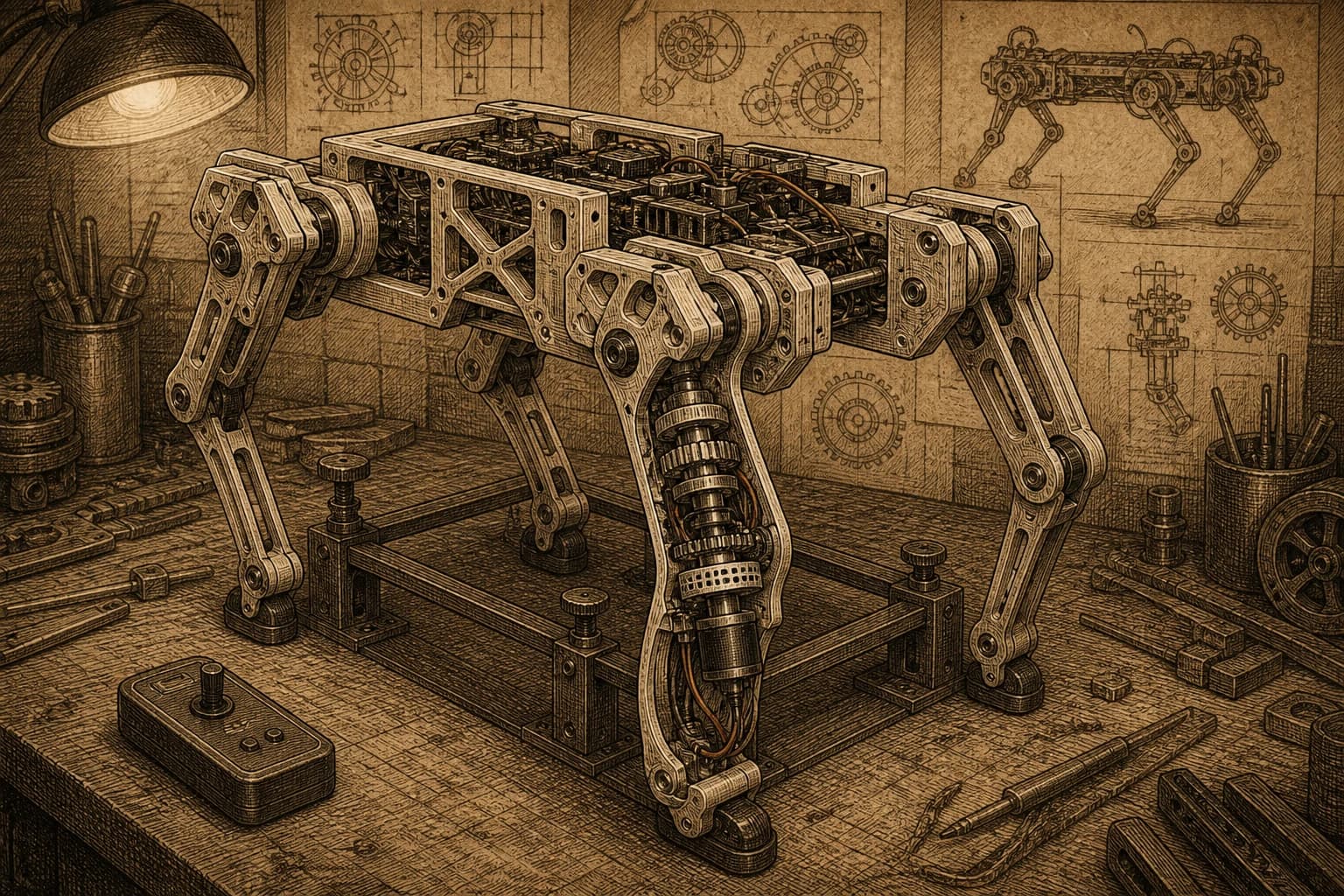
Supplies CAD, code, and a bill of materials for a PLA-printed quadruped with motor-driven joints, closed-loop controls, and an inverse-kinematics walking mode.
Visit openDogV3Original editorial concept art generated with built-in Codex Image Gen for The Machine Press, 2026-08-16.
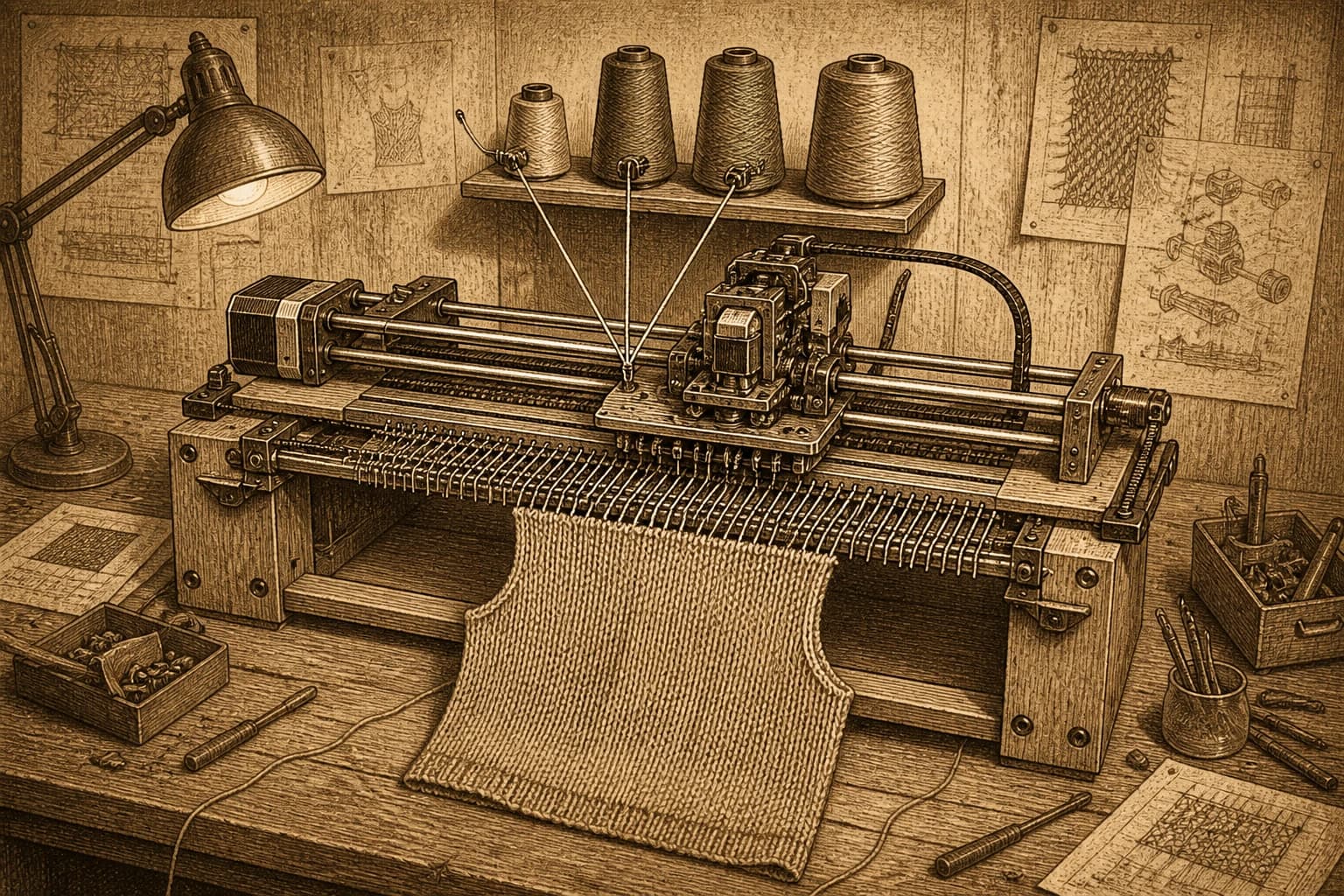
Aims to turn digital garment files into knitted pieces on an open-source machine; its smaller Wally120 design is easier to assemble, but the project remains early beta hardware.
Visit OpenKnitOriginal editorial concept art generated with built-in Codex Image Gen for The Machine Press, 2026-08-16.
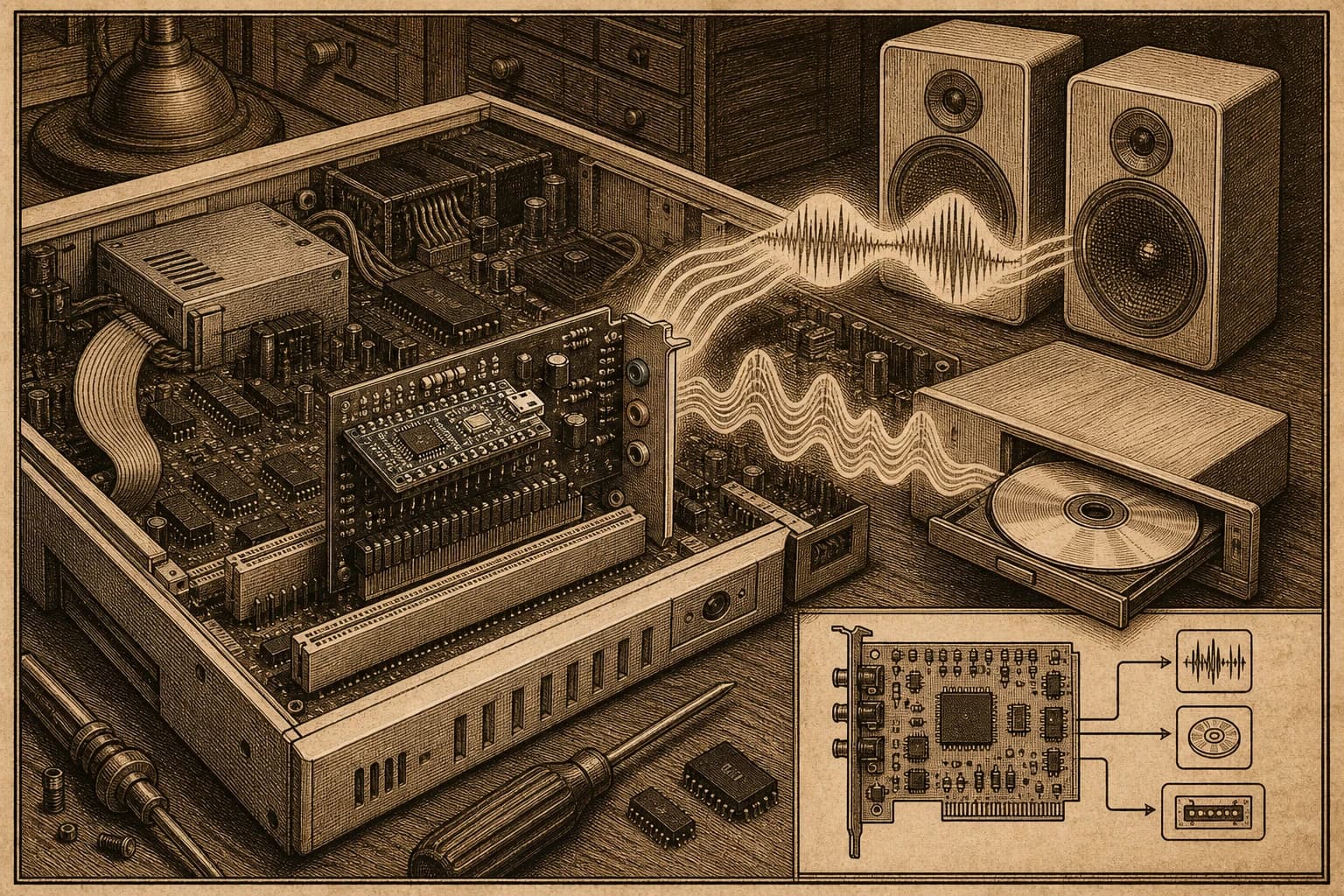
Uses an RP2040 microcontroller to emulate several ISA sound cards and a period CD-ROM interface for retro PCs, with open hardware files and assembled cards available.
Visit PicoGUSOriginal editorial concept art generated with built-in Codex Image Gen for The Machine Press, 2026-08-16.
Turns RFID cards into selectors for local audio, playlists, podcasts, and web streams on a Raspberry Pi, with USB-reader setups and optional physical controls.
Visit PhonieboxOriginal Codex Image Gen concept art from 2026-07-10; carried forward from the validated 2026-08-15 edition.
Desk Picks are selected by the newsroom. Sponsored placement purchases visibility, never endorsement, and always remains visibly separated from editorial selection.
 Editorial illustration