An executed-replay audit found that three common step-level credit signals for tool-using agents identified causal contribution no better than chance.
Editorial illustration
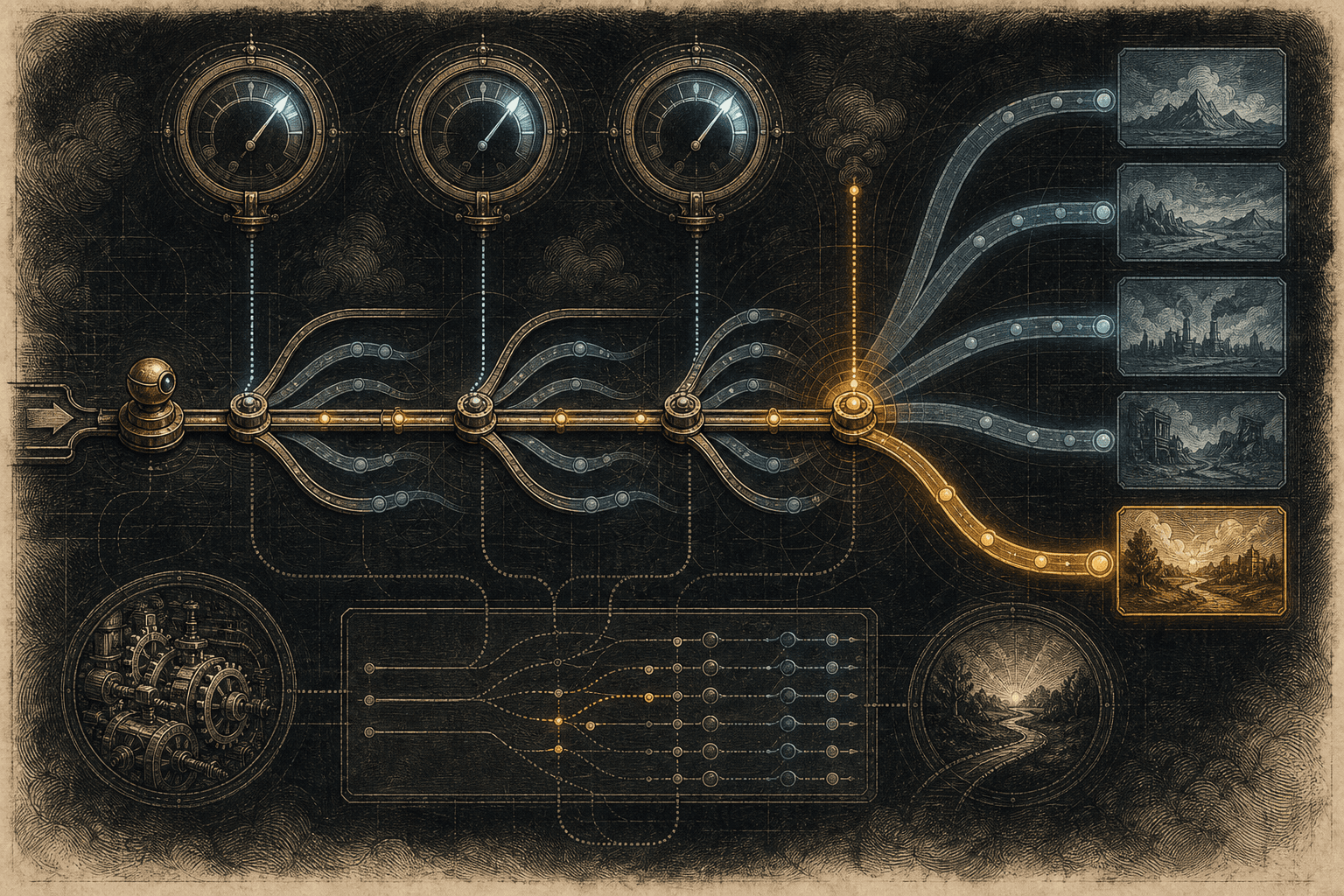
Conceptual illustration: executed counterfactual replay found that three common step-credit signals did not identify causally important agent decisions better than chance in the reported environment. Original editorial concept art generated with built-in Codex Image Gen for The Machine Press, 2026-08-23.
The researchers resampled a policy’s own alternatives at each decision point in ALFWorld and rolled the trajectory forward, creating an executed counterfactual measure of what actually changed the outcome. Against that causal reference, LLM-judge scores, outcome-conditioned log-probability ratios and the policy’s confidence all performed at chance; the authors also report that measurable contribution was sparse and that the available counterfactuals depended on the policy. Their seven-arm training experiment found no arm that reliably beat the untrained policy, while differing sample counts explained apparent training signatures. The result is a preprint finding in one single-agent environment, but its warning is broader: a fluent-looking training signal can measure exposure or correctness without identifying the step that caused success.
Conceptual illustration: a controlled study compared ceiling-mounted FMCW, IR-UWB and Wi-Fi sensing across the same participants and room layouts; it was not a clinical trial. Original editorial concept art generated with built-in Codex Image Gen for The Machine Press, 2026-08-23.
FMCW radar, ultra-wideband radar and Wi-Fi sensing were recorded together across twenty people and six room layouts.
A controlled study mounted three contact-free radio systems above the same bedroom scenes and evaluated them with the same convolutional network. IR-UWB produced the strongest cross-subject result on the ten-class activity task, while FMCW generalized best to unseen room layouts; all three technologies exceeded 92 percent macro F1 on the study’s four-class sleep-monitoring task in unseen environments. The authors attribute the trade-off to differences in range resolution, antenna diversity, Doppler resolution and retained spatial information. The experiment involved twenty participants and should not be read as clinical validation, but it gives designers a rare like-for-like comparison instead of forcing them to compare results gathered with different rooms, hardware and methods.
A controlled benchmark made textual summaries, numerical series and external forecasts disagree on purpose.
Because the synthetic risk trajectories identify which evidence source matches the ground truth, the study can vary modality, recency, stated reliability and provenance independently. Open-weight instruction models showed systematic text-versus-number preferences and followed recent evidence more consistently than reliability labels, sometimes over-weighting an external forecast against direct context. The finding isolates a heuristic failure mode for tool-augmented decisions rather than measuring a deployed domain.
Illustrative generic server-hardware file image; it does not depict StateMem, the tested models, memory backends, conversations or benchmark results. panumas nikhomkhai / Pexels; cropped, resized, metadata stripped, and converted to WebP by The Machine Press.
StateMemBench separates current-state answers from superseded facts across 234 multi-session scenarios.
The benchmark tests whether an agent updates its working world when facts, constraints and decisions change, rather than merely retrieving something that was once true. The authors report that a state-first method improved current-state accuracy over same-backbone and existing-memory baselines, and that a single-call wrapper added 32 to 67 points across six backends; absolute benchmark performance remained limited, keeping the result squarely in research territory.
FleetSieve measures only the LLM-serving configurations likely to change a resource-coupled allocation.
On a fixed H100 grid for a 31-billion-parameter open model, the method matched the oracle aggregate choice with 6.9 percent fewer GPU-seconds than uniform random profiling in the fixed comparison. Its joint capacity and tail-latency model also avoided a configuration whose 46.4-second p99 violated a 30-second service objective, although the paper reports that FleetSieve did not use the fewest GPU-seconds for every workload.
ReCache separates recurring tool and skill descriptions so their key-value states survive changes in order and combination.
Resource-local attention and positions make cached schema blocks composition-invariant, while route selection and pruning reduce what remains visible at inference. On a benchmark assembled from seven public tool-and-skill datasets, the preprint reports nearly unchanged invocation F1, a 3.655-times time-to-first-token speedup for resource-wise attention and a 92.43 percent reduction in allocated KV-tensor memory for the complete framework.
Aggregate accuracy and bias scores concealed subgroup shifts and confident errors across eleven compression methods.
Researchers evaluated three language models across eleven compression methods and found that compressed systems disproportionately lost head knowledge relative to tail knowledge while often remaining confident about newly incorrect answers. Stable aggregate bias scores also masked opposing movements across demographic subgroups, arguing for granular deployment audits rather than a single perplexity, accuracy or bias number.
Thinkingbox evaluates terminal backend state, policy compliance and collateral effects across 507 business workflows.
The strongest tested model reached 65.36 percent pass-at-one but only 25.25 percent success across twenty attempts on the new benchmark. Many failed runs terminated cleanly after valid state-changing actions, supporting the authors’ argument that a plausible response or tool call is not evidence that the right persistent state transition occurred without extra effects.
NASA OSAM-1 file image used illustratively; it does not depict GOAG, the tested grippers, objects, simulations or results. Use does not imply NASA endorsement. NASA Goddard Space Flight Center / Michael Guinto; cropped and converted to WebP by The Machine Press. Use does not imply NASA endorsement.
GOAG introduces object features only at inference time and samples contacts from a learned representation of the hand.
The generative planner starts from the geometric fact that gripper and object surfaces coincide at valid contacts, then models the contact distribution for a specific gripper without object-specific training data. The authors report an 86.93 percent average success rate on MultiDex objects plus simulated and real-world tests across multiple grippers; the claim remains tied to the reported protocols, not universal dexterity.
SWE-bench Science spans 119 tasks, 98 repositories and twenty fields where software is part of the instrument.
The benchmark separates issue-driven, expert-exploratory and engineering-integration work and reports a best pass-at-one below 50 percent. Its error analysis finds failures in scientific abstraction, exploration, repair coverage and generalization; a paired ablation also showed that well-grounded scientific guidance can help while poorly aligned guidance can anchor the repair in the wrong direction.
A role-conditioned allocation method drops redundant judges, routes specialists by slice and stops when validation gain saturates.
The method uses a small labeled audit set, declared slices and call costs to distinguish copies, global complements and conditional specialists. Across reasoning, code, safety, preference, reward, summarization and math audits, the output is an auditable call plan rather than a claim that one fixed panel wins everywhere.
A programmatically bounded action interface put general-purpose reasoning models against a plant-wide benchmark.
The authors report that the leading model maintained hard constraints across all 39 abnormal situations and operating-point changes, while basic regulatory control failed in fifteen. It also matched the benchmark’s expert-engineered advanced control and diagnosed the stated root cause in fifteen safety-critical cases; these are benchmark results without a human in the loop, not authorization to deploy an LLM on a real plant.
Researchers reconstructed in-context secrets from ordinary outputs even when models refused direct extraction.
Across eight proprietary models in controlled experiments, the authors report near-perfect recovery of two-digit secrets and 82 percent exact recovery for four digits from benign responses. They also trained attacks that infer predicates about user memories and extract longer identifiers in a production-style agent, framing context sensitivity itself as a covert leakage channel that capability may amplify.
Staged technology file image; it does not depict a MaliciousSkillBench artifact, a real scanner, malicious code or the reported evaluations. Rafael Minguet Delgado / Pexels; cropped, resized, metadata stripped, and converted to WebP by The Machine Press.
The benchmark reduces 8,414 raw malicious records to 7,539 normalized identities and evaluates both learned detectors and off-the-shelf scanners. Random-split macro F1 reached as high as 0.932, but source-disjoint performance fell to 0.653–0.665; the strongest text model retained high malicious recall while falsely flagging 62.4 percent of benign skills from held-out sources.
ShieldFS extends ZFS so a hostile storage stack cannot silently roll back, replay or fork persistent state.
The design keeps succinct commitments inside trusted execution environments and a lightweight registry, while authenticating the write-ahead log and storage pool with hash chains and an embedded Merkle tree. Reads verify freshness and integrity without application changes; the paper reports performance comparable to other evaluated filesystems, but the security claim remains conditioned on its confidential-computing threat model and trusted registry.
PolicyGuide compiles policy into a graph and returns step-specific remediation at user-turn boundaries.
Across airline, retail and telecom tasks with one agent-verifier pairing, the preprint reports mean four-run pass rate rising from 0.42 to 0.62, with the largest improvement in telecom. The same workflow representation transferred to two other agent families, while complementary tests found lower observed attack success and stronger procedural compliance than the compared safeguards.
A self-contained touchscreen computer boots into MicroPython and combines programmable graphics, MIDI connections, and an open-source synthesizer in focused, buildable hardware.
Visit Tulip Creative ComputerOriginal editorial concept art generated with built-in Codex Image Gen for The Machine Press, 2026-08-23.
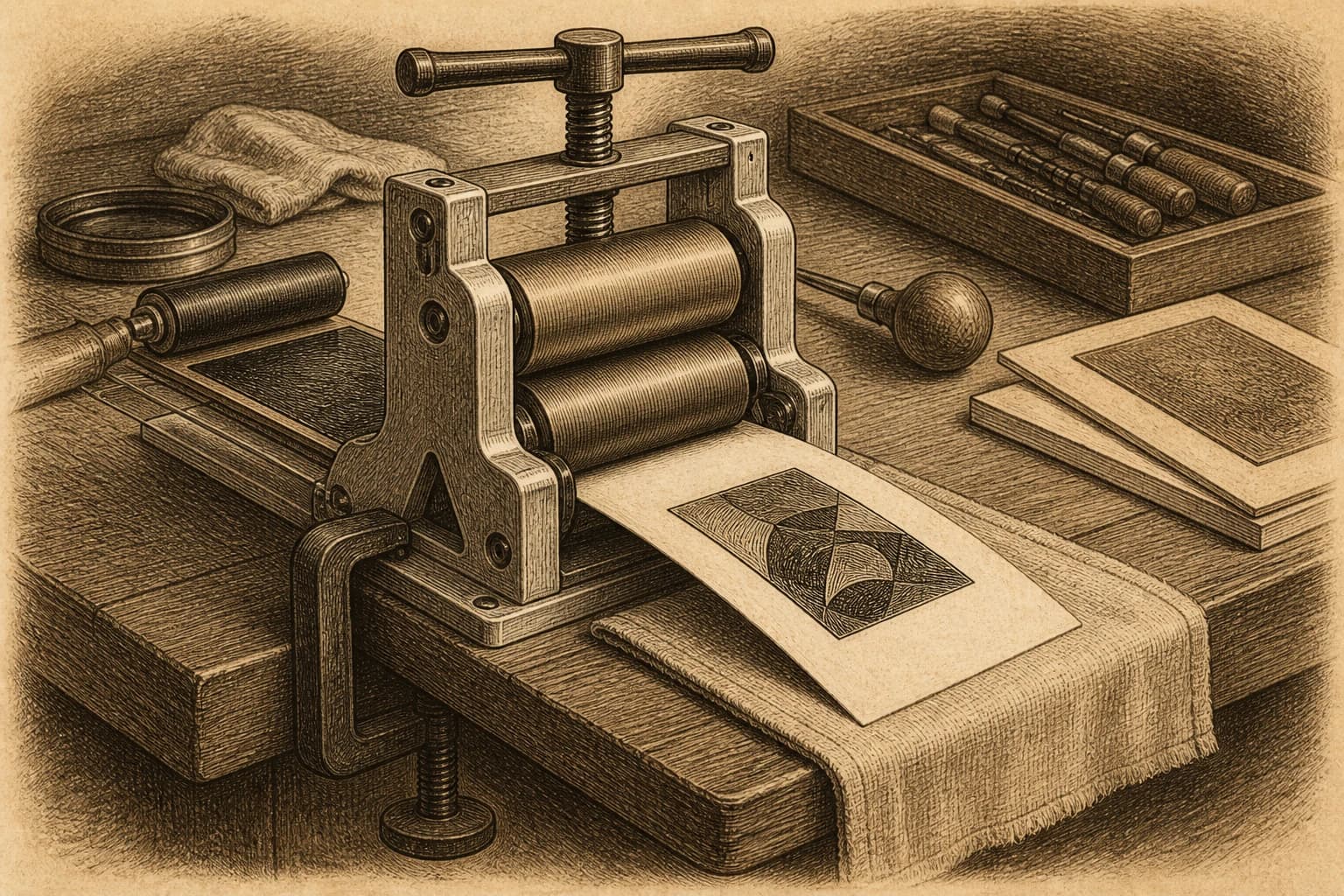
Shrinks an intaglio press into 3D-printed tabletop hardware, with free fabrication plans for makers and finished presses for artists without a printer.
Visit Open Press ProjectOriginal editorial concept art generated with built-in Codex Image Gen for The Machine Press, 2026-08-23.
BuilderRichard Bowman and OpenFlexure contributors
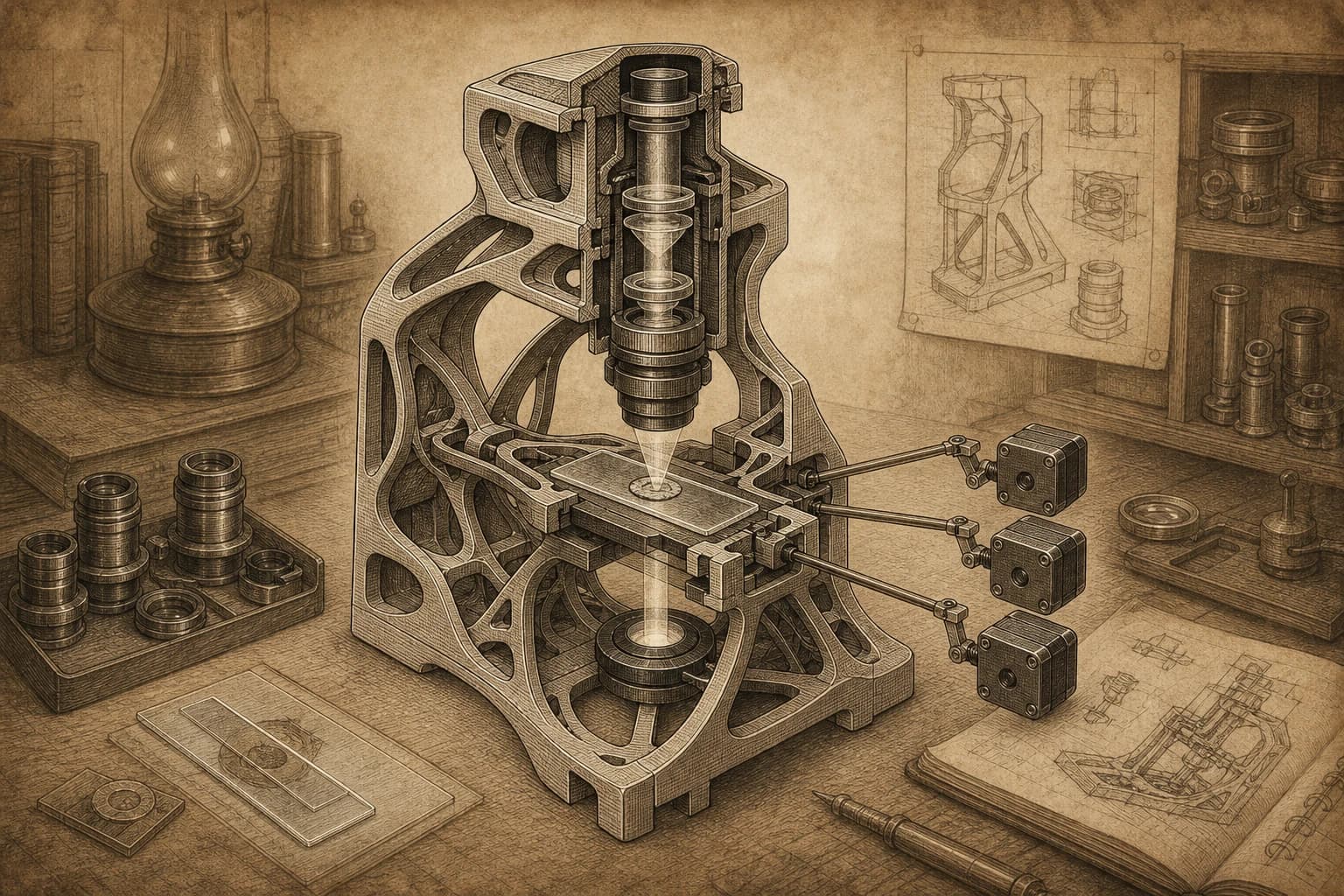
Prints most of a precise microscope body as one flexure mechanism, pairing interchangeable optics with optional motorized sample positioning and open control software.
Visit OpenFlexure MicroscopeOriginal editorial concept art generated with built-in Codex Image Gen for The Machine Press, 2026-08-23.
BuilderLibre Space Foundation and SatNOGS contributors
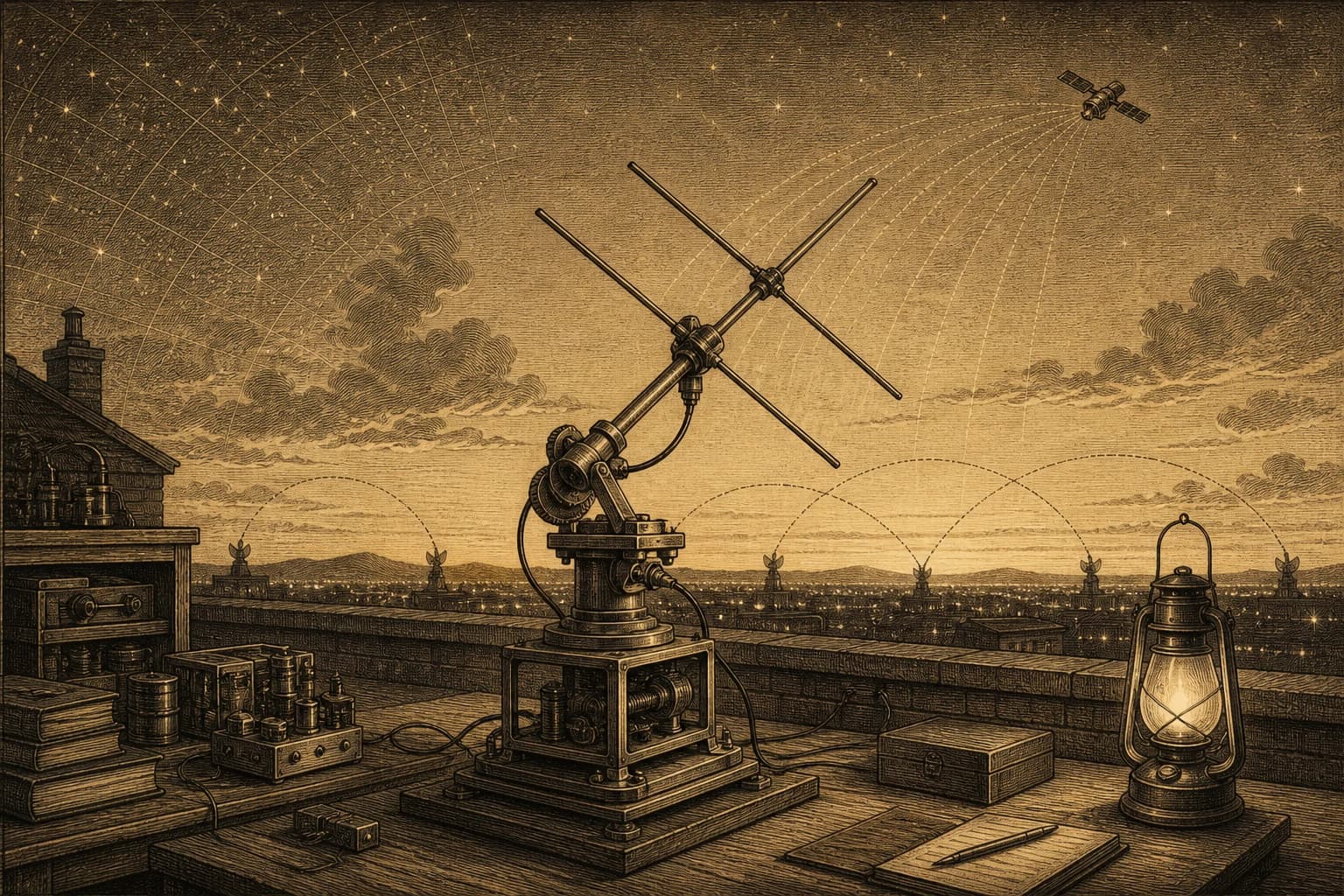
Links volunteer-built radio ground stations to shared scheduling and observation services, turning backyard antennas into a public satellite-observation network.
Visit SatNOGSOriginal Codex Image Gen concept art from 2026-07-10; carried forward from the validated 2026-08-22 edition.
Desk Picks are selected by the newsroom. Sponsored placement purchases visibility, never endorsement, and always remains visibly separated from editorial selection.
 Editorial illustration