research
The Ceiling Saw Sleep Without a Camera
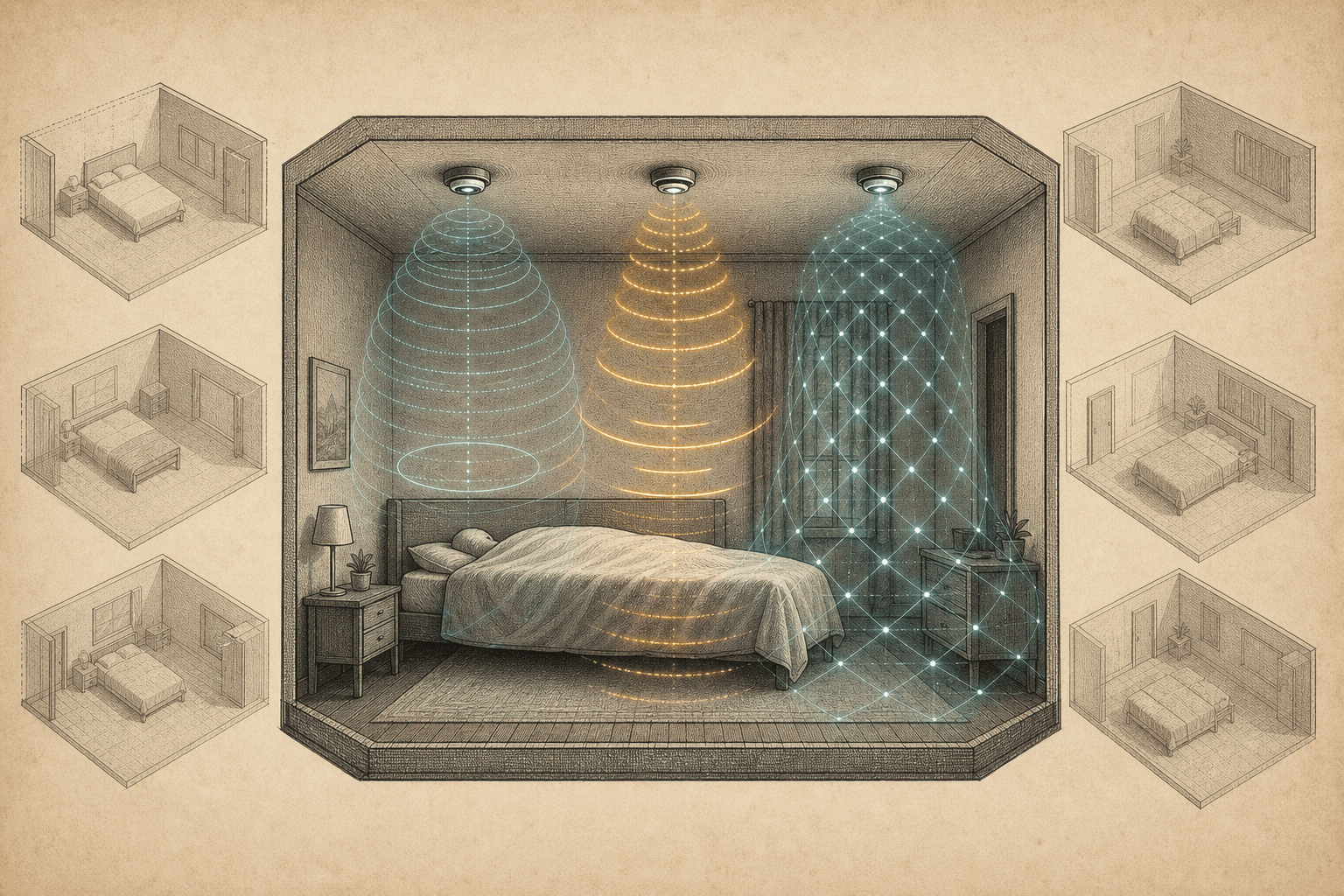
FMCW radar, ultra-wideband radar and Wi-Fi sensing were recorded together across twenty people and six room layouts.
Summary
FMCW radar, ultra-wideband radar and Wi-Fi sensing were recorded together across twenty people and six room layouts.
A controlled study mounted three contact-free radio systems above the same bedroom scenes and evaluated them with the same convolutional network. IR-UWB produced the strongest cross-subject result on the ten-class activity task, while FMCW generalized best to unseen room layouts; all three technologies exceeded 92 percent macro F1 on the study’s four-class sleep-monitoring task in unseen environments. The authors attribute the trade-off to differences in range resolution, antenna diversity, Doppler resolution and retained spatial information. The experiment involved twenty participants and should not be read as clinical validation, but it gives designers a rare like-for-like comparison instead of forcing them to compare results gathered with different rooms, hardware and methods.
Why it matters
FMCW radar, ultra-wideband radar and Wi-Fi sensing were recorded together across twenty people and six room layouts.
Limits and context
- The experiment involved twenty participants and should not be read as clinical validation, but it gives designers a rare like-for-like comparison instead of forcing them to compare results gathered with different rooms, hardware and methods.
Key claims
FMCW radar, ultra-wideband radar and Wi-Fi sensing were recorded together across twenty people and six room layouts.
Qualification: The experiment involved twenty participants and should not be read as clinical validation, but it gives designers a rare like-for-like comparison instead of forcing them to compare results gathered with different rooms, hardware and methods.
Evidence: source-2026-08-23-002
Sources
- arXiv preprint 2608.20322arXiv · primary research
Corrections
No corrections have been recorded for this story.