An autonomous system assembled public and Earth-observation data on demand, then searched for a task-specific model instead of beginning with a fixed dataset.
Editorial illustration
Conceptual illustration: PPE assembles public and Earth-observation data for task-specific geospatial models; this is not a forecast map or result. Original editorial concept art generated with built-in Codex Image Gen for The Machine Press, 2026-08-27.
PPE retrieves spatiotemporally relevant covariates from public and Earth-observation platforms, fuses them with foundation-model embeddings, and searches model families with overfitting guards. The authors report mean R-squared gains across 21 US health indicators, national risk and vulnerability measures, a doubling over a baseline for Nigerian food-security downscaling, and 83.3 percent Recall@10 in five retrospective weekly forecasts for the 2026 DRC Bundibugyo Ebola outbreak. Those are author-reported evaluations on selected tasks; an autonomous pipeline does not remove the need to audit data coverage, target validity, uncertainty, or decisions made from its forecasts.
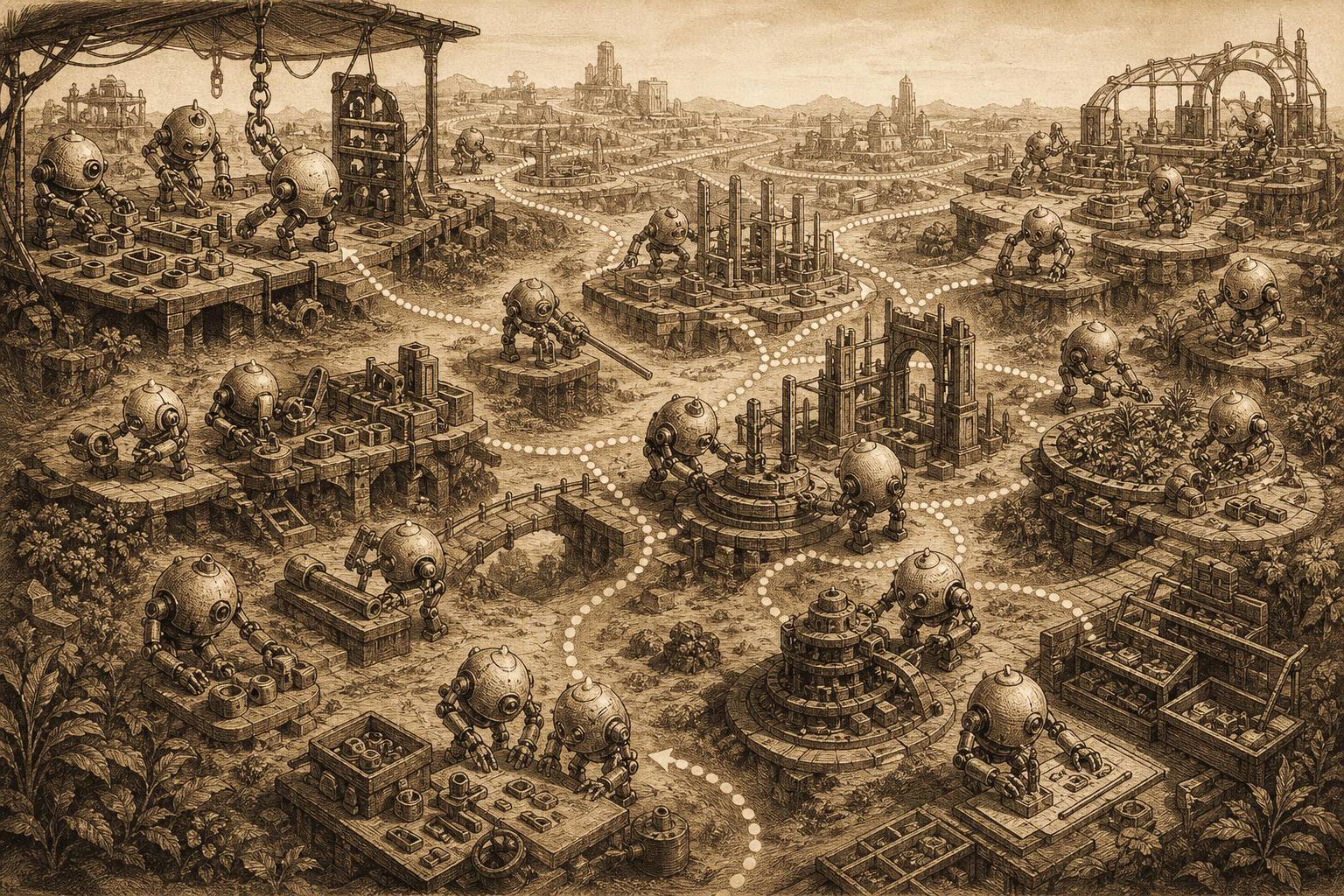
Conceptual illustration: SwarmWorld studies artifact-mediated coordination in a deterministic simulation; this does not depict its agents, world or results. Original editorial concept art generated with built-in Codex Image Gen for The Machine Press, 2026-08-27.
Unassigned language-model agents developed broader technological portfolios through persistent artifacts and environmental traces, while isolated search still produced a competitive best invention.
SwarmWorld places initially homogeneous agents in a deterministic simulated environment where they explore, process materials, build persistent artifacts, and write controllers tested after the agents are removed. Shared societies produced broader and more resilient portfolios than a strong best-of-N isolated-search baseline, though isolated search remained competitive for the strongest single artifact. Agents differentiated into exploration, construction, maintenance, and coordination behaviors, and most reuse began through observing artifacts rather than direct communication. The work demonstrates an engineered simulation of stigmergic coordination, not evidence that today’s models possess human culture, consciousness, or open-ended social agency.
SciMIF tests ten groups of general and discipline-specific constraints across 22 tasks in five sciences.
Experiments across closed and open multimodal models found large discipline gaps, with chemistry especially difficult. Scaling the model did not reliably improve adherence, and fine-grained constraints requiring disciplinary application remained hard. The authors say data and code will be released.
Generic code-screen file image used illustratively; it is not a trace, SQL query, benchmark interface or result. Markus Spiske / Pexels; cropped, resized, metadata stripped, and converted to WebP by The Machine Press.
Trace Integrity separates reference-answer accuracy from executable, schema-valid and replayable computation.
On BIRD Mini-Dev, three SQL-agent variants posted answer accuracies of 20, 22 and 24 percent, while their trace-integrity pass rates were 39, 43 and 40 percent. The authors’ Correct Answer / Invalid Trace rates remained 55, 59.1 and 45.8 percent, showing that answer matching, trace validity and silent-failure risk measured different things in this demonstration.
AsymSpec lets a lightweight drafter see the complete input while the large verifier works from a compressed view.
Across four agentic capabilities and two end-to-end benchmarks, the authors report about 90 percent of full-context accuracy on average. On isolated text capabilities, the method delivered 1.3 to 1.7 times throughput at 0.2 to 0.3 times the compute cost, targeting cases where compression had discarded useful reasoning signals.
ProgRouter chooses a model at each workflow step from evolving completion, difficulty and budget signals.
A multi-view scorer tracks outcome regime, subtask completion, progress trends and state quality before a meta-gate estimates the gain from each candidate model. Experiments across coding, mathematics and retrieval-augmented question answering reduced operating cost against stated baselines while maintaining strong task performance; the abstract does not claim one universal saving.
A four-dataset evaluation found that automated fact-checking rankings changed with domain and metric, while retrieval remained the bottleneck.
The best model on SciFact reached macro-F1 0.70 and fell to 0.31 on ClimateCheck. Replacing retrieved evidence with gold annotations improved veracity accuracy by 14 to 22 points across models, and noisy evidence sometimes made claim-only systems outperform more elaborate pipelines.
SymTrace replays multi-agent trajectories from intervention anchors to separate causal repair from lucky resampling.
Across 536 human-annotated failures in three frameworks, unguided reruns reproduced failures 67.97 percent of the time but repaired only 6.90 percent. A symptom-driven intervention repaired 20.15 percent, a reported 191.89 percent improvement over the studied repair methods while still leaving most failures unresolved.
Staged technology illustration; it is not an alignment audit, model transcript, hidden behavior or experimental result. Rafael Minguet Delgado / Pexels; cropped, resized, metadata stripped, and converted to WebP by The Machine Press.
Reinforcement learning improved model investigations while negative examples helped keep false positives below one percent.
The training environment planted hidden behaviors through target system prompts and rewarded investigations by pairwise comparison with references. The authors report stronger investigations, more concerning behaviors surfaced in unmodified production models, improved realism and cross-scaffold generalization, with false positives below one percent in tested settings.
FRAG scores whether an unlearning update targets forget-critical weights while sparing retain-critical ones.
The authors argue that global weight displacement confuses selective unlearning with random or destructive change. Their training-free Forget-Retain Alignment Gap better separated selective from dense updates, and a pruning method built on the same principle improved relearning robustness in the reported experiments.
Narcissus keeps LLM proposals as context-bearing syntax trees while leaving every grammar rule reachable.
Across five domains and two search backends, the synthesizer beat static guidance at every tested budget and consistently outperformed asking the model to repair its own proposal. It solved 40 percent of ARC tasks where raw proposals solved 13 percent and made no LLM call during search.
CaSKG uses counterfactual probes before publishing a graph for compact procedural retrieval.
Across six model backbones and two embodied-agent benchmarks, CaSKG led all twelve model-benchmark combinations. Against Graph-of-Skills, the reported macro-average rose from 72.62 to 80.50 on ScienceWorld and from 80.01 to 86.79 percent success on ALFWorld, while mean environment steps also fell.
Fixed candidate-pool replays isolated how frequency and judge signals determine the answer a multi-agent system reports.
Across 81,390 fixed pools from 16,278 questions, combining answer frequency with judge evaluation changed only terminal selection and raised accuracy from 63.82 percent to 70.82–70.95 percent. The gains mainly rescued correct answers outnumbered by popular errors; judge reliability varied with task, generator and answer rarity.
Generic source-code illustration; it does not depict a tested project, crash, vulnerability or benchmark result. D. Charbonnier / The Noun Project, via Wikimedia Commons (CC0 1.0); padded, gold background added, and converted to WebP by The Machine Press.
FuzzingBrain-Bench rewards open-ended crash discovery instead of matching one predefined vulnerability.
The first release includes 77 challenges from 43 open-source projects. Of three evaluated models, Claude Opus 4.8 triggered crashes in 60 challenges and scored 196 of 579; none triggered a crash in 13 challenges. Crash signatures measure discovered failures, not exploitability or security severity.
FinRiskAtlas evaluates specific review operations and whether the available evidence supports a defensible next step.
The Chinese-language suite contains 9,742 static instances across 53 task families plus 680 replayed pre-action states from 104 de-identified trajectories. Across 33 model configurations, operation rankings correlated only 0.42 on average, and knowledge-based shortlisting incurred up to 18.01 points of regret on individual operations.
A pre-schematic framework extracts only needed engineering properties, then uses deterministic scripts for compatibility checks.
Across seven embedded-system designs and 34 datasheets, the authors report 97.5 percent compatibility-verification accuracy and an 8.6-fold reduction in input context versus upload-and-query workflows. Intermediate graphs and criteria keep numerical evaluation outside the language model.
A self-contained touchscreen computer boots into MicroPython and combines programmable graphics, MIDI connections, and an open-source synthesizer in focused, buildable hardware.
Visit Tulip Creative ComputerOriginal editorial concept art generated with built-in Codex Image Gen for The Machine Press, 2026-08-23.
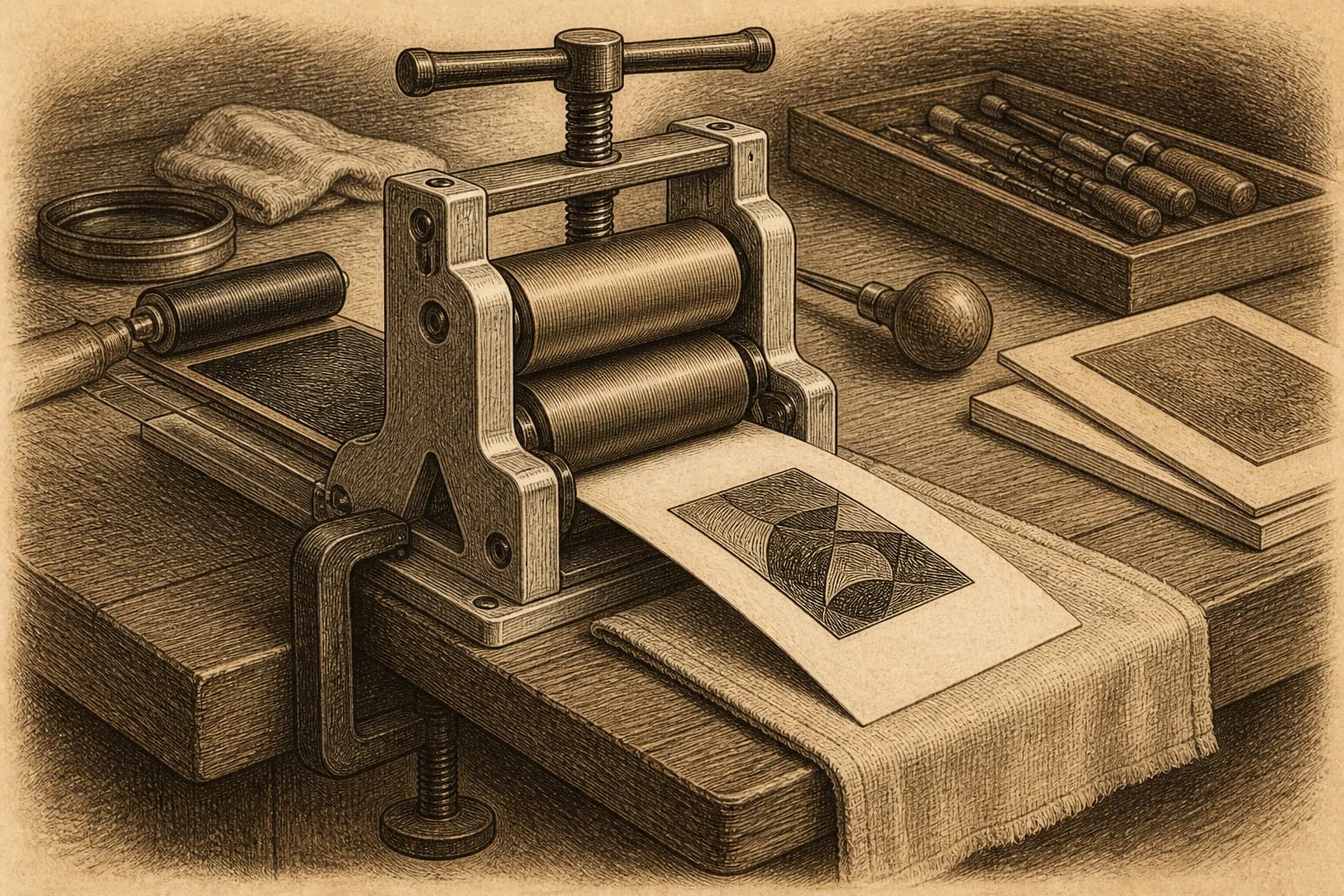
Shrinks an intaglio press into 3D-printed tabletop hardware, with free fabrication plans for makers and finished presses for artists without a printer.
Visit Open Press ProjectOriginal editorial concept art generated with built-in Codex Image Gen for The Machine Press, 2026-08-23.
BuilderRichard Bowman and OpenFlexure contributors
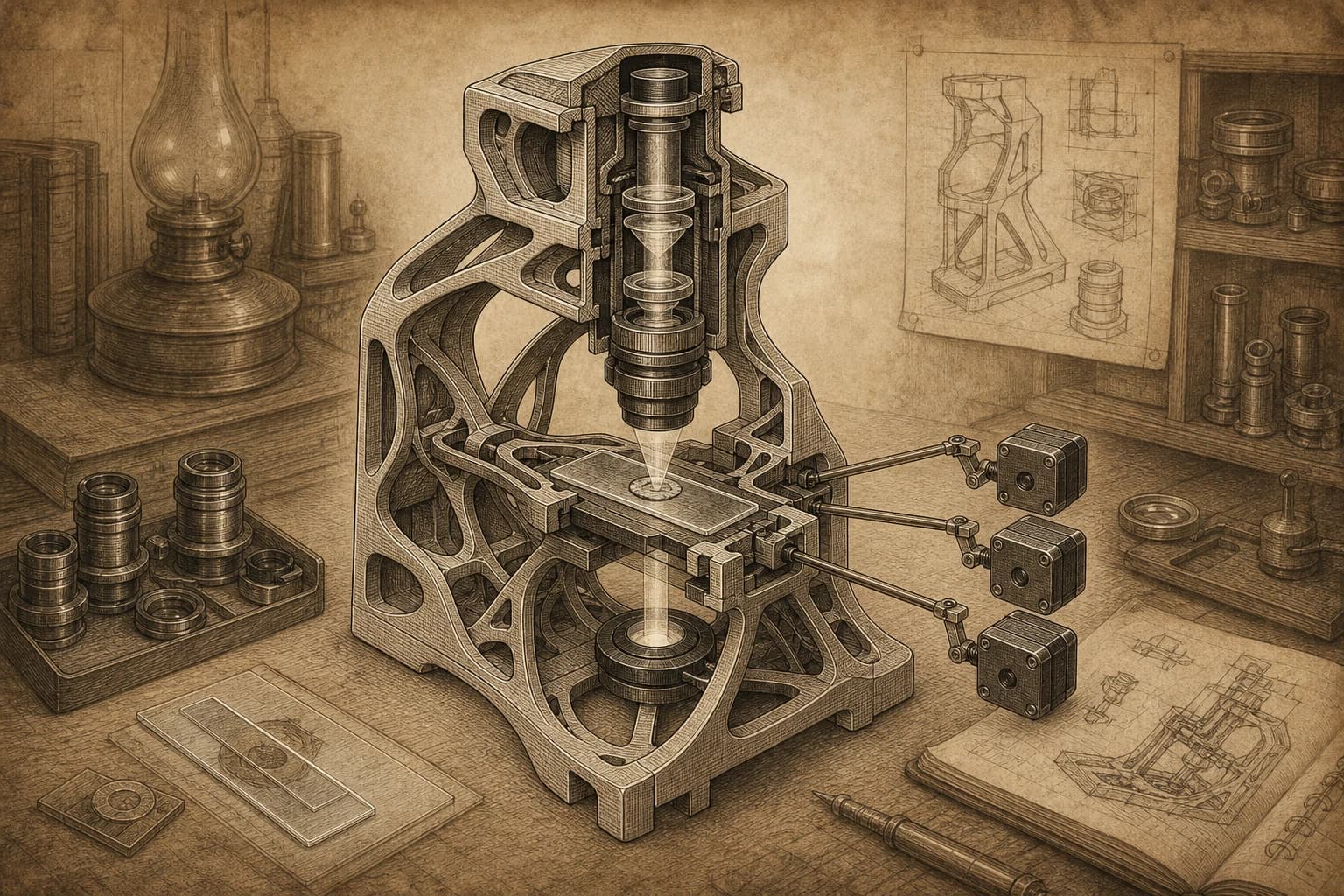
Prints most of a precise microscope body as one flexure mechanism, pairing interchangeable optics with optional motorized sample positioning and open control software.
Visit OpenFlexure MicroscopeOriginal editorial concept art generated with built-in Codex Image Gen for The Machine Press, 2026-08-23.
BuilderLibre Space Foundation and SatNOGS contributors
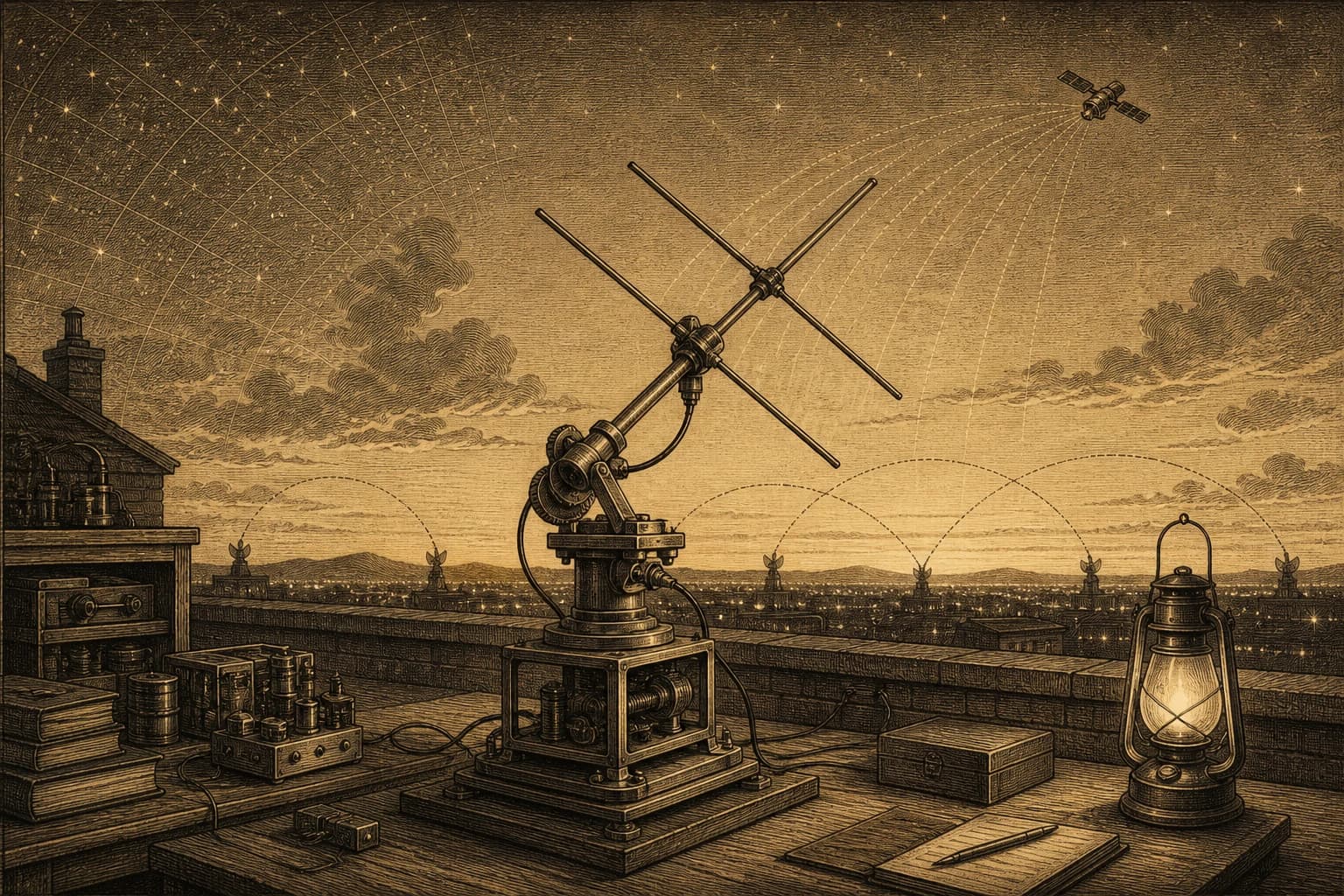
Links volunteer-built radio ground stations to shared scheduling and observation services, turning backyard antennas into a public satellite-observation network.
Visit SatNOGSOriginal Codex Image Gen concept art from 2026-07-10; carried forward from the validated 2026-08-26 edition.
Desk Picks are selected by the newsroom. Sponsored placement purchases visibility, never endorsement, and always remains visibly separated from editorial selection.
 Editorial illustration