research
The Society Built With What It Left Behind
Unassigned language-model agents developed broader technological portfolios through persistent artifacts and environmental traces, while isolated search still produced a competitive best invention.
Summary
Unassigned language-model agents developed broader technological portfolios through persistent artifacts and environmental traces, while isolated search still produced a competitive best invention.
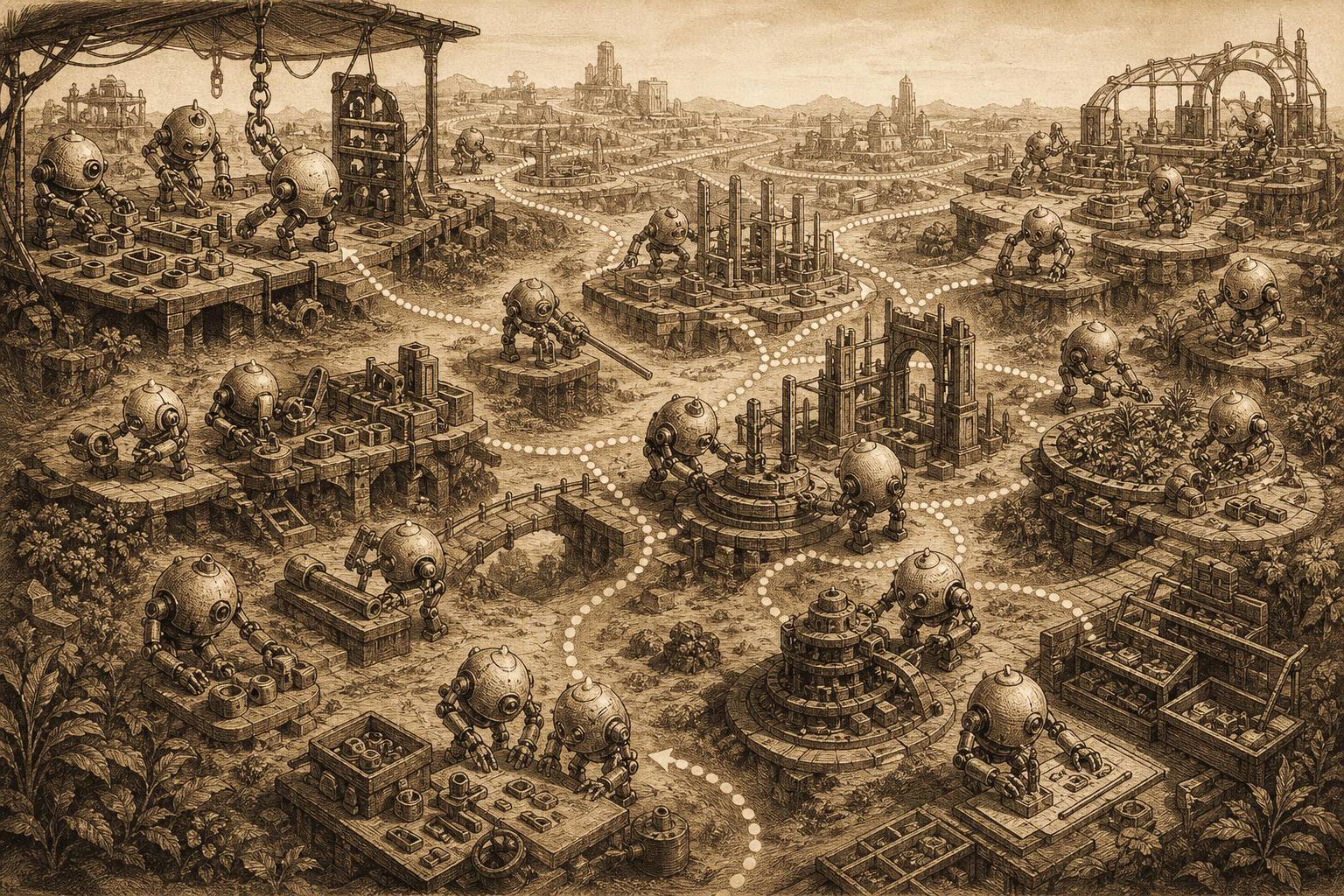
SwarmWorld places initially homogeneous agents in a deterministic simulated environment where they explore, process materials, build persistent artifacts, and write controllers tested after the agents are removed. Shared societies produced broader and more resilient portfolios than a strong best-of-N isolated-search baseline, though isolated search remained competitive for the strongest single artifact. Agents differentiated into exploration, construction, maintenance, and coordination behaviors, and most reuse began through observing artifacts rather than direct communication. The work demonstrates an engineered simulation of stigmergic coordination, not evidence that today’s models possess human culture, consciousness, or open-ended social agency.
Why it matters
Unassigned language-model agents developed broader technological portfolios through persistent artifacts and environmental traces, while isolated search still produced a competitive best invention.
Limits and context
- The work demonstrates an engineered simulation of stigmergic coordination, not evidence that today’s models possess human culture, consciousness, or open-ended social agency.
Key claims
Unassigned language-model agents developed broader technological portfolios through persistent artifacts and environmental traces, while isolated search still produced a competitive best invention.
Qualification: The work demonstrates an engineered simulation of stigmergic coordination, not evidence that today’s models possess human culture, consciousness, or open-ended social agency.
Evidence: source-2026-08-27-002
Sources
- arXiv preprint 2608.26081arXiv · primary research
Corrections
No corrections have been recorded for this story.