A six-stage audit fully or partially reproduced 6.52 percent of 1,304 eligible neuro-symbolic AI studies from their published artifacts.
Editorial illustration
Conceptual illustration: the audit distinguishes published studies from the much smaller set with enough usable artifacts to rerun; this is not a paper figure or repository inventory. Original editorial concept art generated with built-in Codex Image Gen for The Machine Press, 2026-08-30.
The authors began with 5,497 records, deduplicated and screened them, then sought verifiable public code for 1,304 eligible studies. They report that 849 had no qualifying code artifact; 455 entered the artifact inventory and bounded rerun, where 85 studies were fully or partially reproduced. Missing non-code artifacts blocked 321 attempts, while missing or unusable repositories blocked 42. The audit measures one subfield through its stated protocol, not reproducibility across all AI research, but it shows why a code-available label alone does not complete an experimental record.
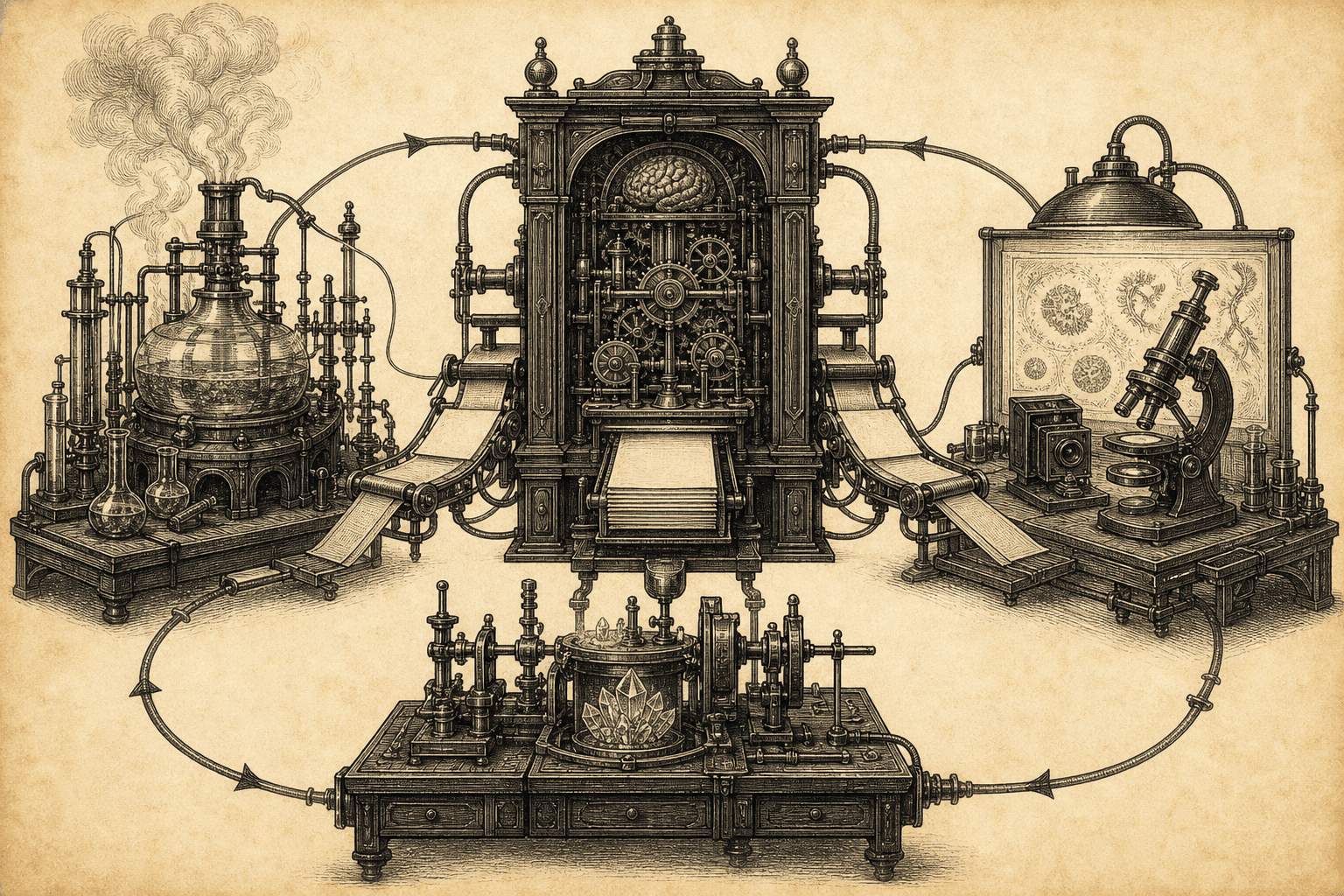
Conceptual illustration: the reported system connects hypothesis work to several laboratory and evaluation loops; this is not a real laboratory, apparatus diagram or confirmed material structure. Original editorial concept art generated with built-in Codex Image Gen for The Machine Press, 2026-08-30.
A Google-affiliated preprint reports a Gemini-based multi-agent system moving from proposals into constrained materials, biology and computer-science experiments.
The authors describe Co-Scientist connecting to a semi-automated chemical-vapor-deposition reactor, adapting crystal-growth recipes to laboratory constraints, predicting engineered E. coli swarming from sparse images and searching for a medical-reasoning inference architecture. They report single-attempt growth of three monolayer semiconductor materials and a blinded review of generated papers by 30 experts across 450 reviews. One MXene-like material still needs atomic-structure confirmation, and the biological comparison uses unpublished measurements. These are author-reported results from a system developed by the paper's contributors, not independent validation of a general autonomous scientist.
A guardrail verdict can be correct when checked and unsafe by the time a self-adaptive system acts.
Across five reproducible environments, fixed-action replay produced verdict-change rates from 5.3 to 48.4 percent after eight simulator steps. The proposed Freshness-Bounded Shield estimates an approval horizon from safety margin and recent feature volatility; under fixed settings, the authors report reducing oracle-labeled expiry from a 3.4-to-24.7-percent range to zero-to-1.8 percent. Four language-model judges still showed nonzero use-time invalidity, motivating a check-time-and-use-time freshness contract.
Generic laboratory-glassware file image used illustratively; it is not an AgentFold experiment, protein structure, code variant or measured result. Rodolfo Clix / Pexels; cropped, resized, metadata stripped, and converted to WebP by The Machine Press.
AgentFold changed, ran and remembered executable protein-folding model variants inside a closed search loop.
Starting from ESMFold, the system proposed and debugged code changes, evaluated variants and stored both successful and failed interventions. The authors report roughly 80 variants, 170 million language-model tokens and about 5,000 GPU-hours. Under their matched budget, the best lDDT improved 7.5 percent over independent Codex proposals and beat random search; the result is a costly benchmarked search, not a claim of a universally better folding model.
GRAPHSU expands deletion pressure from named forget examples into neighboring support routes.
The method builds a weighted graph around aliases, paraphrases and connected training samples, then applies graded forgetting to high-risk neighbors. On TOFU and PISTOL with GPT-2 Medium and Llama-3.2-3B-Instruct, the authors report up to a 49.5-percentage-point leakage reduction over a matched seed-only baseline while retaining feasible utility. Both benchmarks are controlled evaluation settings, so enterprise deletion claims still need domain-specific testing.
BCIT checks whether a previously useful update still applies after later training changed the parent model.
The controller binds each observed update effect to its source model, data and training stage, vetoes hard conflicts and can demand a bounded current-state trial before reuse. In experiments adapting one 4B model across finance reasoning, text-to-SQL and function calling, the authors report fewer harmful authorizations and higher equal-budget final quality than their alternatives. The evidence covers one model and three adaptation contexts.
A 135,389-pair study isolates professional English editing as a confound in AI-text detection.
The authors compared non-native academic manuscripts with native-edited versions while holding authorship and content together. Across 13 detectors, false-positive rates on human writing ranged from zero to 100 percent, and the same edits pushed scores upward for some systems and downward for others. Score movement also tracked editing extent. The study identifies style as a major confound; it does not prove that text origin can never be detected.
A governance paper derives five controls for ephemeral, model-directed agents and reports four running in private pilots.
The proposed primitives are discovery, identity, governance, attestation and supply chain. The implementation mediates actions before execution, authorizes them against a tenant vocabulary and records them in a signed hash-linked ledger. Its authors also name the costs: enforcement sits on the critical path, identity needs a workload sidecar and fail-closed mediation converts outages into denial. Four primitives are in private pilots; the fifth remains separate tooling.
Conceptual Visualising AI file image used illustratively; it is not the CSFG graph, a sentence-transition trace, detector output or measured result. Novoto Studio / Google DeepMind / Pexels; cropped, resized, metadata stripped, and converted to WebP by The Machine Press.
A graph-based detector looks for deviations between adjacent sentences instead of treating style features independently.
The paper calls the signal relational over-regularization: recurring similarity bursts and transition patterns create sentence-pair variance that differs from human text in the tested data. Its CSFG implementation reports 97.14 percent binary accuracy, a 1.57 percent false-positive rate and an 11.14-point gain over the strongest graph baseline. The authors also show the boundary: performance falls when a generator's transition variance reaches or drops below the human baseline.
SIGMA clusters cooperating agents before combining information across the full team.
The framework starts from the claim that independent observation noise acquires local structure through task dependencies. It uses density-based grouping and within-group consensus to smooth agent-specific deviations, then integrates groups with attention. StarCraft II experiments reported stronger robustness under noisy observations while remaining competitive without noise. The evidence is simulation-based and does not establish robustness in open physical teams.
AgentJudgeBench tests language-model judges on 3,808 dependency-ordered tool-calling workflows.
Across six workflow graph shapes and three difficulty levels, alignment with the programmatic reference declined as tasks grew harder and fell faster when ground truth was hidden. On hard no-ground-truth cases, six judges converged in a narrow 77-to-82-percent band despite scale differences. Structured rubrics improved alignment by as much as 6.5 points, while reasoning traces and temperature changes had little effect. Ground truth sometimes reduced alignment through apparent over-anchoring.
DuMateBench reconstructs 200 privacy-screened production-agent tasks with histories, configuration and workspace state intact.
The benchmark spans eight broad scenarios and 17 capability categories, with most tasks requiring several capabilities at once. Isolated containers add insufficient, unstable and noisy environmental conditions. Five agent frameworks paired with four models showed substantial gaps in strict completion, and both the model and harness shaped robustness. The source platform supplies the sessions and evaluation design, so the benchmark still needs broader replication across organizations.
Multi2AV-Safety tests all 11 multi-input combinations of text, image, audio and video conditioning.
The 11,024-instance benchmark is designed around harm that appears only when modalities interact, as well as explicit harmful cues diluted by benign context. Representative safety guards missed both kinds of compositional evidence across time and modality in the authors' evaluation. The dataset is scheduled for release in October 2026, so current claims rest on the paper's reported protocol rather than an independently inspectable public benchmark.
Generic developer-workstation file image used illustratively; it is not a PILOT worker, supervisor trace, benchmark run or stored skill. Dhirendra Singh Dhami / Pexels; cropped, resized, metadata stripped, and converted to WebP by The Machine Press.
PILOT separates a long-running worker from a supervisor that can steer or abort it and retain lessons as skills.
The harness couples live steering with live self-evolution, distilling procedures and failure modes while a task is still active. Across two frozen model backbones and three benchmarks, the authors report first place in five of six configurations, gains up to 9.8 points on Terminal-Bench 2.0 and lower output-token use. In self-improvement settings they report 12.4- and 14.6-point gains. These are benchmarked harness effects, not evidence that intervention always improves open-ended work.
ProofEvolve stores kernel-checked partial proof graphs so unfinished work can contribute to later theorems.
Neural models propose decompositions, repairs and schema combinations while Lean verifies each transition. Within a problem, the system evolves partial AND-OR proof graphs; across problems, verified subgraphs enter a persistent schema library with unresolved premises exposed as new goals. The authors report the highest average solve rate among evaluated systems on three competition-level Lean benchmarks. Formal verification preserves soundness of accepted steps, not the usefulness of every proposal.
FaithSieve admits formal evidence only when an auto-formalized obligation still matches the informal proof's meaning.
The system decomposes natural-language proofs into local units, extracts typed obligations and uses a semantic alignment gate before accepting Lean validation. With a GPT-5.4 backbone, it reports 81.43 percent exact first-error accuracy on 350 Olympiad problems versus 72.29 percent for direct judging, and 84.5 percent on 200 university-level problems versus 75 percent. The benchmarks are expert-verified but finite and model-specific.
Reworks a laptop into public, swappable modules: processor, port boards, keyboard, trackpad, and user-serviceable battery packs can evolve without sealing the whole machine.
Visit MNT Reform NextOriginal editorial concept art generated with built-in Codex Image Gen for The Machine Press, 2026-08-30.
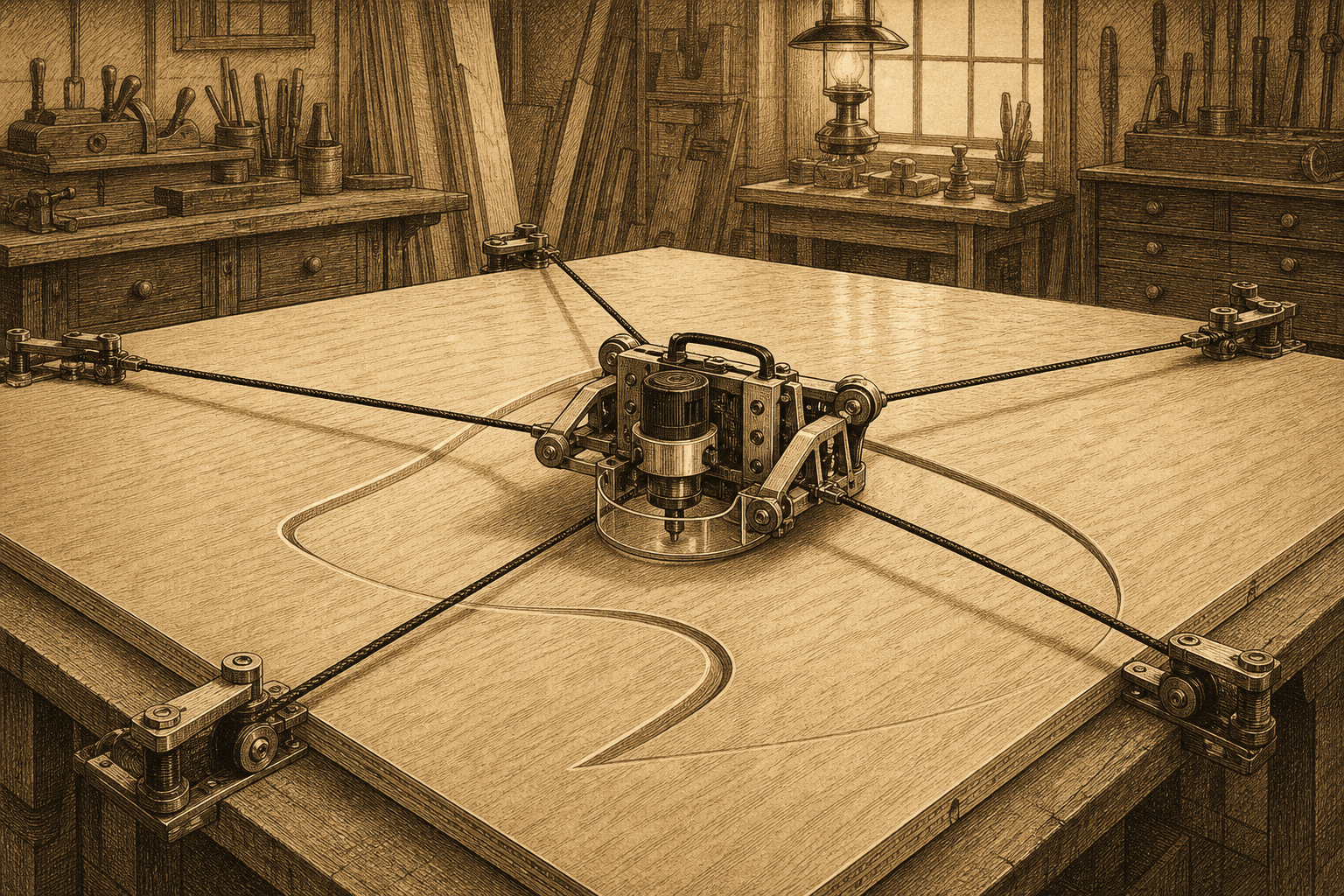
Pulls a compact router sled across full sheets with four measured belts, trading a bulky gantry for corner anchors and community-developed control software.
Visit Maslow 4Original editorial concept art generated with built-in Codex Image Gen for The Machine Press, 2026-08-30.
BuilderRory Aronson, Rick Carlino, Tim Evers, and FarmBot contributors
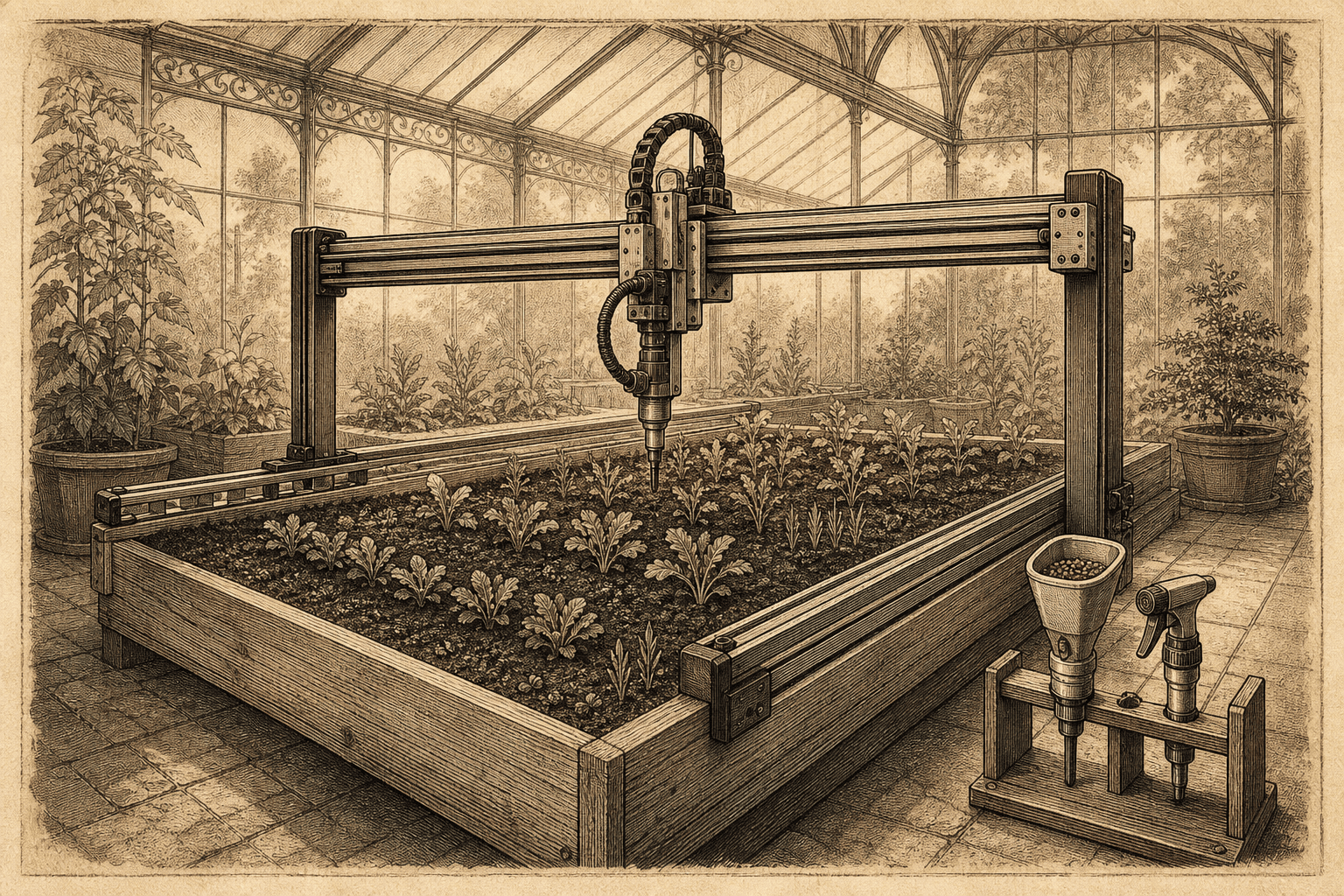
Moves an interchangeable tool head across a raised bed to place seeds, water plants, and measure soil, backed by published hardware, software, data, and documentation.
Visit FarmBot GenesisOriginal editorial concept art generated with built-in Codex Image Gen for The Machine Press, 2026-08-30.
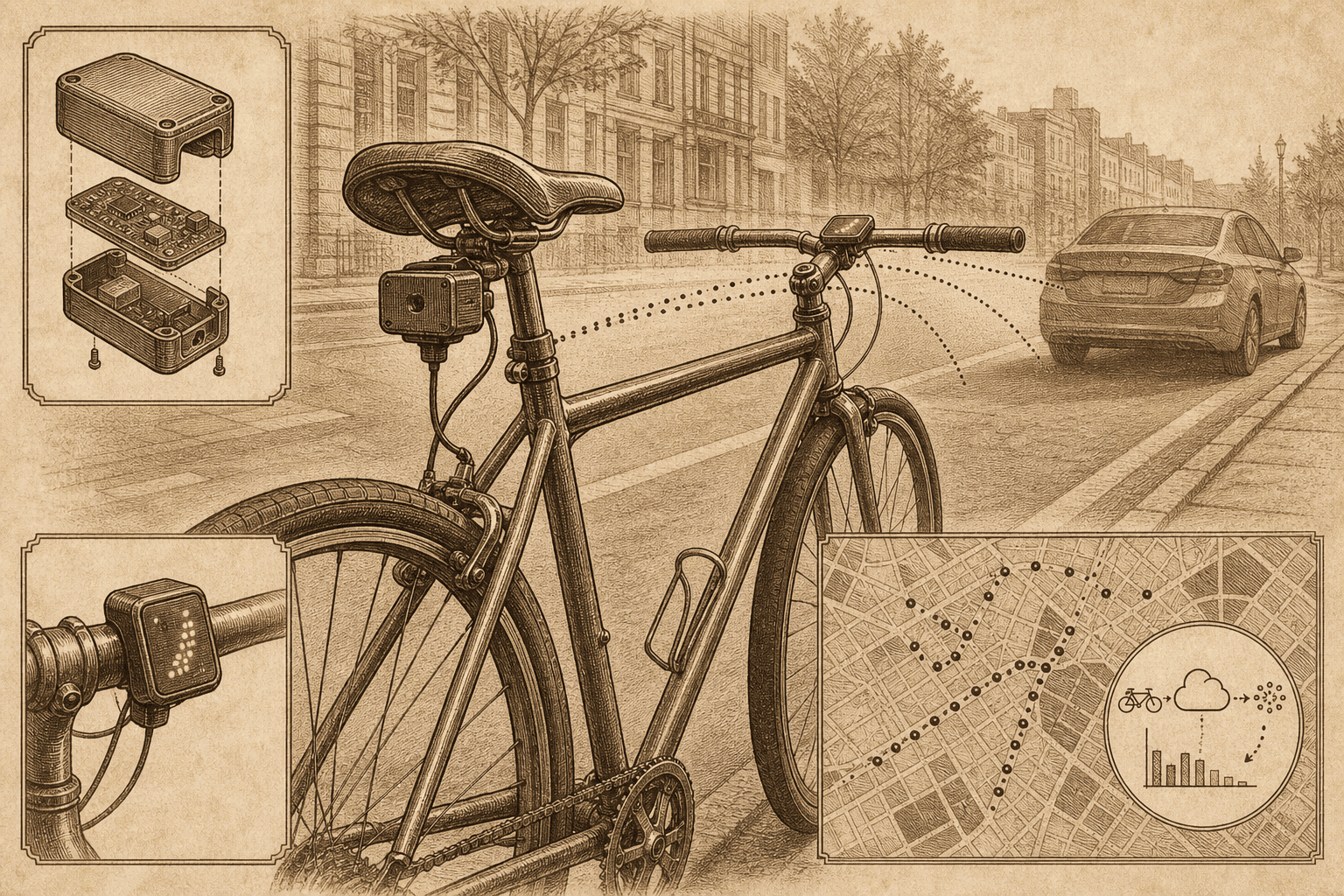
Combines a DIY bicycle distance sensor, GPS, and a shared portal so volunteer riders can map close passes and study where street design needs attention.
Visit OpenBikeSensorOriginal Codex Image Gen concept art from 2026-07-10; carried forward from the validated 2026-08-29 edition.
Desk Picks are selected by the newsroom. Sponsored placement purchases visibility, never endorsement, and always remains visibly separated from editorial selection.
 Editorial illustration