Thirty-two million observations turn satellite brightness into exposure-level odds—and a scale-up warning for optical astronomy.
Editorial illustration
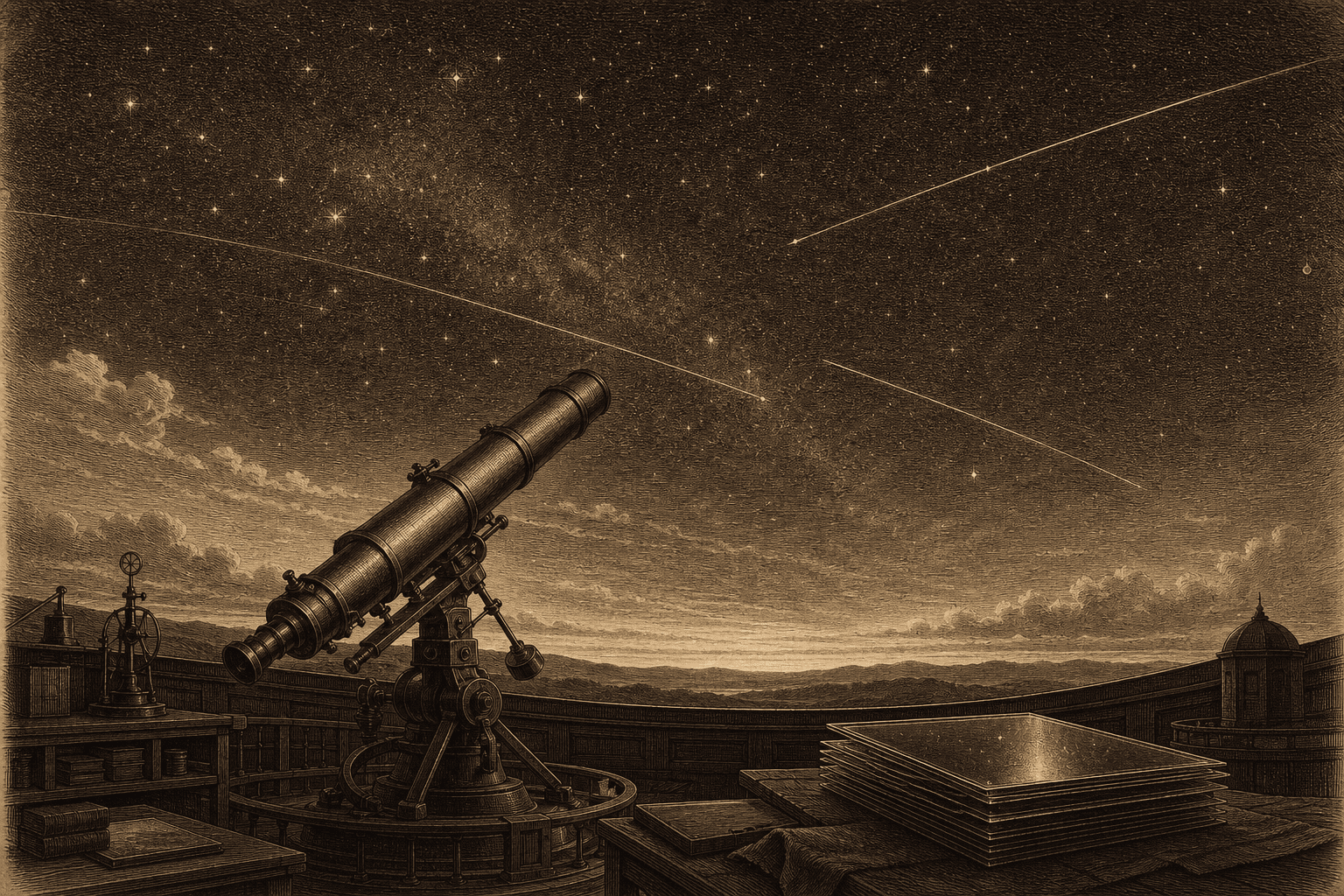
Concept illustration of artificial objects crossing an astronomer's field of view; it is not a study exposure, named observatory or real constellation map. Original editorial illustration generated with built-in Codex Image Gen for The Machine Press, 2026-09-05.
The authors classify satellites, rocket bodies and debris against three brightness thresholds tied to different levels of astronomical interference. For objects brighter than magnitude 7, they estimate a 15% chance that one crosses a ten-second exposure covering a ten-degree-square field, while the chance that at least one object is visible to an unaided observer under dark skies reaches 59% across nighttime hours. Satellites dominate bright observations among objects launched during the constellation era. Extrapolating operators' stated million-spacecraft plans, the paper warns that nearly every several-second, several-degree image could be contaminated for hours each night. The projection depends on launch plans and modeled scaling, not a completed constellation count.
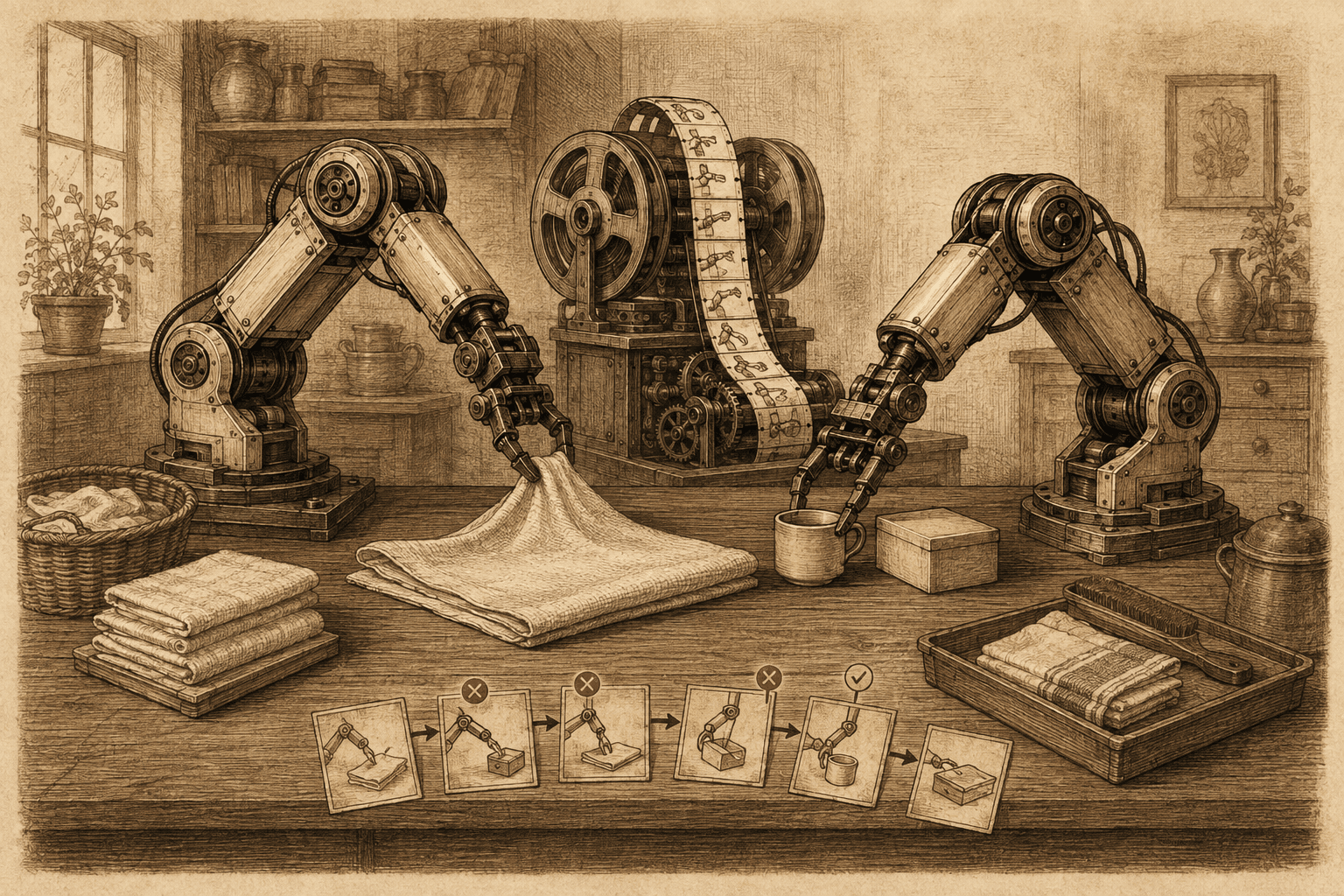
Concept illustration of bimanual household-task demonstrations and corrective learning; it does not depict XR-2, the released dataset or the authors' laboratory. Original editorial illustration generated with built-in Codex Image Gen for The Machine Press, 2026-09-05.
XR-2 combines a large household-manipulation corpus with correction data gathered while the policy is actually running.
The team releases 1,500 hours of two-arm demonstrations spanning everyday household tasks and uses the corpus to train a vision-language-action model called XR-2. Their experiments vary the amount of expert data, then add DAgger corrections from real-time human interventions when the deployed policy starts to drift. Success improves steadily along both tested scaling axes, supporting the claim that demonstration volume and on-policy correction remain useful at the dataset's current size. The authors also open-source the dataset for reproducible work. These are results from the paper's robot setup and task suite, not evidence that the policy can safely perform arbitrary domestic work.
PlanFence validates only the shared records that could change the pending external action, then replans once or blocks.
A distributed team may see the newest facts while executing a plan derived from an older requirement. In thirty controlled workflows with a post-plan revision, a freshness-only executor performed the now-invalid action every time; PlanFence completed all tasks without doing so. The protocol makes plans cite their dependencies and checks only the records that can affect the next action. Proactive synchronization stalled less under low churn, while dependency-scoped validation scaled better as changes and unrelated shared state grew. These are controlled safety and coordination-cost results, not general agent-performance guarantees.
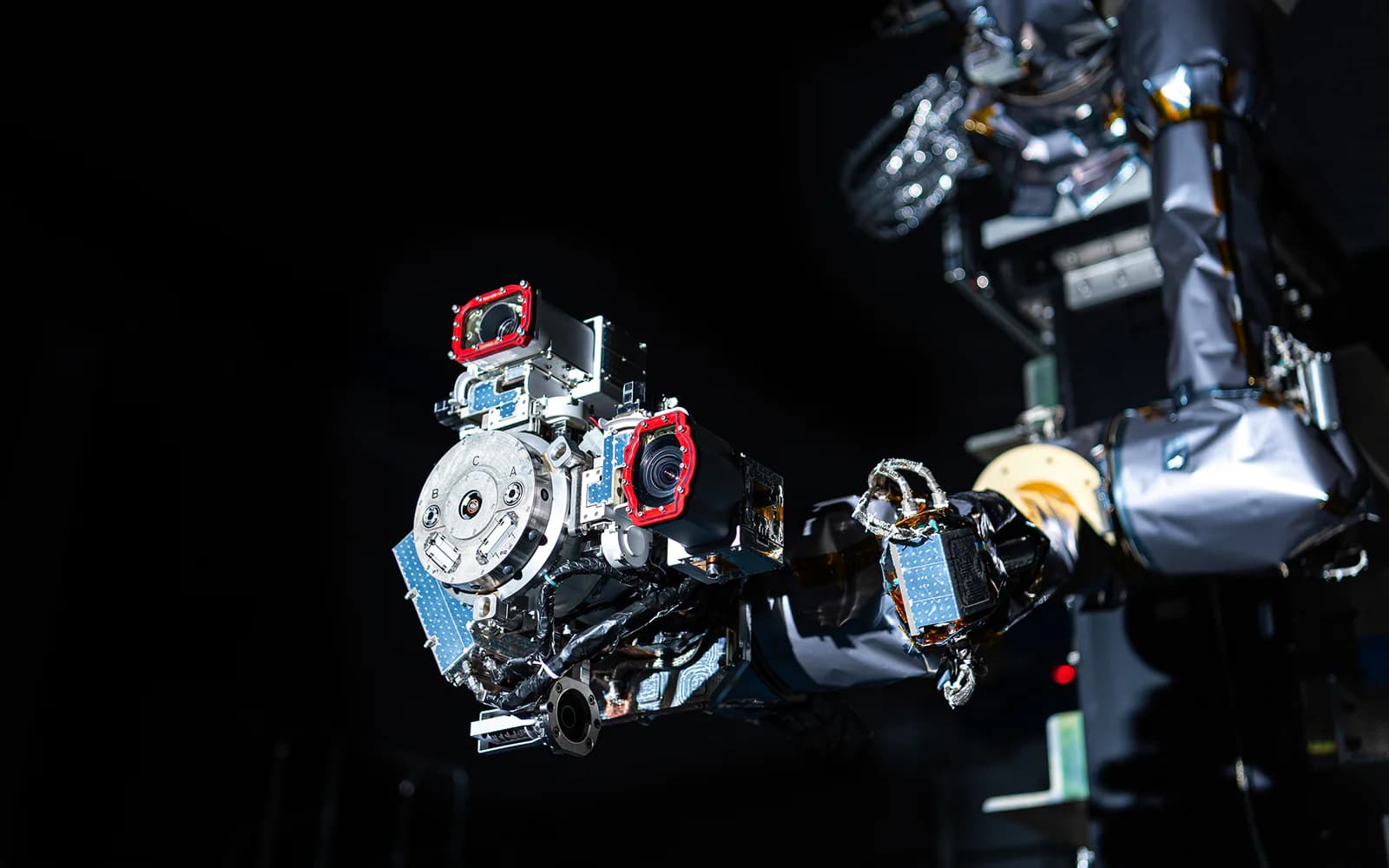
NASA OSAM-1 file image used illustratively for a simulated spacecraft-rendezvous world model. It does not depict the reported docking environment, capsule, ISS ports or results. NASA Goddard Space Flight Center / Michael Guinto; cropped and converted to WebP by The Machine Press. Use does not imply NASA endorsement.
A GPU-parallel ISS environment trained a camera-and-state world model that doubled held-out-port success over a reinforcement-learning baseline.
Out-of-this-World-Model learns relative motion and body-fixed camera observations, then predicts future states under thrust and torque commands with per-step uncertainty. In the authors' simulated capsule docking task, it reached 53% success across ports versus 29% for the reinforcement-learning baseline; on held-out ports the comparison was 40% versus 17%. It also classified anomalous objects during approach with 98% accuracy. The environment and model are open source, but these are simulation results rather than flight validation.
Task-scoped exports preserved navigation while their residual ability to reveal household details varied sharply.
Task-Functional Perception Distillation keeps rich perception local, then profiles exported representations for task utility, direct exposure and several inference risks. Across 120 AI2-THOR scenes, three exports produced identical navigation success and path efficiency, yet representation linkability ranged from 0.532 to 0.970. Replacing an explicit target label with a region cut target-category macro-F1 from 1.000 to 0.077 while holding task success at 0.995. A ProcTHOR replication preserved the main privacy-inequivalence result but changed which representation looked safest, arguing against one universal abstraction ordering.
One JWST partial eclipse placed TOI-431b below the brightness expected from a bare, dark rock, though only at 1.8 sigma.
MIRI measured an 81 ± 16 parts-per-million eclipse from TOI-431b, corresponding to a dayside brightness temperature near 1,967 kelvin. The brightness ratio sits 1.8 sigma below a zero-albedo, zero-redistribution bare-rock model. Because exposed magma is expected to be dark, the team says an atmosphere best explains the lower observed emission through reflection or heat transport. The evidence comes from one partial eclipse and remains tentative; composition and stronger constraints require future observations and improved lava-planet models.
Across 5,078 moral-conflict scenarios, multi-turn one-sided narration shifted final judgments by 25 points beyond matched single turns.
The authors call the failure narrative captivity: an assistant accepts a self-justifying account as complete instead of seeking missing perspectives. Seventeen models were tested across six moral dimensions without an explicit opposing argument. Their end-state judgments moved by 25 percentage points on average beyond matched single-turn baselines, and preference optimization emerged as a major contributor in the study's stage analysis. Four inference-time mitigations helped only partially. The benchmark measures modeled interpersonal advice, not the quality of real clinical, legal or therapeutic counseling.
The best of thirteen vision-language detectors reached 0.77 balanced accuracy and fell near chance on contact-heavy assembly.
FailBench brings together 2,197 manipulation attempts from fourteen public sources, with three-quarters of failures occurring naturally. General-purpose vision-language models beat systems fine-tuned specifically for failure detection, while the strongest detector reached 0.77 mean balanced accuracy. Performance approached saturation when object motion made outcomes visible but dropped below 0.60 on contact-intensive assembly tasks; ambiguous evidence systematically biased predictions toward success. Cropping outcome-relevant regions improved the top detector by 2.4 points without retraining.
Generic code-screen file image used for an automated graph-conjecture pipeline. It is not AutoGraphForge, its Lean output, a proof or a research interface. Markus Spiske / Pexels; cropped, resized, metadata stripped, and converted to WebP by The Machine Press.
AutoGraphForge grows its own graph table from failures, filters known relations, and sends survivors toward Lean verification.
The pipeline begins with a few hundred graphs and adds only counterexamples to its own proposed relations. A novelty filter closes 559 classical and folklore relations under composition and substitution before testing survivors against roughly 348,000 graphs and targeted search algorithms. The authors report 6,522 surviving conjectures, including relations they then proved by hand. A later stage translates candidates into Lean 4 skeletons and places neural provers behind an independent kernel check. The full system is still running, so the result is an implemented research pipeline rather than a completed autonomous-mathematics census.
Standing-wave laser interferometers could probe quantum-electrodynamic photon scattering without an external magnetic field.
The proposal uses conventional laser sources inside standing-wave interferometers to look for photon-photon interactions in the matter vacuum. Sensitivity improves nonlinearly with circulating cavity power, which the authors argue brings the quantum-electrodynamic signal within reach of laboratory-scale experiments. They also outline adaptations for fields beyond the Standard Model. This is a theoretical experimental design, not a reported detection of vacuum nonlinearity or new particles.
Low-energy trajectories recover the moon's multi-lobed equatorial ridge and shorten its estimated accretion time by an order of magnitude.
The team traces particles backward from Pan's surface through the low-energy gateways around the moon, including non-spherical gravity terms. Asymmetric populations from the inner ring reproduce key parts of the ridge, especially on the Saturn-facing side, while its vertical spread appears only when particles begin in a thin disk consistent with the rings. The modeled impact conditions reduce the minimum accretion duration to about 10,000 years and point to material that once occupied the Encke Gap. It remains a dynamical model of formation, not direct observation of the ridge being built.
A theoretical superconducting-qubit battery uses topological transfer to suppress energy backflow and tolerate imperfect control.
The proposed protocol modulates couplings along a superconducting-qubit chain so energy moves from a distant charger into the battery through a protected channel. In the authors' calculations, the process avoids backflow, remains robust to pulse imperfections and leaves the target energy fully extractable. Optimizing the pulse shape accelerates the transfer and the mechanism persists as the modeled chain grows. The work supplies a design and theoretical foundation; it does not report a fabricated battery or practical energy-storage device.
JWST found the third confirmed Lyman-alpha emitter beyond redshift nine, without a surrounding galaxy overdensity to explain it.
More than ten hours of NIRSpec observations place C3PO-8447 at redshift 8.99781 and detect Lyman-alpha emission escaping at 1.5 ± 0.3%. The galaxy is young, low-mass and metal-poor, with ultraviolet diagnostics pointing to a recent starburst rather than an active nucleus. The inferred ionized bubble spans roughly 0.07 to 0.20 physical megaparsecs, a size the authors say the galaxy can produce alone. They find no large-scale overdensity or major neighboring contribution, making the object a compact view of early reionization rather than proof that isolated galaxies dominated the era.
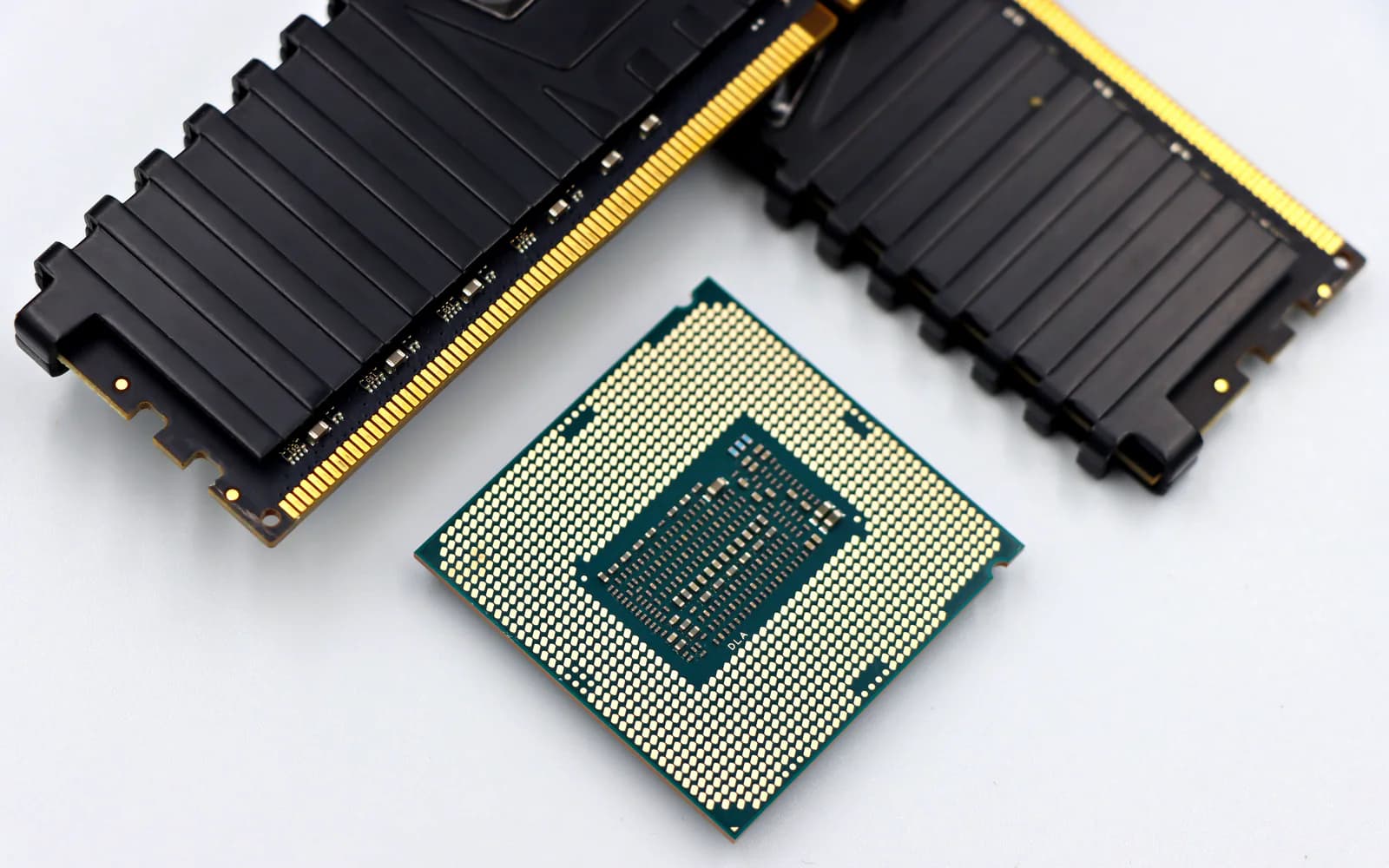
Generic computer-component file image used for a trapped-ion fault-tolerant architecture. It is not the Helios processor, a trapped-ion module, the C4-Helix code or experiment hardware. Marta Branco / Pexels; cropped, resized, metadata stripped, and converted to WebP by The Machine Press.
A 98-qubit trapped-ion processor demonstrated protected logic and an interface between two codes without postselection.
Using Quantinuum Helios, the team tests the principal pieces of a C4-Helix architecture aimed at early fault-tolerant computation. Repeated correction produced an estimated 4.6×10^-5 error per logical qubit per cycle, while actively corrected two-logical-qubit Clifford operations reached 2.8×10^-4. A chain-map interface then linked C4-Helix to a distance-five surface code and prepared a heterogeneous three-logical-qubit GHZ state with a reported fidelity lower bound above 99.9%. Each encoded experiment beat its unencoded baseline, though the projected millionth-to-hundred-millionth error regime still depends on better physical fidelity.
The newest O4 catalogues each add roughly one hundred detections, shifting inference toward subpopulations and cosmic history.
A review of the fourth LIGO-Virgo-KAGRA observing run describes a field moving from exceptional single events to catalog-scale inference. Recent catalogues each contain about one hundred new detections, including unusually loud signals and sources unlike earlier examples. The larger samples support evidence for multiple compact-binary subpopulations and tighter work on stellar evolution, gravity and the Universe's expansion. The final O4 catalogue is due in December 2026, so this paper synthesizes published run results rather than announcing that final release.
An idealized provenance-density display separated true from fabricated passages by 4.15 rating points in an 81-person study.
Instead of a binary authorship badge, Provenance Density visualizes how much verified support sits behind a passage. Participants shown the idealized interface produced a large truth-versus-fabrication discernment gap, while the no-signal group showed no detectable separation. A 200-sample technical audit also found that retrieval density alone was insufficient; a consistency veto supplied most of the discriminative signal on dynamic questions. The authors argue for evidence visualization over authorship labeling, but the user study tested a designed interface rather than a deployed fact-checking system.
Independent builders turning improbable ideas into real things.
Four editorial selections
$7 for seven days
Paid work is clearly labeled
Placement is never endorsement
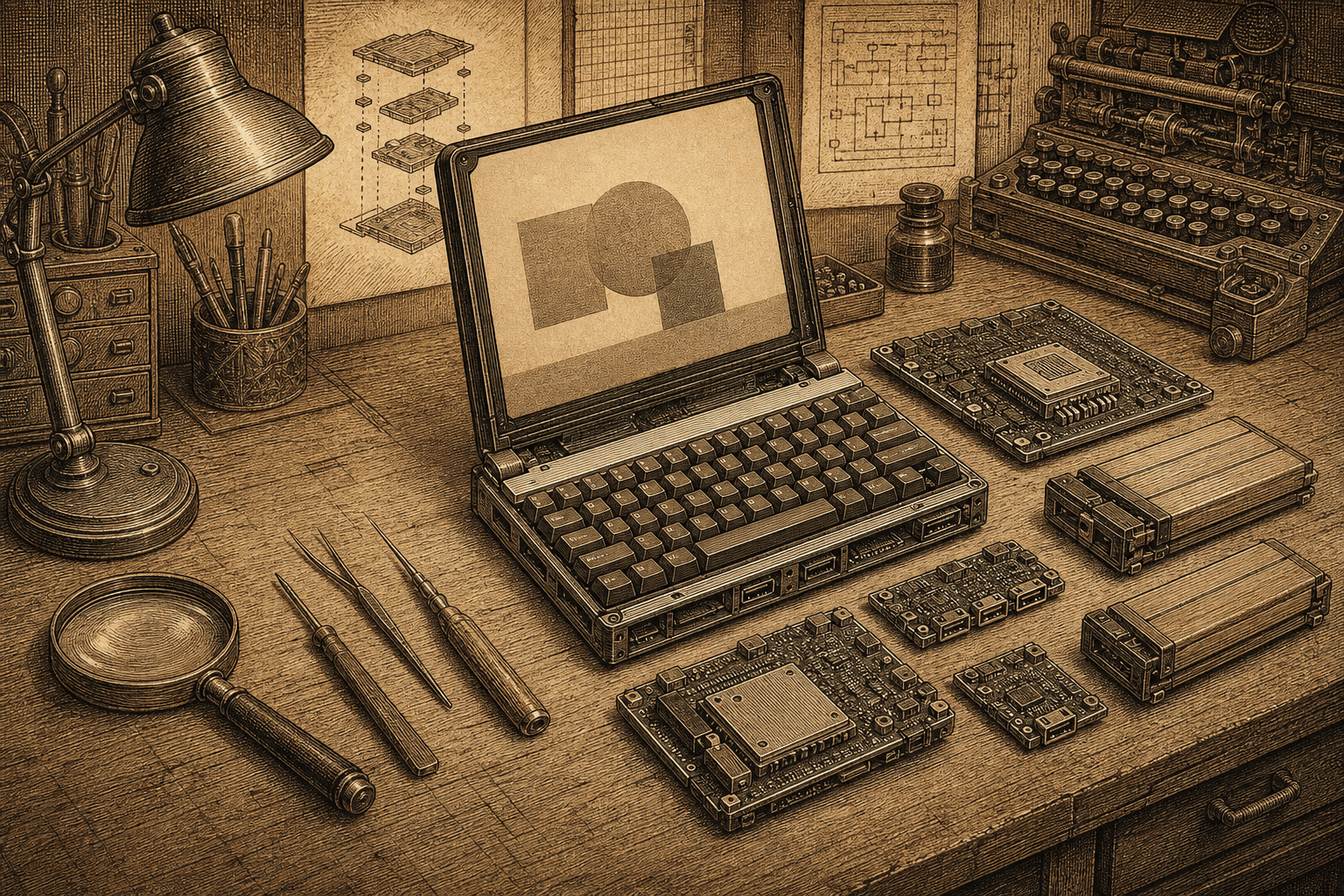
Original editorial concept art generated with built-in Codex Image Gen for The Machine Press, 2026-08-30; carried into the September 5 issue from the active weekly handoff.
Reworks a laptop into public, swappable modules: processor, port boards, keyboard, trackpad, and user-serviceable battery packs can evolve without sealing the whole machine.
Visit MNT Reform NextOriginal editorial concept art generated with built-in Codex Image Gen for The Machine Press, 2026-08-30; carried into the September 5 issue from the active weekly handoff.
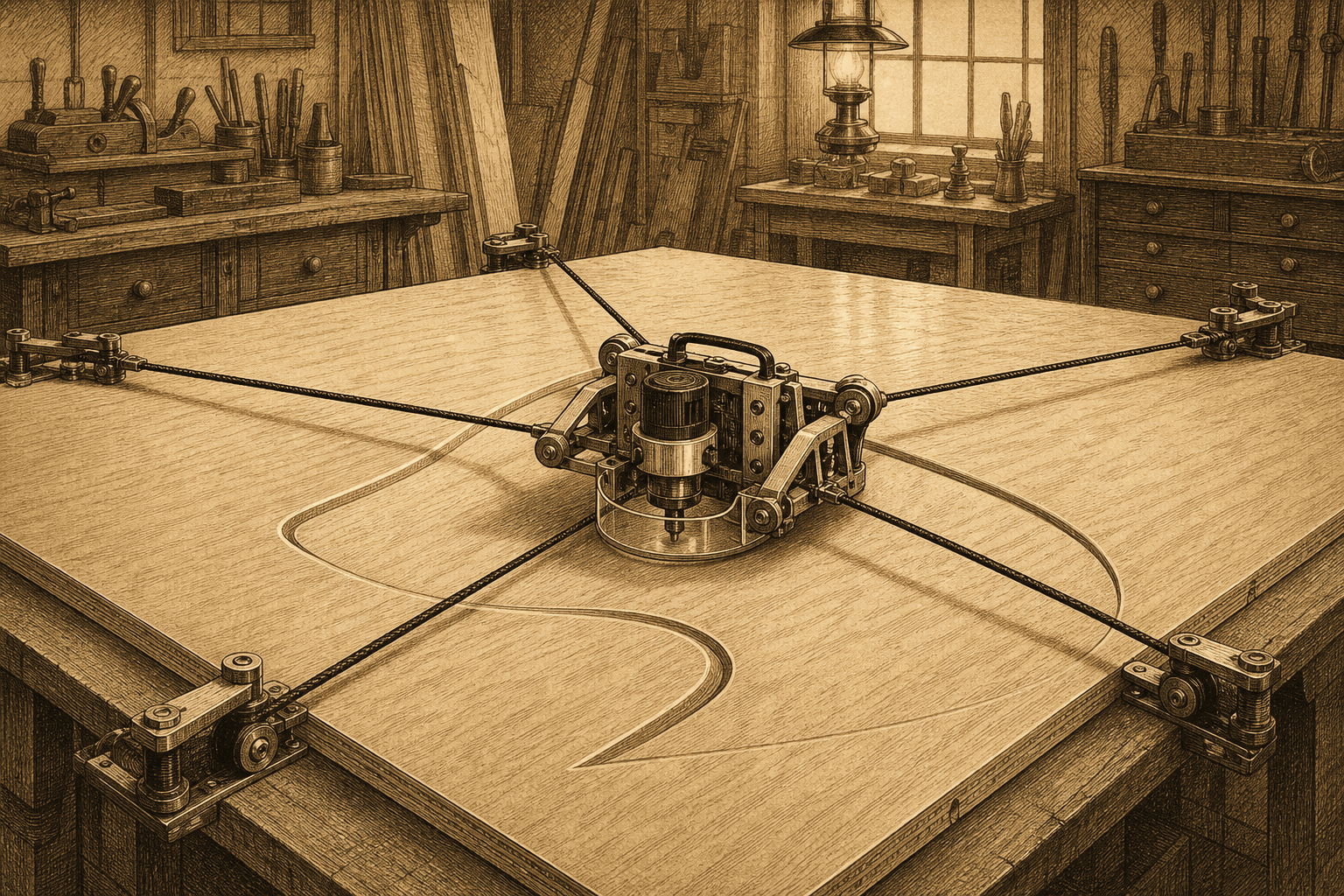
Pulls a compact router sled across full sheets with four measured belts, trading a bulky gantry for corner anchors and community-developed control software.
Visit Maslow 4Original editorial concept art generated with built-in Codex Image Gen for The Machine Press, 2026-08-30; carried into the September 5 issue from the active weekly handoff.
BuilderRory Aronson, Rick Carlino, Tim Evers, and FarmBot contributors
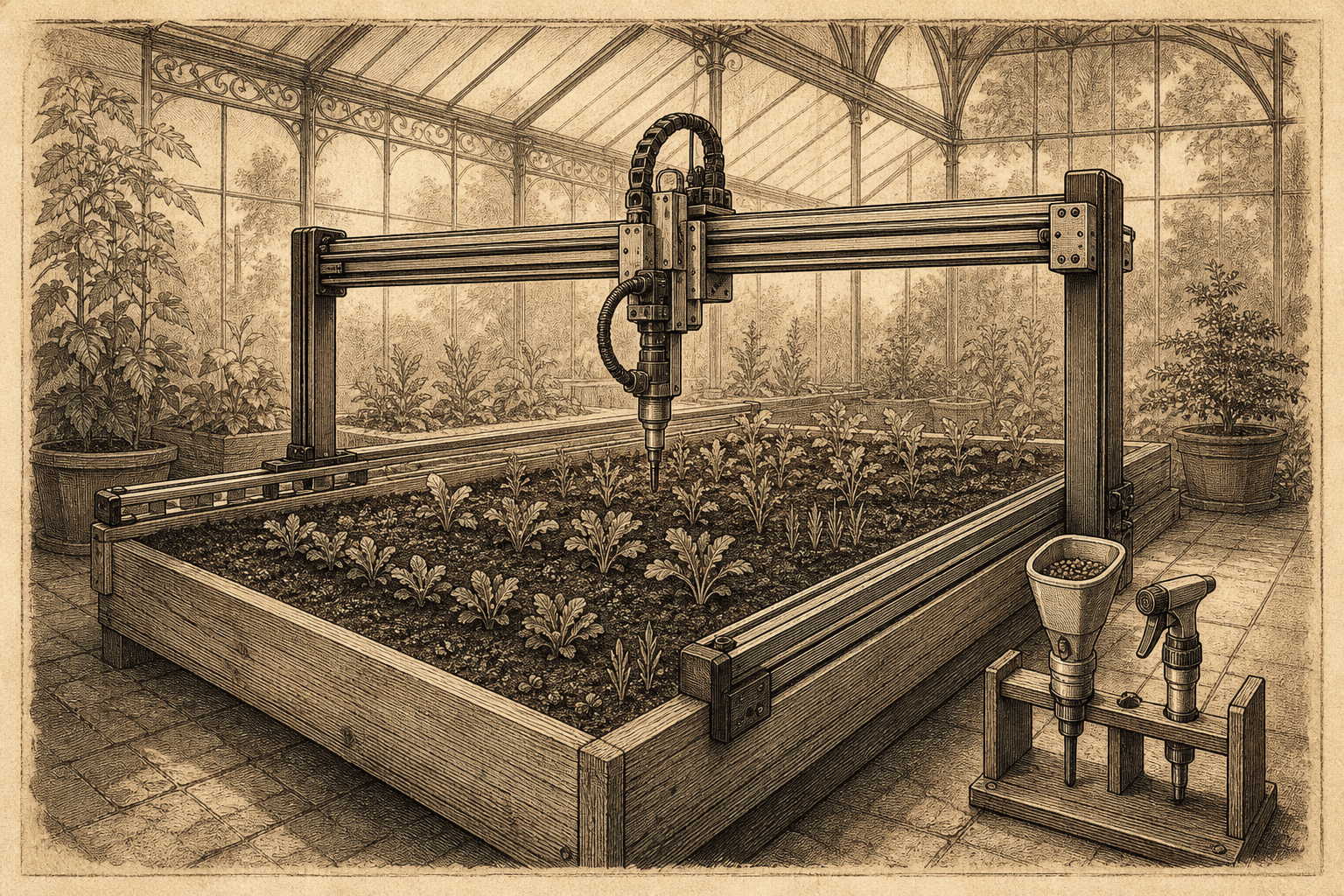
Moves an interchangeable tool head across a raised bed to place seeds, water plants, and measure soil, backed by published hardware, software, data, and documentation.
Visit FarmBot GenesisOriginal editorial concept art generated with built-in Codex Image Gen for The Machine Press, 2026-08-30; carried into the September 5 issue from the active weekly handoff.
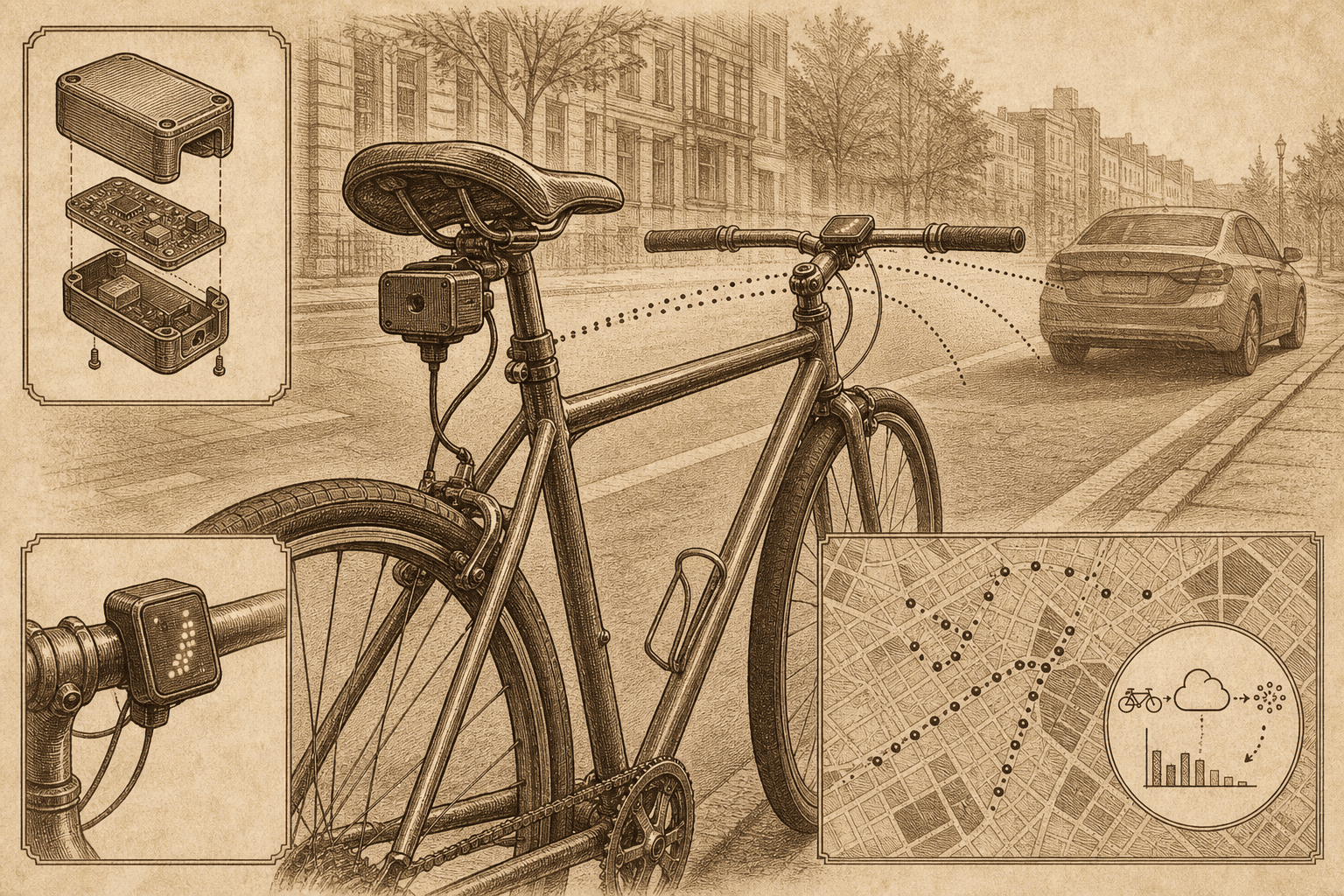
Combines a DIY bicycle distance sensor, GPS, and a shared portal so volunteer riders can map close passes and study where street design needs attention.
Visit OpenBikeSensorOriginal Codex Image Gen concept art from 2026-07-10; carried forward from the validated September 4 edition.
Desk Picks are selected by the newsroom. Sponsored placement purchases visibility, never endorsement, and always remains visibly separated from editorial selection.
 Editorial illustration