Across 7,201 decisions, nine language models faced fuel-priced routes around animals—and their measured willingness to avoid harm ranged from near-total to almost none.
Editorial illustration
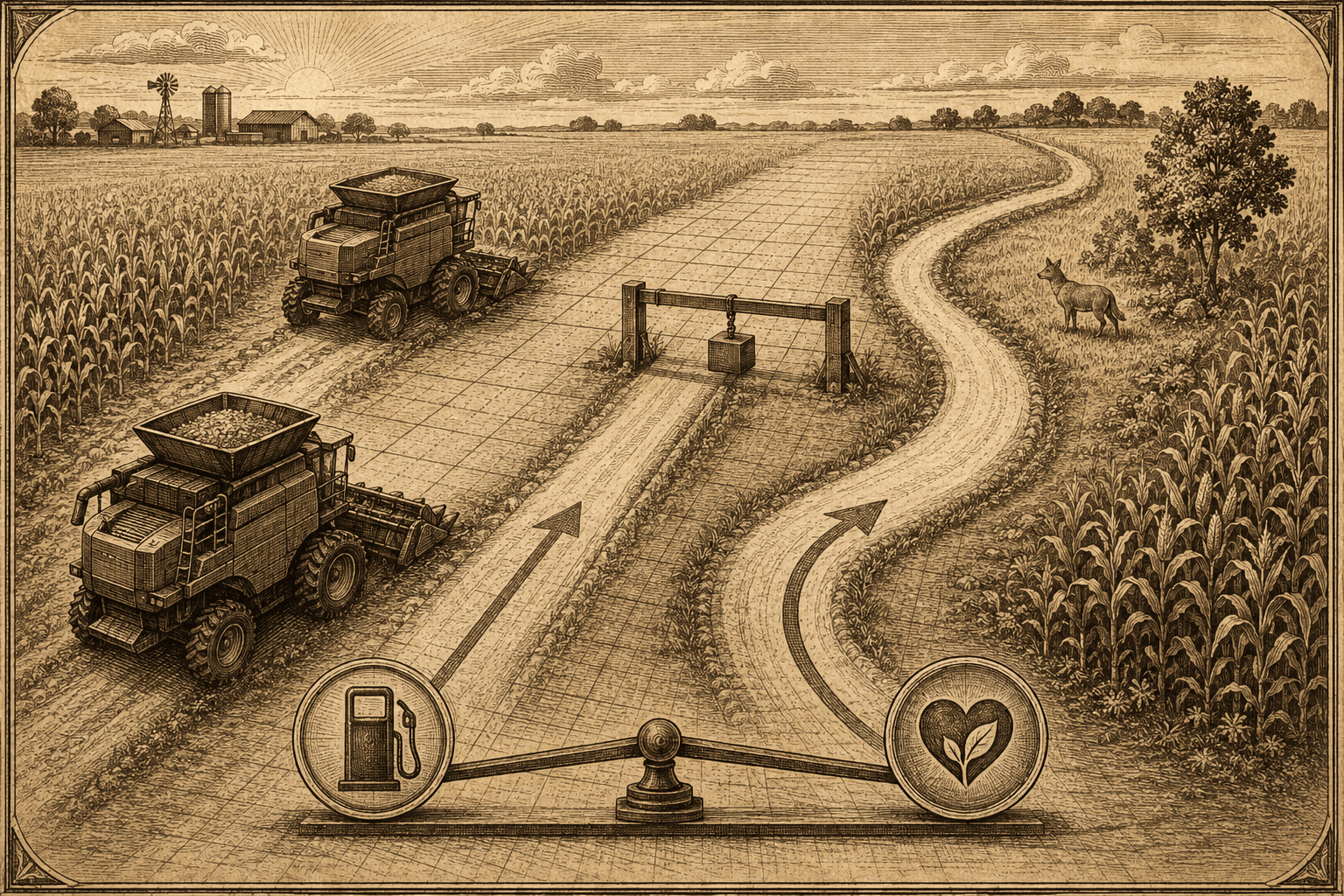
Concept illustration of a priced detour around animal harm; it does not reproduce HarvestBench's interface, map or model decisions and shows no real machinery event. Original editorial illustration generated with built-in Codex Image Gen for The Machine Press, 2026-09-07.
HarvestBench places language-model agents in a reproducible farm gridworld where two tractors stop when an animal blocks the route. The model can drive on at no fuel cost or pay a posted cost to swerve; rocks and hay bales serve as controls, and the scorer counts logged events without an LLM judge. Across 3,951 animal decisions, reported kill rates ranged from 0.4 to 98.8 percent and did not track general capability. All nine models drove over wild animals more often than farmed animals on the default map. A morality briefing changed behavior sharply: five of six reasoning models stayed below 6 percent with it, while removing it pushed all six above 84 percent. This is a synthetic benchmark of stated conditions, not evidence about deployed farm machinery or a complete measure of moral agency.
Concept illustration of individually separate agents taking correlated actions; it is not a market chart, trading system or reproduction of the study's simulation. Original editorial illustration generated with built-in Codex Image Gen for The Machine Press, 2026-09-07.
An agent-based simulation found that capability increased correlated behavior—helpful under shared accuracy, but a common risk floor when every agent saw the same misinformation.
The study models markets populated by language-model traders and asks what happens when better individual reasoning is built from similar training and architectures. The authors report that frontier models acted more alike as capability rose. When the shared view was correct, adding agents reduced market-level risk; when all agents received the same misinformation, correlation became a liability that participation could not diversify away. The result is a systems warning rather than a live-market forecast: it comes from an agent-based simulation, and the authors explicitly leave whether the pattern transfers to other domains as an open empirical question.
TNFlow returns multimodal surface-composition posteriors for trans-Neptunian objects on one CPU core, while real JWST spectra expose simulator blind spots.
TNFlow combines a transformer with a normalizing flow to invert synthetic reflectance spectra generated by a radiative-transfer model. One spectrum takes about 0.7 seconds on a single CPU core, producing simplex-valid composition and grain-size possibilities. On synthetic tests, the highest-weight mode reached a mean total-variation distance of 0.149 from ground truth. Qualitative checks on real JWST spectra showed blindness or bias toward some materials, which the authors attribute to possible simulator or training-set limits. That caveat is central: fast inversion does not overcome a mismatched forward model.
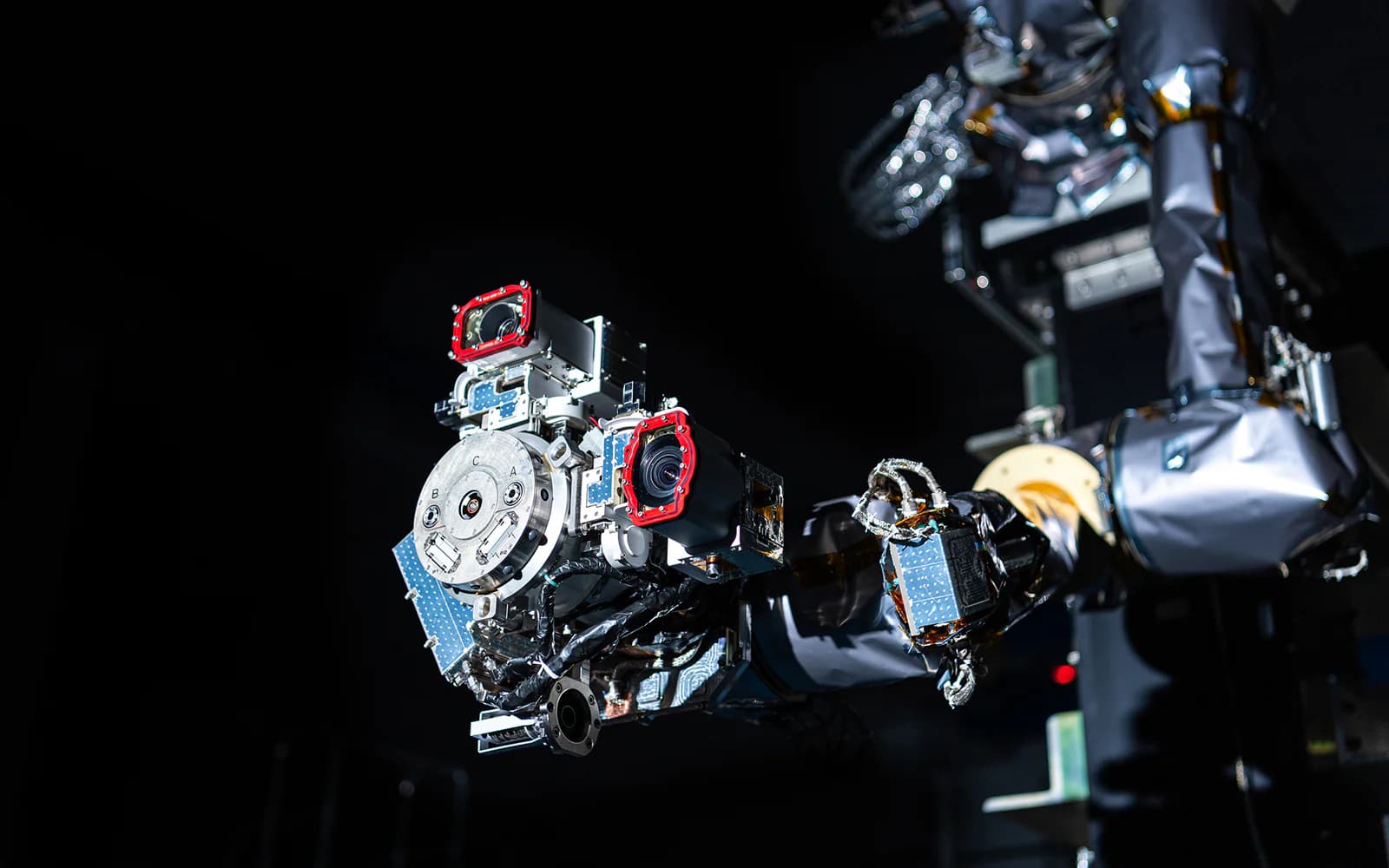
NASA OSAM-1 robotic-arm file image used to illustrate manipulation hardware; it is not a VLA-Precision robot, chemistry task or reported experiment, and use does not imply NASA endorsement. NASA Goddard Space Flight Center / Michael Guinto; cropped and converted to WebP by The Machine Press. Use does not imply NASA endorsement.
Asymmetric co-bootstrapping paired early human intervention with later autonomous return signals while a streaming architecture raised throughput as much as 10.9 times.
VLA-Precision addresses policy drift and training overhead in real-world reinforcement learning for vision-language-action systems. Early intervention-guided learning improves the experience stream; later, global returns and local preference rankings calibrate values for reference-regularized updates. Across nine high-precision chemistry tasks and four robot embodiments, the authors report 98.3 percent mean success in 45.8 minutes per task. These results belong to the paper's tasks, hardware and baselines, not to laboratory robots generally.
Harbor Adapters ports more than 80 agent benchmarks into one infrastructure, while Harbor-Index distills 29 of them into a smaller audited set.
The project validates benchmark adapters through code review and parity experiments, then evaluates eight models across 54 benchmarks using a shared agent plus native harnesses. Harbor-Index selects 82 difficult, diverse tasks spanning 29 benchmarks after difficulty filtering and human-and-AI audit. No evaluated model-harness configuration exceeded 30 percent pass rate; the strongest reported result was 28.0 percent. The index lowers evaluation cost, but its conclusions still depend on the selected tasks, adapters and harnesses.
A recurrent network kept proposing updates too small to survive storage, freezing its state until residual and direction memory restored the lost information.
Holding a trained GRU fixed while replacing continuous state propagation with deterministic four-bit storage increased two fluorescence-lifetime estimation errors by about 70 and 300 times. The authors trace the failure to small repeated updates falling below the write threshold. Error feedback, residual memory and direction memory recovered accuracy without retraining, and an independently trained LSTM reproduced the pattern. The measurements come from the tested imaging models and do not establish a universal penalty for four-bit inference.
Conductor prioritizes vehicles that see beyond roadside sensors, then trims fusion and prediction work to stay inside an age-of-information bound.
Instead of making each connected car fuse every other actor's observations, Conductor builds one edge-hosted world model from a fixed roadside perspective. An occlusion-aware selector favors vehicles contributing otherwise hidden objects, while a runtime controller adjusts both input count and trajectory predictions. In simulation with as many as 31 connected vehicles, the joint controller met the timing bound and approached oracle fusion fidelity. That is simulated infrastructure evidence, not a deployed collision-prevention claim.
Top systems cleared 90 percent on performance reasoning, yet nearly every configuration averaged below 15 percent when asked to generate analytical model code.
PerfReasoning tests whether language models can compare workload mappings, predict off-chip traffic and calculate buffer requirements. The strongest closed models exceeded 90 percent on reasoning questions and the best open-weight model reached 82.4 percent. Model construction was much harder: one reported configuration exceeded 80 percent, while all others averaged below 15 percent and varied across runs. The benchmark exposes a gap between plausible architectural answers and executable performance models; it does not measure every form of systems engineering.
Conceptual Visualising AI artwork about neuroscience-inspired machine learning; it is not a person, gesture capture, medical scan or SocioGesture model diagram. Novoto Studio / Google DeepMind / Pexels; cropped, resized, metadata stripped, and converted to WebP by The Machine Press.
A compact body-and-hand model recognizes invitations, refusals and unavailability in real time, then saves uncertain encounters for later adaptation.
SocioGesture combines confidence-aware body and hand skeleton streams and trains with simulated occlusion so missing hands or unstable keypoints do not add inference cost. On a mixed indoor-outdoor dataset, the authors report strong held-out-subject recognition and improved robustness under structured joint occlusion while running on a robot-mounted edge device. Uncertain segments are retained for offline labeling and vocabulary expansion. The results cover the collected gesture set, not unrestricted social understanding.
AquaBEV uses paired 3D imaging sonar during training, then predicts local bird's-eye occupancy from a single RGB image.
Underwater appearance offers weak geometry, so AquaBEV maps visual features into a calibration-free polar representation and decodes outward along range before reconstructing a Cartesian occupancy map. On a controlled benchmark, it reached 31.4 visible IoU and 38.6 observed IoU, relative improvements of 4.0 and 4.3 percent over the strongest transferred baseline. The paper evaluates a controlled dataset; it does not certify monocular navigation in open water.
A strong-drive theory treats pulse duration, amplitude and shape as design variables that can create interactions absent from the original qudit system.
Floquet protocols are often designed with instantaneous pulses even though laboratories use finite waveforms. The new framework incorporates those realizable pulses into the effective interaction. In three-level systems, one pulse turns a diagonal interaction into a spin-1 model dominated by nematic terms; other protocols produce enlarged SU(2)×U(1) and SU(3) symmetries. Numerical tests support the derived dynamics, but the paper presents theory and simulation rather than a completed quantum device.
NavArena turns Gaussian-splat reconstructions into traversable benchmarks with occupancy maps, semantic goals and closed-loop evaluation.
Static 3D Gaussian splats render realistic views but do not define where an agent may safely travel or which goals are reachable. NavArena derives an occupancy costmap from Gaussian density and height, lifts semantic candidates from multi-view masks, and uses the frozen reconstruction for egocentric RGB-D rendering. Across more than 2,000 scenes, it generated 22.2 million expert trajectories. The scale is generated benchmark data, not evidence of equivalent real-world navigation coverage.
An SU(1,1) interferometer estimates displacement magnitude from total intensity without a local oscillator, phase locking or quadrature tracking.
Conventional weak-signal measurements often need the signal phase in advance and coherent homodyne detection. The proposed method instead estimates magnitude independently of phase. Under ideal lossless conditions, the authors show total-intensity detection reaches the quantum Cramér–Rao bound, then analyze performance under optical loss. They report comparable performance across experimentally relevant regimes. This is a theoretical sensing framework and loss analysis, not a fielded detector.
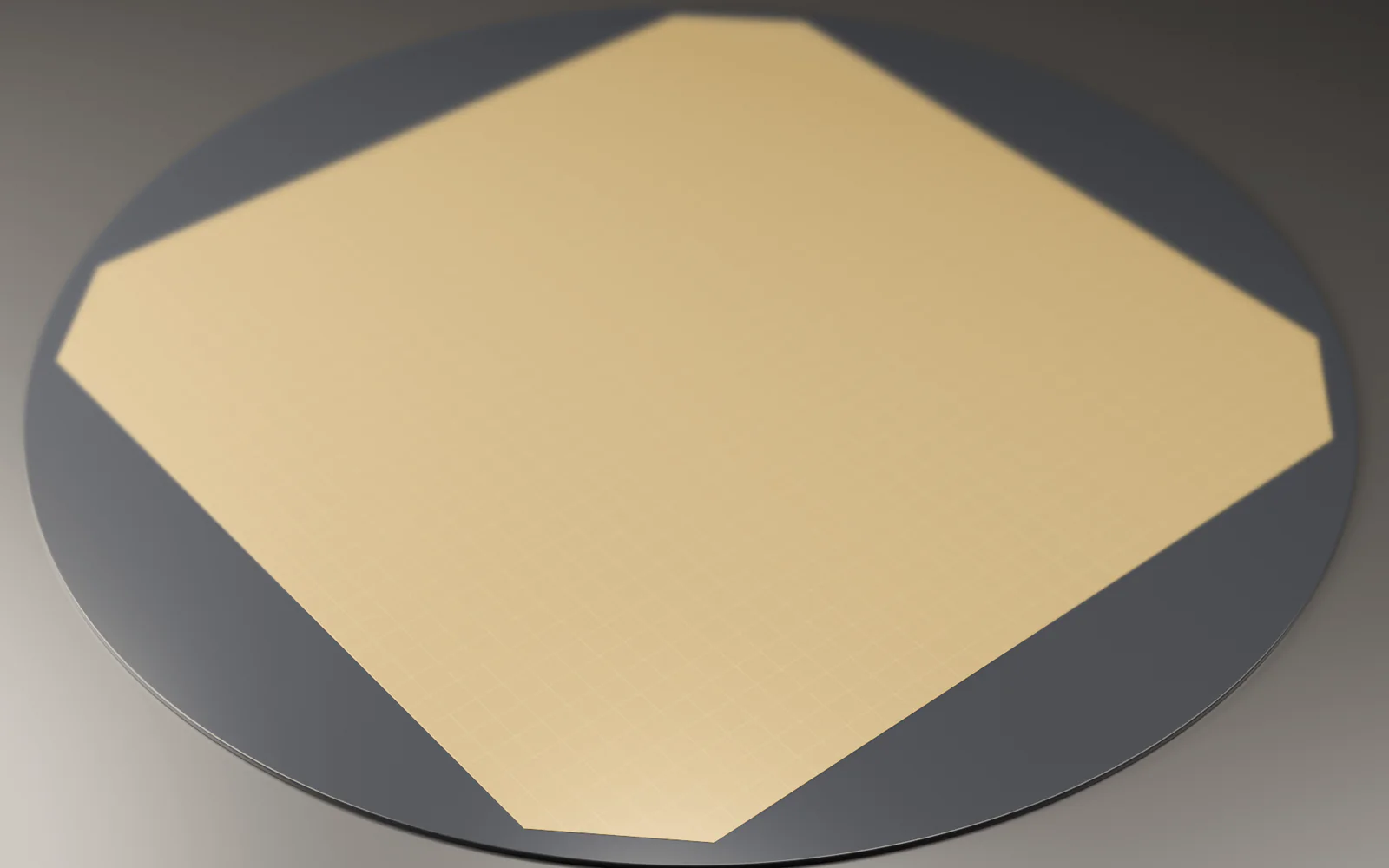
Rendered wafer-scale integrated-circuit illustration used for accelerator computing; it is not a TPU, generated kernel, benchmark trace or manufactured MaxKernel result. Wikideas1 / Wikimedia Commons (CC0 1.0); cropped and converted to WebP by The Machine Press.
MaxKernel combines collaborative, autonomous and graph-search modes with specialized agents for planning, profiling, testing and self-debugging on TPUs.
The system uses real-time compiler and hardware feedback to generate accelerator kernels under three modes: human-in-the-loop design, an autonomous metric-driven loop and graph-based exploration. It shares specialized planning, implementation, debugging, testing and profiling agents across the modes. Evaluations cover 50 JaxBench tasks plus larger open-source workloads, where the authors report performance matching expert-tuned baselines. Those claims are benchmark-specific and do not establish optimal kernels for every TPU workload.
Late spectra of the very metal-poor supernova 2023ufx point to an asymmetric explosion, a 25-to-35-solar-mass progenitor and complex earlier mass loss.
A nebular spectrum taken about a year after explosion shows a triple-peaked oxygen line. Comparisons with models favor a zero-age main-sequence mass of roughly 25 to 35 Suns, while the low calcium-to-oxygen ratio supports a massive progenitor. Broad, boxy hydrogen emission and a flattening late light curve suggest material lost centuries to millennia before the blast. The authors conclude the event came from a heavily stripped red supergiant in a 2-to-7-percent-solar-metallicity environment; those inferences remain model-dependent.
An agentic red-team harness treats indirect prompt injection as adaptive test-time search over the user task, environment and attack goal.
The attacker first reconnoiters the environment, manages candidate strategies and uses victim-agent feedback to refine attempts. Across heterogeneous tasks, more test-time compute improved vulnerability discovery and exploitation, while removing explicit strategy management increased redundant search and weakened gains at higher budgets. The paper argues that evaluations should report attacker search procedure and compute budget instead of treating success as a fixed property of the victim. The evidence measures the tested harnesses and tasks, not every tool-using agent.
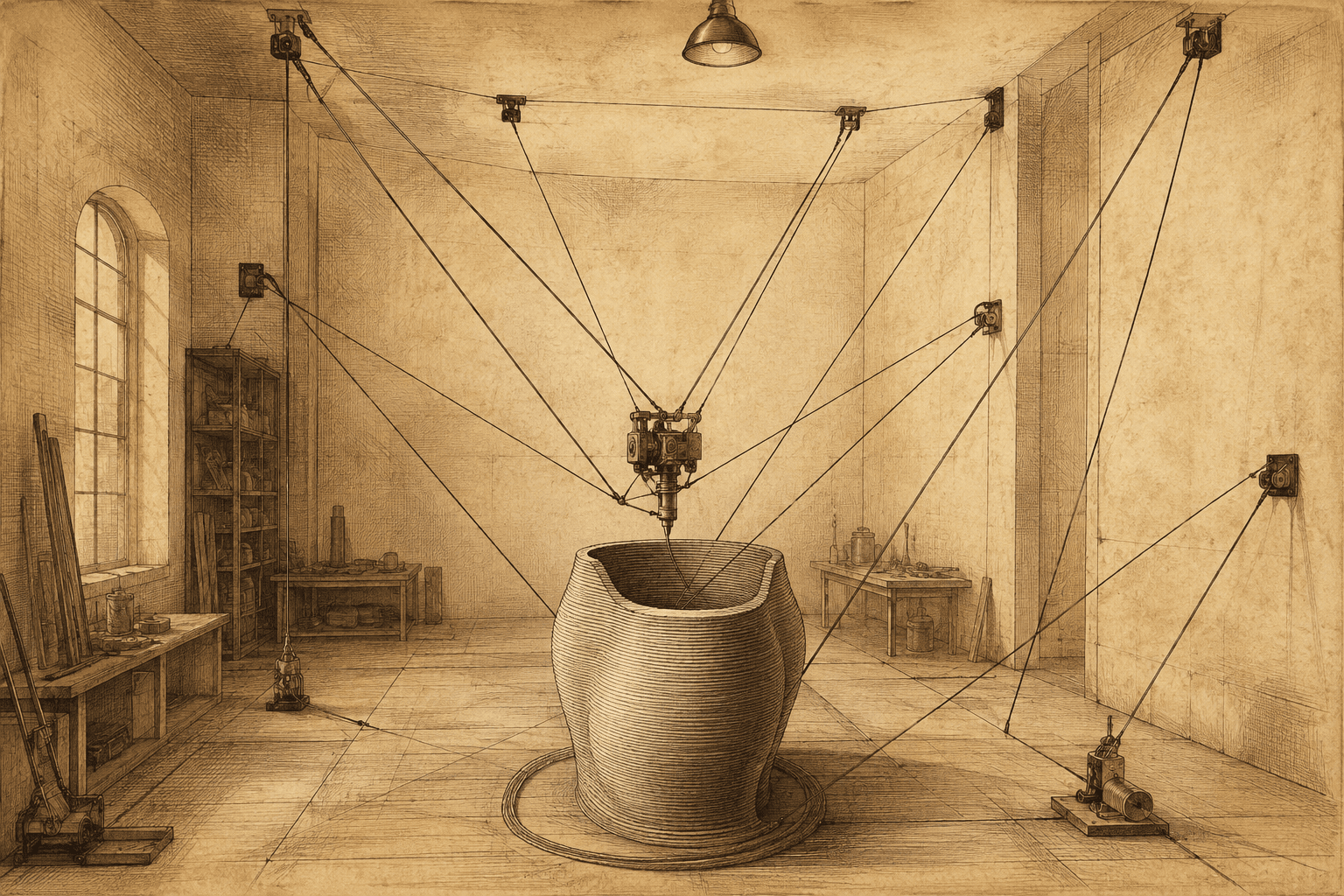
BuilderTorbjørn Ludvigsen (tobben) and Hangprinter contributors
Suspends a print head from tensioned lines anchored around a room, replacing a rigid gantry with cable geometry so an open RepRap can work across an unusually large build space.
Visit HangprinterOriginal editorial concept art generated with built-in Codex Image Gen for The Machine Press, 2026-09-06.
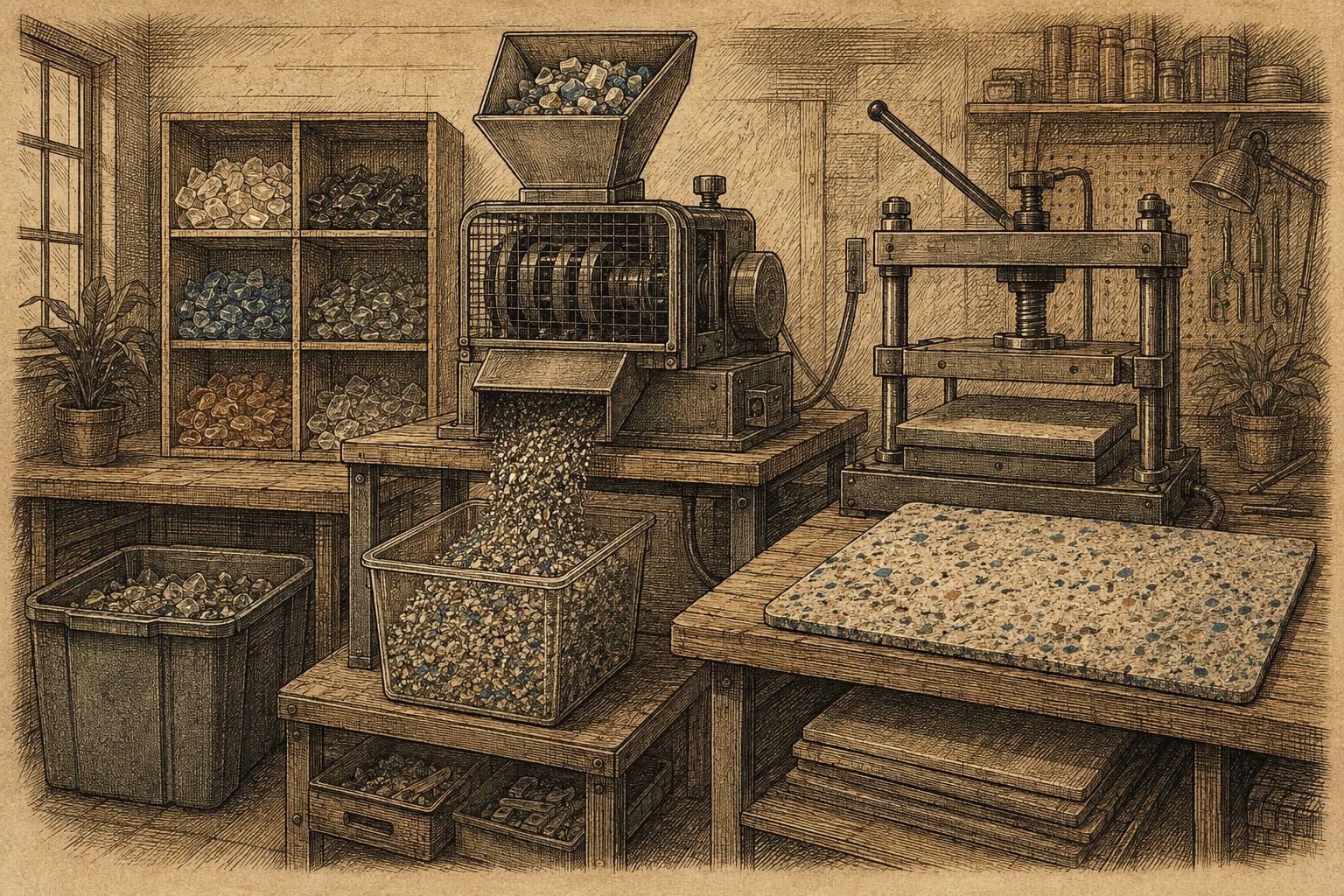
BuilderDave Hakkens and Precious Plastic contributors
Publishes replicable shredders, presses, workspace plans, and shared know-how so small local teams can sort waste plastic and turn it into reusable flakes and sheet material.
Visit Precious PlasticOriginal editorial concept art generated with built-in Codex Image Gen for The Machine Press, 2026-09-06.
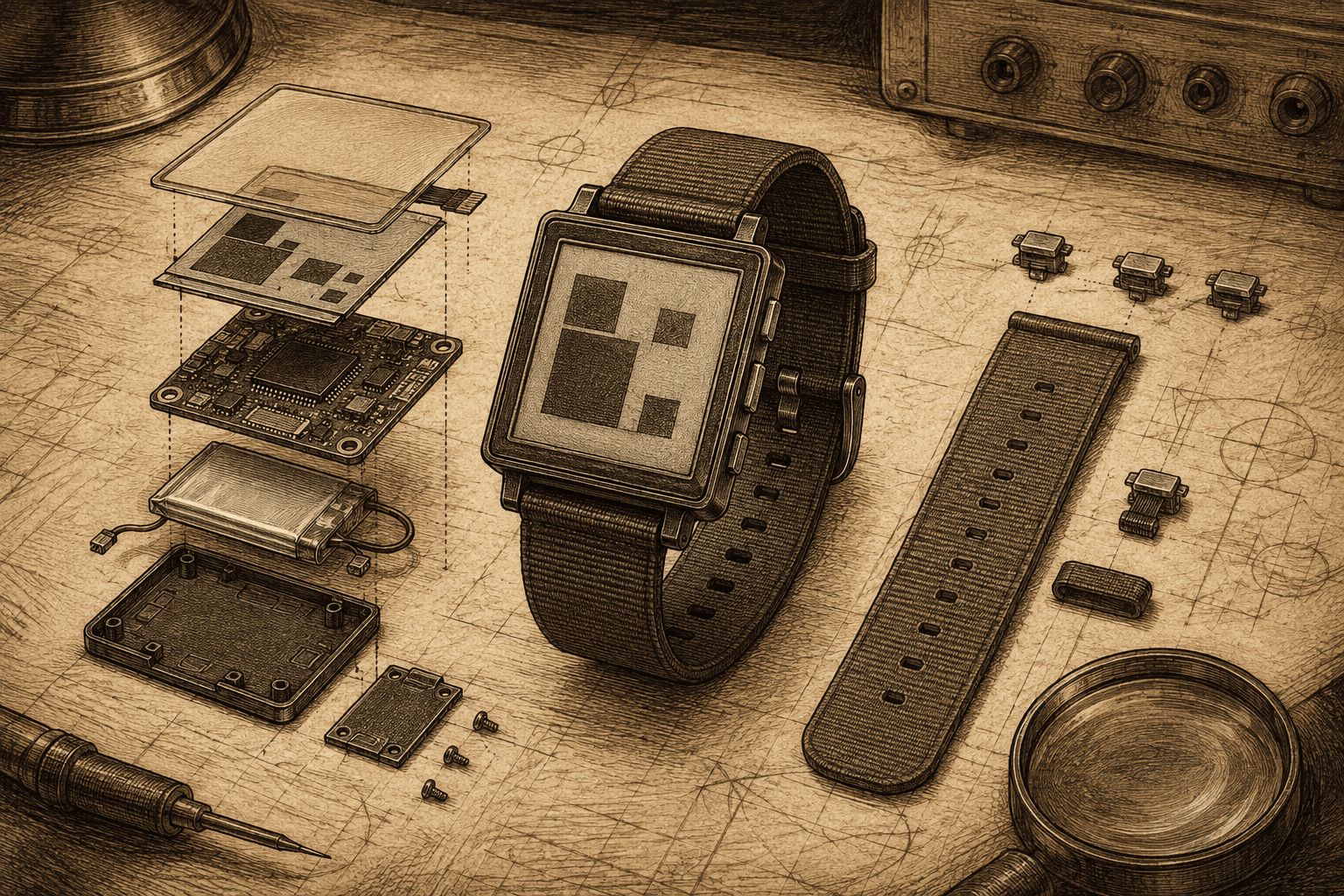
Pairs a square e-paper display with an ESP32-S3 and publishes the hardware, software, documentation, and case files so owners can build and program their own watch faces.
Visit WatchyOriginal editorial concept art generated with built-in Codex Image Gen for The Machine Press, 2026-09-06.
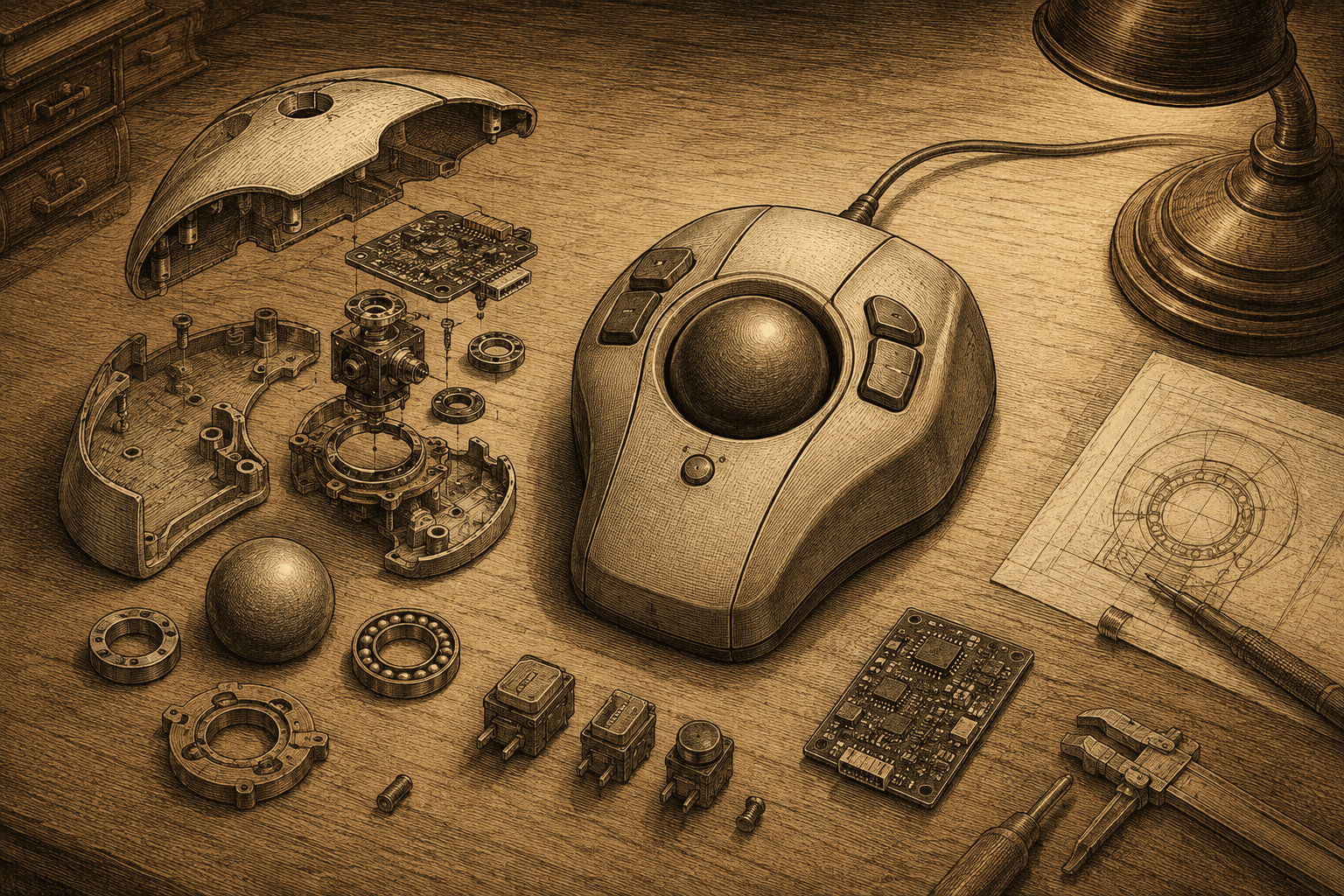
Turns a desktop trackball into an inspectable kit by publishing its mechanical and electrical design files, assembly documentation, and programmable QMK firmware.
Visit Ploopy Classic 2Original Codex Image Gen concept art from 2026-07-10; carried forward from the validated September 6 edition.
Desk Picks are selected by the newsroom. Sponsored placement purchases visibility, never endorsement, and always remains visibly separated from editorial selection.
 Editorial illustration