AgentZip compressed related agent environments against their common template, then hid much of the restore cost inside the model’s waiting time.
Editorial illustration
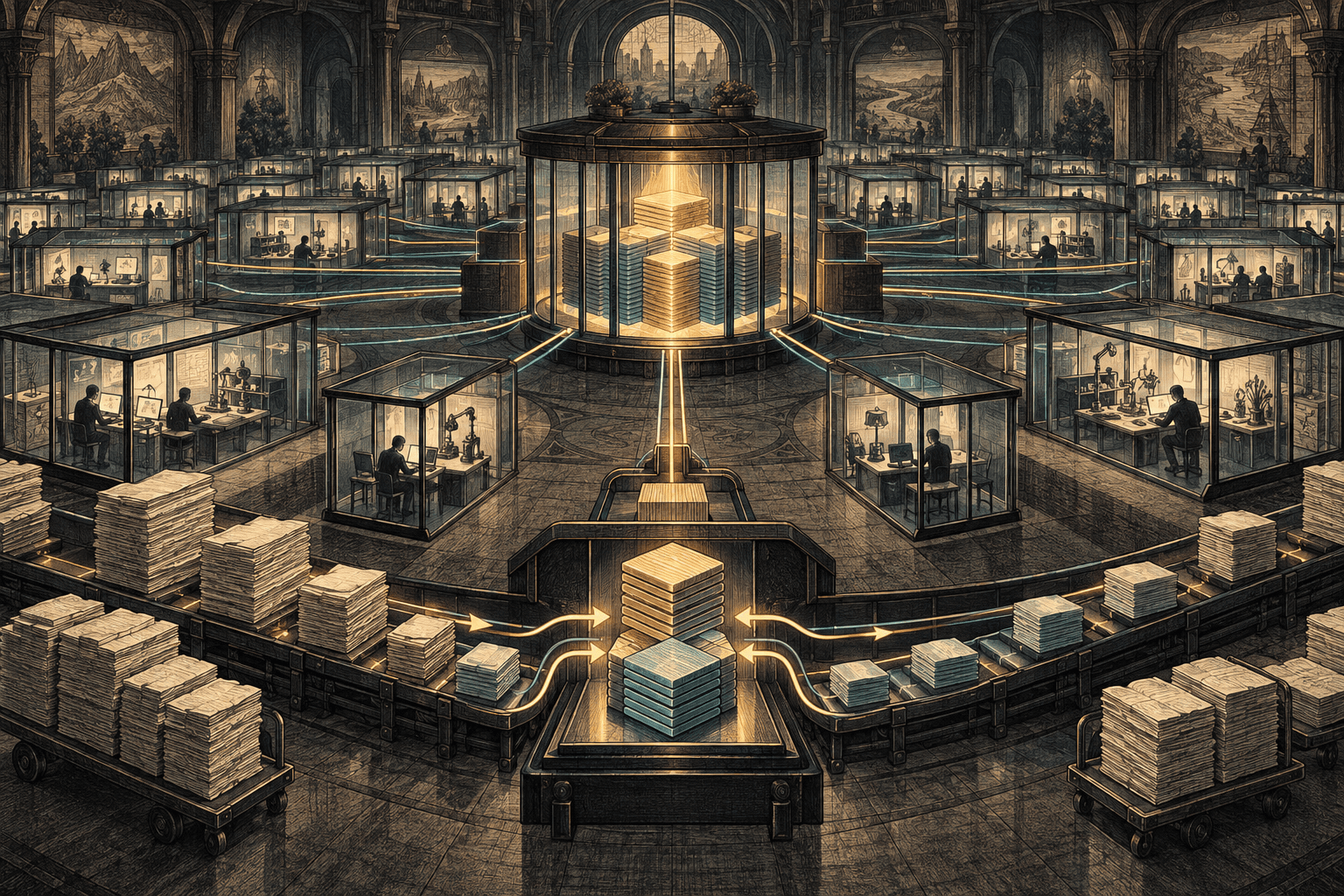
Concept illustration: related agent sandboxes consolidate template and cross-session memory; the rooms and archive are symbolic, not a literal AgentZip deployment. Original editorial illustration generated with built-in Codex Image Gen for The Machine Press, 2026-09-12.
High-fanout agent jobs can open many concurrent sandboxes that begin from one template and follow related trajectories, leaving redundancy that ordinary per-page compression misses. AgentZip compresses against the template and across sandboxes, expands the set of pages considered profitable, prefetches restoration, and schedules expensive work during LLM waits. Across the authors’ training and inference workloads, sandbox-owned memory fell by as much as 8.7×, versus 2.1× for the tested Linux configuration. Execution-aware scheduling and prefetching reduced the slowdown of aggressive compression from as high as 3.1× to 1.40×. These are preprint results on the reported workloads, not a universal capacity guarantee.
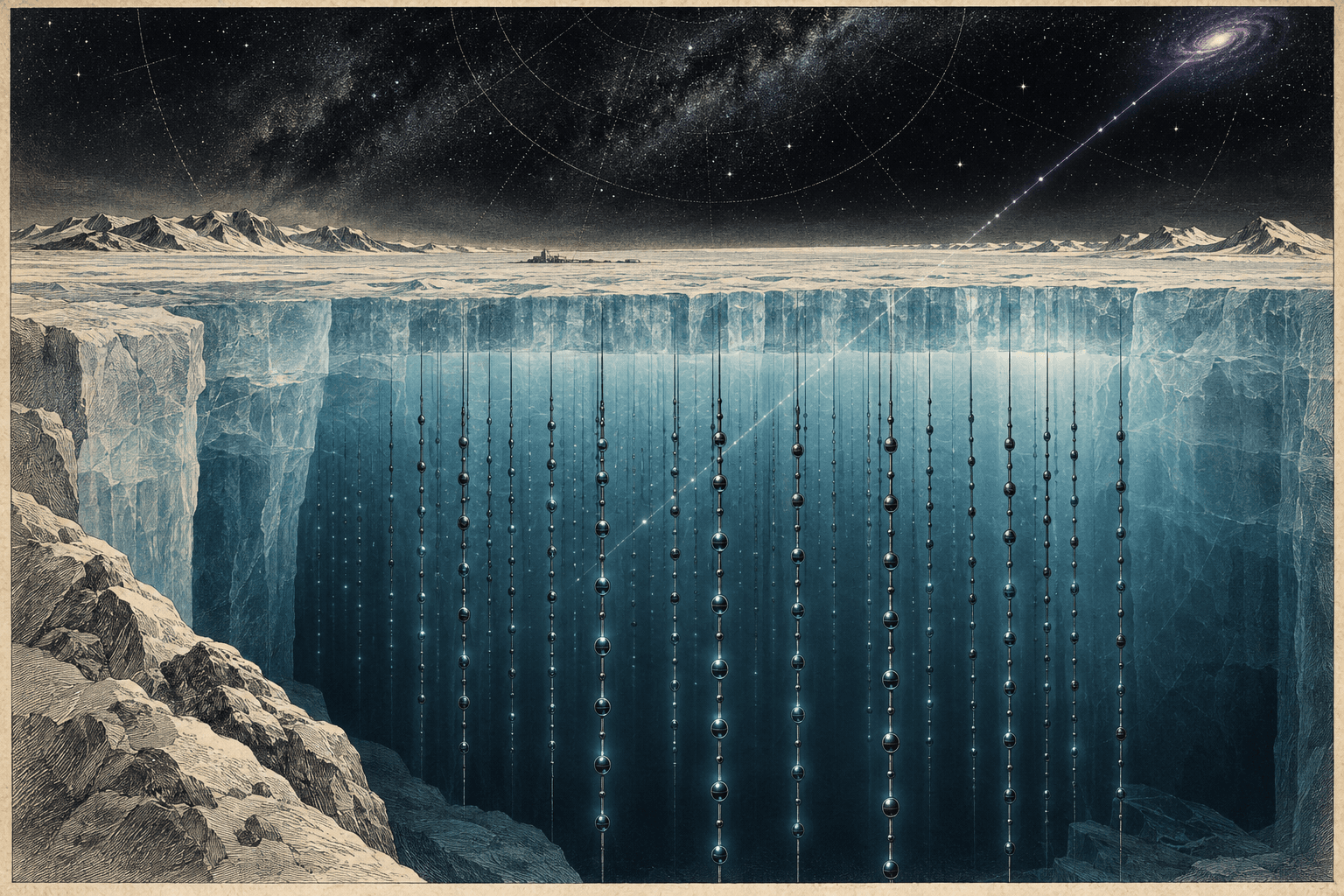
Concept illustration: IceCube’s long archive is contrasted with one ultra-high-energy neutrino direction; this is not the event geometry or an experimental plot. Original editorial illustration generated with built-in Codex Image Gen for The Machine Press, 2026-09-12.
IceCube searched toward KM3NeT’s roughly 200-PeV event under steady, coincident-flare and arbitrary-time hypotheses—and reported no evidence of a point source.
KM3NeT’s partially built ARCA detector recorded KM3-230213A on February 13, 2023, the highest-energy neutrino yet reported at roughly 200 PeV. The IceCube Collaboration searched 15 years of South Pole data in the same direction for a steady source, a flare coincident with the event, or emission at another time. None of the searches found evidence for neutrino emission. The resulting upper limits strongly constrain several astrophysical explanations that treat the single KM3NeT event as coming from a steady or transient point source with the assumed spectrum. A null result does not identify the event’s origin; it narrows a specific family of explanations.
The companion needed to sustain the hot Jupiter’s obliquity would be too massive to hide in existing radial-velocity data.
WASP-12b’s orbit is shrinking faster than standard stellar-tide models explain. One proposal gives the planet persistent obliquity tides, maintained by a nearby companion. Reworking the angular-momentum transfer, the authors find that companion would need at least about 65 Earth masses, not the earlier estimate near 10. Existing radial-velocity observations exclude such an object; within three astronomical units, the reported 95% limit is roughly 14 meters per second. The mechanism therefore cannot account for the decay, whose cause remains open.
Generic source-code illustration, used as a file image; it does not depict Program-Solve, a clinical record, generated Python or a benchmark result. D. Charbonnier / The Noun Project, via Wikimedia Commons (CC0 1.0); padded, gold background added, and converted to WebP by The Machine Press.
A restricted Python solver improved one 32-billion-parameter clinical model by seven points, but did not reliably help the smaller one.
Program-Solve asks a clinical language model to write case-specific Python for a restricted local executor instead of calculating directly. On 1,100 cases covering 55 calculators, the 32B model rose from 83.47% to 90.53%, a paired gain of 7.05 points whose reported interval cleared zero. The 7B model’s 3.29-point increase was not statistically reliable. The study supplied formulas and gold variables, and its audit flagged version, use or coefficient concerns in 16 calculators, so deterministic execution does not replace verified formulas or extraction.
ARCHE generated reaction hypotheses, ran computational workflows and revised its conclusions against the results.
ARCHE combines a general reasoning model, a chemistry-specialized model and a structured tool registry in a closed loop. The authors tested it on reconstructing stereocontrolling transition states, proposing a radical pathway for an unpublished cleavage reaction, and finding a descriptor for selectivity in nickel-catalyzed coupling. In each case the system generated and ranked mechanisms, orchestrated calculations, and revised the explanation from computed evidence. The code is public, but the three demonstrations remain a bounded preprint evaluation rather than proof of autonomous chemistry in the lab.
SemVerBench found predictable version-constraint blind spots across npm, PEP 440 and Cargo—and a resolver solved the task.
SemVerBench contains 240 machine-checkable version-constraint questions with unique answers across npm, Python’s PEP 440 and Cargo. Six frontier models showed mechanism-specific failures: Cargo’s partial-comparator carry rule trapped every model near 60%, while a PEP 440 corner set split one model’s 0-of-26 result from another’s 97–100%. Supplying the governing rule recovered many errors; interval decomposition did not. Because a free resolver was effectively perfect, the authors recommend tool delegation over in-head version reasoning.
Across 235 multimodal science tasks, answer accuracy exceeded complete evidence recovery by more than 20 points.
Sci-MMR links scientific claims to citations, figures and supporting image regions across 235 multi-hop tasks in four disciplines. Eight frontier multimodal models consistently answered more often than they recovered all required evidence, with a gap above 20 percentage points. Missing or incomplete figure evidence accounted for 57.2% of failures; gold evidence improved accuracy by as much as 37 points. Even with gold evidence, the strongest model reached 69.1% on the hardest tasks, exposing a second bottleneck in combining what had been found.
Hanabi logs exposed a 26-point gap between literal information and human play—almost absent in AI-only pairs.
The proposed convention gap compares failure predicted from a message’s literal content with what players actually do. Across about 101,000 Hanabi actions, the gap measured 26.2 points for human pairs, minus 0.7 for AI pairs and 16.4 for human–AI teams. Unhinted human plays drove a 46-point gap, suggesting shared conventions carried information beyond explicit clues. Within human–AI games, partners with similar literal information produced sharply different human outcomes. The authors argue that AI–AI score alone can miss compatibility with people.
NASA OSAM-1 robotics file image, used illustratively; it does not depict the simulated hazardous explorer, risk maps or planning results. Use does not imply NASA endorsement. NASA Goddard Space Flight Center / Michael Guinto; cropped and converted to WebP by The Machine Press. Use does not imply NASA endorsement.
Changing only the path-value objective shifted simulated explorers between informative danger and safer future sensing.
A hazardous explorer can lose the chance to learn later if an informative path destroys it now. The study held the belief update, sensor, physical-risk model and finite-horizon planner fixed, then changed only the scalar used to value feasible paths. A Prelec-weighted behavioral-information objective created interpretable conservative-to-aggressive regimes and switching boundaries along the information–risk frontier. In failure-truncated grid worlds, risk-aware valuations reduced hazard exposure and robot losses, while plain Shannon information remained a strong raw-information baseline. Physical validation remains to be shown.
Graph-guided fingering and a physics-inspired acoustic model paired mechanical accuracy with score-level dynamics.
The robotic pianist uses graph optimization to choose natural pre-press and key-press finger transitions, then a physics-inspired acoustic model varies key velocity with the musical score. The authors report gains over baselines in motion similarity and dynamic accuracy across multiple styles. In listening tests, participants preferred the expressive system to baseline robot performances; nonprofessional listeners rated it indistinguishably from human performances. That perceptual result is limited to the reported audience and repertoire, not a general claim of human-level musicianship.
A sketch interface extracted target points, assigned robots and guaranteed against unintended mirrored shapes.
Users drew a desired geometry; the system extracted formation points, built a rigid graph, assigned swarm members and executed distributed control. Its construction includes a guarantee against unintended reflected formations, a subtle failure mode when a shape can be mirrored. Twenty study participants produced 42 geometric shapes and rated the interface 84.25 on the System Usability Scale. The result supports sketching as an approachable swarm-programming layer, though the study does not establish performance in a field deployment.
MaP-WAM compressed episodic context into segment plans while keeping executor latency approximately constant.
MaP-WAM stores completed segments as language plus sparse visual context, converts that history into the next language and visual plan, and lets a progress-aware model execute each segment for an unknown duration. Because the executor sees the compact plan instead of the full growing history, its context and approximate inference latency stay fixed. The authors report 83.3% success on RMBench and 78.0% on real-robot tasks. The architecture separates planning-time memory from action-time execution rather than treating one expanding window as both.
Measurements on 7.3 kilometers of deployed fiber turned dark counts, classical traffic and state drift into engineering parameters.
Researchers measured a 7.3-kilometer metropolitan fiber loop linking two Naples campuses and defined quantum-network counterparts to classical signal-to-interference-plus-noise and bit-error metrics. They separated intrinsic detector dark counts from photons induced by classical traffic, including Raman scattering and inter-fiber crosstalk. They also tracked degradation and drift for polarization, time and frequency encodings. The result is a compact experimental link budget intended to move deployed quantum fiber from a one-off physics demonstration toward repeatable network engineering.
Rendered wafer-scale integrated-circuit illustration, used as a file image; it does not depict a quantum processor, surface-code layout or the authors’ hardware. Wikideas1 / Wikimedia Commons (CC0 1.0); cropped and converted to WebP by The Machine Press.
A traceable path from algorithms to surface-code schedules showed why logical gate totals miss physical cost.
The framework converts hierarchical quantum algorithms into dependency-preserving schedules and time-resolved workloads, then co-designs surface-code layout, resource-state supply and execution. Across 20 circuits in seven families, similar logical counts produced very different physical costs. Under the authors’ direct-rotation calibration, choosing the non-Clifford implementation reduced space-time volume by as much as 241.5× for one QAOA amplitude-amplification workload. Tailored layouts lowered routed latency for every benchmark and lowered space-time volume for 13 of them.
BIND learned field-level gas, star and dark-matter structure across a 35-dimensional simulation space.
Weak-lensing forecasts need the way gas and stars reshape matter, but full hydrodynamic simulations are expensive. BIND learns to map dark-matter-only halos to dark matter, gas and stellar fields using 1,024 paired CAMELS simulations spanning cosmology and galaxy-formation parameters. The authors report percent-level mass recovery, radial profiles within roughly 10%, and preserved shape and residual relationships without giving the model halo mass as an input. Applied halo by halo to a 512-cubed-particle volume, it reproduced projected power suppression in minutes on one GPU.
DESI spectra found metal enrichment in 9.8% of cool white dwarfs in wide binaries, versus 20.5% of single controls.
Metals in a cool white-dwarf atmosphere are evidence of recently accreted planetary material. In DESI DR1, 9.8 ± 2.1% of cool white dwarfs in wide binaries were metal enriched, compared with 20.5 ± 0.9% of matched single systems, a reported 4.7-sigma difference. The authors also found tentative trends with projected separation and temperature. They interpret the deficit as either smaller starting reservoirs from suppressed planetesimal formation or faster depletion early in the white-dwarf stage; the data do not yet choose between those routes.
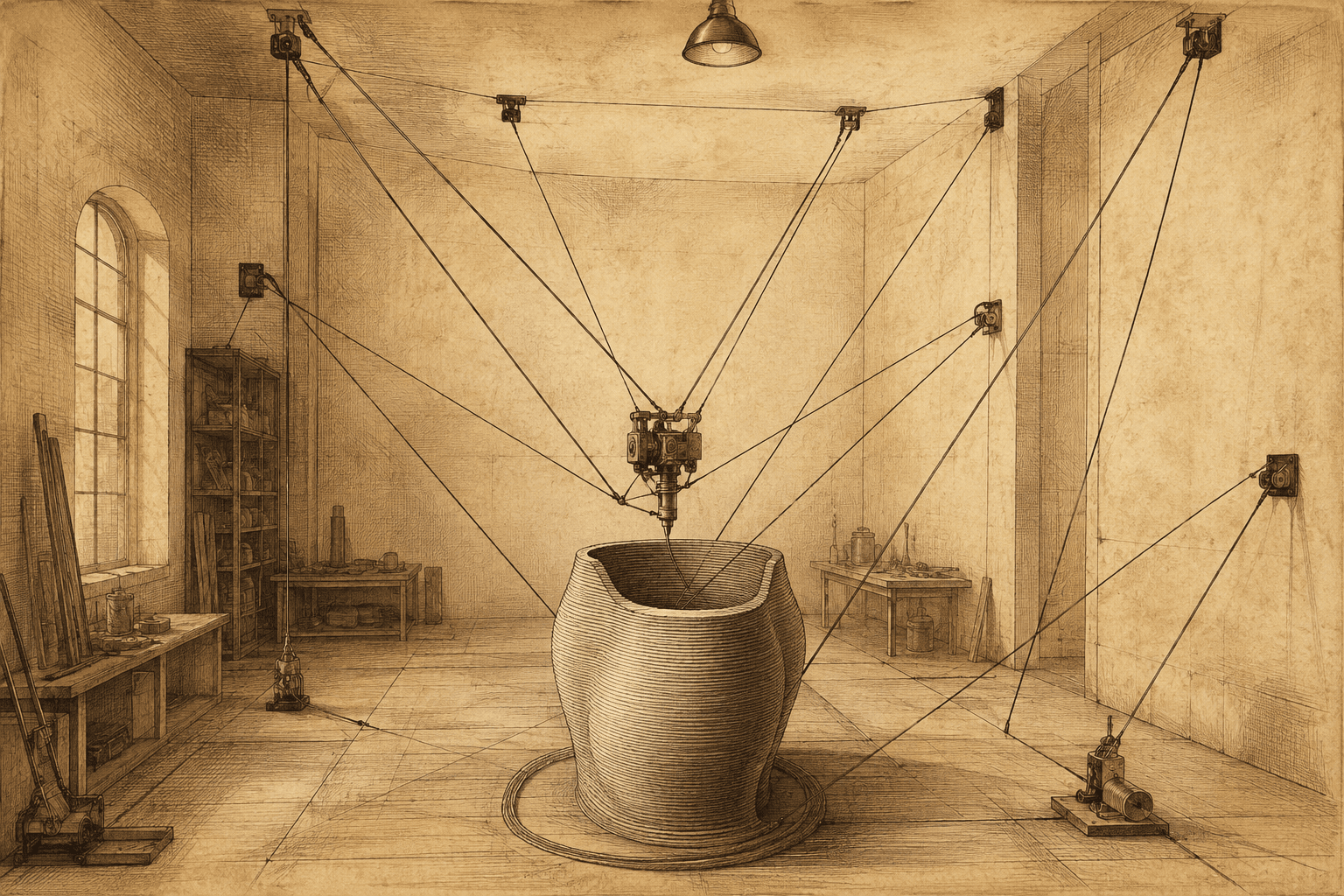
BuilderTorbjørn Ludvigsen (tobben) and Hangprinter contributors
Suspends a print head from tensioned lines anchored around a room, replacing a rigid gantry with cable geometry so an open RepRap can work across an unusually large build space.
Visit HangprinterOriginal editorial concept art generated with built-in Codex Image Gen for The Machine Press, 2026-09-06.
BuilderDave Hakkens and Precious Plastic contributors
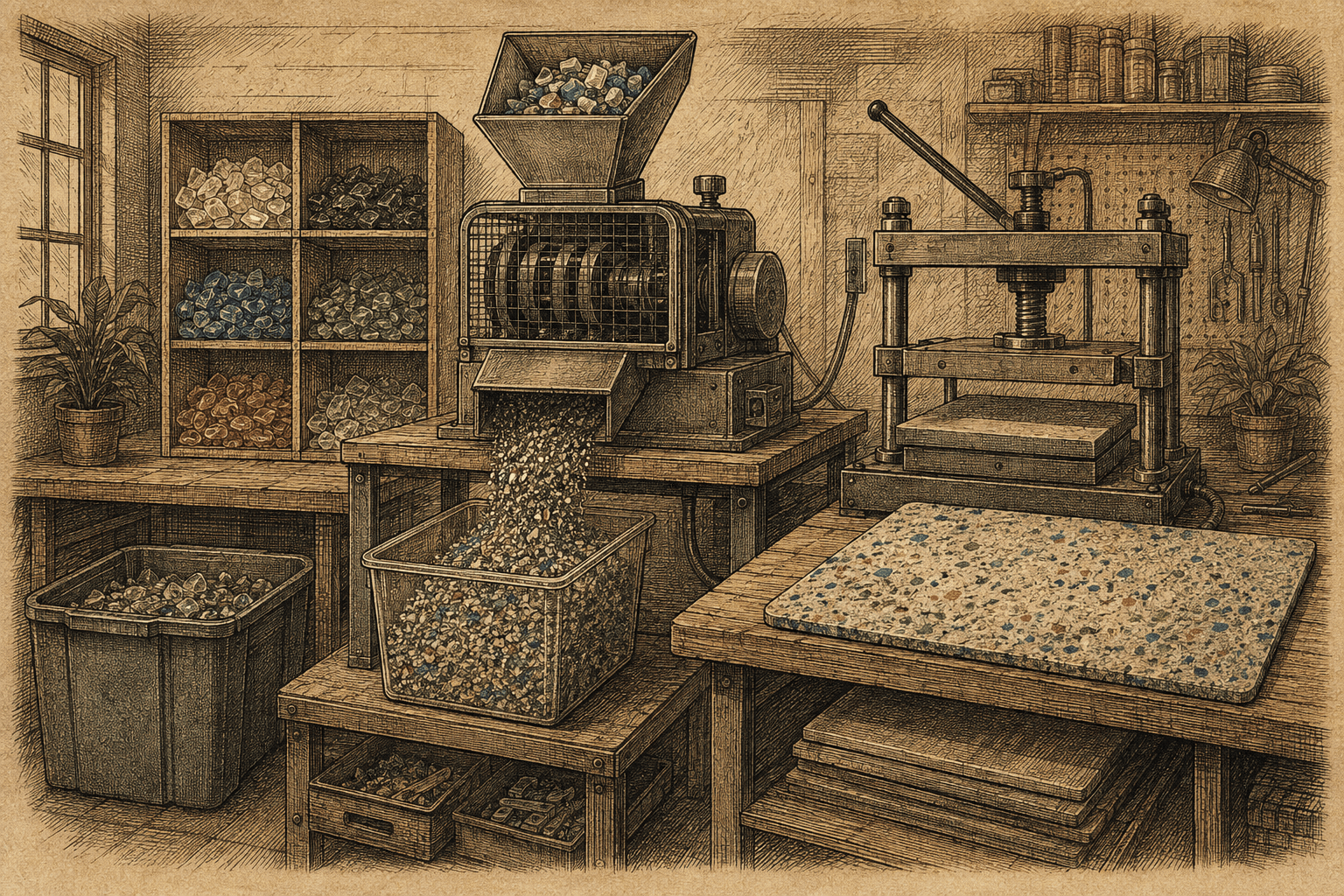
Publishes replicable shredders, presses, workspace plans, and shared know-how so small local teams can sort waste plastic and turn it into reusable flakes and sheet material.
Visit Precious PlasticOriginal editorial concept art generated with built-in Codex Image Gen for The Machine Press, 2026-09-06.
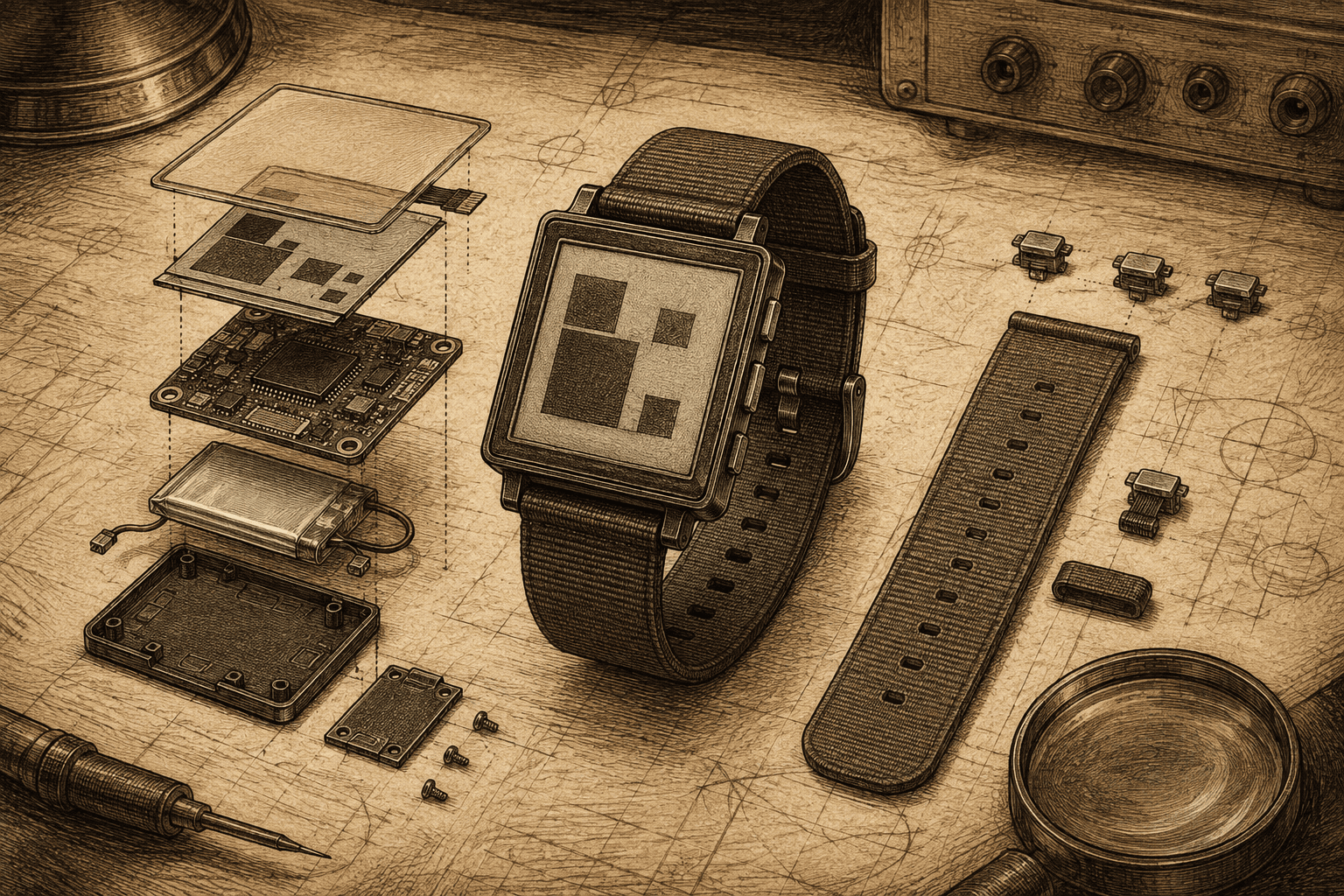
Pairs a square e-paper display with an ESP32-S3 and publishes the hardware, software, documentation, and case files so owners can build and program their own watch faces.
Visit WatchyOriginal editorial concept art generated with built-in Codex Image Gen for The Machine Press, 2026-09-06.
Turns a desktop trackball into an inspectable kit by publishing its mechanical and electrical design files, assembly documentation, and programmable QMK firmware.
Visit Ploopy Classic 2Original Codex Image Gen concept art from 2026-07-10; carried forward from the validated September 11 edition.
Desk Picks are selected by the newsroom. Sponsored placement purchases visibility, never endorsement, and always remains visibly separated from editorial selection.
 Editorial illustration