research
Fifteen Years of Ice Found No Companion Signal
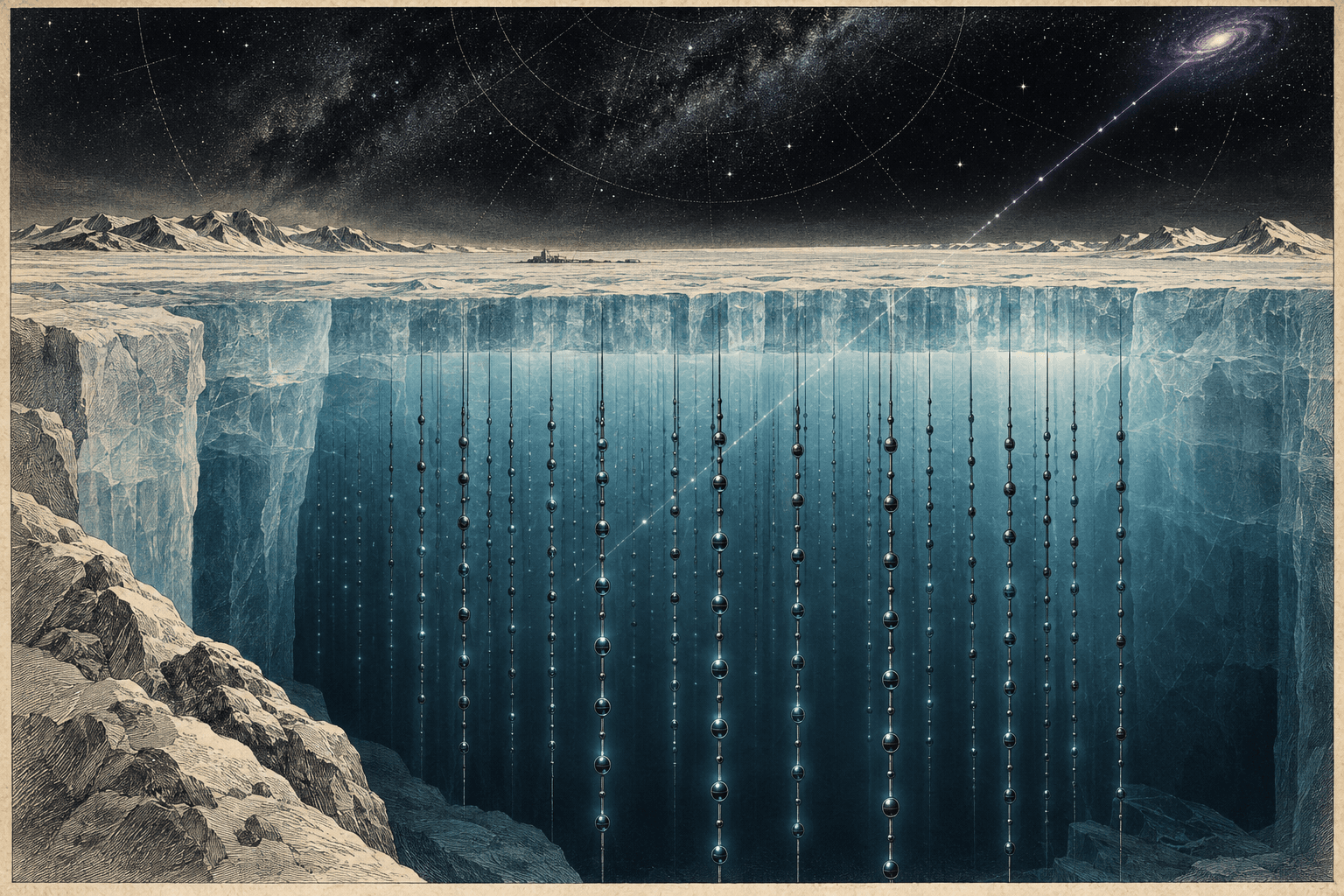
IceCube searched toward KM3NeT’s roughly 200-PeV event under steady, coincident-flare and arbitrary-time hypotheses—and reported no evidence of a point source.
Summary
IceCube searched toward KM3NeT’s roughly 200-PeV event under steady, coincident-flare and arbitrary-time hypotheses—and reported no evidence of a point source.
KM3NeT’s partially built ARCA detector recorded KM3-230213A on February 13, 2023, the highest-energy neutrino yet reported at roughly 200 PeV. The IceCube Collaboration searched 15 years of South Pole data in the same direction for a steady source, a flare coincident with the event, or emission at another time. None of the searches found evidence for neutrino emission. The resulting upper limits strongly constrain several astrophysical explanations that treat the single KM3NeT event as coming from a steady or transient point source with the assumed spectrum. A null result does not identify the event’s origin; it narrows a specific family of explanations.
Why it matters
IceCube searched toward KM3NeT’s roughly 200-PeV event under steady, coincident-flare and arbitrary-time hypotheses—and reported no evidence of a point source.
Limits and context
- A null result does not identify the event’s origin; it narrows a specific family of explanations.
Key claims
IceCube searched toward KM3NeT’s roughly 200-PeV event under steady, coincident-flare and arbitrary-time hypotheses—and reported no evidence of a point source.
Qualification: A null result does not identify the event’s origin; it narrows a specific family of explanations.
Evidence: source-2026-09-12-002
Sources
- arXiv preprint 2609.10931arXiv · primary research
Corrections
No corrections have been recorded for this story.