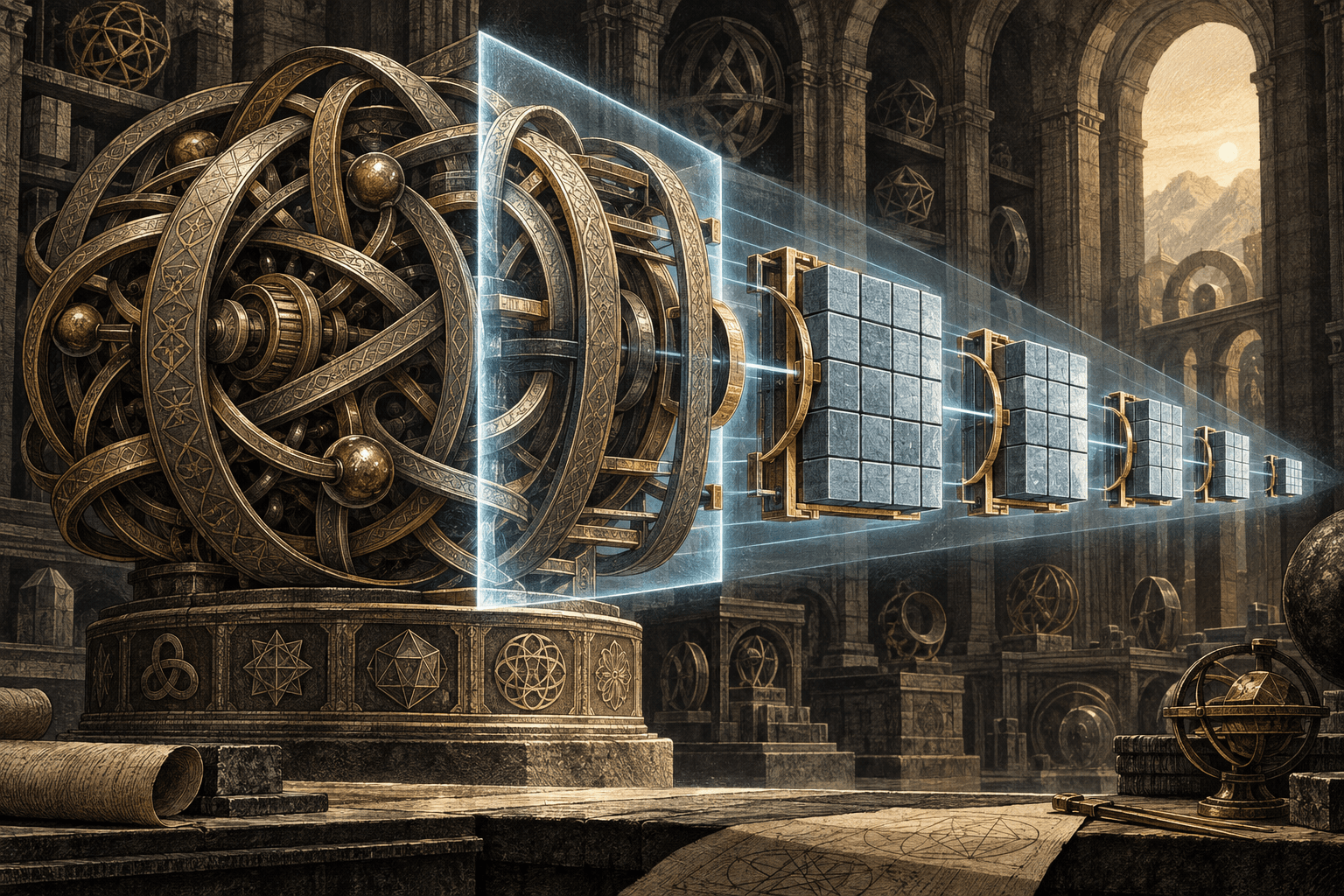
A Fourier change of basis reduced group-ring unit inversion to matrix blocks, making dihedral constructions polynomial-time despite their non-commutativity.
Editorial illustration
Concept illustration: a change of basis decomposes an intimidating group-ring inversion into small representation blocks; this is not a deployed cipher or paper figure. Original editorial illustration generated with built-in Codex Image Gen for The Machine Press, 2026-09-13.
Some public-key proposals moved from abelian to non-abelian group rings after a quantum attack, expecting the harder dihedral hidden-subgroup problem to provide protection. This preprint argues that unit inversion does not require solving that problem. When a semisimple group ring has an efficient generalized Fourier transform and its largest representation block is polynomially bounded, a change of basis splits inversion into manageable matrices. Dihedral groups meet those conditions because their irreducible representations have dimension at most two. The author supplies an explicit reversible block-inversion circuit and simulator results. This is a preprint cryptanalysis of a construction class, not evidence that broadly deployed encryption has been broken.
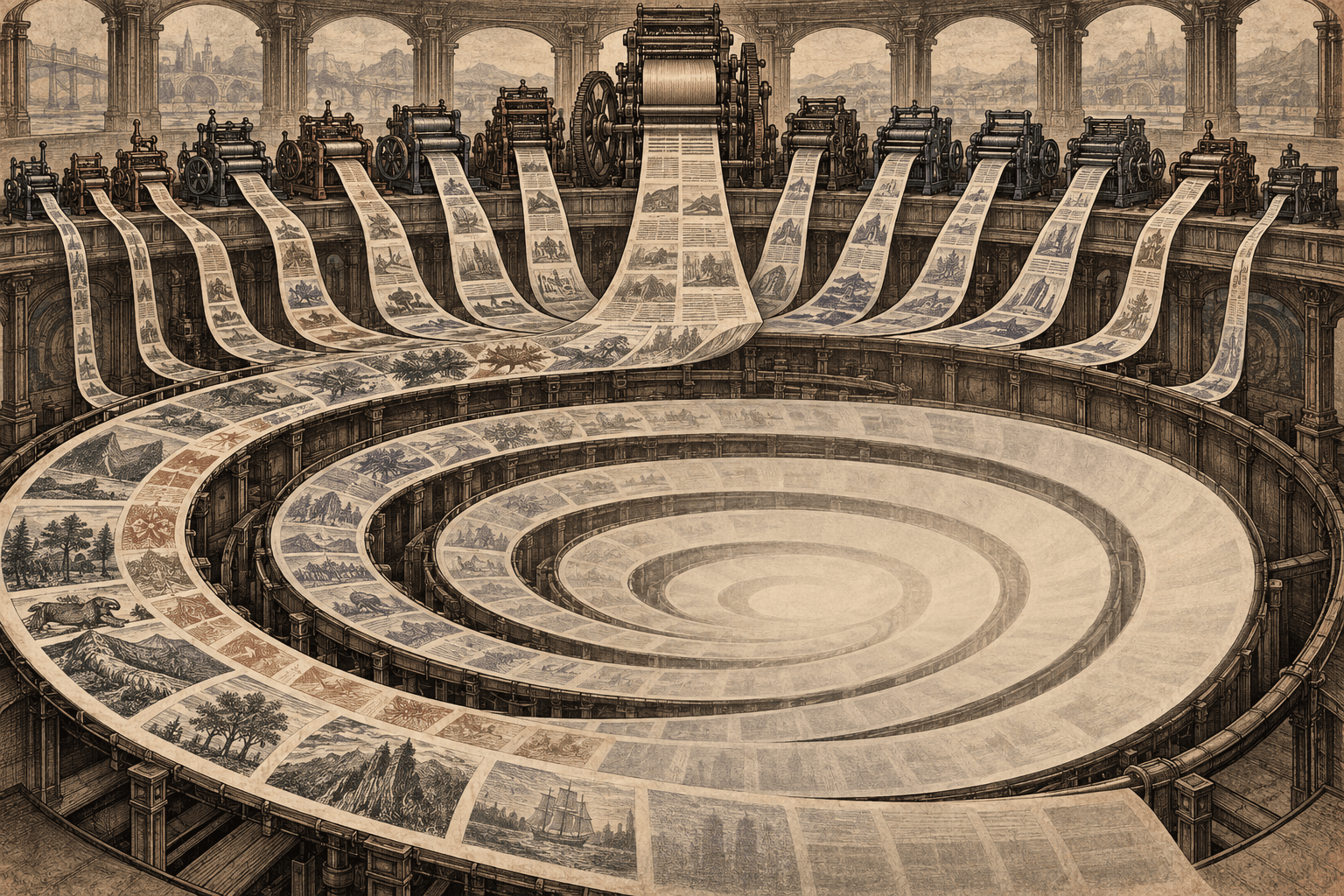
Concept illustration: unequal model suppliers recursively feed one shared corpus toward a similar faded endpoint; the presses are symbolic, not an experimental plot. Original editorial illustration generated with built-in Codex Image Gen for The Machine Press, 2026-09-13.
Across controlled ecosystems of up to thirteen models, unequal market share scarcely changed recursive collapse; supplier susceptibility changed its speed 2.8-fold.
Researchers repeatedly retrained ecosystems of three to thirteen open 1–4B models on a shared pool containing their own generated text, varying market concentration through a 90% injected supplier and following five generations. Within that controlled range, greater concentration barely changed the speed or destination of model collapse. Holding shares fixed but changing which three models supplied the pool changed five-generation drift by 2.8×, and a share-weighted susceptibility index explained 68% of speed differences across nineteen arms. Replacing half the pool with human text roughly halved drift. The result is a bounded synthetic ecosystem study: it does not establish how proprietary production models or real web-scale corpora will evolve.
WINTER’s open pipeline turned six InGaAs detectors into reduced images, subtractions and Avro transient alerts.
The Wide-field Infrared Transient Explorer uses six lower-cost InGaAs detectors on a robotic one-meter telescope at Palomar. Its open winterdrp pipeline reduces dithered images, performs subtraction and emits Avro transient alerts for vetting and follow-up. During 2024 observations, the six detectors reached median five-sigma J-band depths of 18.1–18.8 AB magnitude in 960-second integrations, about 0.2 arcsecond astrometric accuracy and 0.09–0.18 magnitude photometric accuracy. Early science included a stellar merger in M31 and follow-up of neutrinos, gravitational waves and high-energy transients. Performance varies by detector and observing conditions.
Generic code-screen file image, used illustratively; it does not depict the studying agent, prepared artifacts, benchmark environments or results. Markus Spiske / Pexels; cropped, resized, metadata stripped, and converted to WebP by The Machine Press.
A meta-agent prepared reusable artifacts without task examples, then reduced the frozen solver’s test-time sampling on six benchmarks.
Task-agnostic environment preprocessing lets an agent explore corpora and tools before it knows the downstream task distribution. Across six heterogeneous benchmarks, an archive-equipped meta-agent chose preparation artifacts and achieved the highest Avg@3 reward on five, while fixed corpus processing remained best on the largest corpus. Larger study budgets did not reliably improve reward, but the resulting artifacts reduced how many test-time samples were needed to reach a given score. The study shifts some computation from repeated attempts into reusable preparation without claiming one study strategy works everywhere.
A range-based confidence gate admitted none of a common update stream at 2,000 episodes, while paired checks admitted 31.6%.
Independent validation can stop harmful policy updates, but an overconservative test can also freeze a continual agent. In a constructed one-step pushing diagnostic with 32 seeds, fresh paired-binomial checks admitted 31.6% of a common update stream at 2,000 episodes per stage; a range-based confidence gate admitted none. Unconditional replay still learned better in closed-loop runs. The paper proposes auditing both error control and missed learning opportunities, plus controlled historical-reference promotion. Physical-robot and vision-language-action validation remain open.
Veilmind-4B selected removal or replacement from user intent instead of applying one static privacy rule.
The study argues that sensitive attributes have context-dependent utility: a detail may be essential to one request and disposable in another, while combinations of attributes can reveal more than either alone. Its local protection pipeline uses a distilled 4B model to extract, sanitize and restore context, choosing removal or replacement according to the task’s need for factual integrity or structural coherence. The authors report a lower-leakage operating point with more utility than tested privacy baselines. Those claims come from the reported evaluations; the abstract does not establish protection against every inference attack.
Benchmark Radar joins 1,283 source records with 12,916 numeric observations and preserves the evidence behind comparisons.
Benchmark Radar is a living database for discovering AI evaluations, their datasets, code, model-card mentions and score histories. Its daily discovery system watches 37 first-party research and engineering sources. At release, the catalog contained 1,283 source records drawn from four benchmark catalogs and 12,916 numeric observations on 790 records. The project includes a web dashboard, saturation and trend views, downloadable evidence and an offline CLI. It is a new research infrastructure release, and the paper explicitly treats cross-setting score comparison as something to audit rather than assume.
Five instruments on 70,500 messages separated semantic agreement from predictive ordering around securities lawsuits.
Researchers linked 70,500 X messages about securities class actions from 2002–2025 to abnormal returns, then ran VADER, Loughran–McDonald, FinBERT, Twitter-RoBERTa and an LLM annotator through one pipeline. Human-label agreement aligned more closely with graded same-day associations under conventional sampling, while a fixed-size panel produced similar graded rank correlations at same-day and one-day horizons. Coarse predictive ordering remained weak, and message volume predicted neither market damage nor settlement size in a corpus with 17.6% spam. This observational result is not trading guidance.
NASA OSAM-1 robotics file image, used illustratively; it does not depict the reported IK solver, RB-Y1 arm, box-moving demonstration or results. Use does not imply NASA endorsement. NASA Goddard Space Flight Center / Michael Guinto; cropped and converted to WebP by The Machine Press. Use does not imply NASA endorsement.
The inverse function theorem recovered differentiable charts from ordinary forward-kinematic Jacobians and guided a real box-moving arm.
Most analytic inverse-kinematics functions come from meta-solvers such as IKFast and are difficult to rewrite for gradient-based trajectory optimization. The proposed method recovers gradients of their local solution charts from the ordinary forward-kinematic Jacobian through the inverse function theorem. A least-squares extension preserves useful gradient signal outside the reachable workspace, while an explicit reachability description constrains optimization. Numerical experiments and a hardware demonstration had an RB-Y1 pick up a box and place it on a table. The approach applies where the local chart and selected Jacobian remain regular.
IMLE-VLA raised inference from 15 to 55 hertz while reporting 98% average success across forty LIBERO tasks.
Diffusion and flow-matching action heads often sample through several iterative steps, creating stop-and-go robot motion. IMLE-VLA replaces that loop with a single-step conditional generator trained to preserve multiple plausible actions. Applied to the reported π0.5 backbone, it raised inference frequency 3.67×, from 15 to 55 Hz, and achieved 98.0% average success across the 40-task LIBERO benchmark. Four real-world Franka tasks showed 2.2–3.0× lower jerk and 3.9–6.6× less VLA inference time per episode. These are the authors’ benchmark and hardware results, not a universal latency guarantee.
A target–obstacle–background representation reached 75.41% success and 8.20% collisions across 366 real-robot trials.
ObstaDiff decomposes a cluttered manipulation scene into target, obstacle and background representations before a diffusion policy plans toward a target-centered bottleneck pose. The authors evaluated six methods over 61 greenhouse trials each, for 366 real-robot executions. ObstaDiff reported 75.41% average task success and an 8.20% average obstacle-collision rate, outperforming the selected imitation-learning baselines. The result suggests that explicit obstacle structure can improve generalization beyond clean training backgrounds, but it is limited to the reported agricultural tasks and test setup.
RIDE combined sparse PnP correspondences with a video-depth prior and carried metric scale through short observation gaps.
Render–match–PnP relocalization normally uses image-to-map correspondences only to recover camera pose. RIDE reuses the inlier geometry as sparse metric-depth observations, then combines them with a pretrained video-depth prior through global and local correction plus temporal memory. Once a metrically scaled 3D Gaussian Splatting map initializes scale, the system can estimate dense depth from an RGB stream and bridge short periods without new observations. Tests on robot sequences without fine-tuning improved depth accuracy and temporal consistency over scale-only calibration.
A quadruped runtime joined navigation, voice, memory and hazard reporting without allowing unconstrained self-modification.
Harness Robotic OS organizes a property-inspection system into robot, autonomy-skill, cognitive-agent, interaction and operations planes. Its Argos prototype combined quadruped navigation, stereo depth, multimodal analysis, voice interaction and hierarchical memory, while a safety gate converted execution traces only into versioned candidate updates. In the reported residential environment, waypoint reachability was 100%, outdoor localization error stayed below 10 centimeters, obstacle response below 200 milliseconds and alarm/report delivery reached 99%. Hazard detection ranged from 85–95% on representative cases. Those prototype figures are environment-specific, not a certification for unattended deployment.
Staged technology file image, used illustratively; it is not a real power-grid console, nitrogen-vacancy sensor, attack trace or experimental result. Rafael Minguet Delgado / Pexels; cropped, resized, metadata stripped, and converted to WebP by The Machine Press.
Quantum computational sensing reached 0.944 average precision in the 14-bus simulation, but its advantage narrowed when more measurements were available.
The study tests whether nitrogen-vacancy sensors can provide a physical channel when manipulated digital power-grid telemetry still looks plausible. Under a matched budget of 40 physical trials per sensor in the IEEE 14-bus simulation, quantum computational sensing reached 0.944 average precision, versus 0.800 for conventional four-setting readout and 0.751 for tomography; the low-budget ordering persisted in the 30- and 118-bus cases. Multi-setting methods recovered with larger budgets, and improved quantum sensitivity did not always yield task-relevant state separation. This is simulation evidence with Lindblad sensor models, not a field deployment.
Refocusing suppressed slow unwanted terms in a proposed superconducting gate and pushed optimistic simulated encoding fidelity above 0.99.
The proposed conditional-squeezing gate drives a SQUID-terminated resonator along a direction set by a dispersively coupled qubit. A refocusing sequence suppresses slowly varying unwanted terms during state-dependent parametric resonance. The authors use the gate to encode arbitrary qubit states into superpositions of one- and two-mode squeezed resonator states whose parity can reveal errors. Under experimentally optimistic nonlinearities and decay rates, simulated encoding fidelity exceeded 0.99. Kerr nonlinearities and dissipation remain the limiting mechanisms, and the work presents an implementation route rather than a reported hardware demonstration.
A separability framework for dark-matter-deficient galaxies predicts a conjugate baryon-depleted regime testable with kinematics and globular clusters.
A theoretical extension of the dark-matter–baryon separability condition admits a branch where baryons are preferentially depleted rather than dark matter. Using the recently reported almost-dark galaxy TTT J1237327+143535 as a worked example, the authors derive relationships among line-of-sight velocity dispersion, dynamical mass, enclosed baryon fraction and mass-to-light ratio as the unknown progenitor ratio varies. They also connect the inferred halo to an expected globular-cluster population. Future stellar-kinematic, gas and cluster measurements are needed to test whether the galaxy actually occupies that branch.
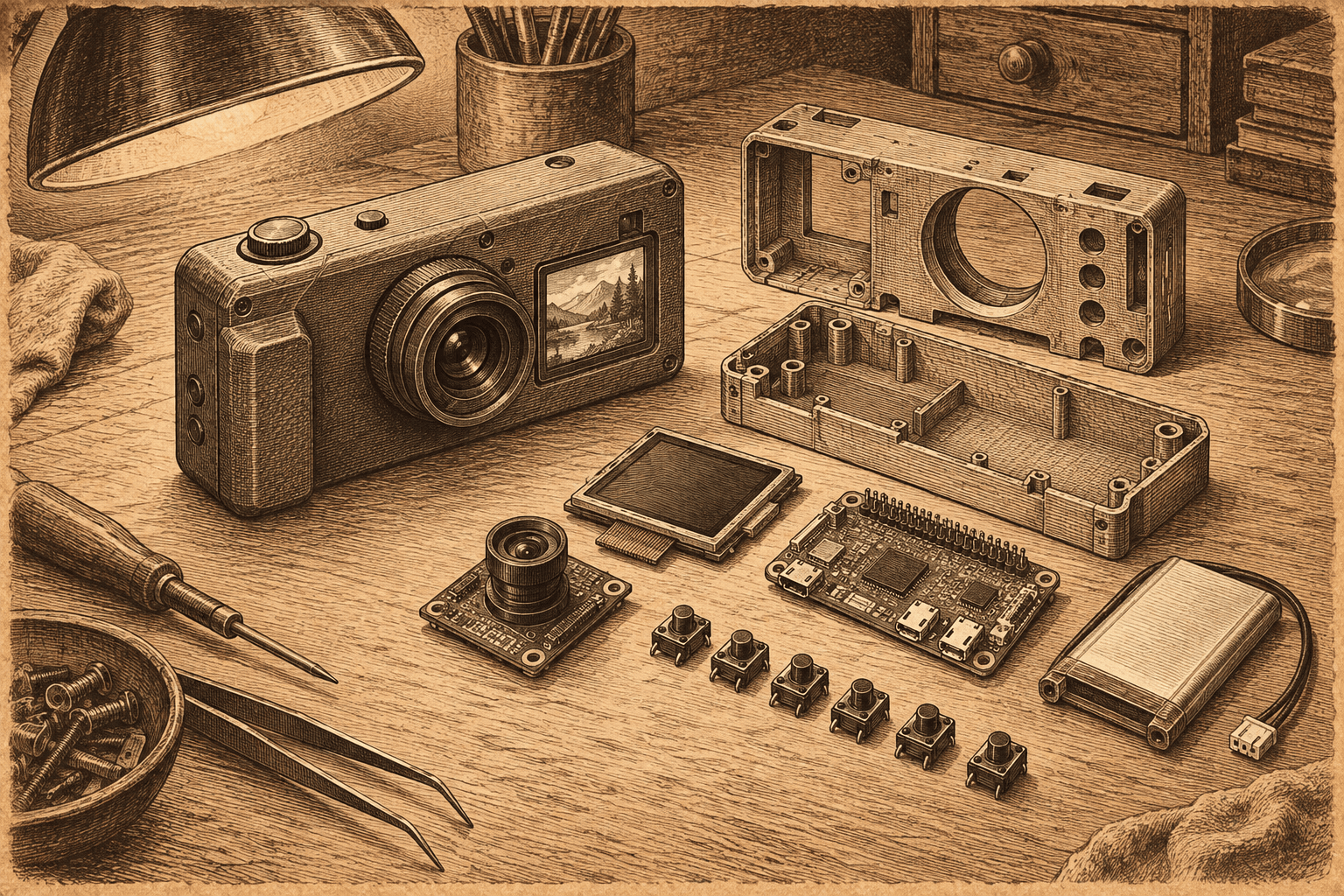
Builds a tactile digital camera around a Raspberry Pi Zero 2 W, an autofocus sensor, a small viewfinder, and mechanical-switch controls while publishing the software and printable hardware files.
Visit SATURNIXOriginal editorial concept art generated with built-in Codex Image Gen for The Machine Press, 2026-09-13.
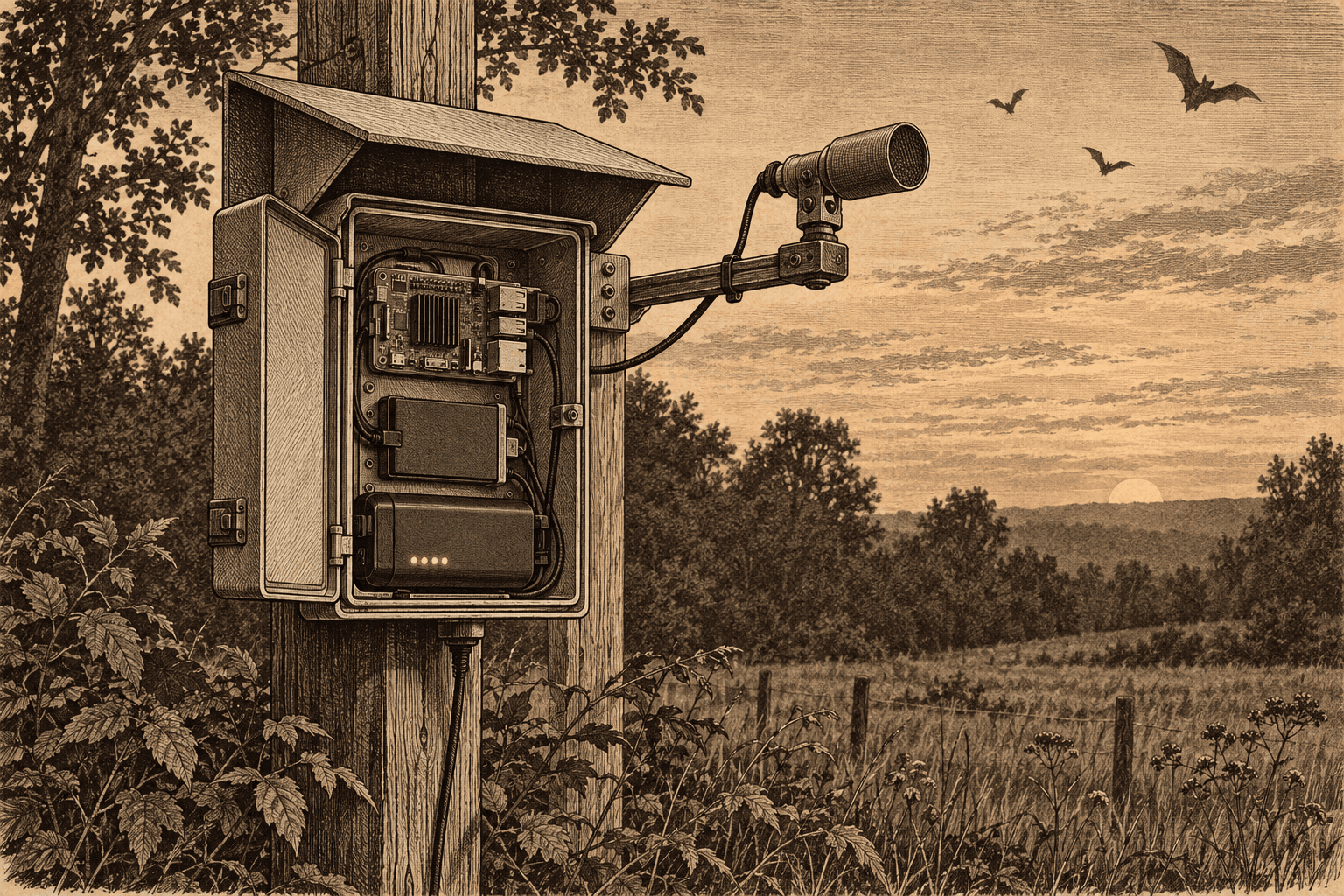
Combines a Raspberry Pi-class computer, an ultrasonic microphone, local storage, and a web interface into a modular recorder for active or unattended bat monitoring.
Visit WURB-2026Original editorial concept art generated with built-in Codex Image Gen for The Machine Press, 2026-09-13.
BuilderOceanography for Everyone core team and contributors
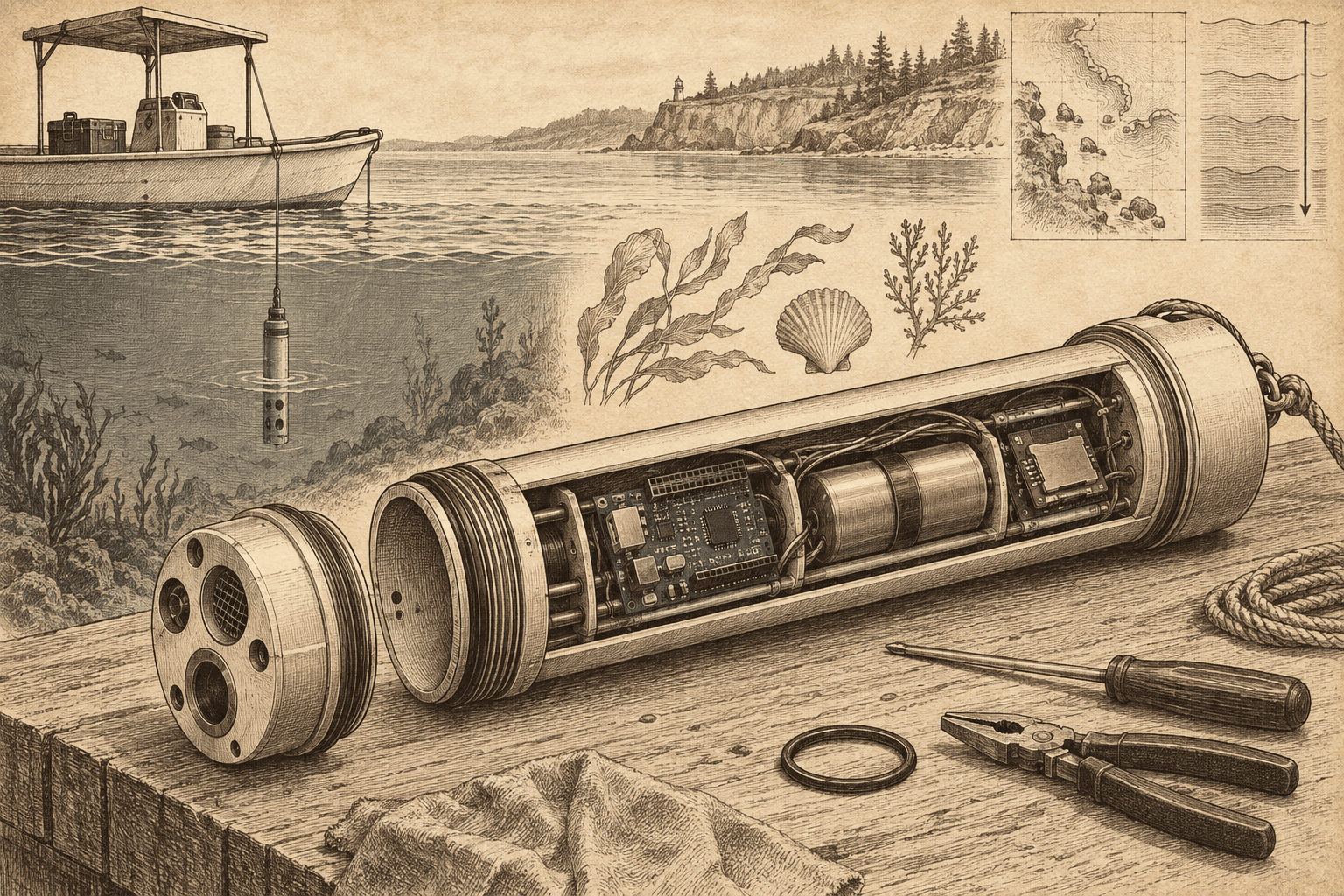
Packages conductivity, temperature, and depth sensors with an Arduino-compatible controller, battery, and SD storage inside a user-built housing for nearshore research and education.
Visit OpenCTDOriginal editorial concept art generated with built-in Codex Image Gen for The Machine Press, 2026-09-13.
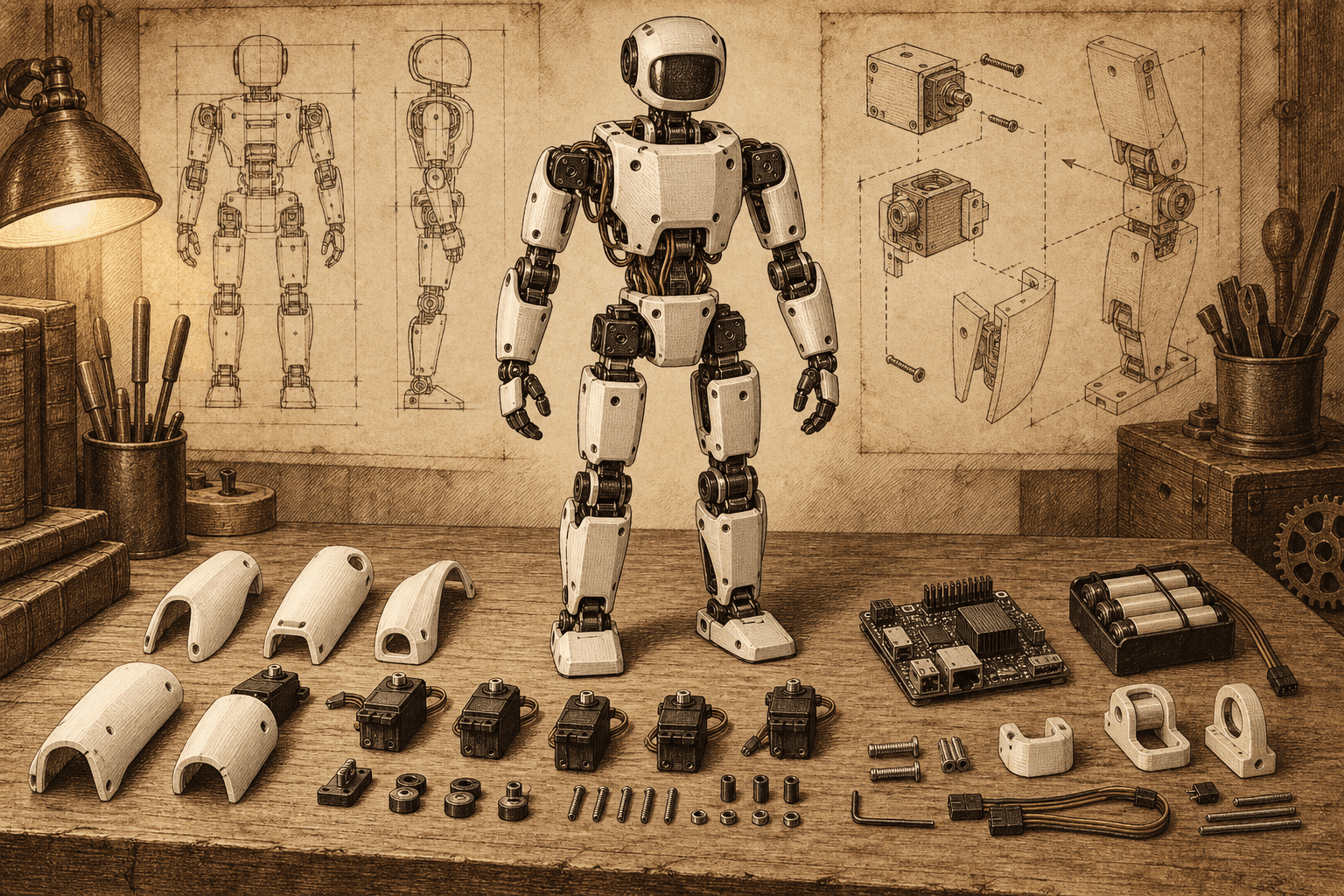
Turns printable body parts, nineteen servomotors, a Raspberry Pi Zero 2 W, batteries, and shared control software into a compact humanoid platform for hands-on robotics work.
Visit MicrobanOriginal Codex Image Gen concept art from 2026-07-10; carried forward from the validated 2026-09-12 edition.
Desk Picks are selected by the newsroom. Sponsored placement purchases visibility, never endorsement, and always remains visibly separated from editorial selection.
 Editorial illustration