safety security
The Non-Abelian Lock Still Broke Into Small Pieces
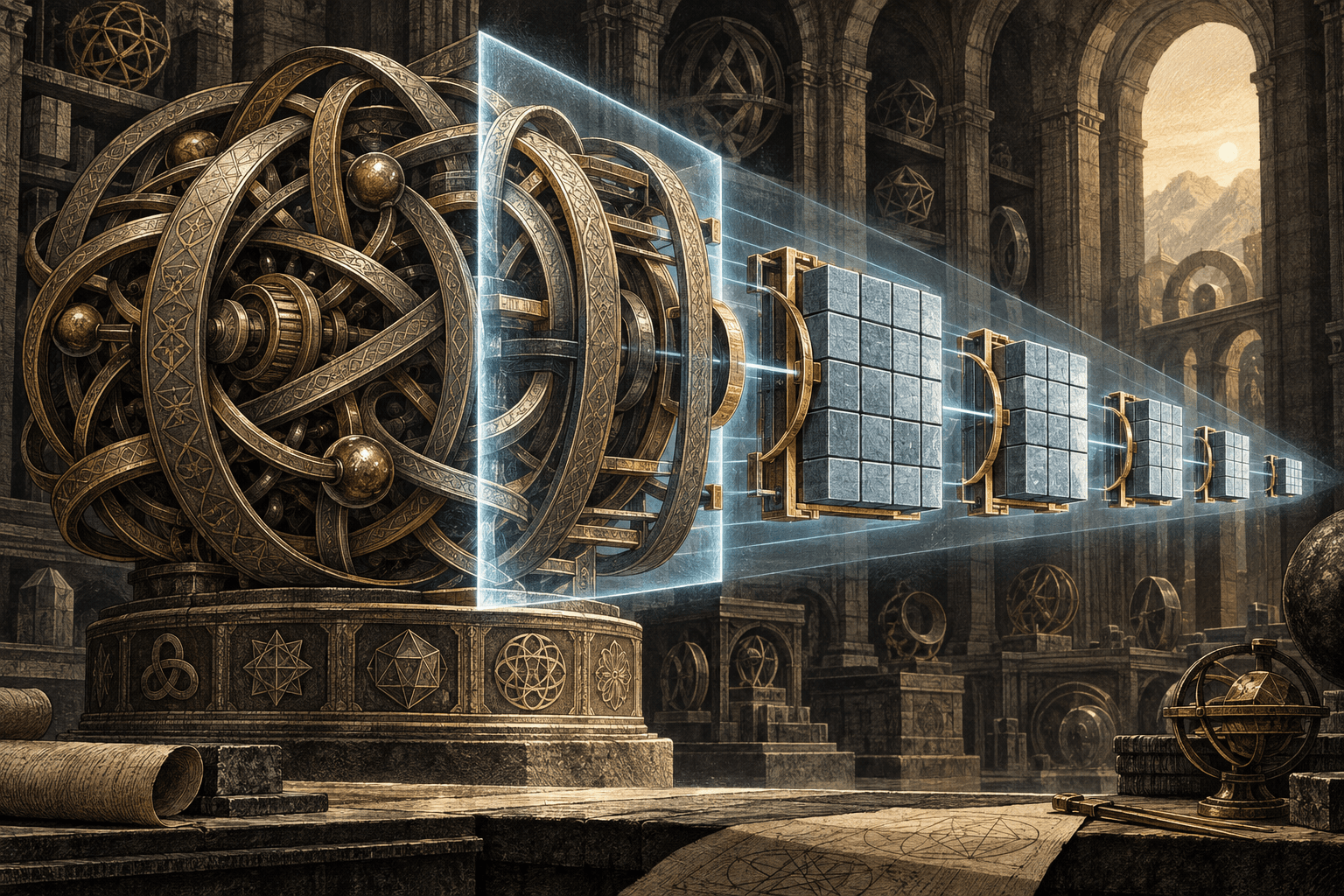
A Fourier change of basis reduced group-ring unit inversion to matrix blocks, making dihedral constructions polynomial-time despite their non-commutativity.
Summary
A Fourier change of basis reduced group-ring unit inversion to matrix blocks, making dihedral constructions polynomial-time despite their non-commutativity.
Some public-key proposals moved from abelian to non-abelian group rings after a quantum attack, expecting the harder dihedral hidden-subgroup problem to provide protection. This preprint argues that unit inversion does not require solving that problem. When a semisimple group ring has an efficient generalized Fourier transform and its largest representation block is polynomially bounded, a change of basis splits inversion into manageable matrices. Dihedral groups meet those conditions because their irreducible representations have dimension at most two. The author supplies an explicit reversible block-inversion circuit and simulator results. This is a preprint cryptanalysis of a construction class, not evidence that broadly deployed encryption has been broken.
Why it matters
A Fourier change of basis reduced group-ring unit inversion to matrix blocks, making dihedral constructions polynomial-time despite their non-commutativity.
Limits and context
- This preprint argues that unit inversion does not require solving that problem.
- This is a preprint cryptanalysis of a construction class, not evidence that broadly deployed encryption has been broken.
Key claims
A Fourier change of basis reduced group-ring unit inversion to matrix blocks, making dihedral constructions polynomial-time despite their non-commutativity.
Qualification: This preprint argues that unit inversion does not require solving that problem.
Evidence: source-2026-09-13-001
Sources
- arXiv preprint 2609.10596arXiv · primary research
Corrections
No corrections have been recorded for this story.