Continual Search lifted GPT-5.5 root-cause F1 from 0.349 to 0.498 on 50 human-annotated, long-horizon agent failures.
Editorial illustration
Concept illustration: continual search revisits a long execution trace to connect sparse evidence with an agent failure; it is not a benchmark plot or documentary scene. Original editorial illustration generated with built-in Codex Image Gen for The Machine Press, 2026-09-15.
Long agent runs can bury the decisive evidence hundreds of actions away from the visible failure. A one-shot judge may settle early on a diagnosis that sounds plausible while leaving most of the trace unexplored. Continual Search instead asks the judge to keep looking across successive turns for unresolved evidence. Across four existing root-cause benchmarks and the new 50-trial MegaRCA-Mix set, the authors report consistent gains; on MegaRCA-Mix, GPT-5.5 F1 rose more than 40%, from 0.349 to 0.498. The benchmark is research evidence, not proof that automated diagnosis can replace production incident review.
Concept illustration: a reachability critic gates a robot policy near an unsafe region; it is not a test photograph or paper figure. Original editorial illustration generated with built-in Codex Image Gen for The Machine Press, 2026-09-15.
A reachability-based safety critic cut cumulative safety cost 57% on average while improving task success by 0.13 over SafeVLA.
Safety fine-tuning for vision-language-action models often treats violations as a soft penalty, forcing one objective to trade reward against risk. ShieldVLA instead learns a model-free approximation of a Hamilton–Jacobi reachability value function from visual observations. The critic separates ordinary reward optimization inside the feasible region from recovery behavior near unsafe states; rubric-based vision-language scores provide training targets without dense manual cost labels. Across five navigation and manipulation benchmarks and multiple VLA backbones, the authors report 57% lower cumulative safety cost on average and a 0.13 gain in task success over SafeVLA. Those benchmark results do not constitute a formal guarantee for an untested physical deployment.
Population fits identify 3C 66B and Mrk 501 as promising individual gravitational-wave targets and forecast tens of SKAO detections.
A population model fitted to NANOGrav’s 15-year data asks whether electromagnetically identified supermassive-black-hole binaries occupy the rare loud tail of the gravitational-wave distribution. The analysis finds that 3C 66B and Mrk 501 are likely to stand out from the unresolved background, with 3C 66B robustly detectable in the authors’ Square Kilometre Array Observatory forecast. The same models predict tens of individually resolvable binaries and suggest their abundance could distinguish environmental hardening from purely gravitational-wave-driven evolution. These are model-based forecasts, not detections.
Generic code-screen file image, used illustratively; it does not depict ZGCM-1, its training code, data, checkpoints or benchmark results. Markus Spiske / Pexels; cropped, resized, metadata stripped, and converted to WebP by The Machine Press.
ZGCM-1 reports a 4.2-fold improvement in 16K pretraining time-to-loss and releases weights, checkpoints, code, data recipes and logs.
ZGCM-1 is a dense seven-billion-parameter foundation model built around the claim that compact models should combine internal reasoning with external tool use instead of trying to memorize the open web. Its recipe mixes sliding-window and full attention, FP8 Muon optimization, progressive context scaling to 256K and interaction traces recast as Markov decision processes. The team reports roughly 4.2× better 16K pretraining time-to-loss and competitive results against larger models on selected math and agentic-search suites. It also releases stage-by-stage weights, checkpoints, code, data recipes and experiment logs; independent replication remains necessary.
Across 446 pairwise comparisons, a two-stage Bayesian-optimization strategy won 72.9%, tied 21.1% and lost 6.1%.
Multi-objective Bayesian optimization normally tries to approach the Pareto front and preserve diversity at the same time. Under tight evaluation budgets, the authors argue that this split attention can prevent either goal from succeeding. Their converge-then-diversify strategy first drives the search toward a single Pareto point, then spreads solutions across the front. Two implementations based on standard acquisition functions statistically outperformed state-of-the-art methods in 72.9% of 446 pairwise comparisons, tied in 21.1% and lost in 6.1%, with the largest gains in tight-budget and high-dimensional settings.
Iterative judge feedback helped a low-reasoning drafting agent approach a costlier agent, but attorney agreement varied sharply with the metric.
Vibe Patenting tests an agent that drafts patents and a separately invoked language-model judge that critiques each revision. Judge-guided iteration consistently raised judge-assessed quality, while unguided revision saturated; a lower-reasoning agent approached the score of a more expensive high-reasoning configuration. A professional patent attorney’s review found meaningful agreement with the automated judge, but calibration and agreement changed substantially by metric. The result supports structured critique as an optimization signal while warning that self-scoring is not a substitute for qualified legal judgment.
Zero-shot language-model agents matched reinforcement learning under familiar weather and adapted better after the environment shifted.
Long-horizon physical management requires an agent to observe, act and recover as conditions change. This study combines planning, tool use, observation and verification in a multi-agent framework and tests it on agricultural management tasks against reinforcement-learning agents. Under the same weather pattern, the zero-shot language-model agents achieved comparable management outcomes; when evaluated after a weather shift, they adapted more effectively than the trained RL policies. The result is a controlled feasibility study, not evidence that general language agents can safely manage farms without domain controls or human oversight.
LabAgent recorded executable skills and corrective experience, reproduced a published figure and led tested generalist agents in four life-science domains.
When students leave a lab, tacit fixes and fragile procedures can disappear with them. LabAgent packages methods as executable, verifiable skills and records corrections so later attempts can avoid the same failure. The authors applied it to drug-property prediction, biomedical analysis, protein-variant effects and statistical genetics, reporting first place over tested commercial generalist agents in each domain and successful reproduction of a published figure. The evaluation supports institutional memory as an agent design goal, but broad scientific reliability still depends on transparent protocols and independent reproduction.
The National Archives server-room file image, used illustratively; it does not depict TimeThink, its synthetic time series, training run or benchmarks. The National Archives (UK), via Wikimedia Commons, CC BY 3.0; cropped and converted to WebP by The Machine Press.
TimeThink trained only on generated time-series primitives and outperformed strong baselines on synthetic and real-world compositional questions.
Time-series language models can answer familiar questions while failing when trends, seasonality and other temporal primitives must be composed in a new way. TimeThink generates atomic and composite question-answer pairs with deterministic ground truth, then uses reinforcement learning with verifiable rewards to train explicit reasoning. The model was trained only on synthetic data yet outperformed strong baselines on both synthetic and real-world benchmarks in the authors’ experiments. The finding isolates a useful training mechanism; it does not establish clinical readiness for the high-stakes applications that motivate the work.
On 45 Canvas tasks, OdoBot used 44% and 80% fewer tokens than two agent baselines while beating one on task success.
Conventional web agents repeatedly inspect an interface and reason about low-level interactions. OdoBot instead builds an application behavior model from successful demonstrations, then uses that reusable structure to execute natural-language tasks. On 45 tasks in the Canvas learning-management system, the authors report 44% fewer tokens than Agent-E and 80% fewer than WebVoyager, while also surpassing WebVoyager’s task-success rate. The evaluation is limited to one application and task set, but it suggests that explicit behavior models can replace a costly share of repeated visual reasoning.
Fraglingo jointly predicts fragment identity and attachment and generalized to inference libraries four times larger than its training vocabulary.
Fragment-based molecular generators often choose a fragment from a fixed vocabulary and predict its attachment separately. Fraglingo represents both decisions in one attachment-aware continuous embedding, retrieves the next fragment by nearest-neighbor search and encodes the growing molecule from its active attachment site. Because inference operates over embeddings rather than fixed identifiers, new fragments can be added without retraining. The authors report stronger joint property control than comparable baselines and generalization to fragment libraries four times larger than the training set. Computational benchmarks do not establish laboratory synthesis or drug efficacy.
AutoTailor’s final tool set reached 90.6% correctness with fallback while cutting request tokens 57.8% and latency 29.4%.
Tool-discovery systems can leave web agents with hundreds of redundant, badly sized APIs. AutoTailor converts successful trajectories into parameterized browser programs, filters them for granularity and likely use, then watches outcomes to add missing capabilities and prune unused ones. On 106 WebArena Postmill tasks, offline filtering reduced 1,283 candidate APIs to 87 and dynamic reselection produced 33. With ReAct fallback, the final set achieved 90.6% correctness versus 87.5% for ReAct alone while reducing request-token cost 57.8% and latency 29.4%.
A live robot-to-VR link averaged 29.63-millisecond state updates and 2.28% route-progress error over 20 trials.
Passenger-facing autonomous-vehicle studies often use simulated motion or scripted scenes. This framework links a physical ROS 2 robot vehicle to a Unity application on a VR headset, transmitting state and onboard video separately so the virtual vehicle mirrors real motion and exposes navigation decisions. Across 20 closed-loop trials, the authors report 29.63 ms mean state-update latency, 2.28% mean relative route-progress error, 10.006 video frames per second and 0.25% frame loss, with all monitored decisions reflected correctly. The laboratory-scale setup demonstrates synchronization, not passenger trust or road deployment.
NASA OSAM-1 robotics file image, used illustratively; it does not depict the construction installer, simulated assembly setup or reported results. Use does not imply NASA endorsement. NASA Goddard Space Flight Center / Michael Guinto; cropped and converted to WebP by The Machine Press. Use does not imply NASA endorsement.
With two millimeters of clearance, the simulated assembly pipeline reached 100% seating after 12–15 minutes of takeover supervision.
Precision construction assembly depends on tacit installer knowledge at contact and failure boundaries. This framework starts with teleoperated demonstrations, then records sparse binary takeovers and acceptance-aligned terminal rewards while a temporally abstract policy learns recovery maneuvers. In stress tests with two millimeters of clearance, randomized pose and friction, the simulated system reached 100% autonomous seating after 12–15 minutes of cumulative installer supervision over three hours of online training; the 95% milestone arrived in about 0.5 and 1.5 hours across two experiments. Physical-site validation remains open.
The outcome-centered representation was 288 times smaller than one RGB-D frame and reached 0.876 AUC on 11,979 simulated grasps.
Networked robot arms often transmit dense geometry even when the action only needs a compact prediction of outcomes. This work learns an action-conditioned stochastic bottleneck that preserves outcome distributions rather than reconstructing the whole scene. Across 11,979 simulated grasps on 13 objects, its representation reached 0.876 AUC for lift success versus 0.542 for a reconstructed-geometry wrench score. The 512-byte interface was 288× smaller than one RGB-D frame and ran in 16 ms per CPU decision. Performance on unseen objects weakened before a feedback update, underscoring the remaining generalization gap.
GzDRL synchronized actions directly with Gazebo physics, led tested workstation throughput and transferred a policy to a quadrotor without fine-tuning.
Middleware can make reinforcement-learning experiments in Gazebo nondeterministic and difficult to reproduce. GzDRL moves environment stepping into one process, directly synchronizing agent actions with physics updates to support vectorized, repeatable data collection. The authors report the highest workstation throughput among evaluated frameworks, competitive performance with GPU-accelerated simulators on laptop hardware, multi-agent scaling and reproducible runs. A learned policy was also deployed on a physical quadrotor without fine-tuning. The transfer is one validation case, not a general sim-to-real guarantee.
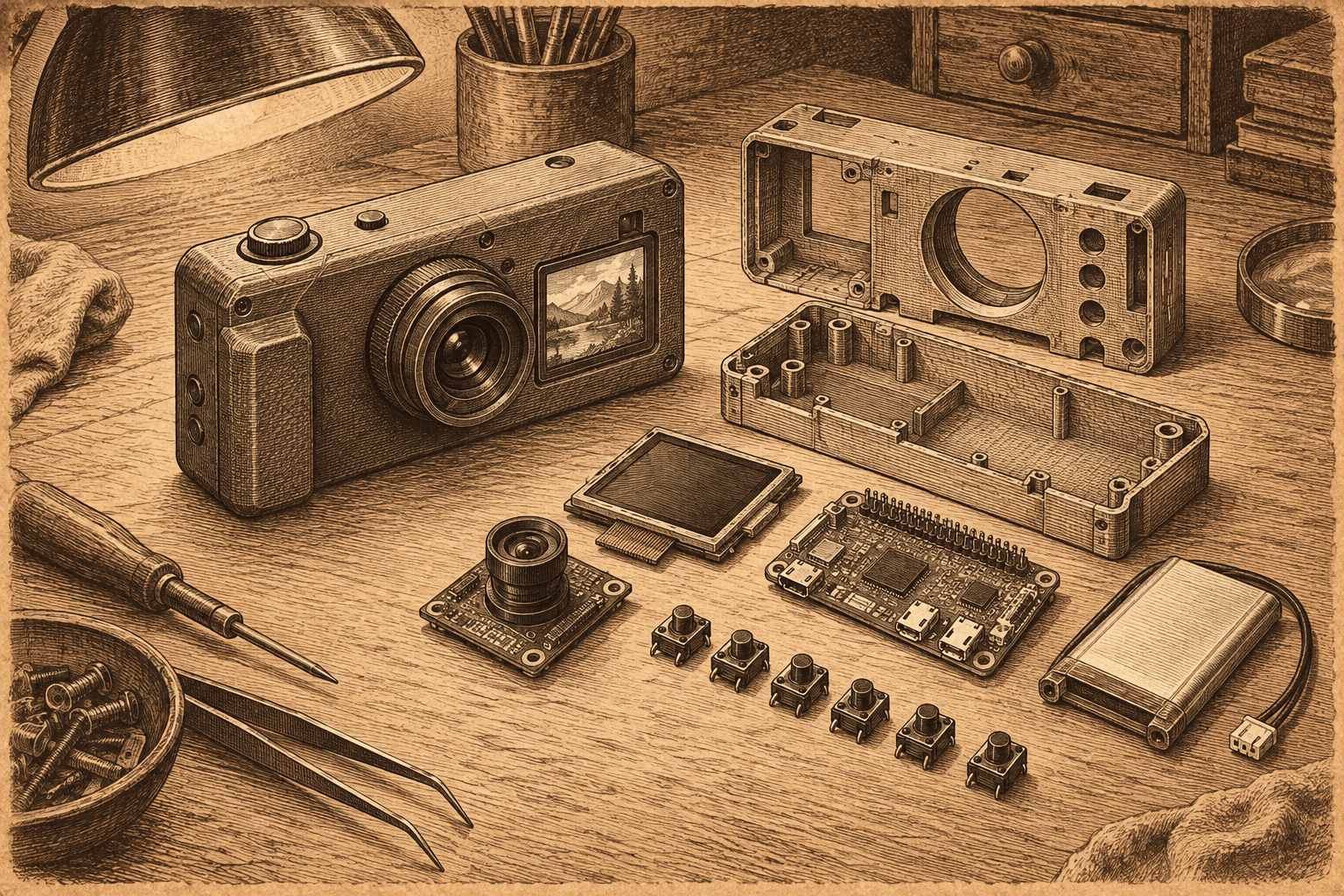
Builds a tactile digital camera around a Raspberry Pi Zero 2 W, an autofocus sensor, a small viewfinder, and mechanical-switch controls while publishing the software and printable hardware files.
Visit SATURNIXOriginal editorial concept art generated with built-in Codex Image Gen for The Machine Press, 2026-09-13.
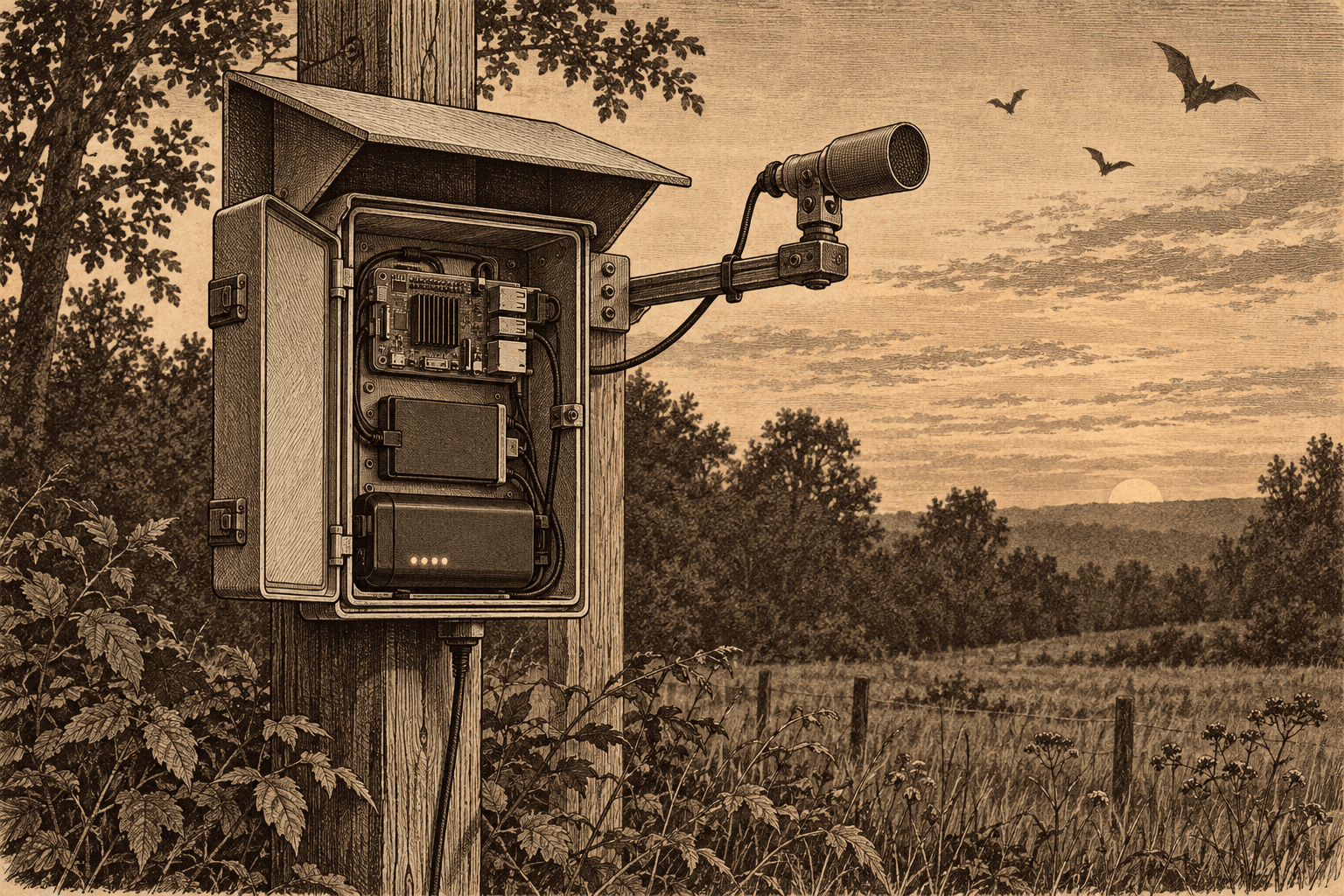
Combines a Raspberry Pi-class computer, an ultrasonic microphone, local storage, and a web interface into a modular recorder for active or unattended bat monitoring.
Visit WURB-2026Original editorial concept art generated with built-in Codex Image Gen for The Machine Press, 2026-09-13.
BuilderOceanography for Everyone core team and contributors
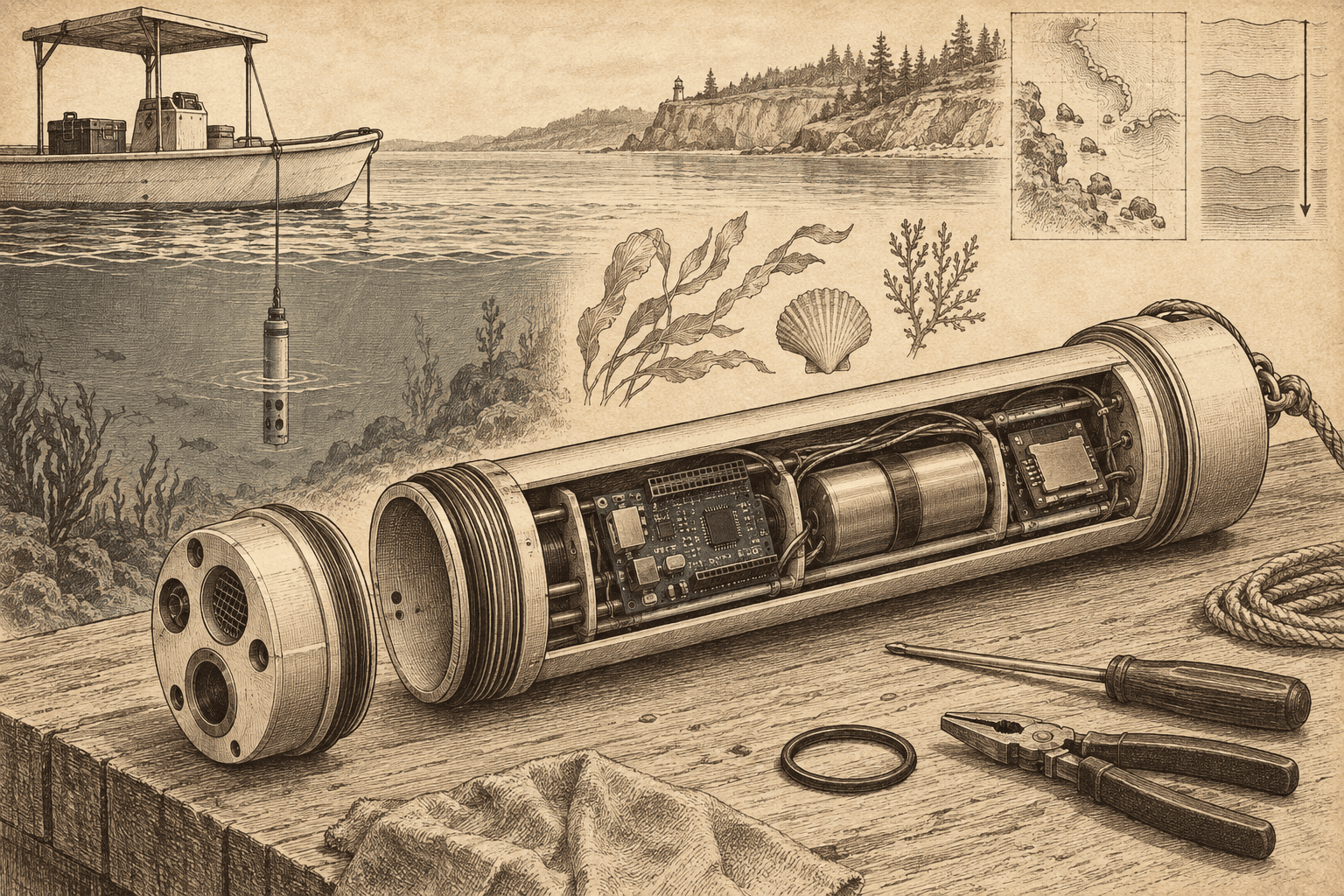
Packages conductivity, temperature, and depth sensors with an Arduino-compatible controller, battery, and SD storage inside a user-built housing for nearshore research and education.
Visit OpenCTDOriginal editorial concept art generated with built-in Codex Image Gen for The Machine Press, 2026-09-13.
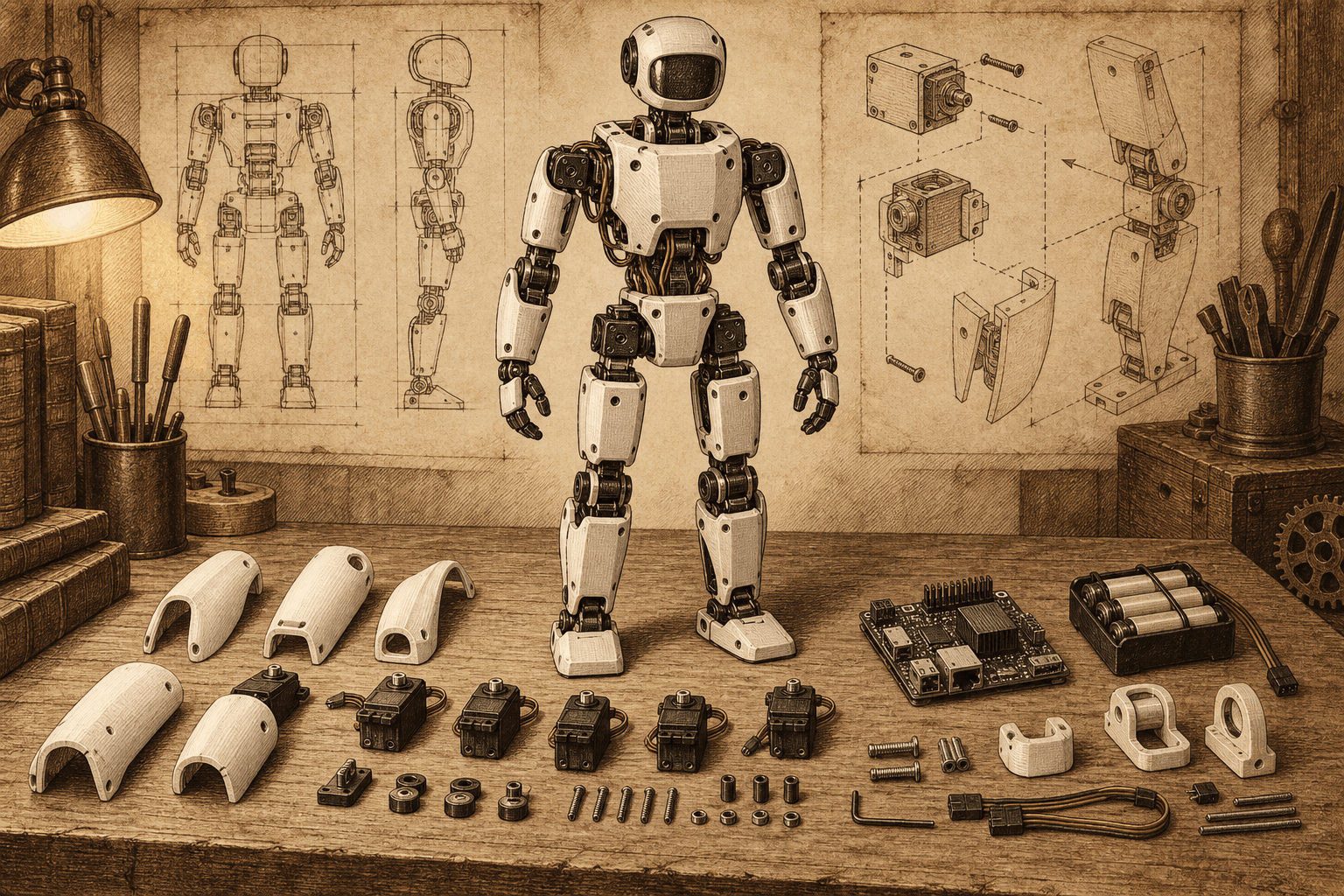
Turns printable body parts, nineteen servomotors, a Raspberry Pi Zero 2 W, batteries, and shared control software into a compact humanoid platform for hands-on robotics work.
Visit MicrobanOriginal Codex Image Gen concept art from 2026-07-10; carried forward from the validated 2026-09-14 edition.
Desk Picks are selected by the newsroom. Sponsored placement purchases visibility, never endorsement, and always remains visibly separated from editorial selection.
 Editorial illustration