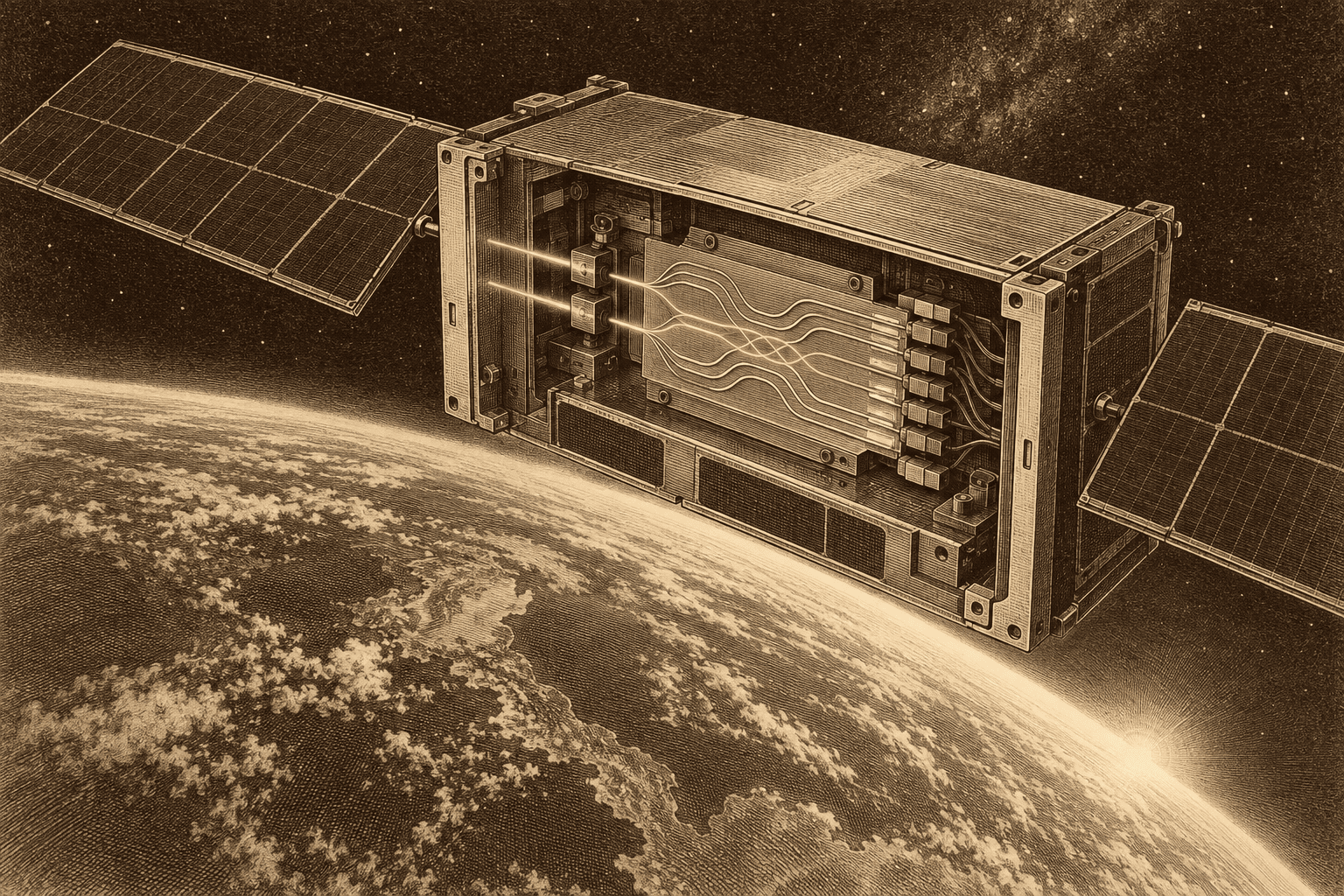
A nanosatellite generated, manipulated and detected non-classical light in a programmable six-mode circuit.
Editorial illustration
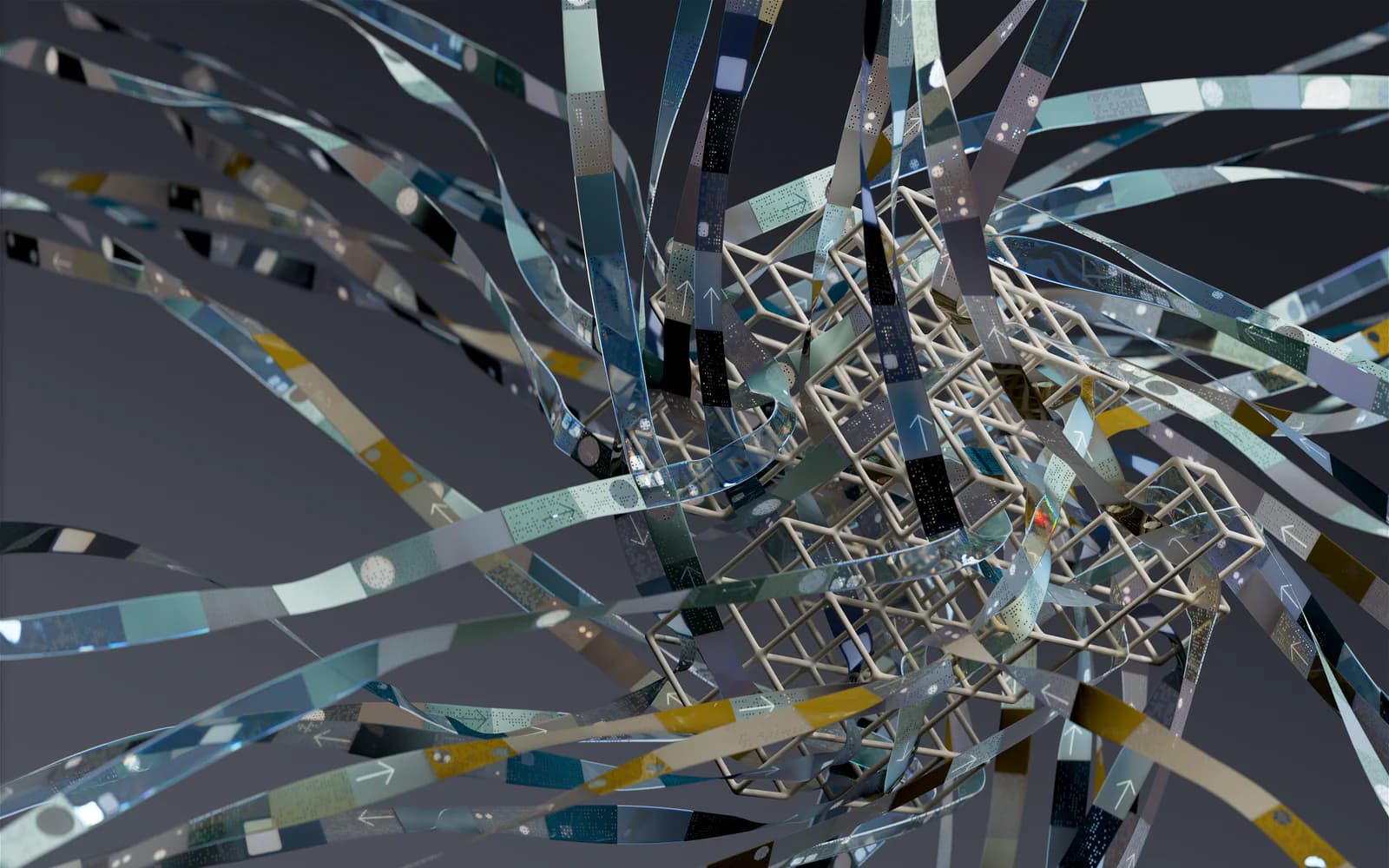
Concept illustration of an in-orbit programmable quantum photonic processor; not the actual nanosatellite, payload or optical layout. Original editorial illustration generated with built-in Codex Image Gen for The Machine Press, 2026-09-23.
Researchers report operating a programmable quantum photonic platform aboard a nanosatellite. The payload processed two photons in a six-mode integrated circuit, programmed distinct optical transformations and tuned the photons into indistinguishability; the observed two-photon interference establishes onboard generation, manipulation and detection of non-classical light. The demonstration moves quantum states of light from orbital communication experiments toward computation, but it is not a claim of general-purpose quantum advantage or a production Earth-observation system.
Concept illustration of a randomized prompt-to-design workflow study; not the actual participants, tasks or software interface. Original editorial illustration generated with built-in Codex Image Gen for The Machine Press, 2026-09-23.
A 100-participant randomized trial found larger gains for product managers than professional designers.
A randomized controlled trial assigned 50 product designers and 50 product managers to three standardized design tasks with or without access to Figma Make, a conversational prompt-to-design system. Among participants who completed the study tasks, tool access was associated with roughly 20% shorter completion times, with larger gains for product managers. The authors say the result suggests non-designers may contribute more to design work while professional-designer benefits depend on the task. The study measures selected tasks and completers; it does not establish universal productivity or design-quality gains.
CliffCompaction reported lower long-horizon cost while avoiding recursive summaries.
CliffCompaction bounds coding-agent context by truncating or dropping original material rather than rewriting it, and each pass starts from original content instead of compacting a prior compaction. The authors report cost reductions of up to 50% while maintaining or improving performance on Terminal-Bench, alongside longer KernelBench runs exceeding one million tokens. Parallel test-time scaling also shifted the reported cost-performance frontier. These results depend on the evaluated agents, benchmarks and pricing assumptions; deletion can still discard information a future step needs.
Generic code-screen photograph used illustratively; it does not depict MCP, the attack framework or a compromised system. Daniil Komov / Pexels; cropped, resized, metadata stripped, and converted to WebP by The Machine Press.
A black-box attack optimized MCP listings and returns to attract calls and steer outcomes.
A2M targets agents that choose Model Context Protocol tools through semantic matching. Its attraction stage rewrites attacker-controlled metadata to raise invocation probability; its manipulation stage refines tool returns from execution traces. On LiveMCPBench, attacks optimized for one model reached a 93.6% macro-average malicious invocation rate across four scenarios, while cross-model transfer was lower. These are benchmark results under a constructed threat model, but they support stronger tool vetting and runtime isolation.
Harness artifacts and compiler flags moved the metric without proving a security fix.
A study of 203 vulnerable C and C++ functions found compile rate to be an unreliable proxy for LLM vulnerability repair. About 64% of compile failures were not attributed to the model, and a compiler-standard flag changed compile rates by 1.8 to 2.7 times on identical patches. A compiler-feedback loop also rewarded deletions and placeholders while similarity to human fixes fell. The authors propose a change-aware screen as a cheap filter, not a substitute for execution-grounded security evaluation.
The first blind survey tracked dense neutral gas across 214,035 quasar sightlines.
A blind survey of DESI Data Release 1 identified 3,636 intervening sodium doublets along 214,035 quasar sightlines over the last roughly three billion years. Injection-and-recovery tests put 50% completeness near a 0.95-angstrom rest-equivalent width and catalog-weighted purity near 77%. In the fiducial sample, absorber incidence rose by about 3.4 times from redshift 0.25 to 0.03. The foreground-galaxy association remains preliminary and awaits dedicated surveys.
The extended stream looked like polar-coronal-hole wind about ten solar radii out.
Near its 23rd perihelion, Parker Solar Probe sampled an extended sub-Alfvénic interval at roughly ten solar radii with speeds mostly above 400 kilometers per second. The authors identify it as the first polar-coronal-hole-like fast stream observed inside the sub-Alfvénic corona. Its turbulence was already developed, strongly transverse and highly imbalanced despite the close distance. The source is inferred as a large equatorial coronal hole rather than directly traced to a polar hole.
Spectra placed the interstellar comet outside the canonical Solar System composition cluster.
High-resolution VLT spectroscopy followed interstellar comet 3I/ATLAS before and after perihelion and measured emissions from water-related OH, NH, CN, C3, CH and C2. The team reports strong depletion of ammonia-related volatiles and carbon-chain depletion, with abundance correlations outside the canonical Solar System comet cluster. Differing water estimates from oxygen lines and OH point to changing coma chemistry. The study extends observed comet diversity; it does not identify the comet's home system.
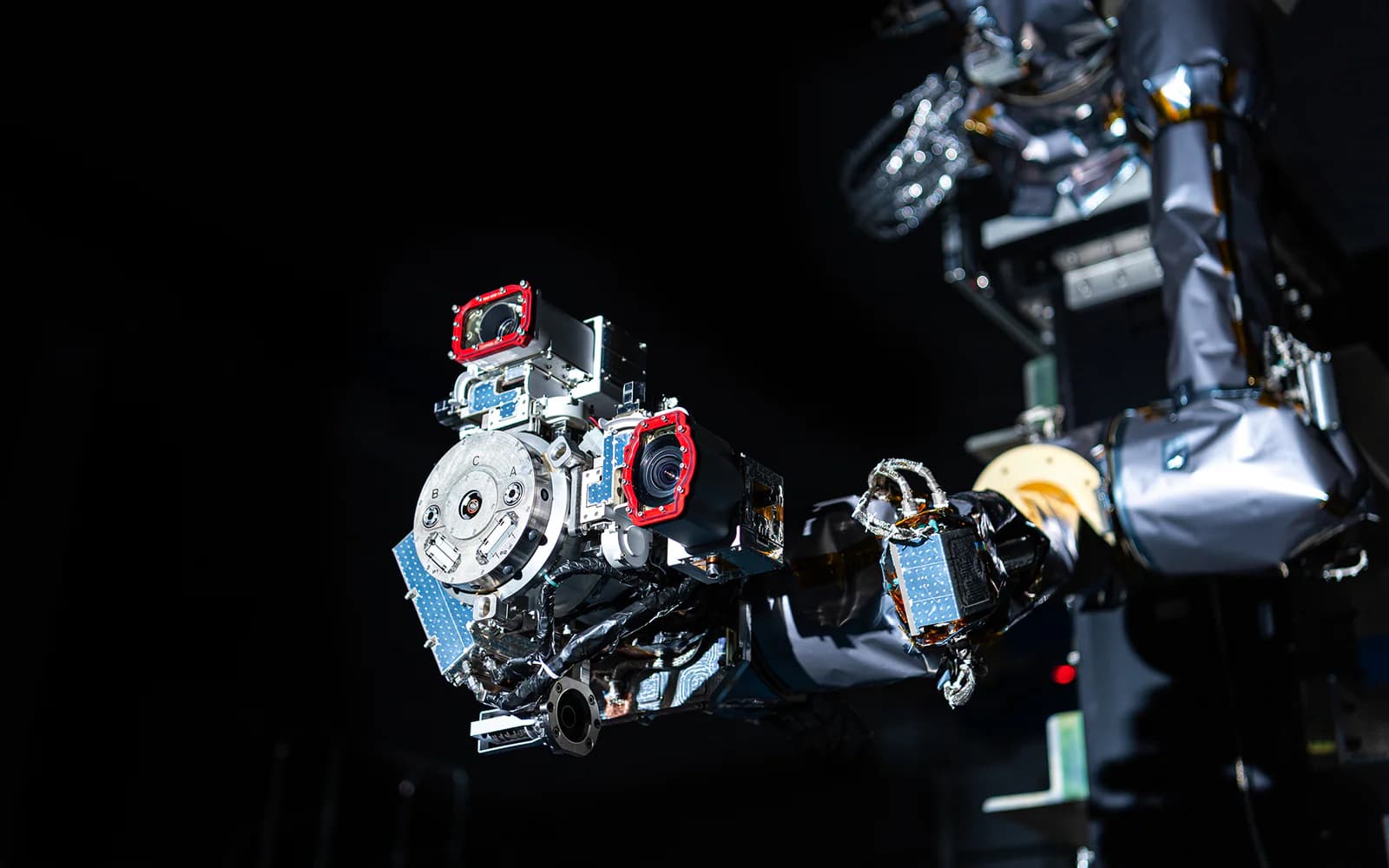
NASA OSAM-1 arm file photograph used illustratively; it does not depict GINIO, its sensors or test robots, and NASA does not endorse this report. NASA Goddard Space Flight Center / Michael Guinto; cropped and converted to WebP by The Machine Press. Use does not imply NASA endorsement.
A rotation-equivariant interface cut unseen-remount error without retraining.
GINIO constrains neural inertial-odometry predictions so motion vectors and uncertainty transform consistently when an IMU is mounted at a new orientation. On the Fetch benchmark, the authors report that unseen physical-remount absolute trajectory error fell from 8.15 meters to 0.50 meters without retraining. Other tested backbones also improved while using fewer operations than one comparison. Results span selected datasets and platforms, not every sensor or motion regime.
Predicting shared-object motion reduced effort in 108 collaborative transport trials.
PROACT combines a learned prediction of human collaborative behavior with compliant whole-body control for carrying a shared object. Across 108 real-world trials with a nine-degree-of-freedom mobile manipulator, it reduced mean interaction work by 59.2% against a compliance-only baseline and 20.4% against model-predictive control. Completion time also fell by 12.9% and 6.9%, respectively. The result applies to the study's dyadic transport tasks and hardware.
Intent confidence alone caused over-helping when autonomous execution was weak.
A shared-control system paired a language model's estimate of human intent with an online estimate of a robot policy's own capability. In a 12-participant pick-and-place and stacking study, capability-aware arbitration reached 92% task success, versus 83% for manual teleoperation, 44% for intent-only arbitration and 10% for fixed equal weighting. The capability signal came from variation in sampled action trajectories. The small, specific study supports the design principle rather than a general safety guarantee.
Jointly denoising actions and future 3D tracks improved bimanual manipulation.
JAMB generates two-arm actions and future three-dimensional point tracks together, letting each evolving hypothesis refine the other. Across 16 simulated tasks, the authors report 83.4% average success, 23.9 percentage points above the strongest evaluated baseline. On three real-world tasks, it beat action-only and auxiliary-geometry methods by 50.0 and 21.2 points. The gains come from the reported task suite and do not establish general dexterity.
Scenes with only one plausible task let embodied policies ignore language.
RoboFollow raises scene entropy by placing multiple valid task branches in one scene, so a policy must distinguish instructions rather than infer the sole available action. Nine evaluated VLA and world-action models that performed well in the easiest setting did not reliably transfer across progressively changed layouts and semantics after fine-tuning. Stronger vision-language backbones and several training adjustments did not close the gap. This is a diagnostic benchmark finding, not a claim that every deployed robot ignores language.
Abstract AI artwork used illustratively; it does not depict φ-RIE, a scanned room or a simulator asset. Tim West / Google DeepMind / Pexels; cropped, resized, metadata stripped, and converted to WebP by The Machine Press.
A Gaussian-splat pipeline separated movable objects while filling their hidden backgrounds.
The φ-RIE pipeline converts selected objects in 3D Gaussian-splat reconstructions into movable simulator assets while preserving the rest of the scene. It couples object extraction with removal and background completion so visual and physical state stay aligned. Across 50 ScanNet++ scenes, selection and registration retry raised matched F1 at 20 millimeters from 0.336 to 0.383 at fixed retention. The work demonstrates executable conversions but also reports a visual cost from editing incomplete observations.
A new metric ranked scenes by policy-relevant fidelity instead of appearance alone.
DreamStream uses a simulator-grounded video model to vary visual appearance while preserving traffic layout and dynamic-object continuity for closed-loop driving tests. Its FDπ metric measures scene similarity through features used by public driving policies; under that metric, the system improved over the strongest evaluated simulator by 1.6 times on nuScenes and 4.7 times on NAVSIM. A new adversarial benchmark exposed scorer bias and weak recovery behavior. These are simulation and metric results, not evidence of safe road deployment.
PAH velocity maps separated rotation from launched material in two starbursts.
JWST/MIRI spectroscopy mapped several polycyclic aromatic hydrocarbon features and gas lines in M82 and NGC 253. In M82, the dust features largely traced a rotating disk; in NGC 253, the 6.2- and 11.3-micron features traced the outflow's launching region. The 11.3-micron feature moved more like ionized than warm molecular gas, while the 6.2-micron feature was faster still. The authors interpret this as evidence that the observed PAHs associate more closely with ionized outflow gas near the base.
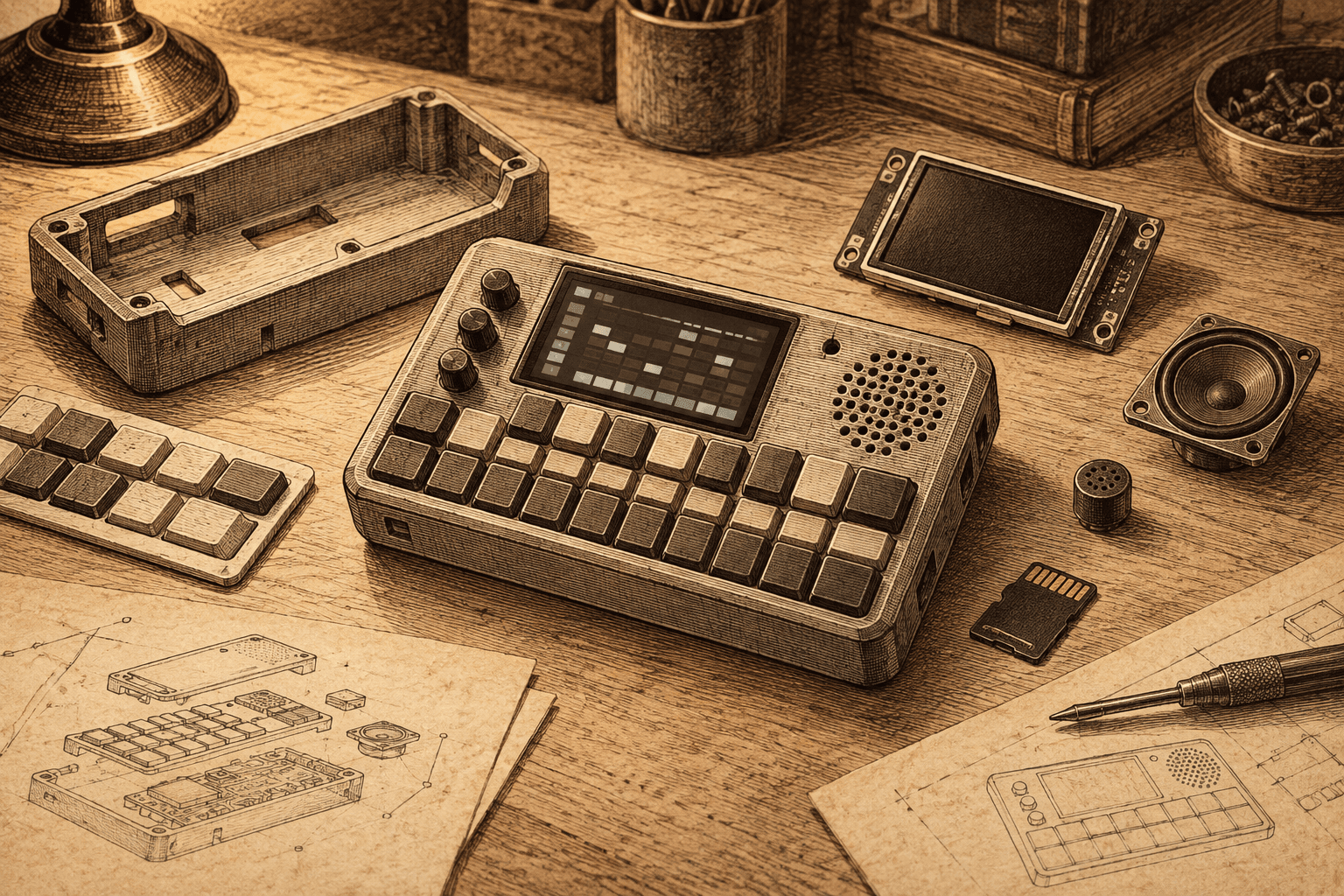
Turns a Cardputer-ADV, a printable shell, and open firmware into a pocket four-track instrument with synthesis, drums, microphone sampling, resampling, and step sequencing.
Visit MicroGrooveOriginal editorial concept art generated with built-in Codex Image Gen for The Machine Press, 2026-09-20.
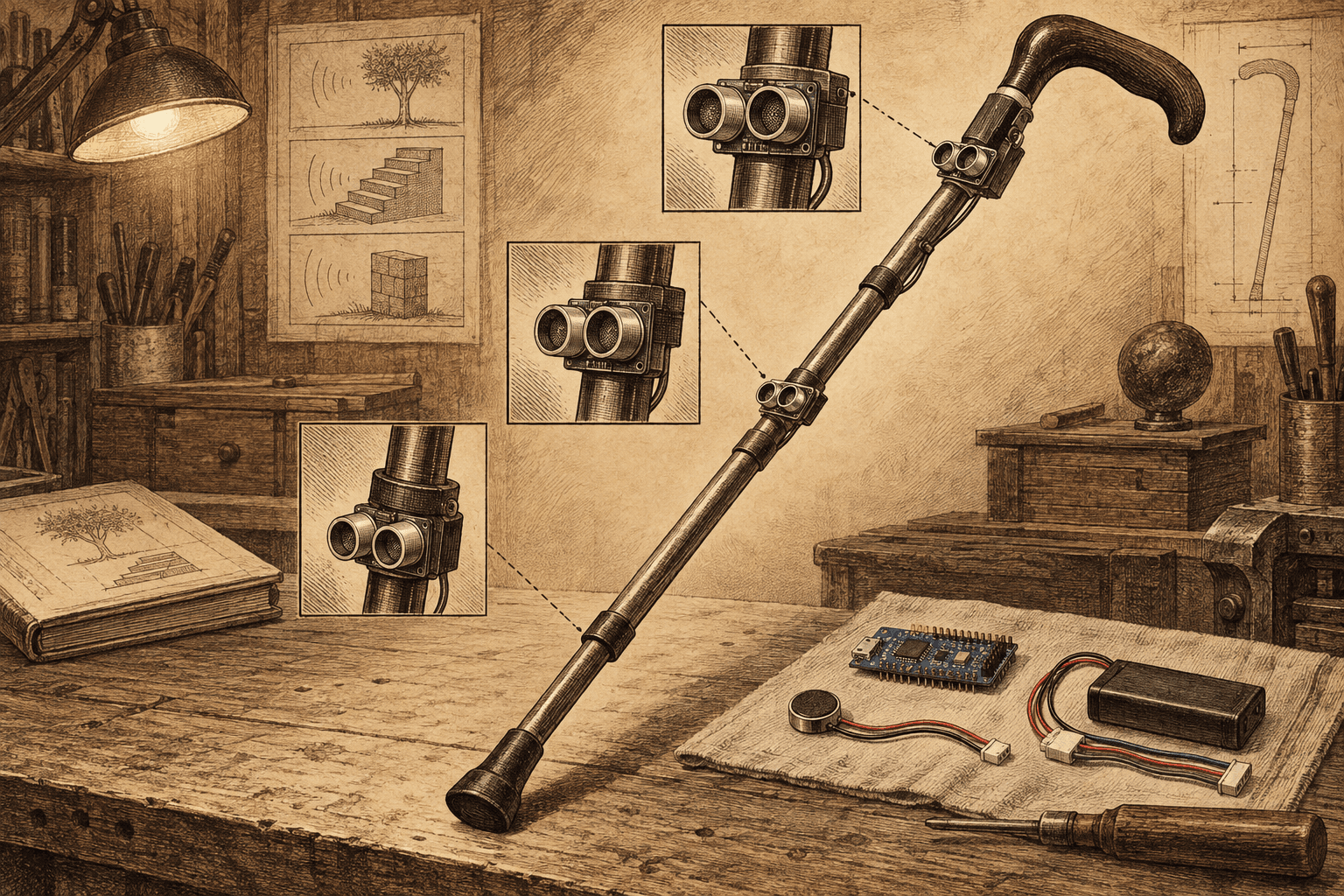
Combines three ultrasonic modules, a small controller, and one vibration motor so a buildable cane prototype can signal obstacles at different heights without audio, an app, or a phone.
Visit Sense CaneOriginal editorial concept art generated with built-in Codex Image Gen for The Machine Press, 2026-09-20.
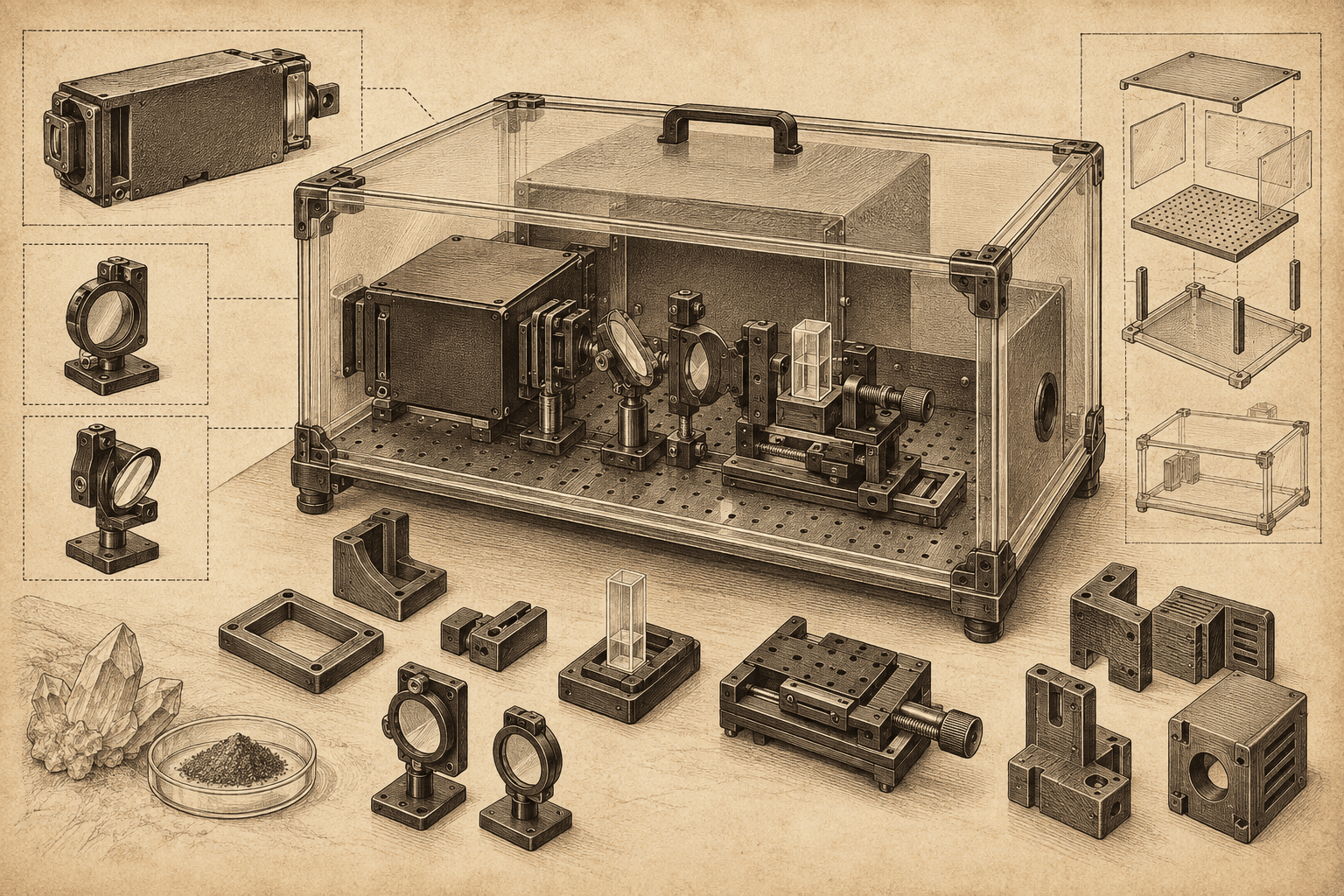
Pairs a surplus spectrometer, filtered 532-nanometer excitation, and printable mechanics in a documented Raman setup for optics education and cautious exploratory materials analysis.
Visit DIYramanOriginal editorial concept art generated with built-in Codex Image Gen for The Machine Press, 2026-09-20.
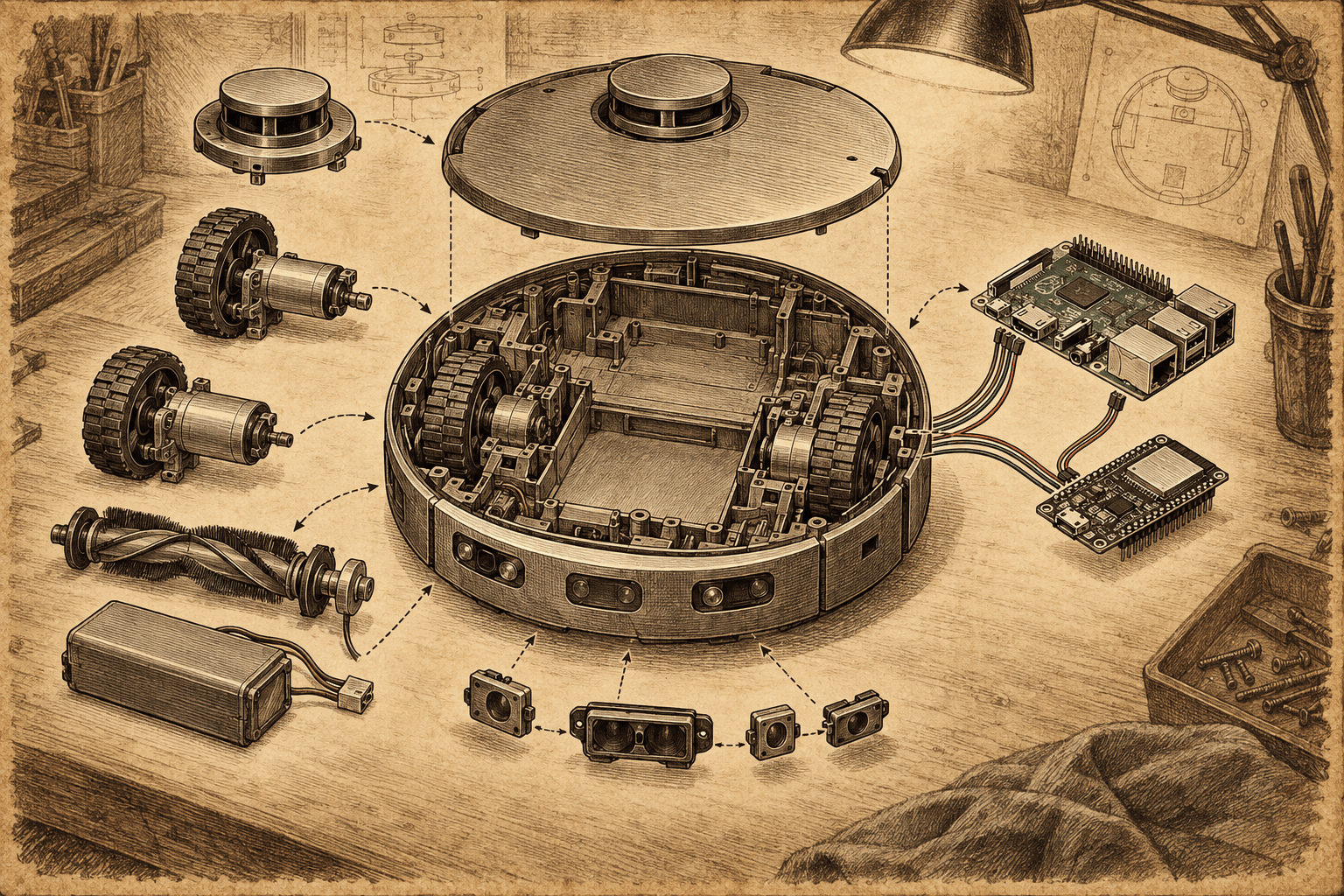
Documents replacing a cloud-disabled robot vacuum's locked control electronics with a Raspberry Pi, an ESP32, and ROS 2 while reusing its chassis, motors, battery, sensors, and lidar.
Visit the build serialOriginal Codex Image Gen concept art from 2026-07-10; carried forward from the validated 2026-09-22 edition.
Desk Picks are selected by the newsroom. Sponsored placement purchases visibility, never endorsement, and always remains visibly separated from editorial selection.
 Editorial illustration