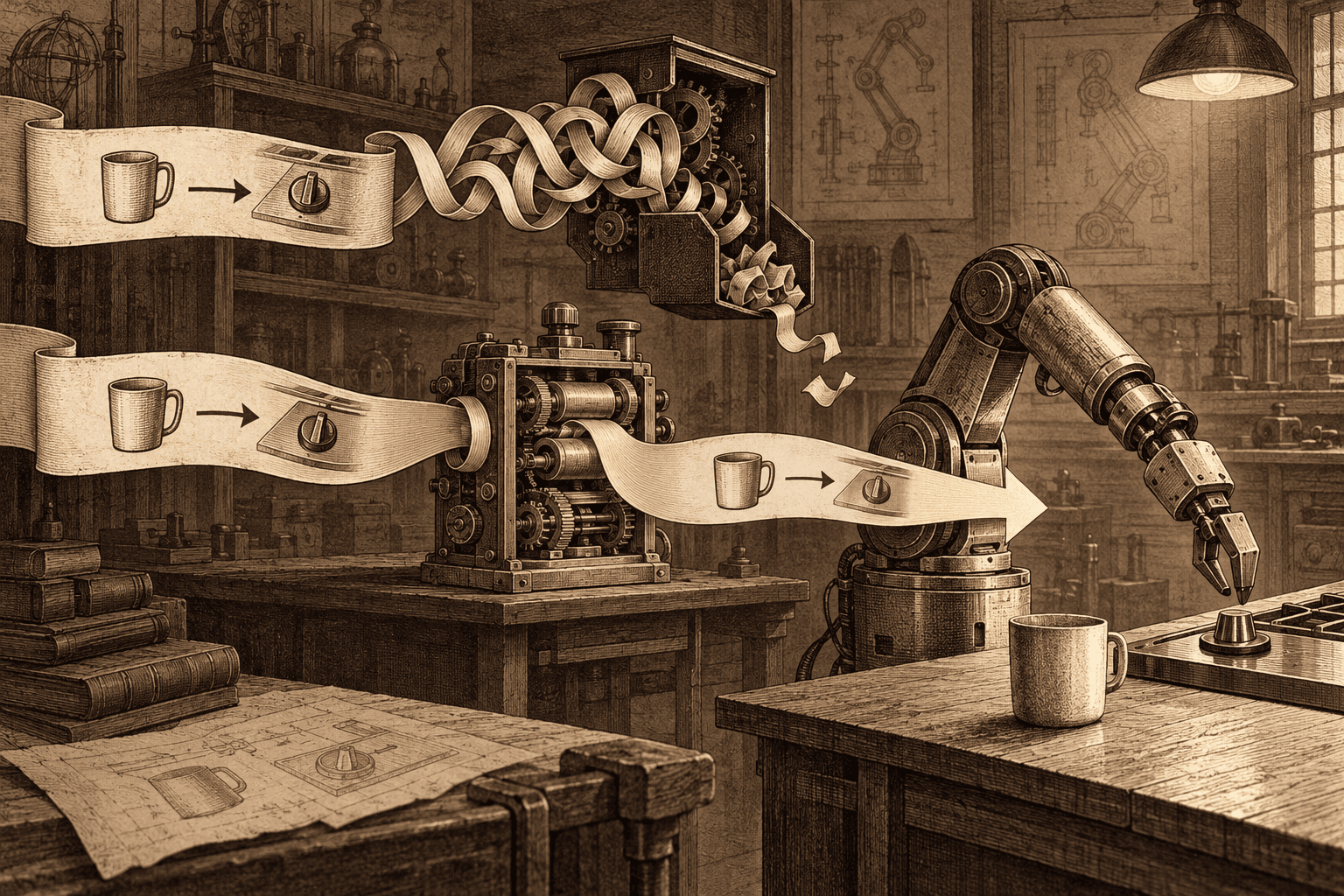
A vision-language-action policy switched on a stove in every trial under one instruction and only 2% under a near-synonym; a one-pass rewriter recovered part of the gap without retraining.
Editorial illustration
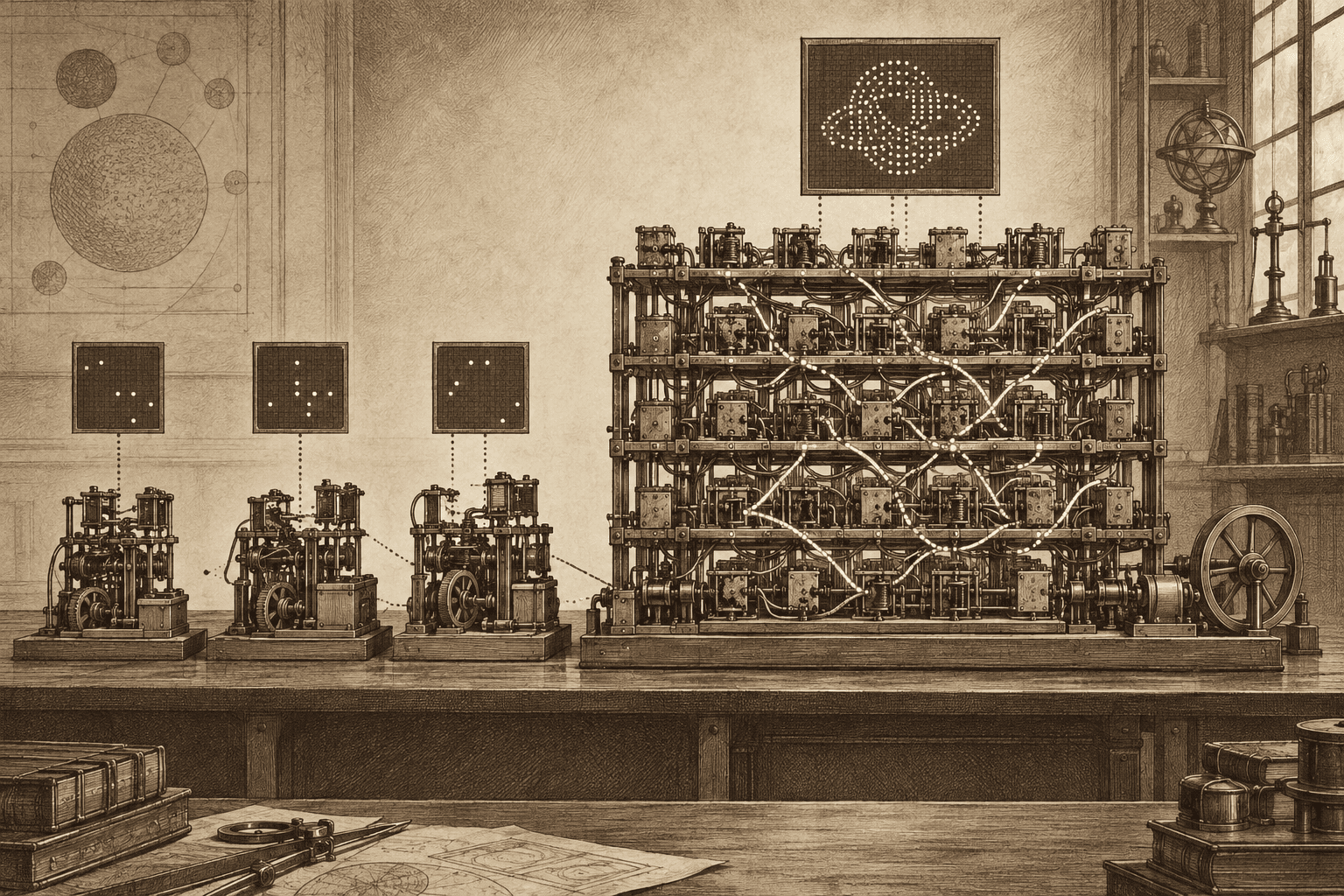
Concept illustration of instruction sensitivity and deployment-time rephrasing; not a tested robot, benchmark scene or system diagram. Original editorial illustration generated with built-in Codex Image Gen for The Machine Press, 2026-10-08.
Language robustness in a vision model does not guarantee language robustness after that model is connected to action. Researchers measured statistically significant single-edit swings in vision-language-action policies: one tested policy completed the same LIBERO stove task 100% of the time for “switch on the stove” and 2% for “switch on the hot plate,” while a rephrase-augmented checkpoint still showed swings as large as 61 points. An oracle search suggested that phrasing alone nearly closed a 21-point in-distribution gap. The proposed mitigation scores alternative instructions on a few training tasks, distills the evidence into rewriting rules and rewrites each incoming command once before the frozen policy acts. Across twelve held-out tasks, the rules improved the tested policy by 16% to 27% relative. This is benchmark evidence, not a general safety guarantee, but it turns wording into an observable control variable rather than user error.
Concept illustration of trained resilience to simulated digital faults; not deployed hardware, a measured circuit or proof of fault tolerance. Original editorial illustration generated with built-in Codex Image Gen for The Machine Press, 2026-10-08.
Training runs on simulated faulty digital hardware suggest that error resilience can rise with model scale, opening a speculative route to lower-energy inference.
Efficient hardware often becomes less reliable as voltage and safety margins fall. A study built modified neural scaling laws from 40,000 GPU-hours of language-model training with simulated digital faults and found that appropriately trained models became more resilient as they grew rather than more fragile. The authors interpret the behavior as learned computation inside good error-correcting codes whose relative overhead need not expand with model size. That interpretation remains a conjecture: the experiments simulate faulty hardware, do not establish formal fault tolerance and do not demonstrate an energy-saving production chip. Yet the result reframes the systems bargain. Instead of forcing every transistor to behave perfectly and treating model computation as brittle, future hardware and training might divide the reliability work between them. The immediate contribution is evidence that scale can absorb faults under training—not proof that unreliable accelerators are ready for deployment.
BehaviorTrace planted a known learned behavior and found that simple confounds often matched targeted rollout-attribution scores.
BehaviorTrace asks which online reinforcement-learning rollout taught a model a known planted behavior. Across three Qwen2.5-1.5B seeds, a control that ranked training steps only by gradient magnitude reached 4.2 to 4.5 times chance and matched or beat the best targeted estimator on two seeds. At saturated checkpoints, fluency predicted the behavior label at least as well as every compared gradient method. After controlling for fluency, per-rollout findings changed across seeds and generation draws; only trigger-token gradient alignment held consistently. The study proposes no replacement estimator. Its contribution is a stricter evaluation harness and a warning that plausible attribution maps can be driven by update size or fluency rather than the behavior being traced.
Conceptual Visualising AI artwork used illustratively; it does not show Ledger, egocentric video, a 3D object map or reported result. Tim West / Google DeepMind / Pexels; cropped, resized, metadata stripped, and converted to WebP by The Machine Press.
A persistent 3D ledger retained locations, histories and context after objects left view, lifting accuracy on three egocentric-memory tests.
Ledger associates object observations across egocentric video, clusters each object by resting location and records a move only after repeated evidence, reducing false changes from localization noise. It also stores short descriptions such as contents or supporting surfaces and can answer later questions without reopening the original video. The authors report accuracy rising from 29.7% to 42.6% on HD-EPIC and from 33.8% to 38.5% on UCS-Bench, with 0.99-meter median localization error for returned Ego4D objects. Performance fell across stitched multi-scene streams, and per-scene construction recovered only part of that loss. The work makes persistence a first-class component of embodied memory: what matters later may be something the wearer merely passed.
Exploration-Distillation separated novelty-seeking policies from the student that ultimately learned their filtered successes.
Novelty bonuses can push reinforcement learning with verifiable rewards toward new solutions, but they can also damage behavior that sparse task rewards cannot restore. Exploration-Distillation trains separate explorer policies with novelty incentives, filters their trajectories for correctness and quality, and distills the survivors into a student trained without the bonus. Repeating that cycle lets exploration become aggressive without making the deployed student absorb every experiment. Across seven mathematics benchmarks and two model families, the authors report better results than DAPO at the same wall-clock budget and stronger pass-at-k scaling, indicating more diverse correct solutions. The paper's operational point is broader than math: exploration and optimization need not occur in the same policy at the same time.
Sparse traces, target points and directions altered actions in noise space without changing the base policy architecture.
RoboPrompt translates intuitive human guidance into an action draft, then lets the base diffusion or flow-matching policy refine that draft through its normal generation dynamics. The reusable steering module worked across Diffusion Policy, pi-0.5 and FastWAM without policy-specific architectural changes or steerability fine-tuning. The researchers then used corrected rollouts for DAgger-style improvement. After two or three rounds, average success increased 15.5% for pi-0.5 across three tasks and 21.3% across three policies on an Insert Bread task, while intervention counts fell by 44.0% and 81.9% in the respective comparisons. The tested settings are limited, but the interface makes occasional human intent a lightweight input rather than a full teleoperation session.
EngramEdit changed conditional n-gram memory while leaving the Transformer backbone fixed and penalizing broadly shared embeddings.
Conditional-memory models look up learned embeddings from input n-grams, creating a possible place to update facts without rewriting a model's general computation. EngramEdit first finds target memory representations that produce the new fact across several phrasings, then jointly updates the shared embeddings while penalizing changes to frequently reused entries. The authors report near-perfect edit success, transfer to unseen expressions and multi-hop reasoning, and almost three times the strongest comparison's chain-of-thought accuracy. Unrelated knowledge and general capabilities were largely preserved as edits accumulated in the reported tests. That does not settle open-world model maintenance, but it turns a scaling component into a concrete interface for decoupled knowledge updates.
Fault-counting matched finite differences while using one to two orders of magnitude fewer surface-code shots at the same variance.
Quantum error budgets usually vary each physical noise parameter and rerun simulations to estimate how logical failure responds. This work derives a differentiable estimator that extracts every component of that gradient from one Monte Carlo data set by retaining information about the underlying fault configurations. In circuit-level surface-code simulations, the estimator agreed with conventional finite differences while requiring ten to one hundred times fewer shots for comparable variance. The authors use it to resolve sensitivities down to individual qubits, infer effective code distance and trace threshold contours in multidimensional noise models with Newton updates. The evidence is simulation, but the method could make detailed error-budget diagnosis much cheaper.
NASA OSAM-1 hardware used illustratively; it does not depict Long-WAM, the tested robots, tasks, context window or results. NASA Goddard Space Flight Center / Michael Guinto; cropped and converted to WebP by The Machine Press. Use does not imply NASA endorsement.
Long-WAM gained from longer context only when its video foundation had learned causal prediction rather than bidirectional reconstruction.
Long-WAM asks whether a real-time robot can use more visual history without delaying control. Its video foundation is pretrained autoregressively on robot and egocentric footage, then adapted while preserving the history-to-future objective. On RoboCasa GR-1, extending context from zero to 19.2 seconds raised success from 63.3% to 78.7%; a bidirectionally pretrained initialization gained nothing overall. Streaming encoding and asynchronous execution kept an action chunk, including predicted future-video latents, to 107.4 milliseconds on an RTX 5090. The authors also report 95% success on dynamic cup stacking with a Unitree G1 where two compared policies failed all twenty trials. These are benchmark and controlled hardware results, but they isolate a useful distinction: storing history is not the same as training a controller to use it causally.
GRACE compressed a pretrained autoencoder while aligning its new latent to the frozen diffusion transformer's feature space.
Compressing a video autoencoder reduces the token load seen by a diffusion transformer, but the new latent can drift away from what that transformer learned. GRACE keeps a frozen base latent, learns a residual for information lost under heavier compression and aligns the compressed representation inside the frozen transformer's feature space. Lightweight adaptation and asymmetric denoising then process the base ahead of the residual. On Wan2.1-I2V-14B at the reported resolution and duration, the method cut token count eightfold and latency 11.1-fold while matching the pretrained pipeline's VBench generation quality. The comparison is tied to that pipeline and benchmark, yet it shows why reconstruction quality alone is the wrong target when a latent exists to serve a generator.
Lower bounds show that forget-only unlearning can need information ordinary training was designed to discard.
Forget-only unlearning gives a deletion algorithm the trained model and examples to remove, but no retained data or training trace. The paper shows why that setup cannot always reproduce retraining: different datasets can produce the same model yet require different outputs after the same deletion. It derives accuracy lower bounds for several standard learners and then asks how much training information successful deletion must preserve. For simple threshold learners, arbitrary deletion requests can require memory as large as the full dataset even though ordinary training keeps only a boundary point. The result is theoretical, not a measurement of current large-model unlearning, but it exposes a design conflict: minimal sufficient state for prediction may be insufficient state for future erasure.
A hidden-grader exam tested whether open-ended agent research reproduced ENSO statistics, inferred unseen variables and forecast held-out years.
SciExam for ENSO gives agents six hours to process real observations, write diagnostics that are then frozen and build low-order stochastic climate models using only those diagnostics as feedback. Hidden graders evaluate statistics, unobserved-variable recovery and held-out forecasts, and score a published model under the same procedure. Six of twelve agent systems scored higher than that baseline, mainly through reconstruction and forecasting. Simplified versions of the stronger models aligned with the two competing explanations of ENSO's warm-cold asymmetry even though the prompt did not mention the debate. The benchmark does not establish new climate science by itself, but it offers an unusually demanding test: research output is judged by unseen physical behavior rather than a known answer or another model's review.
EmbodiedRSI maintained competing code-and-skill hypotheses and selected physical trials by their expected information value.
Self-improving robot harnesses can waste scarce hardware trials testing changes that do not distinguish competing explanations. EmbodiedRSI keeps a graph of code and skill hypotheses, chooses experiments by value of information, and uses outcomes to evolve both runtime code and reusable skills. A slower memory system retains only experience that improves later fast decisions. The authors report 77.0% overall success on RoboCasa365 versus 40.1% for the strongest baseline, 86.8% on LIBERO-Pro and 71.3% after zero-shot transfer to a real robot across the tested tasks. The claims combine benchmark and controlled robot evidence; the core systems idea is to make every physical trial adjudicate a hypothesis rather than merely add another trajectory.
Generic Pexels code-screen image used illustratively; it does not show SWE-bench, a tested checkpoint, agent trajectory or repository result. Nemuel Sereti / Pexels; cropped, resized, metadata stripped, and converted to WebP by The Machine Press.
Three screens evaluated decisive actions inside successful trajectories instead of demanding cold-start tool use from an untrained checkpoint.
Base checkpoints often fail an agent benchmark because they cannot yet format tool calls, hiding whether their weights contain useful coding behavior. This work replays successful post-training trajectories, finds the first cumulative patch that flips tests from failing to passing and evaluates base models at that decisive step. Bits-per-byte on the certified action, multiple-choice discrimination against verifier-rejected alternatives and prefix-conditioned pass-at-k all ranked ten base/post-trained model pairs in close agreement with eventual SWE-bench Verified performance. The screens still depend on successful trajectories and a verifier, but they may prevent expensive post-training runs on checkpoints whose apparent weakness is only harness fluency—or whose underlying coding distribution truly lacks the needed action.
PHRBench classified whether models complied with, avoided or heuristically corrected a false premise across 4,820 controlled cases.
Hallucinated context can become the premise for another model's reasoning, so final-answer accuracy alone cannot show how the error was handled. PHRBench evaluates eighteen language models across four domains and labels trajectories as compliance, avoidance or heuristic correction, reserving an insightful outcome for a correction that also reaches the right answer. Successful recovery was relatively rare and coincided with more belief updates through the trace. Prompt properties alone carried enough signal for a lightweight predictor to reach 0.847 AUROC on recovery. The benchmark does not remove hallucinations, but it makes downstream behavior inspectable: a system that lands on the right answer may still have accepted the false premise for the wrong reasons.
CoTrace routed verified terminal-agent trajectories by runtime provenance instead of pooling every successful replay.
Terminal agents learn inside a harness that formats prompts, binds tools and recovers from errors, making a trajectory's value conditional on the runtime that produced it. CoTrace alternates harness search and policy training while matching supervised rollouts to the adopted harness and using fresh interactions for reinforcement learning. On the Tmax promotion split, the authors report Qwen3.5-9B advancing from 78 to 88 solved tasks under supervised fine-tuning and to 90 with online reinforcement learning. A compact harness-matched corpus outperformed much larger pools from sibling harnesses, and out-of-distribution tests showed failures when training and evaluation scaffolds diverged. The result treats harness provenance as training data, not incidental metadata.
Independent builders turning improbable ideas into real things.
Four editorial selections
$7 for seven days
Paid work is clearly labeled
Placement is never endorsement
Original editorial concept art generated with built-in Codex Image Gen for The Machine Press, 2026-09-27; carried over because the 2026-10-04 handoff is incomplete.
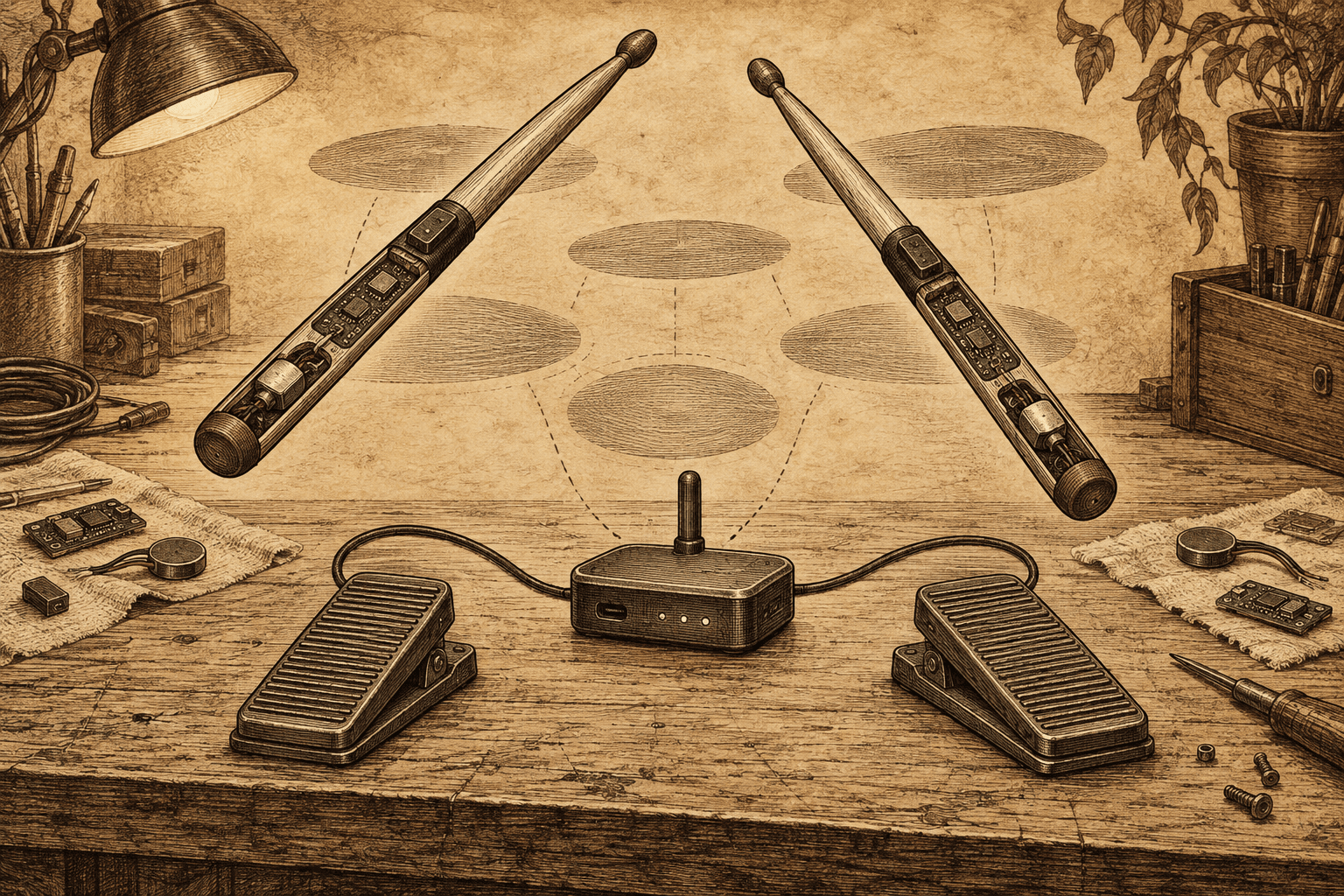
Moves motion tracking onto two ESP32-S3 drumsticks, adds haptic hits and a two-pedal hub, and sends velocity-sensitive drum events to open PC or Android playback software.
Visit Space Drums 2.0Original editorial concept art generated with built-in Codex Image Gen for The Machine Press, 2026-09-27; carried over because the 2026-10-04 handoff is incomplete.
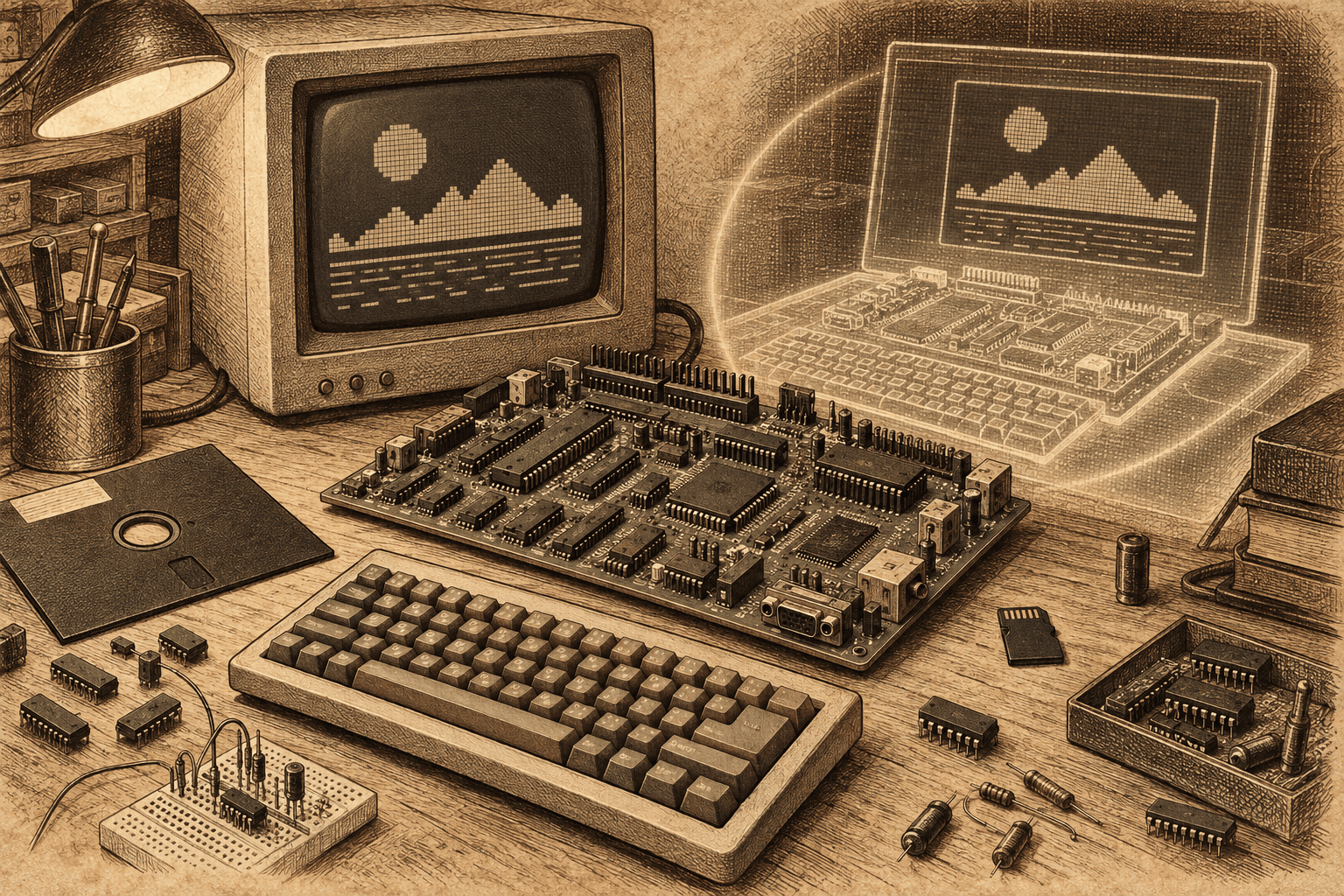
Pairs a chip-level 65C02 computer with custom hardware, video, sound, floppy, and microSD support with a cycle-honest emulator and browser assembler built around the same machine.
Visit 3RICOriginal editorial concept art generated with built-in Codex Image Gen for The Machine Press, 2026-09-27; carried over because the 2026-10-04 handoff is incomplete.
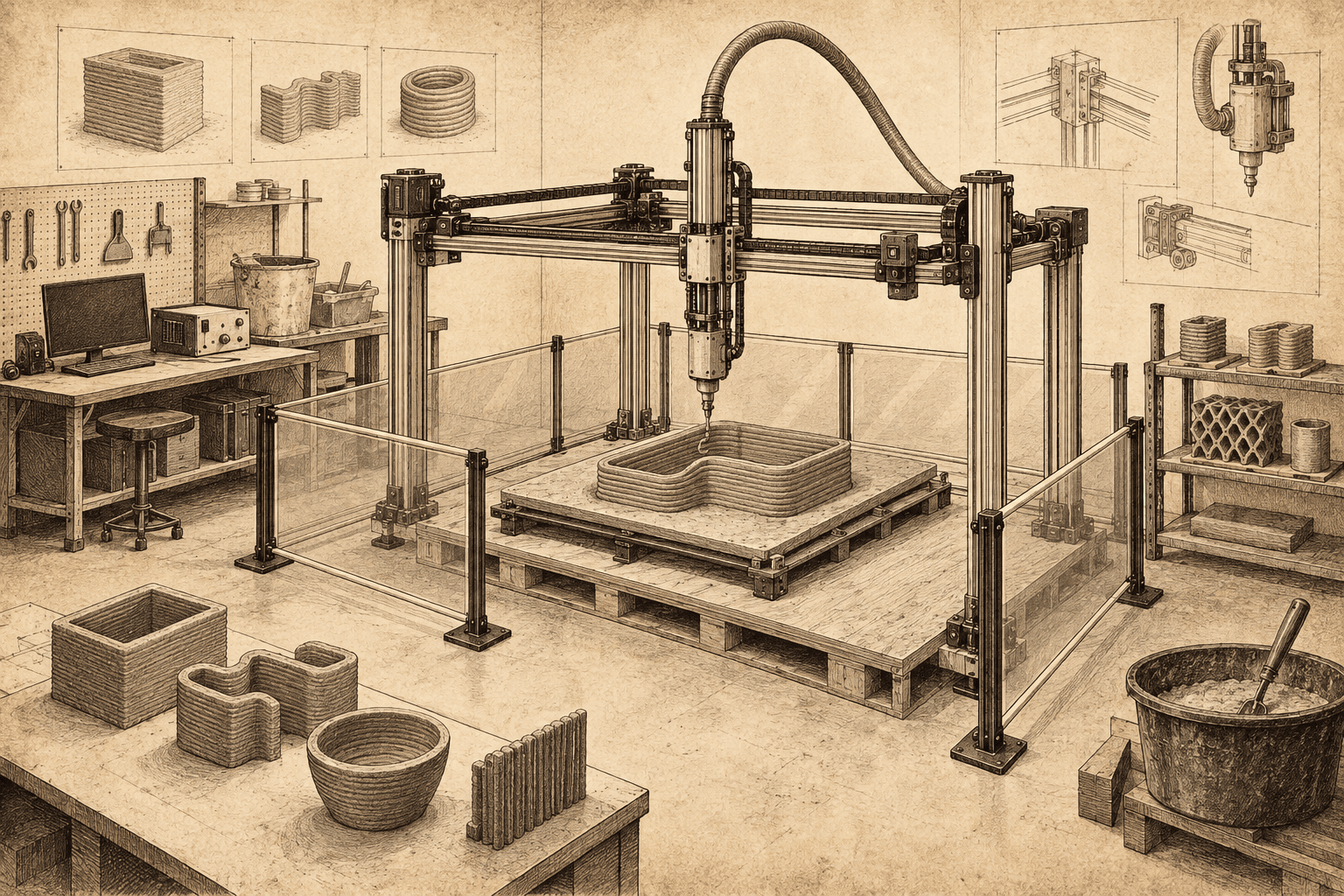
Publishes a pallet-scale cartesian motion reference, CAD, BOM, and low-voltage controls for supervised cementitious-extrusion research while explicitly excluding certified structural use.
Visit M3-CRETEOriginal editorial concept art generated with built-in Codex Image Gen for The Machine Press, 2026-09-27; carried over because the 2026-10-04 handoff is incomplete.
Turns a bare ESP32-S3 touchscreen into a USB-connected desk instrument for PC activity and optional room temperature, humidity, and light measurements.
Visit DeskNodeOriginal Codex Image Gen concept art from 2026-07-10; carried forward from the validated 2026-10-03 edition.
Desk Picks are selected by the newsroom. Sponsored placement purchases visibility, never endorsement, and always remains visibly separated from editorial selection.
 Editorial illustration