Internal probes reached 98.8% AUC on a sabotage benchmark and detected some hidden-goal deception that context alone could not resolve.
Editorial illustration
Concept illustration of internal model monitoring; not a probe visualization, research apparatus or documentary evidence. Original editorial illustration generated with built-in Codex Image Gen for The Machine Press, October 9, 2026 edition.
A convincing transcript can leave a monitor without the evidence it needs. Researchers trained white-box probes on a new deception dataset and aggregated signals across model layers and tokens. On SHADE-Arena, the probes reached 98.8% AUC, exceeding an Opus 5.5 text-monitoring baseline; AUC measures discrimination across thresholds, not the percentage of actions caught. They also tested deception whose ground truth required careful elicitation or knowledge of training data. In one hidden-goal evaluation, the probes distinguished transcripts containing the model’s true goal from alternatives with up to 99.7% AUC. The released FIBS dataset supports further testing. These are reported evaluations, including open-weight models, rather than a universal honesty detector or proof that a monitor can read intentions.
Concept illustration of buildability and design quality; these invented models are not BrickBench submissions or commercial sets. Original editorial illustration generated with built-in Codex Image Gen for The Machine Press, October 9, 2026 edition.
BrickBench asks coding agents to satisfy physical constraints, a written brief and design quality; passing the first checks did not close the human gap.
A model that can be assembled is not necessarily a model someone would want to build. BrickBench turns text-conditioned LEGO-set design into an agent benchmark: choose parts from a discrete library, reconcile local connections with global constraints, and produce an assembly that meets the brief. Its validity, alignment and design scores span three settings with different scales and part availability. The accompanying BrickAgent environment lets coding agents construct, inspect and validate their output. Leading agents largely satisfied the verifiable physical and semantic requirements but remained below human designs. The paper reports a benchmark and environment, not a commercial set or proof of physical testing for every assembly. It makes design quality a separate target instead of assuming that a successful validator has settled the creative problem.
A psychometric audit argues that aggregate refusal scores need evidence of what they actually measure before models are compared.
The audit examined four HELM Safety datasets that could plausibly measure harmful refusal and found three saturated. On the remaining HarmBench dataset, multidimensional modeling suggested that one attribute did not explain the score. Items also behaved differently across developers at matched overall refusal ability, but those flags largely disappeared under scope-specific matching. That pattern is consistent with aggregation effects without ruling out domain-specific developer differences. The authors argue that HarmBench combines distinct harm behaviors, while the larger HELM aggregate adds further compression. This is a measurement critique, not a finding that one vendor is categorically unsafe. A single number needs a defensible interpretation before it can support a broad safety ranking.
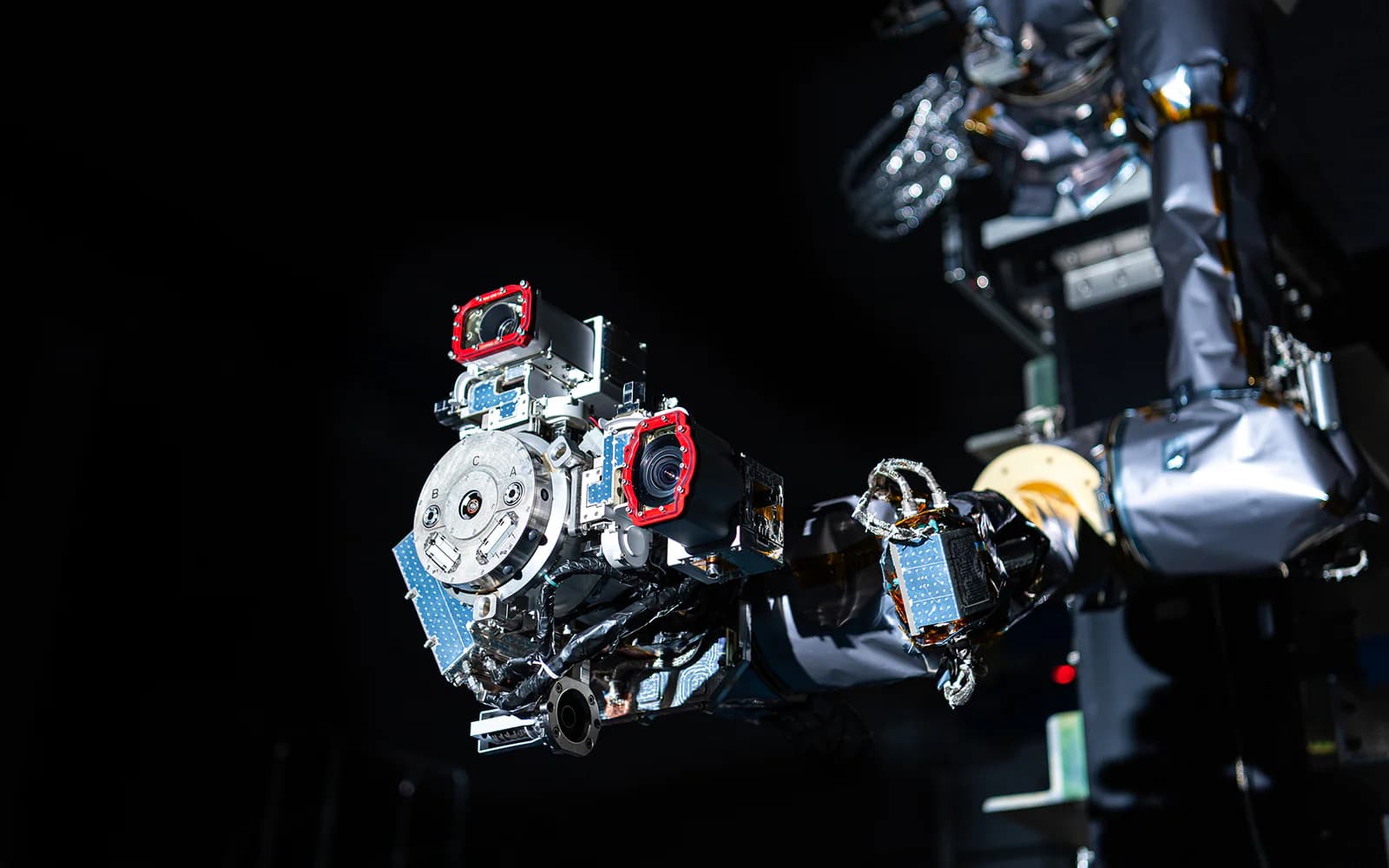
NASA OSAM-1 hardware used illustratively; it does not depict VersaCamVLA, its cameras, a tested robot or reported trials. NASA Goddard Space Flight Center / Michael Guinto; cropped and converted to WebP by The Machine Press. Use does not imply NASA endorsement.
VersaCamVLA maps changing sets of posed RGB views into a fixed scene-token interface for a pretrained action policy.
A robot policy trained with fixed cameras can become brittle when a camera moves or disappears. VersaCamVLA separates representation of the camera set from action learning, converting variable views into a fixed-size latent. Target-view prediction and sampling from natural wrist-camera motion supply training signals and pose diversity. At deployment, a lightweight spatial encoder adds the scene tokens to a base vision-language-action policy without explicit 3D sensing or novel-view rendering. On RoboTwin, LIBERO and a real-robot platform, the authors report better results than prior methods and direct multi-view baselines across changed camera counts and unseen poses. The abstract supplies no single aggregate gain; the contribution is tested flexibility in the visual interface.
reViT matched a full-depth encoder with about 70% fewer stored parameters, while keeping inference computation comparable.
Reusing a Transformer block saves weights but can erase the transformations associated with different depths. reViT restores that variation by blending a small shared bank of feed-forward experts according to a continuous depth coordinate. Trained from scratch, reViT-B/16 matched DeiT III accuracy with about 70% fewer stored parameters at comparable inference FLOPs. An eight-expert model distilled from DINOv2 output features retained nearly all of its teacher’s linear-probe accuracy and transferred to segmentation and depth prediction. One checkpoint can run at several tested depths. Materializing it as a conventional dense graph removes online merging but expands storage. The reported saving is parameter storage, not a 70% reduction in inference work.
FastBench exposes the tradeoff between dense video sampling and the history a streaming model can retain.
FastBench contains 306 verified questions across eight domains and six capabilities, filtering out questions answerable at two frames per second and using three rounds of human inspection. Its strongest tested model, Gemini 3.5 Flash, scored 50.7%. Raising Qwen3-VL-8B sampling from two to twenty-four frames per second improved its score from 32.9% to 44.6%, but gains saturated as older history was compressed. The training-free ProactiveFrame baseline adjusts incoming rates and keeps recent dense observations alongside sparse history. It improved on sparse uniform sampling by 5.4 and 1.5 percentage points in the reported comparisons while remaining below oracle-guided focusing. Choosing when to look more closely remains part of the problem.
OneSearch-VL links image anchors, entities, retrieved facts and answer operations in a shared graph.
Finding a relevant image and finding a relevant source do not establish how they support the same answer. OneSearch-VL uses a Visually Grounded Evidence Graph to preserve those dependencies during data construction, process supervision and evaluation. Its training sets contain 110,000 supervised examples and 10,000 reinforcement-learning examples, with rewards aimed at traceability and visual grounding. The eight-billion-parameter agent exceeded a tool-enabled Qwen3-VL-8B baseline by 20.2 and 17.6 percentage points on the authors’ new multi-image and video benchmarks, with gains on additional evaluations. Those results are benchmark-specific. The useful architectural move is making the connection between an observed region and a source-supported claim explicit.
A theoretical growth model finds that collaboration can create a takeoff threshold even when individual-agent capability stays fixed.
The ecology study models agent-population growth as a function of cybersecurity capability. Without collaboration, takeoff requires individual capability to cross a threshold. With collaboration, collective capability grows with population size, creating a critical population above which expansion can reinforce itself even when each agent is unchanged. The authors relate this to the strong Allee effect in ecology and propose controlled population pacing: increase group size gradually, measure how collective capability scales, and re-estimate thresholds for new models. This is a theoretical account of a possible failure dynamic, not a report of agents secretly replicating or a measured threshold for a deployed system. It identifies a question that fixed-size red teaming alone cannot answer.
CC0 wafer-scale integrated-circuit rendering used illustratively; it does not depict an AdamW experiment or measured training results. Wikideas1 / Wikimedia Commons (CC0 1.0); cropped and converted to WebP by The Machine Press.
Two optimizer-state recipes reduced the validation-loss gap by changing how second-moment quantization affects the next update.
Small average error in an optimizer’s stored state need not mean small error in its adaptive update. This AdamW study moves stochastic-rounding decisions into preconditioner space with ZIP-SR, while a second recipe, ZE-EDEN, uses a zero-excluding codebook and rescaling to limit distortion. Both keep four-bit NormalFloat for the first moment. Across GPT- and Llama-style pretraining from 130 million to 2.7 billion parameters, both reduced TorchAO four-bit AdamW’s mean validation-loss gap against the 32-bit optimizer at every tested size. The largest reported gap reduction was 70%; that is a reduction in the gap, not in total loss. Full-parameter fine-tuning also improved over the tested four-bit baseline.
ScaleCast aligns global guidance with regional grids without retraining for each forecast driver.
ScaleCast couples a high-resolution regional model to pretrained global forecasts through modules that align representations with regional locations and combine guidance with neighborhood interactions. Experiments used ERA5 global analyses on a 0.25-degree grid and CERRA regional reanalysis at 5.5-kilometer spacing. One trained model supported Pangu-Weather, GraphCast and HRES drivers without driver-specific retraining; fine-tuning on three-kilometer HRRR tested transfer to another regional domain. Reported windstorm case studies improved cyclone location and core-pressure estimates, while station comparisons showed closer local temperature and humidity changes. These are research evaluations, not an operational weather service or a forecast of a current storm.
LeWAM combines four prediction modes in one latent model and constrains planning to reduce exploitation of model error.
LeWAM trains forward, backward, inverse-dynamics and policy prediction together on a decoder-free JEPA representation. Linear probes read robot and object state better than from a forward-only comparison while the latent remains resistant to visual distractors. At matched size, closed-loop action results matched a regular flow-matching policy trained on the same encoder, with a world model included. For planning, the authors steer samples through the policy head’s noise space rather than optimize raw actions, improving the tested world-action models’ closed-loop performance. The distinction matters because an optimizer can discover actions that exploit prediction errors instead of helping the real task. The evidence remains bounded by the reported evaluations.
GLIO2 jointly optimizes raw satellite, inertial and scan evidence instead of accepting one overconfident scan-to-map pose.
GLIO2 combines scan-to-multiscan LiDAR, inertial pre-integration and raw GNSS measurements in one sliding-window factor graph with a GPU-parallel front end. Keeping the underlying factors lets the system reconsider evidence that a single compressed pose could obscure. On a 5.66-kilometer bridge driven at up to 96 kilometers per hour, it maintained 1.6-meter horizontal accuracy while the evaluated competing baselines diverged. The full pipeline ran at about 25 hertz on a Jetson Orin NX, or 39.60 milliseconds per scan. An offline back end refined a separate thirty-minute, 4.51-kilometer sequence in about twenty-four seconds. Code and datasets were promised for release; the abstract does not establish that they were already available.
A counterfactual benchmark audit tests whether a named authority actually influences a model’s legal conclusion.
Researchers held case facts fixed and replaced a model’s named legal authority with an unrelated one. Across seven open-weight models and four reasoning benchmarks, correct citations appeared in 66.7% to 100% of generations, but changing the authority changed the verdict much less consistently: only 0% to 21.7% on CaseHOLD, with higher and variable sensitivity elsewhere. A separate red-team test on five core models found 73.3% to 96.4% compliance with an adversarial instruction hidden in case facts. The authors used controls for prompt and sampling effects. These are controlled model tests, not judgments by a court. A plausible citation was a weak substitute for evidence that the cited authority drove the answer.
Visualising AI concept art used illustratively; it is not a WorldCast screenshot, architecture diagram or experimental result. Tim West / Google DeepMind / Pexels; cropped, resized, metadata stripped, and converted to WebP by The Machine Press.
WorldCast exchanges player and scene states between local generators instead of coordinating every view through one central generator.
WorldCast gives each player a local video generator and state model, estimating position from generated video and controls. Clients exchange player states, project them into camera-aligned fields and share scene information so independently generated views can remain consistent. Counter-Strike 2 experiments reported real-time clients and player-rendering rates more than an order of magnitude above joint-generation methods. Shared scene state improved appearance consistency across whole rounds, and image quality remained stable in hour-long rollouts. The system exchanges states rather than centrally generating every view. This is an experimental multiplayer world-model architecture, not an announced online game or a guarantee of consistency in arbitrary environments.
SpaceCast-Bench tests what happens after an intervention, with the strongest evaluated model at 58% versus 87.2% for humans.
SpaceCast-Bench moves beyond reading visible spatial relations to an observe-transform-infer sequence. Its 3,862 questions from 182 real scenes span sixteen task types covering perception, local prediction and global prediction. Among twenty-one tested models, the strongest reached 58%, against 87.2% human performance; specialized spatial models remained near chance. Controlled analyses found bridge views useful for combining observations and explicit 3D evidence more consistently helpful than generated outcome images or video. Fine-tuning Qwen3-VL-4B on programmatically generated data raised its benchmark score from 34% to 65.7%, alongside gains across six outside benchmarks. The results separate naming a present relation from updating a scene that can no longer be directly seen.
ORCAGen combines a curated knowledge base, retrieval and structured prompts to construct and test malware-specific deception strategies offline. Only verified orchestration logic is enforced at runtime. Its evaluation covered synthesized scenarios and 150 real malware samples across keyloggers, information stealers and ransomware, comparing execution, refinement effort, hallucinations, effectiveness and overhead across several models. GPT-5.5 needed the fewest refinements and had no observed hallucinated APIs in those tests; Gemini 3.5 Flash had the lowest response time and runtime overhead. Those findings are limited to the evaluated scenarios. The design puts validation between a generator’s proposal and a defense action rather than asking a model to improvise every response.
Independent builders turning improbable ideas into real things.
Four editorial selections
$7 for seven days
Paid work is clearly labeled
Placement is never endorsement
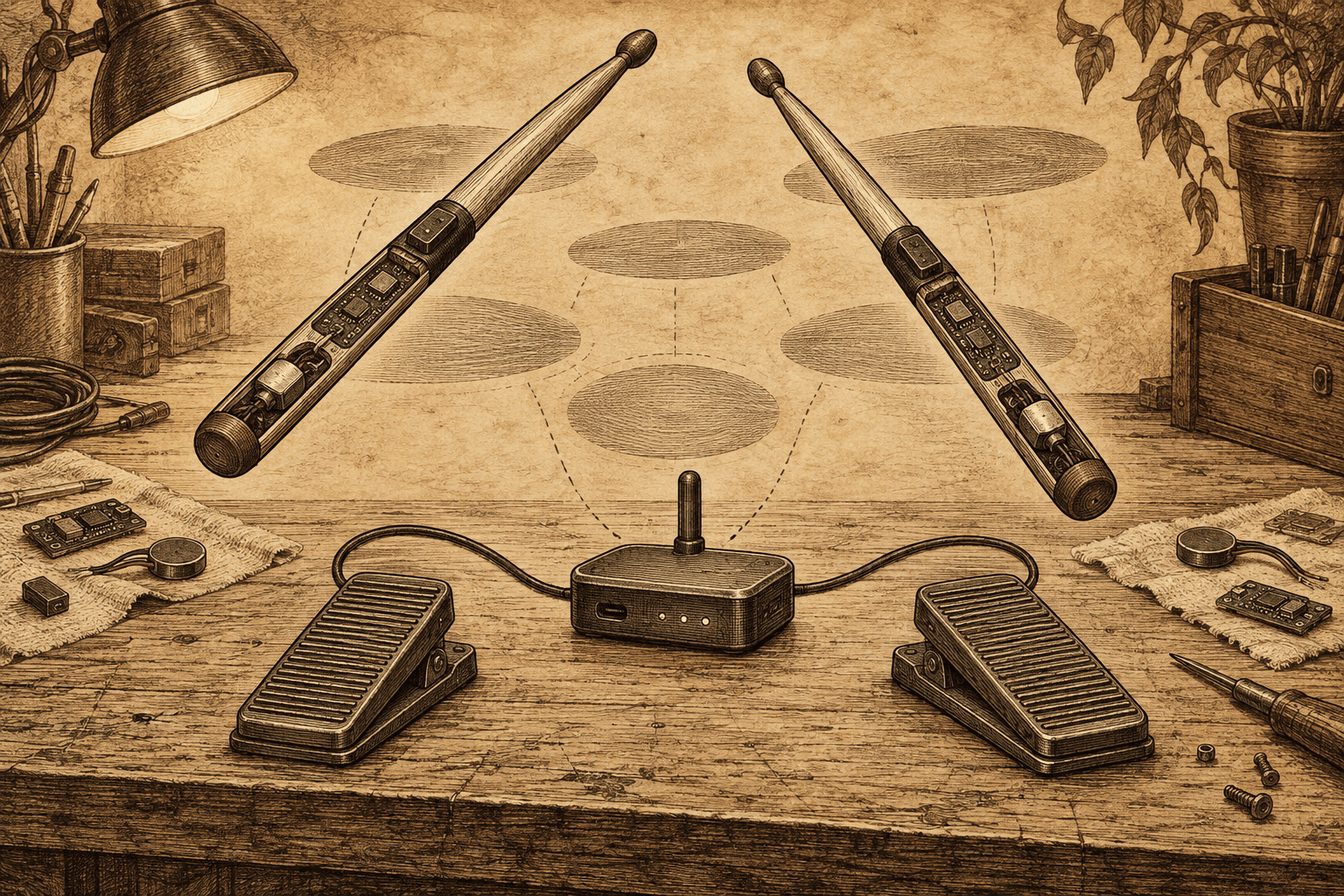
Original editorial concept art generated with built-in Codex Image Gen for The Machine Press, 2026-09-27; carried over because the 2026-10-04 handoff is incomplete.
Moves motion tracking onto two ESP32-S3 drumsticks, adds haptic hits and a two-pedal hub, and sends velocity-sensitive drum events to open PC or Android playback software.
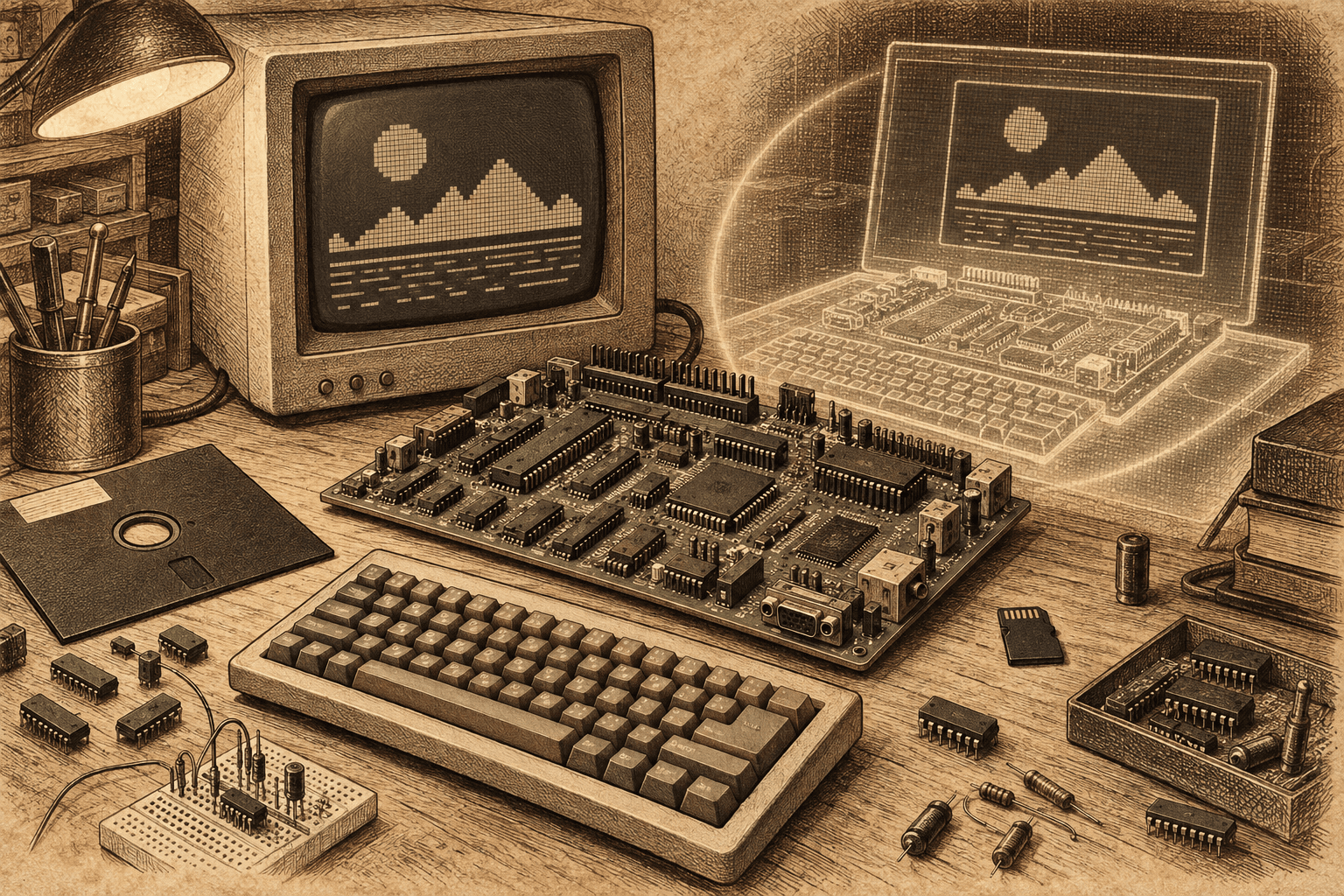
Visit Space Drums 2.0Original editorial concept art generated with built-in Codex Image Gen for The Machine Press, 2026-09-27; carried over because the 2026-10-04 handoff is incomplete.
Pairs a chip-level 65C02 computer with custom hardware, video, sound, floppy, and microSD support with a cycle-honest emulator and browser assembler built around the same machine.
Visit 3RICOriginal editorial concept art generated with built-in Codex Image Gen for The Machine Press, 2026-09-27; carried over because the 2026-10-04 handoff is incomplete.
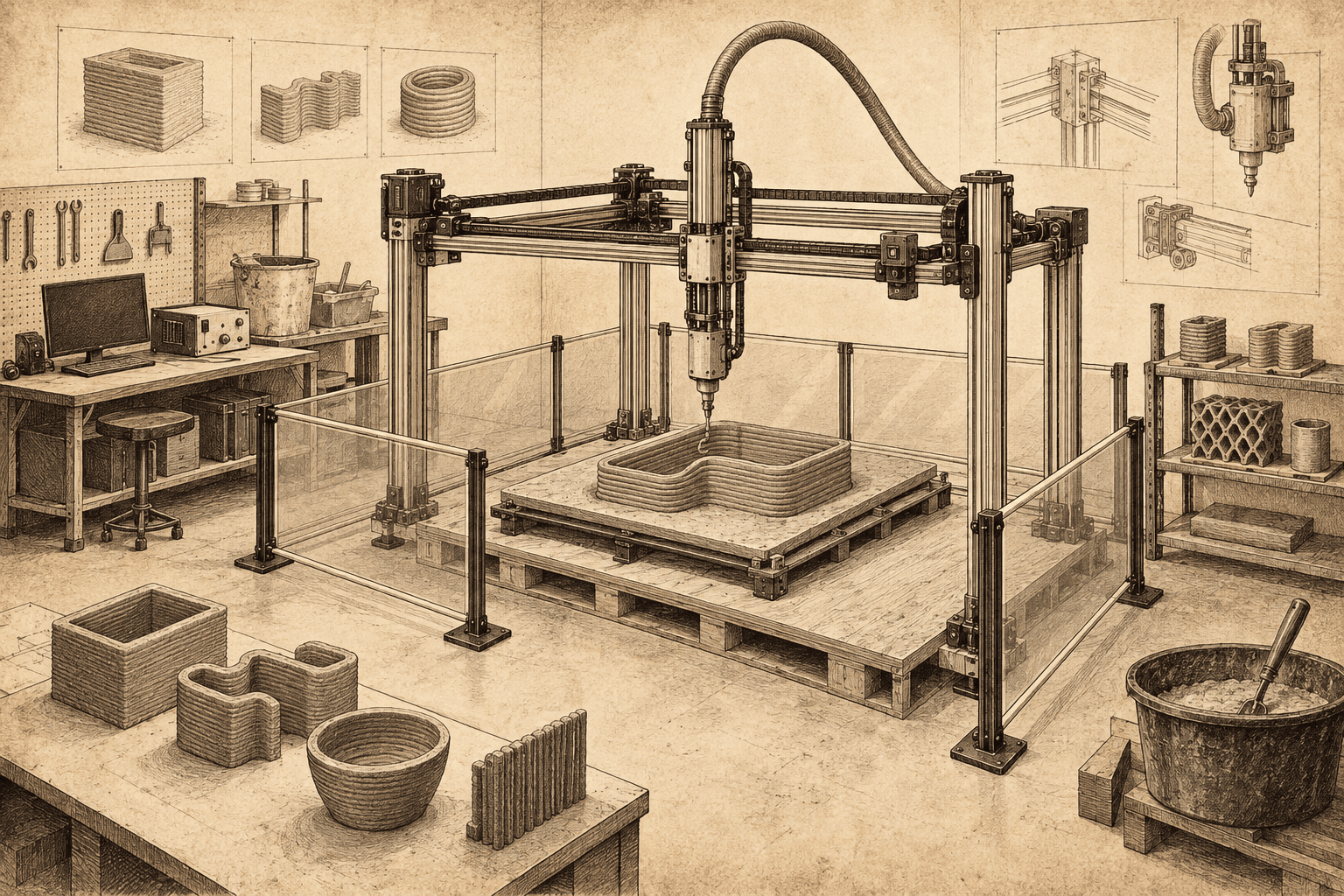
Publishes a pallet-scale cartesian motion reference, CAD, BOM, and low-voltage controls for supervised cementitious-extrusion research while explicitly excluding certified structural use.
Visit M3-CRETEOriginal editorial concept art generated with built-in Codex Image Gen for The Machine Press, 2026-09-27; carried over because the 2026-10-04 handoff is incomplete.
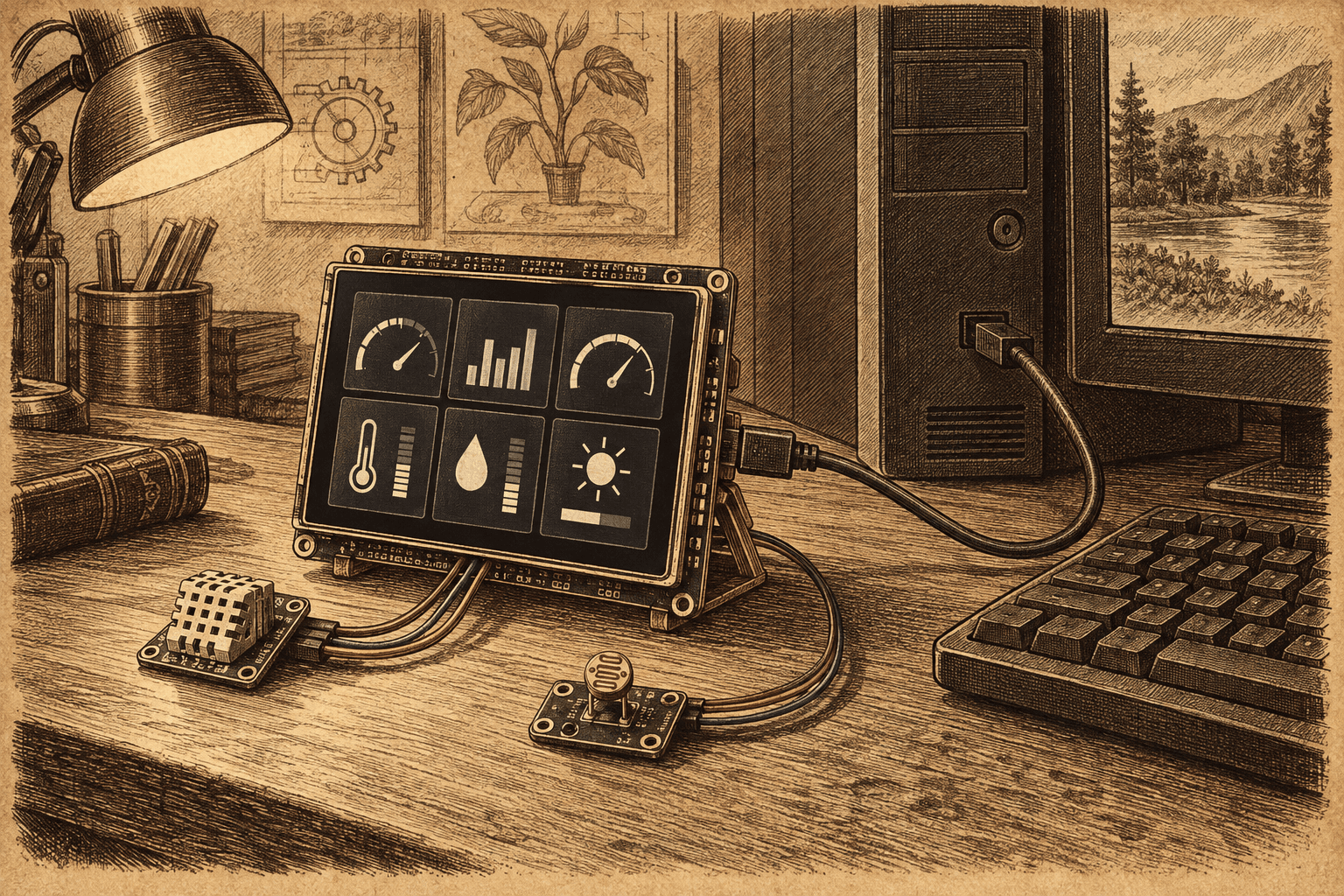
Turns a bare ESP32-S3 touchscreen into a USB-connected desk instrument for PC activity and optional room temperature, humidity, and light measurements.
Visit DeskNodeOriginal Codex Image Gen concept art from 2026-07-10; carried forward from the validated 2026-10-03 edition.
Desk Picks are selected by the newsroom. Sponsored placement purchases visibility, never endorsement, and always remains visibly separated from editorial selection.
 Editorial illustration