SafeDriveVLA simulates strict compliance with a navigation instruction, then decides whether the resulting maneuver conflicts with the road scene.
Editorial illustration
Concept illustration of testing a navigation command against road conditions; not SafeDriveVLA output, an autonomous-driving interface or a documented road event. Original editorial illustration generated with built-in Codex Image Gen for The Machine Press, October 15, 2026 edition.
Natural-language navigation gives a driving agent more freedom than a fixed turn command—and more ways to be told something unsafe. SafeDriveVLA separates that problem from steering by first predicting whether an instruction should be followed, modified or refused. Its world model deliberately imagines strict compliance so the system can inspect what obeying would cause before producing an action. On the authors' Bench2Drive evaluation, the model reached an 88.16 Driving Score and 68.64 percent success rate. Against their strongest SimLingo variant, it raised closed-loop language following by 49.3 percent and reduced collisions under unsafe instructions from 60 to 38. Those are benchmark results, not proof of road readiness. The useful systems claim is narrower: conflict detection becomes an explicit decision instead of an emergent hope hidden inside action generation.
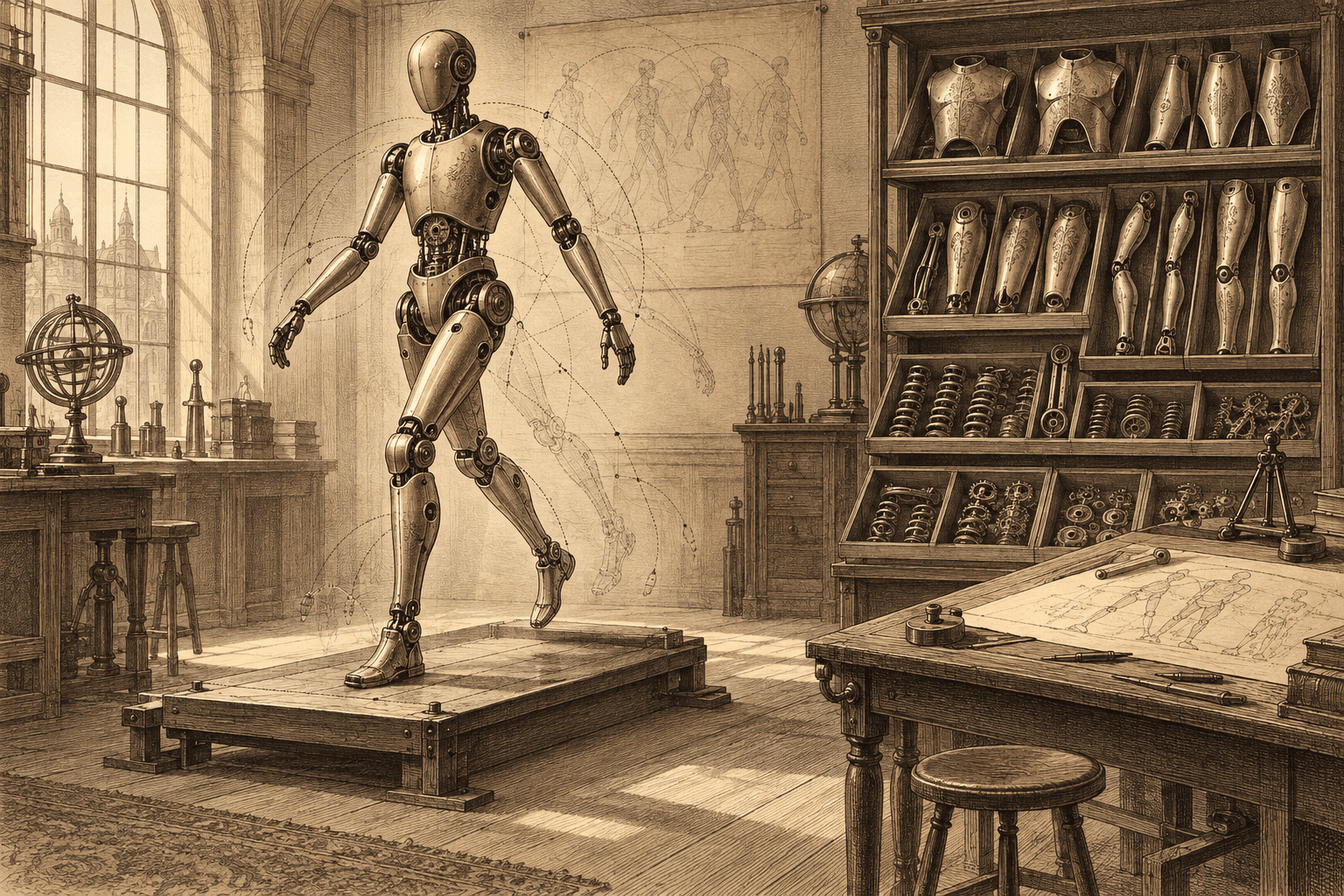
Concept illustration of learned weight-space patterns reflecting a humanoid body; not a Unitree robot, neural-network diagram, generated policy or experiment photograph. Original editorial illustration generated with built-in Codex Image Gen for The Machine Press, October 15, 2026 edition.
A diffusion model generates deployable humanoid-control networks directly in weight space—and exposes a recurring imprint of the robot's body.
Robot policies are normally treated as the output of training, not as objects with a distribution of their own. This study compresses the parameters of Unitree G1 control networks into a latent space, then trains a Diffusion Transformer to model and generate those latents. The authors report that sampled networks can be deployed for real-world motions including walking and dancing. They also identify a repeated structure in first-layer weights that tracks the robot's kinematic prior, appearing in policies produced by both reinforcement and imitation learning. The result does not mean arbitrary robot intelligence can be summoned from noise, and the abstract supplies no broad safety or reliability guarantee. It does suggest that a family of trained controllers may contain learnable regularities tied to embodiment—patterns that can be generated and inspected rather than rediscovered from scratch each time.
GracefulRL changes the reward landscape so a model can preserve task performance yet choose a safe fallback when a long-shot action is unreliable.
Outcome-only reinforcement learning can make guessing rational: an uncertain action has some chance of reward, while abstaining never completes the task. GracefulRL reshapes that optimization problem so fallback behavior can emerge from outcome-level signals without labeled abstention moments or an inference-time verifier. Across the authors' evaluated tasks and scales, trained models largely preserve task-solving ability while declining selectively when action is unreliable. The abstract does not establish deployment safety, calibration guarantees or universal error reduction. It does isolate an incentive problem that matters whenever a wrong action can change code or data.
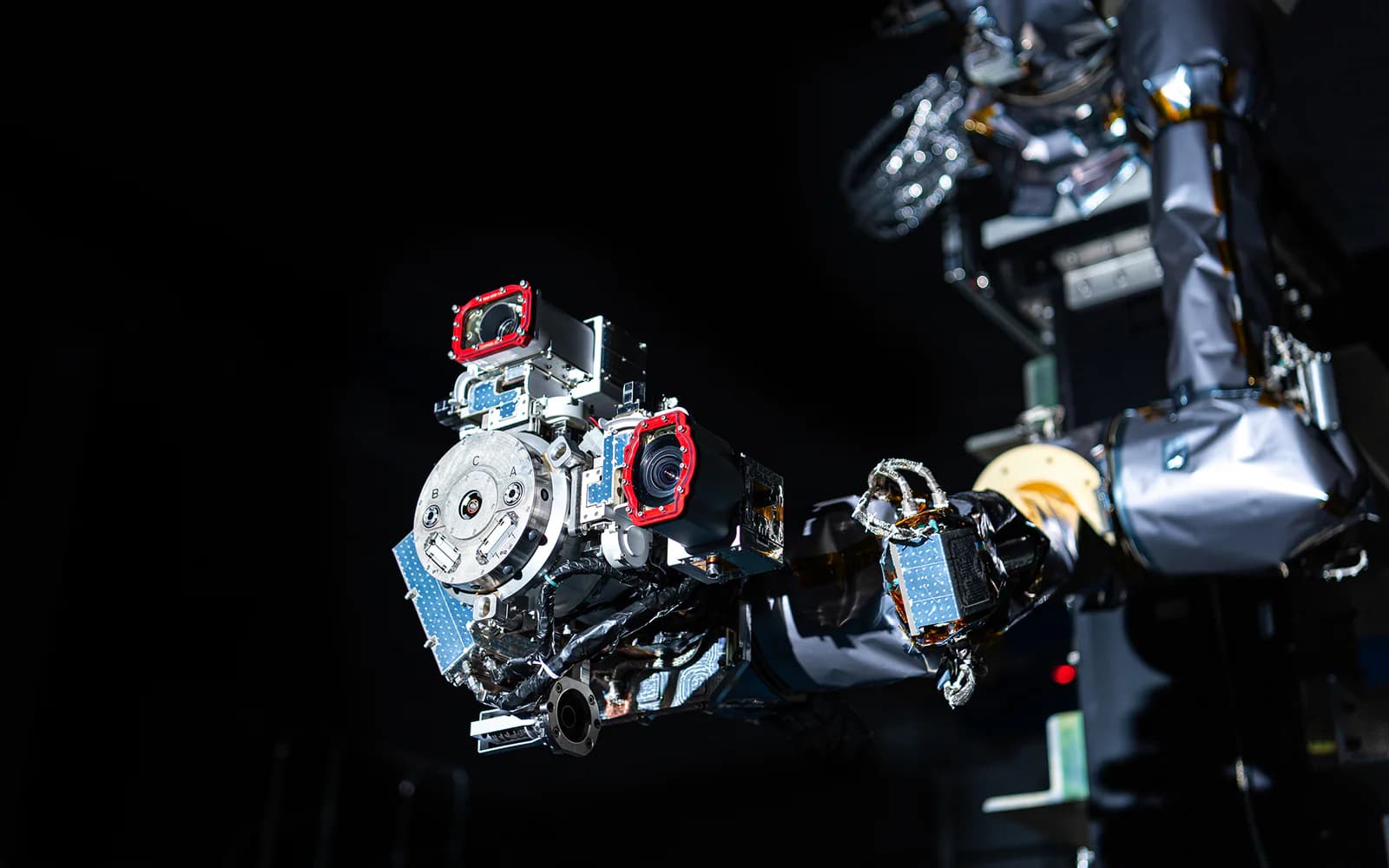
NASA OSAM-1 hardware used illustratively; it does not depict HiRe-MoMa, TIAGo++, human interventions or reported trials. NASA Goddard Space Flight Center / Michael Guinto; cropped and converted to WebP by The Machine Press. Use does not imply NASA endorsement.
HiRe-MoMa freezes a base policy, learns separate residual corrections for the mobile base and arm, and uses sparse human interventions to shape exploration.
Fine-tuning a mobile manipulator on hardware entangles two different control problems: moving the base and handling objects with the arm. HiRe-MoMa leaves the original policy frozen and learns additive corrections through separate, one-way-conditioned heads. Human interventions covering less than 20 percent of training reshape the value estimate rather than becoming a full demonstration set. The authors report consistent gains on a TIAGo++ robot after roughly 30 minutes of online interaction across different base policies. That is evidence from the evaluated tasks and platform, not a general deployment guarantee.
Ask4NV trains novel-view generation beside 3D language understanding so object identities and spatial relationships can inform synthesis.
Novel-view systems must preserve more than pixels when they imagine a camera angle that was never observed. Ask4NV adds supervision from questions about objects, attributes and spatial relationships, while injecting camera geometry into its visual representations. Joint attention connects the understanding and generation paths. The authors report stronger image quality and geometric consistency alongside competitive 3D-language performance, with improved correspondence across views. The evaluation supports complementary supervision, not guaranteed scene truth in every generated frame.
RECON routes visual-encoder representations into later diffusion-transformer layers and reuses the alignment head after the clean training image disappears.
Representation-aligned diffusion training usually teaches an intermediate layer with a vision encoder, then throws away the projection head. RECON keeps that pathway useful: during training it conditions later layers on encoder tokens; during inference the retained head stands in for the unavailable clean-image representation. The authors say the change adds no parameters and converges 63 times faster than SiT and 25 times faster than REPA in their comparisons. Those ratios depend on the reported setups, but the design closes a clear gap between early semantic supervision and later generation layers.
VITAL makes visually derived motion the main action target, then carries the remaining trajectory error in a small residual code.
A future image can reveal the shape of a driving maneuver while still missing the exact trajectory needed for control. VITAL separates those scales: a motion scaffold comes from visual dynamics, and a compact residual records the metric error left behind. With one action-denoising step, the authors report 90.8 PDMS on NAVSIM v1 navtest—within 0.13 points of the ten-step result—at 3.29 times the end-to-end inference speed. Its NAVSIM v2 scores require no retraining. These are simulator-benchmark outcomes, not public-road validation.
DynThinker constrains the parameters most vulnerable to static-dynamic interference while selectively fusing geometry and motion priors.
Training for static 3D reasoning can weaken understanding of motion, while 4D specialization can cost geometric skill. DynThinker traces much of that interference to particular parameter groups, especially late-layer MLPs. Its decoupled moving average limits drift there, while a fusion module adds geometry and temporal priors selectively. Across ten metrics from nine benchmarks, the authors report the highest average among compared systems and leading open-model scores on four named evaluations. The claim is comparative and benchmark-bound, but it identifies where multi-capability training fights itself.
CC0 wafer-scale circuit rendering used illustratively; it does not depict the elastic-transformer method, evaluated models, A100 hardware or measured results. Wikideas1 / Wikimedia Commons (CC0 1.0); cropped and converted to WebP by The Machine Press.
A retraining-free ranking of individual neurons and attention heads lets one pretrained model trade capacity for speed across a continuum of sparsity targets.
Model families normally force a fixed size choice even when hardware and load change. This method jointly ranks individual MLP neurons and attention heads while optimizing across many soft-pruning targets. Across 27 encoders from 22 million to 8 billion parameters, the authors report smooth degradation through 60 percent sparsity. At 50 percent sparsity, a DINOv3 encoder loses 427 million parameters with a 0.8-point linear-probe accuracy drop; another model reaches 1.80 times throughput at 60 percent sparsity. Those figures are workload-specific, but the output is one adjustable model rather than a shelf of separately trained sizes.
CoWear synchronizes a phone, watch and smart glasses, then fuses role-specific inertial estimates according to learned uncertainty.
A phone, watch and glasses observe the same walk from different moving reference points. CoWear collects device-specific motion-capture ground truth for more than 30 participants, 300 sessions, 30 hours and 100 aggregate kilometers. Separate estimators predict displacement for a shared reference; gyroscope integration rotates those estimates into the world frame before uncertainty-weighted fusion. Across phone-, watch- and glasses-centered tests, the authors report consistent gains over individual devices. The dataset is a research baseline, not a consumer tracking product or safety claim.
GeoThinker-F learns predictive geometric and future-semantic latents from an offline expert, then removes that expert for inference.
External 3D encoders provide useful geometry but add a second runtime path. GeoThinker-F first trains lightweight heads to predict geometry-expert features and future semantics while the main multimodal model is frozen. It then removes the expert and teaches the backbone to fuse its own predictions. The authors report up to a 3.6-times speedup, cutting latency from 1.45 seconds to 0.40 seconds while retaining competitive performance across their spatial benchmarks. The efficiency claim is tied to the evaluated stack, but the handoff from teacher to internal representation is explicit.
Latent Compaction freezes model weights and optimizes a document-specific KV cache without seeing the downstream questions it will later answer.
Long prompts enlarge the key-value cache that generation must repeatedly read. Latent Compaction treats that cache as a tiny trainable object: it initializes entries from reconstruction, attention and key diversity, then fits attention outputs and distills behavior from the full cache. Model weights stay frozen, and training uses generic prompts about the document rather than evaluation answers. On one RULER setting, the authors report 96.7 percent accuracy at 32-times compression versus 40.0 percent for KVZip+. Transfer tests span Qwen3 and MiniCPM5. The result is not free compression; it exchanges per-document test-time training for a smaller serving memory.
PingpongDuo chooses team positions jointly, filters risky movements and trains footwork and striking skills for rapid handoffs in a confined space.
Doubles table tennis forces two humanoids to alternate strikes while repeatedly entering and clearing the same workspace. PingpongDuo gives a team planner learned risk estimates and preserves the current striker's target when alternatives look unsafe. Separate footwork and racket skills are trained on one another's states, with a residual refining strikes after movement. In simulation, the authors report a 13.2 percent gain in return success and roughly two-centimeter clearance positioning error. In hardware tests, one robot completes a 2.15-meter recovery cycle in 2.4 seconds, and two robots sustain more than ten alternating strikes. These are controlled demonstrations, not general human-safe collaboration.
Visualising AI concept art used illustratively; it is not a CIPR interface, action distribution, function-call trace or benchmark result. Tim West / Google DeepMind / Pexels; cropped, resized, metadata stripped, and converted to WebP by The Machine Press.
Cross-Interface Policy Regularization shows the same training task under two action vocabularies and penalizes behavioral disagreement between them.
An agent can learn a task and still fail when an equivalent tool gets a new name or notation. CIPR replaces action names with uninformative identifiers and pairs each training example across two known-equivalent interfaces. A consistency loss aligns the resulting action distributions. On held-out function-calling perturbations, ordinary post-training loses nearly 25 percent accuracy; the authors report recovering 10.5 percent with CIPR while preserving performance on the original interface. The method does not solve unseen tool semantics, but it directly targets brittle dependence on surface labels.
A verification pipeline combines semantic review with numerical and vacuity tests that produce checkable failures for Lean translations.
A proof assistant can accept a formally valid statement that mistranslates the source or says something vacuous. This work supplements language-model review with mechanical numerical and vacuity checks, then uses the process in an Extract-Verify-Proof pipeline for a partial formalization of the NIST Digital Library of Mathematical Functions. Across three labeled datasets, the authors report the lowest accepted-error rate among compared methods, while expert review found defects in both translations and source datasets. The result supports layered verification rather than replacing mathematical expertise.
Researchers transported thousands of confined ions for 15- and 45-minute journeys in a radiofrequency trap, moving a common quantum-science platform beyond the lab.
Mobile ion transport had previously been demonstrated in magnetic Penning traps. This team reports carrying a few thousand ions in a linear radiofrequency Paul trap over several kilometers, with journeys lasting 15 and 45 minutes. Paul traps are widely used in quantum science, so the demonstration points toward transferring exotic ions between facilities and operating transportable quantum devices while moving. It establishes confinement during the reported trips, not a complete mobile quantum computer or a field-ready logistics system.
Independent builders turning improbable ideas into real things.
Four editorial selections
$7 for seven days
Paid work is clearly labeled
Placement is never endorsement
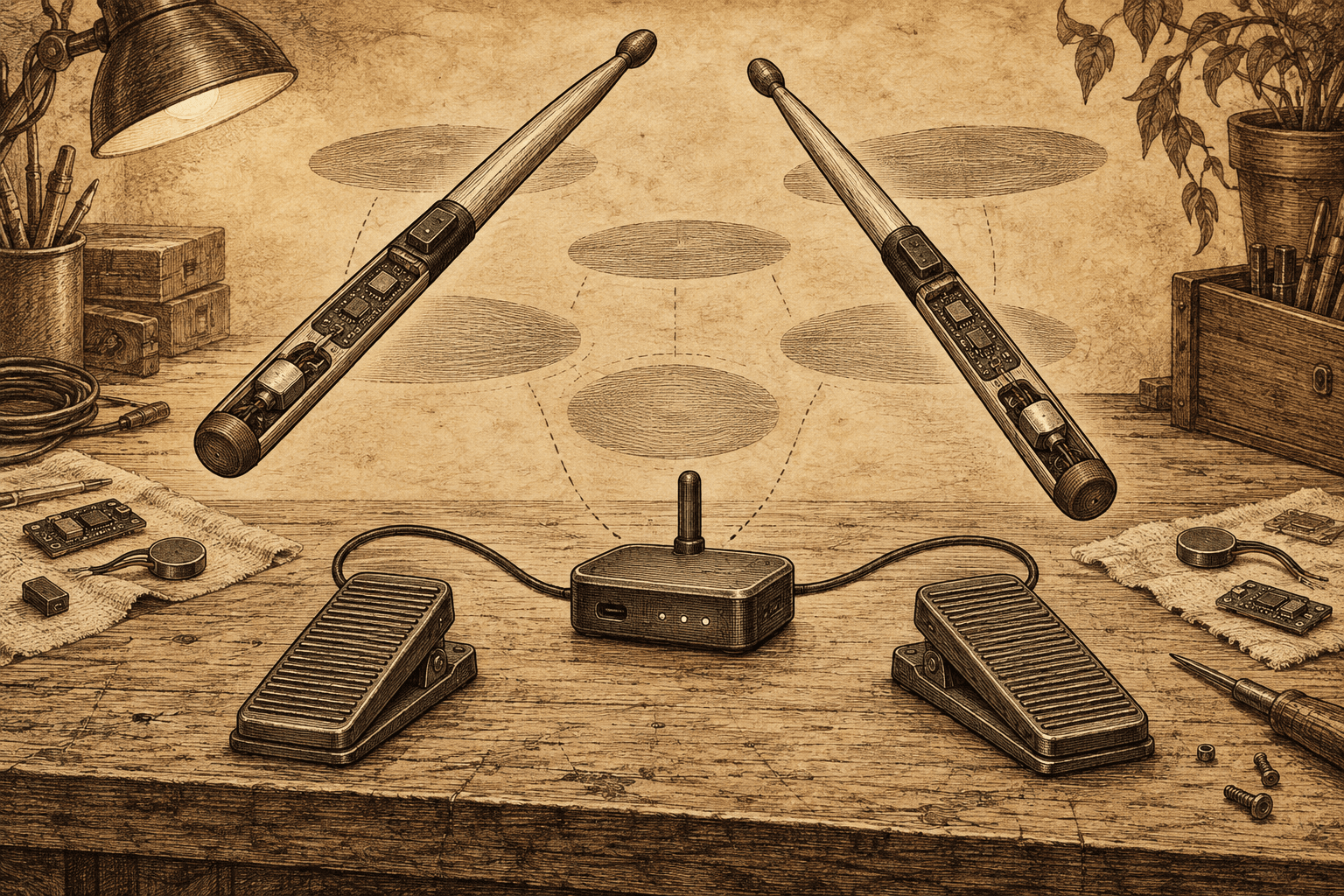
Original editorial concept art generated with built-in Codex Image Gen for The Machine Press, 2026-09-27; carried over because the October 4 handoff remains validation pending and no complete October 11 handoff exists.
Moves motion tracking onto two ESP32-S3 drumsticks, adds haptic hits and a two-pedal hub, and sends velocity-sensitive drum events to open PC or Android playback software.
Visit Space Drums 2.0Original editorial concept art generated with built-in Codex Image Gen for The Machine Press, 2026-09-27; carried over because the October 4 handoff remains validation pending and no complete October 11 handoff exists.
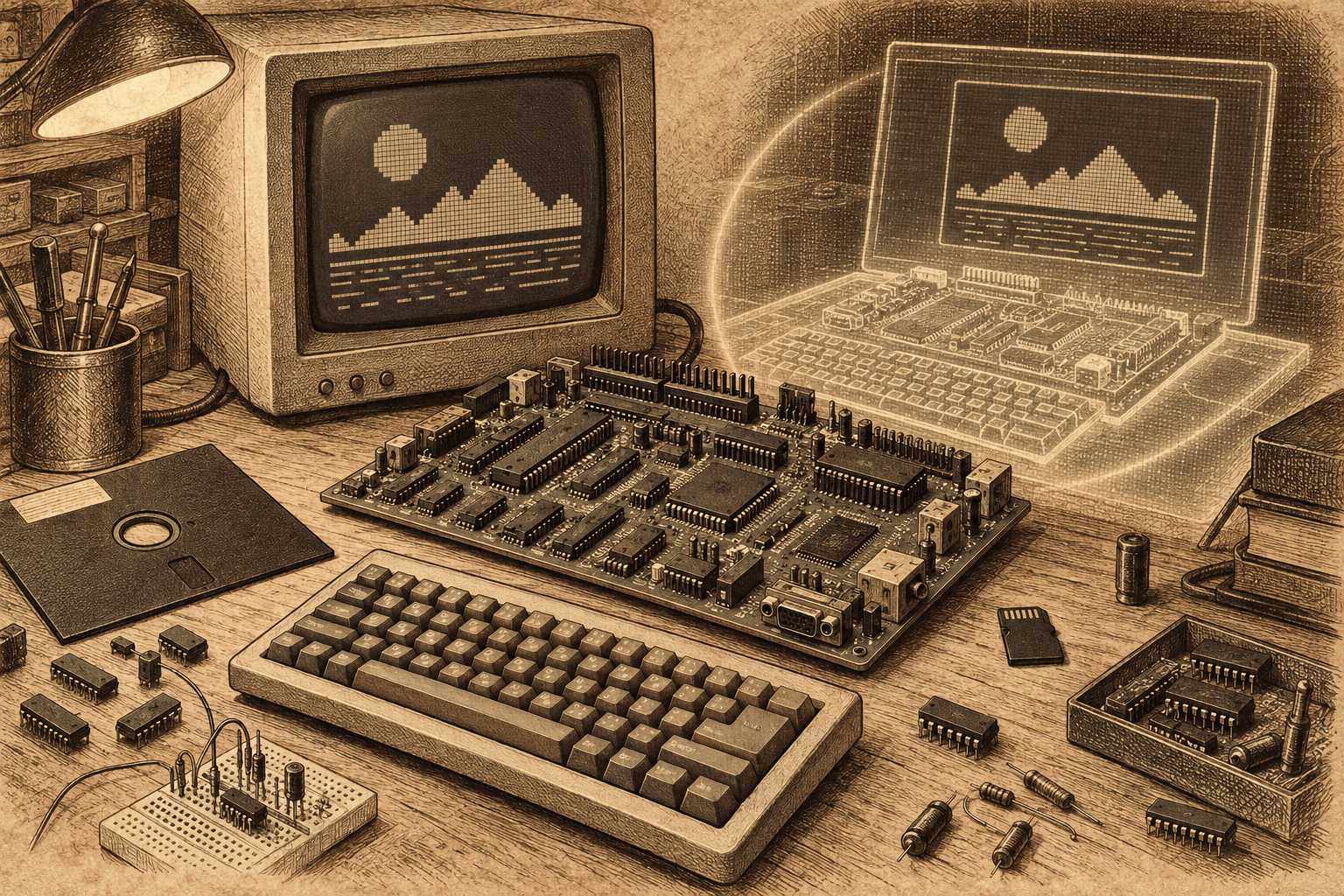
Pairs a chip-level 65C02 computer with custom hardware, video, sound, floppy, and microSD support with a cycle-honest emulator and browser assembler built around the same machine.
Visit 3RICOriginal editorial concept art generated with built-in Codex Image Gen for The Machine Press, 2026-09-27; carried over because the October 4 handoff remains validation pending and no complete October 11 handoff exists.
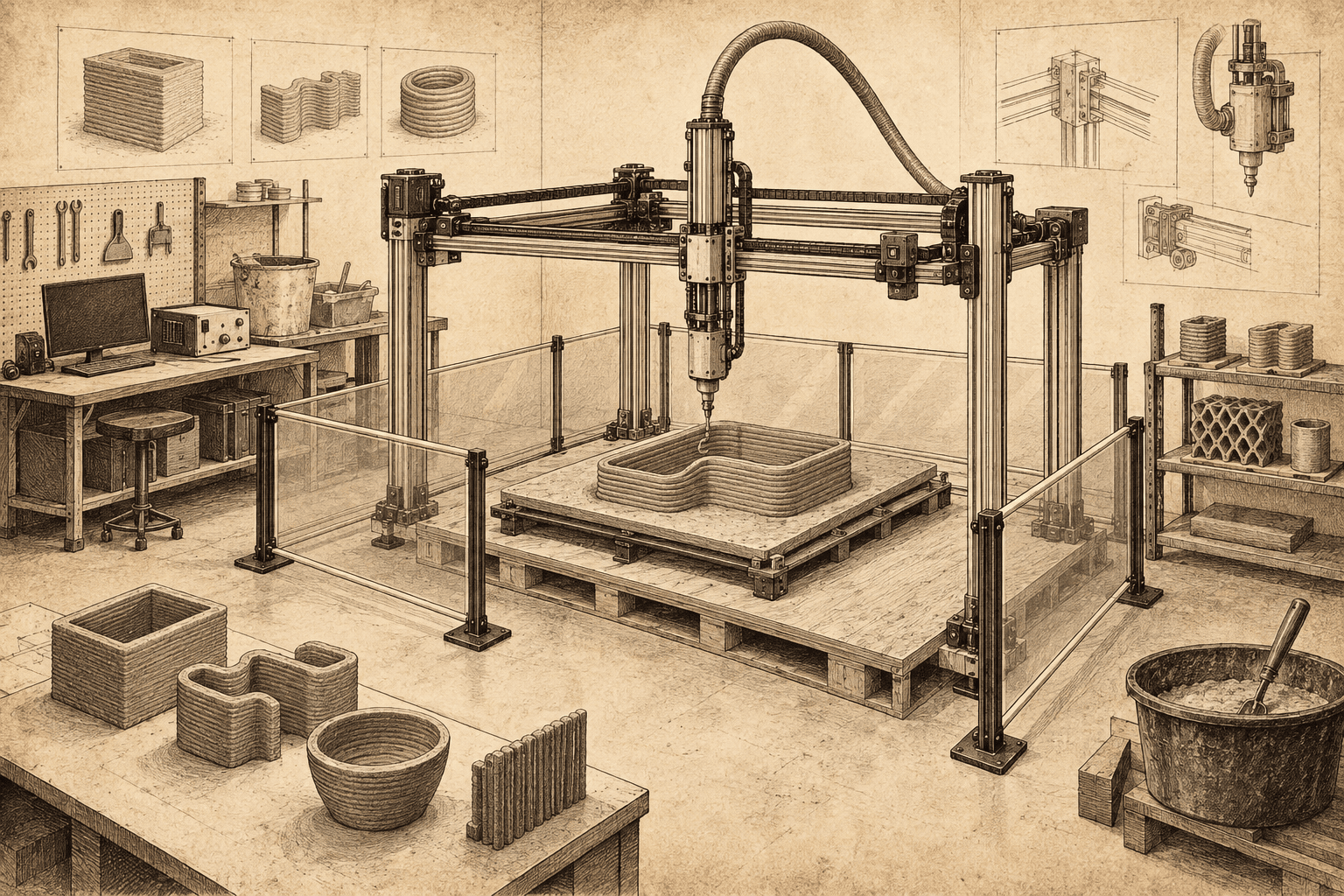
Publishes a pallet-scale cartesian motion reference, CAD, BOM, and low-voltage controls for supervised cementitious-extrusion research while explicitly excluding certified structural use.
Visit M3-CRETEOriginal editorial concept art generated with built-in Codex Image Gen for The Machine Press, 2026-09-27; carried over because the October 4 handoff remains validation pending and no complete October 11 handoff exists.
Turns a bare ESP32-S3 touchscreen into a USB-connected desk instrument for PC activity and optional room temperature, humidity, and light measurements.
Visit DeskNodeOriginal Codex Image Gen concept art from 2026-07-10; carried forward from the validated 2026-10-03 edition.
Desk Picks are selected by the newsroom. Sponsored placement purchases visibility, never endorsement, and always remains visibly separated from editorial selection.
 Editorial illustration