safety security
The Car Imagines Obeying Before It Does
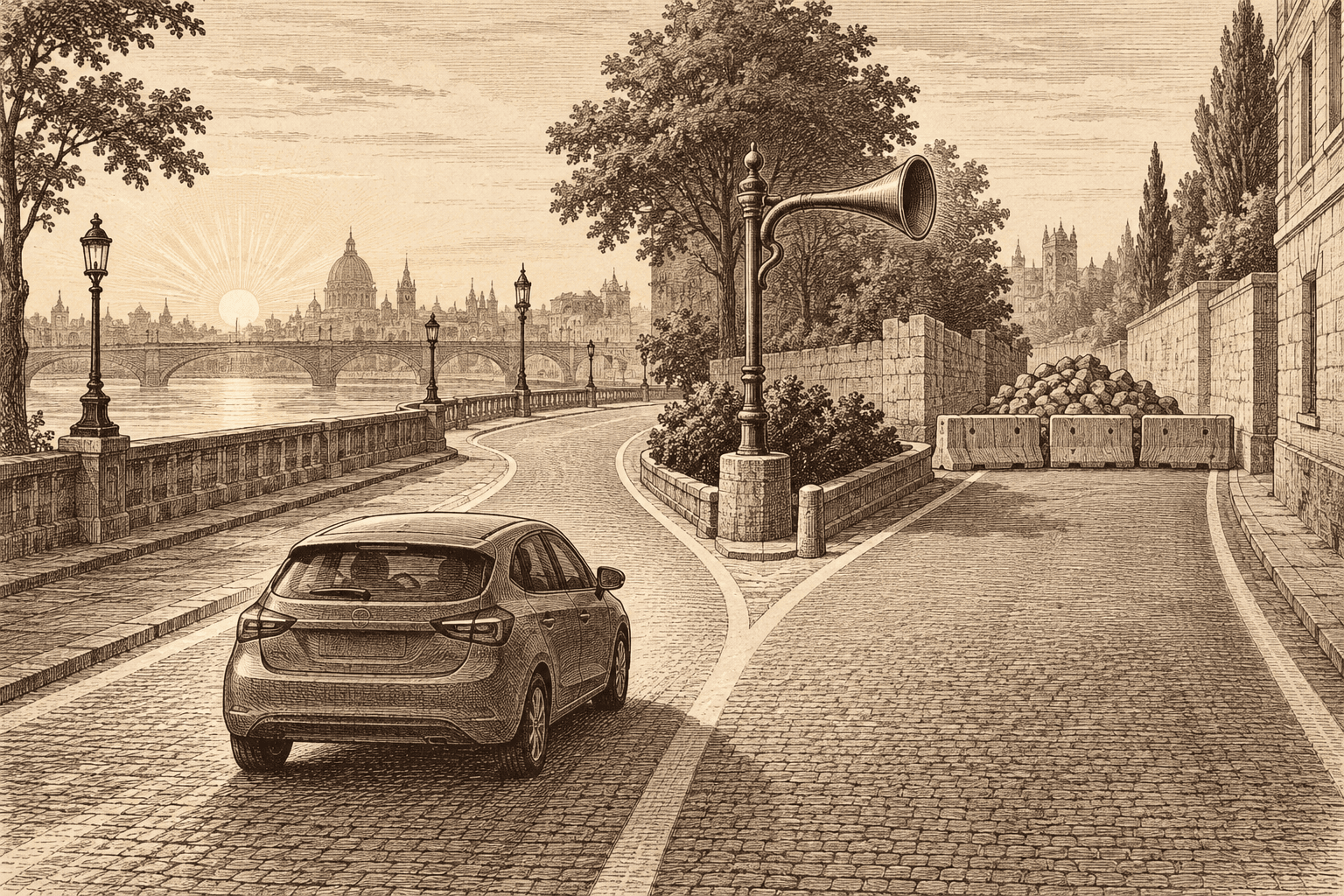
SafeDriveVLA simulates strict compliance with a navigation instruction, then decides whether the resulting maneuver conflicts with the road scene.
Summary
SafeDriveVLA simulates strict compliance with a navigation instruction, then decides whether the resulting maneuver conflicts with the road scene.
Natural-language navigation gives a driving agent more freedom than a fixed turn command—and more ways to be told something unsafe. SafeDriveVLA separates that problem from steering by first predicting whether an instruction should be followed, modified or refused. Its world model deliberately imagines strict compliance so the system can inspect what obeying would cause before producing an action. On the authors' Bench2Drive evaluation, the model reached an 88.16 Driving Score and 68.64 percent success rate. Against their strongest SimLingo variant, it raised closed-loop language following by 49.3 percent and reduced collisions under unsafe instructions from 60 to 38. Those are benchmark results, not proof of road readiness. The useful systems claim is narrower: conflict detection becomes an explicit decision instead of an emergent hope hidden inside action generation.
Why it matters
SafeDriveVLA simulates strict compliance with a navigation instruction, then decides whether the resulting maneuver conflicts with the road scene.
Limits and context
- Those are benchmark results, not proof of road readiness.
Key claims
SafeDriveVLA simulates strict compliance with a navigation instruction, then decides whether the resulting maneuver conflicts with the road scene.
Qualification: Those are benchmark results, not proof of road readiness.
Evidence: source-2026-10-15-001
Sources
- arXiv preprint 2610.20609, original v1arXiv / submitting research authors · primary research
Corrections
: Publication note: This October 15 edition was prepared before its scheduled 9:00 AM America/Detroit reveal, but publication was delayed by a production build failure. The original reporting and image-generation timestamps are preserved.