3DVerifierBench finds a 21.6-point gap between people and the strongest tested model—and shows why one plausible projection is not enough.
Editorial illustration
Concept illustration of multi-view requirement verification for generated 3D content; not a benchmark sample, published figure or experiment photograph. Original editorial illustration generated with built-in Codex Image Gen for The Machine Press, October 17, 2026 edition.
A generated 3D object can look convincing from one camera while violating a requirement elsewhere. 3DVerifierBench tests that problem across ten tasks, scoring acceptance decisions, rejection explanations and responses to controlled changes in both specifications and candidate objects. In the authors' human study, the strongest evaluated model, GPT-6 Astra, trailed people by 21.6 percentage points. Errors concentrated around exact values, binding a requirement to the right target and deciding whether an apparent mismatch was merely projection-dependent. The team also built 14,126 training examples with contradiction explanations and linked counterfactuals. In human-labeled pools of sixteen candidates, an oracle choice raised complete factual success from 26.7 to 90 percent. Those are benchmark results, not proof that every 3D generator fails. They do show that visual plausibility and requirement-level correctness are separate jobs—and that reliable verification must see the whole object.
Concept illustration of equivalent actions receiving different guard treatment because of presentation cues; not a tool trace, benchmark screen or security incident. Original editorial illustration generated with built-in Codex Image Gen for The Machine Press, October 17, 2026 edition.
A three-level audit finds that command length, tool names and formatting markers can change both guard decisions and reported benchmark scores.
A safety benchmark can accidentally reward a guard for recognizing the way a risky action is written instead of the risk itself. The Shortcut Sensitivity study separates three questions: whether labels can be predicted from superficial cues, whether guard decisions correlate with those cues and whether controlled rewrites actually change a decision. In LinuxArena, shorter average shell commands strongly predicted trajectory labels. Under domain holdout, an exact-tool lookup baseline on AgentDojo-Traj fell from an F1 of 0.901 to 0.495. On a fixed safe-row cohort, rewriting an information marker lowered blocking by 8.33 percentage points, while replacing tool names with opaque aliases raised it by 11.46 points; all unsafe calls in that screen remained blocked. The paired effects appeared for the tested Haiku configuration but not Luna or deterministic Q8 TS-Guard. The result is not a universal ranking of guards. It is evidence that representation shortcuts can alter both behavior and the score meant to measure safety.
FEB-30 inspects the store after each fact change instead of using downstream question answering as the only proxy.
Question-answering accuracy can blame a good memory for a retrieval failure or reward a broken memory when generation guesses correctly. FEB-30 inverts the usual benchmark: known fact-evolution trajectories generate the documents, emails and conversations, producing deterministic ground truth for direct store inspection. On one representative system, intrinsic and downstream evaluation differed by 16 points on average, with 44 percent of trajectories crossing the authors' meaningful-divergence threshold. The system classified create, update, reinforce and supersede operations correctly only 20 percent of the time. Thirty trajectories are not a comprehensive memory benchmark, but the result exposes failures that answer-only scoring cannot see.
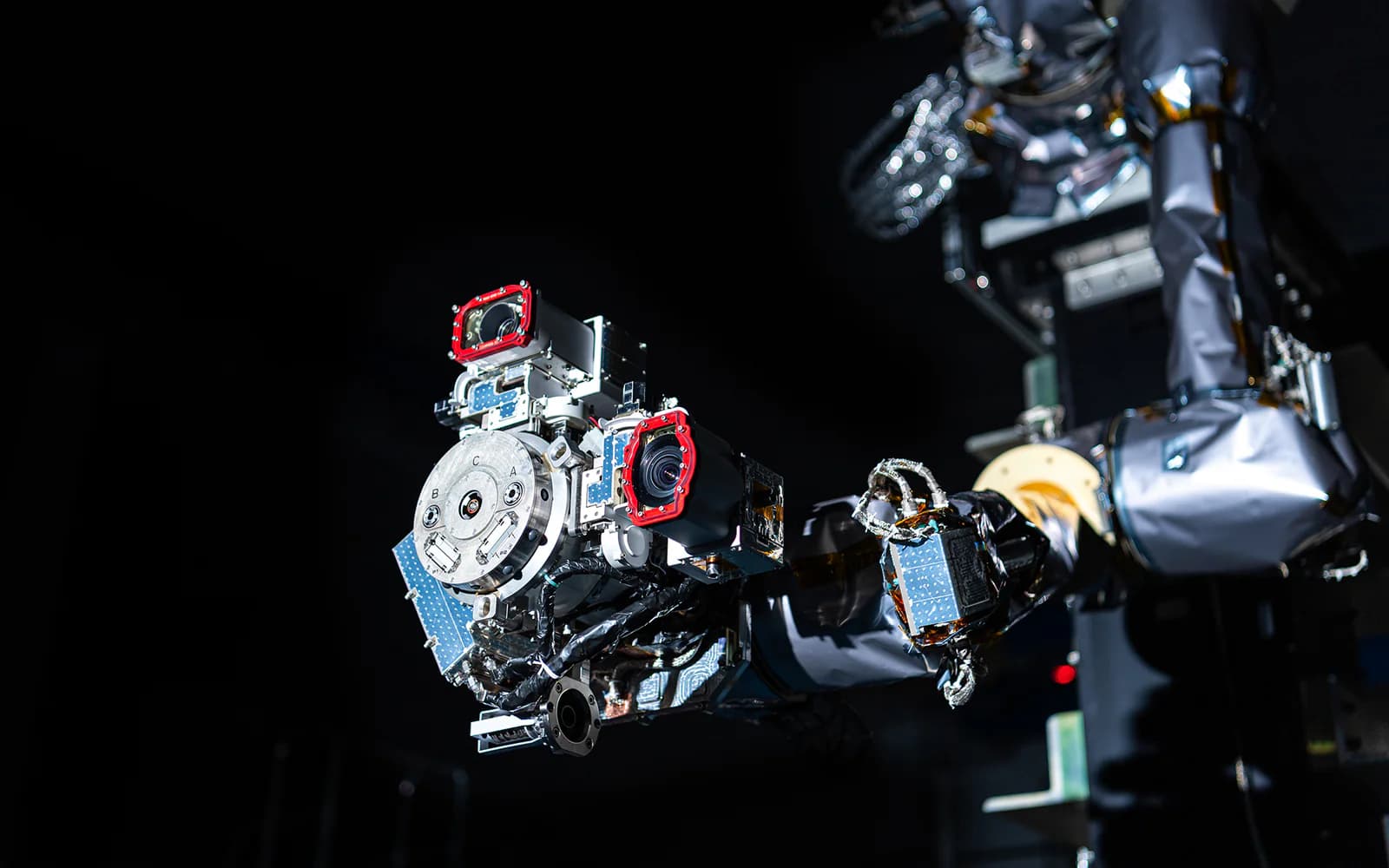
NASA OSAM-1 hardware used illustratively; it does not depict Value as Memory, the evaluated robots, policy state or reported tasks. NASA Goddard Space Flight Center / Michael Guinto; cropped and converted to WebP by The Machine Press. Use does not imply NASA endorsement.
Value as Memory feeds recent value predictions back into a general policy, then updates it during real-world practice.
Partial observability can leave a robot unsure whether a long task is advancing or repeating. Value as Memory caches recent value predictions as a compact progress signal and combines offline demonstrations, human interventions and autonomous rollouts for online reinforcement learning. On the authors' deformable-object and contact-rich tasks, value caching produced a 29.4-point mean absolute success-rate gain, while online learning added 32.8 points over matched offline training. Concurrent collection and training also completed eight times as many policy iterations under the same gradient-step budget. These results cover the reported tasks and hardware, not general household autonomy.
T2-Z adapts a compact environment latent at test time to represent friction, mass and other hidden conditions.
A world model can observe an object without seeing the friction, mass or local rule that governs what happens next. T2-Z keeps the model frozen at deployment and optimizes a newly initialized environment latent from one or more interactions. Across seven simulated settings and four real robot tasks, the authors report object-prediction error falling from 15.20 to 7.00 and action success rising from 33.73 to 72.96 percent. Some useful latent structure emerged from a single trajectory. The evaluation does not establish that the learned coordinates correspond cleanly to every physical property, but it offers a compact route to test-time adaptation.
CoDA shares a memory between the data engine and robot policy so new environments target diagnosed weaknesses.
Physically valid simulated scenes are not necessarily useful training examples. CoDA stores environment programs, policy failures and learning progress in one heterogeneous memory. A vision-language critic turns validated diagnoses into new generation programs, while staged reward potentials supervise policy updates. Across four manipulation families, the authors report out-of-distribution success rising from 5.3 percent after supervised fine-tuning to 27.6 percent, 9.5 points above the strongest closed-loop baseline at the same generation budget. On LIBERO-Pro, fifteen rounds produced larger gains under position and instruction perturbations. The measurements remain simulator- and benchmark-specific.
PathFM generates complete multivariate paths instead of predicting each future quantile in isolation.
Marginal forecasts can score well while missing whether peaks, totals and event times cohere along one plausible trajectory. PathFM uses flow matching to generate complete future paths, distills sampling to one or two steps and shares the history-attention cache across draws. The authors report competitive marginal accuracy on fev-bench and TIME, plus the best aggregate path score among their external baselines on a new benchmark that adds energy, variogram and downstream metrics. In chaotic-system tests, the flow model preserved long-run variability where comparison systems collapsed. The new benchmark and model are author-defined; the result does not settle forecasting across every operational domain.
LeanGraphSearch propagates relevance through Mathlib's proof graph before reranking lemmas against the target.
A useful lemma may be several proof dependencies away from anything that looks lexically similar to the theorem at hand. LeanGraphSearch builds a graph from Mathlib's forward dependencies, spreads relevance from semantically matched declarations and reranks the expanded candidates. Across two retrieval benchmarks, the authors report recall gains of up to 12 percent over LeanSearch v2 and coverage of additional complete proof routes. In iterative Lean-guided proving, pass rates improved by as much as 40 percent over the vanilla prover and at most 10 percent over LeanSearch v2 at matched reflection-turn budgets. The gains are benchmark-bound, but they connect better retrieval to machine-checked downstream proofs.
Visualising AI concept art used illustratively; it is not an idea set, model architecture, source paper or evaluation result. Tim West / Google DeepMind / Pexels; cropped, resized, metadata stripped, and converted to WebP by The Machine Press.
A set-level objective trains one model to generate grounded scientific proposals that remain distinct across the batch.
Research-idea systems usually optimize each suggestion alone, which can produce a polished set of near-duplicates. This work scores a generated set jointly, weighting each idea by both quality and distance from ideas already proposed. On a contamination-free benchmark, the authors' 8-billion-parameter model achieved higher creative utility than the tested Claude Opus 4.8 and GPT-6 Astra configurations. Four experts judged its sets about as promising as Claude's and marginally more unique; coding-agent proof-of-concept runs kept comparable success-at-k. The pilot is small and does not establish scientific novelty or validity, but it makes diversity an explicit training target rather than a prompt request.
Market-based post-training lets decentralized agents bid for participation and learn coordination with their individual policies.
Fixed orchestration can separate what each agent learns from how the group organizes itself. Market-based post-training lets agents bid to participate, uses those bids to determine who acts and converts the collective outcome into local training credit. The authors report that learned self-orchestration supports larger populations at inference time and loses less performance when agents drop out. The paper evaluates controlled multi-agent tasks rather than an open-world organization, so bidding is a training mechanism, not evidence that markets are universally optimal. Its useful move is to make coordination structure itself learnable.
AI Consilium evaluates 3,040 reports across grounding, coherence, management and multidisciplinary synthesis.
A plausible differential diagnosis is not enough for a useful clinical second opinion. AI Consilium uses 300 resolved NEJM–MedQA cases, with 110 for physician reference ratings and judge calibration and 190 held out. Eight pipelines produced independent role-specific opinions and interactive multidisciplinary reports; a physician-calibrated model judge scored 3,040 final reports and their structured primary-role outputs. Structured synthesis improved pooled scores across all five shared criteria, especially prioritization, grounding and coherence, while model identity explained more variation than format. This is a retrospective benchmark using an LLM judge, not clinical validation or medical advice.
An environment-agnostic coding agent improves when it reports difficulty and yields control for automatic continuation.
Access to tools and instructions does not guarantee that an agent will use them effectively. Across ARC-AGI-3, AGI Maze and Terminal-Bench, one prompt change—reporting difficulty and returning control for continuation—improved mean scores on the first two environments while producing small, mixed changes on the third. Moving reset decisions into a simple scripted controller recovered part of a specialized agent's advantage, while extra tutorial experience could hurt. The experiments cannot separate better procedure use from additional or differently allocated inference, and gains cost more tokens. They nevertheless show that control scaffolding remains consequential for the tested models.
Generic policy illustration used for partially ordered legal guidance; it does not depict a court, maritime authority, enacted rule or tested encounter. Perhelion / Wikimedia Commons (CC0 1.0); gold background added and converted to WebP by The Machine Press.
Posetal games translate legal guidelines into auditable multi-agent preferences without collapsing every duty into one score.
Real movement rules often prioritize some duties without ranking every possible conflict. This framework derives scenario-specific agent preferences from partially ordered legal guidelines, then lets agents add private objectives without creating new illegal equilibria. Belief play coordinates without revealing those private preferences. In seven maritime encounters with up to four vessels, every violation in the committed equilibria was certified as forced by the hierarchy or unsatisfiable, and tested defectors were identified from public information. The cases are limited and do not constitute legal certification, but the method makes the path from written guidance to a motion plan inspectable.
Generic policy illustration used for partially ordered legal guidance; it does not depict a court, maritime authority, enacted rule or tested encounter. Perhelion / Wikimedia Commons (CC0 1.0); gold background added and converted to WebP by The Machine Press.
OS-Helix trains GUI actions and code execution in one action space after naive tool addition made the visual agent worse.
Desktop work crosses visible interfaces, files, scripts and hidden system state. OS-Helix trains GUI actions and code execution together, using application-artifact composition to build executable Ubuntu tasks with solution-independent final-state checks. Step-balanced reinforcement learning aggregates importance by action step so long code blocks do not dominate optimization. On OSWorld-Verified, the authors report 33.7 to 35 percent relative gains over matched hybrid baselines; the 27-billion-parameter RL version reached 66.44 percent success and transferred to WindowsAgentArena. These are benchmark results in constructed environments, not proof of safe unattended desktop operation.
Whole-Body Dexterity trains a policy to brace and slide bulky objects against arms and body surfaces.
Dexterous manipulation is often reduced to the hands. Whole-Body Dexterity first generates feasible body-contact grasps, trains reinforcement-learning experts to move between them and distills those experts into one policy using proprioception and object geometry. Transferred without hardware-specific fine-tuning to a Unitree G1, the controller repositioned a basketball and box around the torso and completed a teleoperated sequence that stowed, carried and placed a box. Across the reported real-world tasks, it completed 90 percent of trials, versus 18 percent for direct retargeting and 4 percent for a generalist whole-body controller. The task set is narrow and still uses coarse human references.
DaTMe decides which image tokens to merge from denoising dynamics and local structure, not prompt relevance alone.
Training-free token merging can speed image diffusion by collapsing redundant computation, but preserving only prompt-aligned foreground regions can erase background structure and unmentioned detail. Dynamics-aware Token Merging builds an importance map from the predicted clean image: temporal change marks unresolved regions, while local high-frequency content identifies boundaries and fine structure. Important tokens remain anchors; stable, homogeneous regions become merge candidates. Across PixArt-a and FLUX, the authors report better fidelity across the full image than comparison methods at matched compression settings. The evidence is benchmark- and model-specific, but it replaces a semantic shortcut with signals from the generation process itself.
Independent builders turning improbable ideas into real things.
Four editorial selections
$7 for seven days
Paid work is clearly labeled
Placement is never endorsement
Original editorial concept art generated with built-in Codex Image Gen for The Machine Press, 2026-09-27; carried over because the October 4 handoff remains validation pending and no complete October 11 handoff exists.
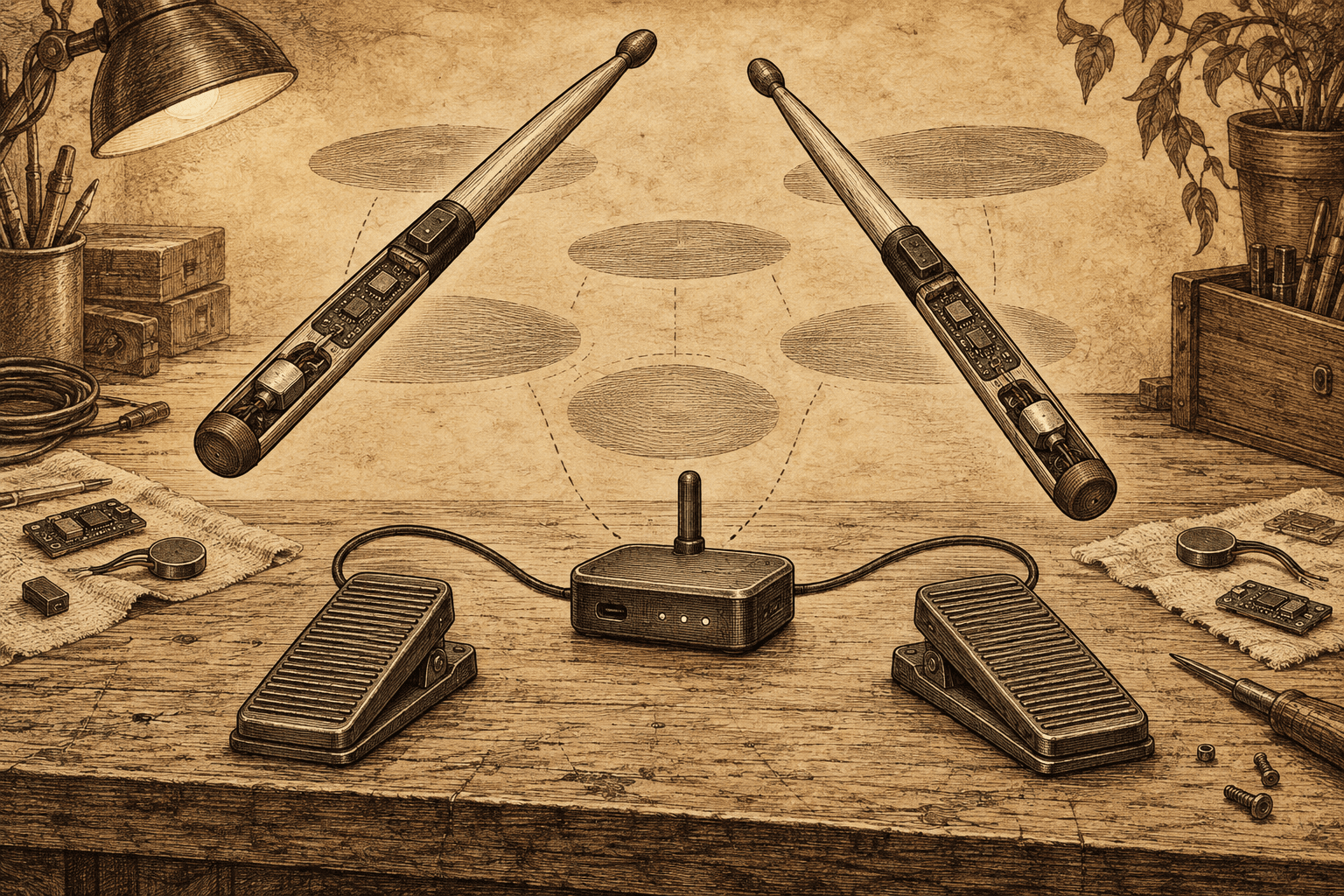
Moves motion tracking onto two ESP32-S3 drumsticks, adds haptic hits and a two-pedal hub, and sends velocity-sensitive drum events to open PC or Android playback software.
Visit Space Drums 2.0Original editorial concept art generated with built-in Codex Image Gen for The Machine Press, 2026-09-27; carried over because the October 4 handoff remains validation pending and no complete October 11 handoff exists.
Pairs a chip-level 65C02 computer with custom hardware, video, sound, floppy, and microSD support with a cycle-honest emulator and browser assembler built around the same machine.
Visit 3RICOriginal editorial concept art generated with built-in Codex Image Gen for The Machine Press, 2026-09-27; carried over because the October 4 handoff remains validation pending and no complete October 11 handoff exists.
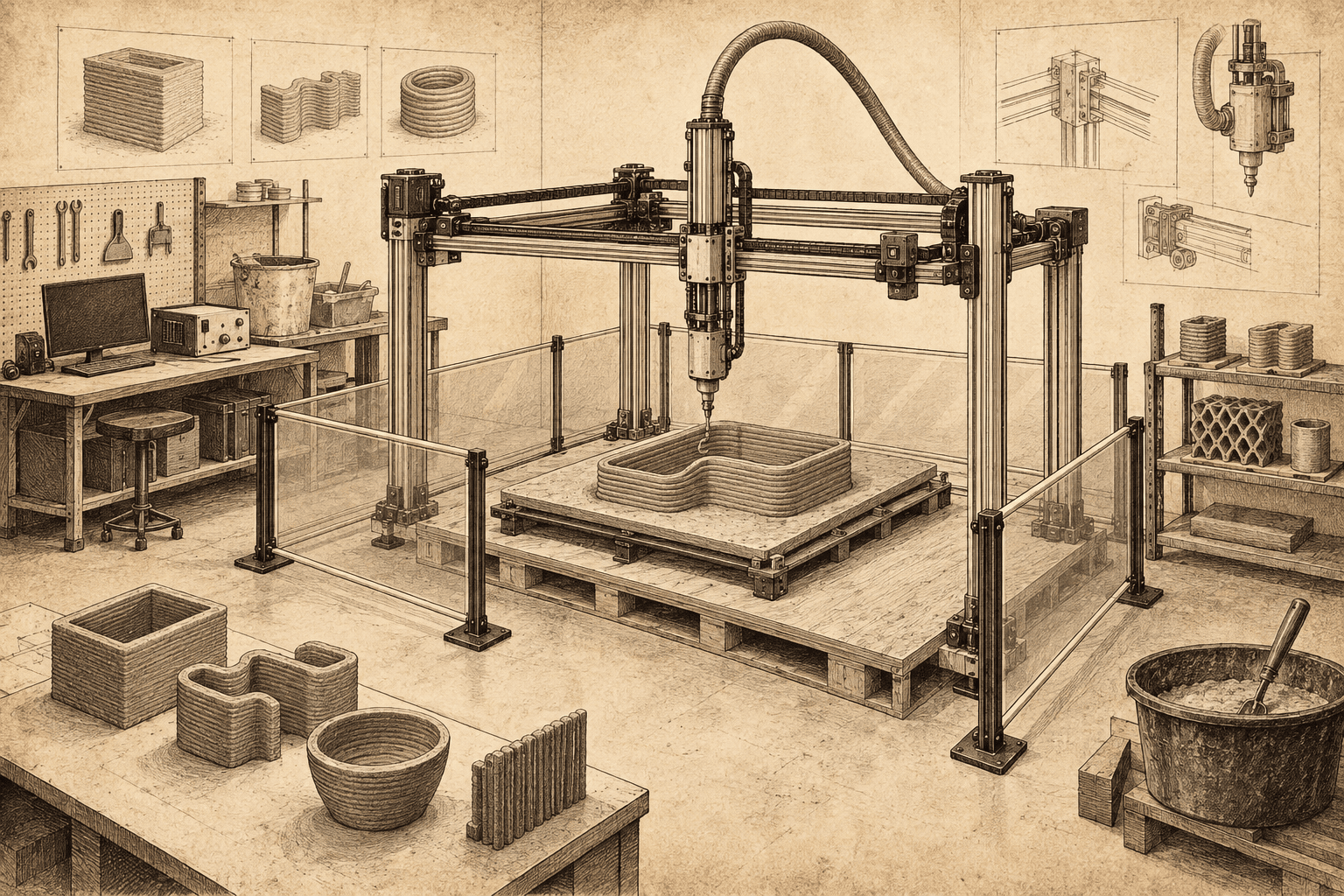
Publishes a pallet-scale cartesian motion reference, CAD, BOM, and low-voltage controls for supervised cementitious-extrusion research while explicitly excluding certified structural use.
Visit M3-CRETEOriginal editorial concept art generated with built-in Codex Image Gen for The Machine Press, 2026-09-27; carried over because the October 4 handoff remains validation pending and no complete October 11 handoff exists.
Turns a bare ESP32-S3 touchscreen into a USB-connected desk instrument for PC activity and optional room temperature, humidity, and light measurements.
Visit DeskNodeOriginal Codex Image Gen concept art from 2026-07-10; carried forward from the validated 2026-10-03 edition.
Desk Picks are selected by the newsroom. Sponsored placement purchases visibility, never endorsement, and always remains visibly separated from editorial selection.
 Editorial illustration