A general multimodal model interpreted vision-based tactile images and used their contact cues across nineteen simulated manipulation tasks.
Editorial illustration
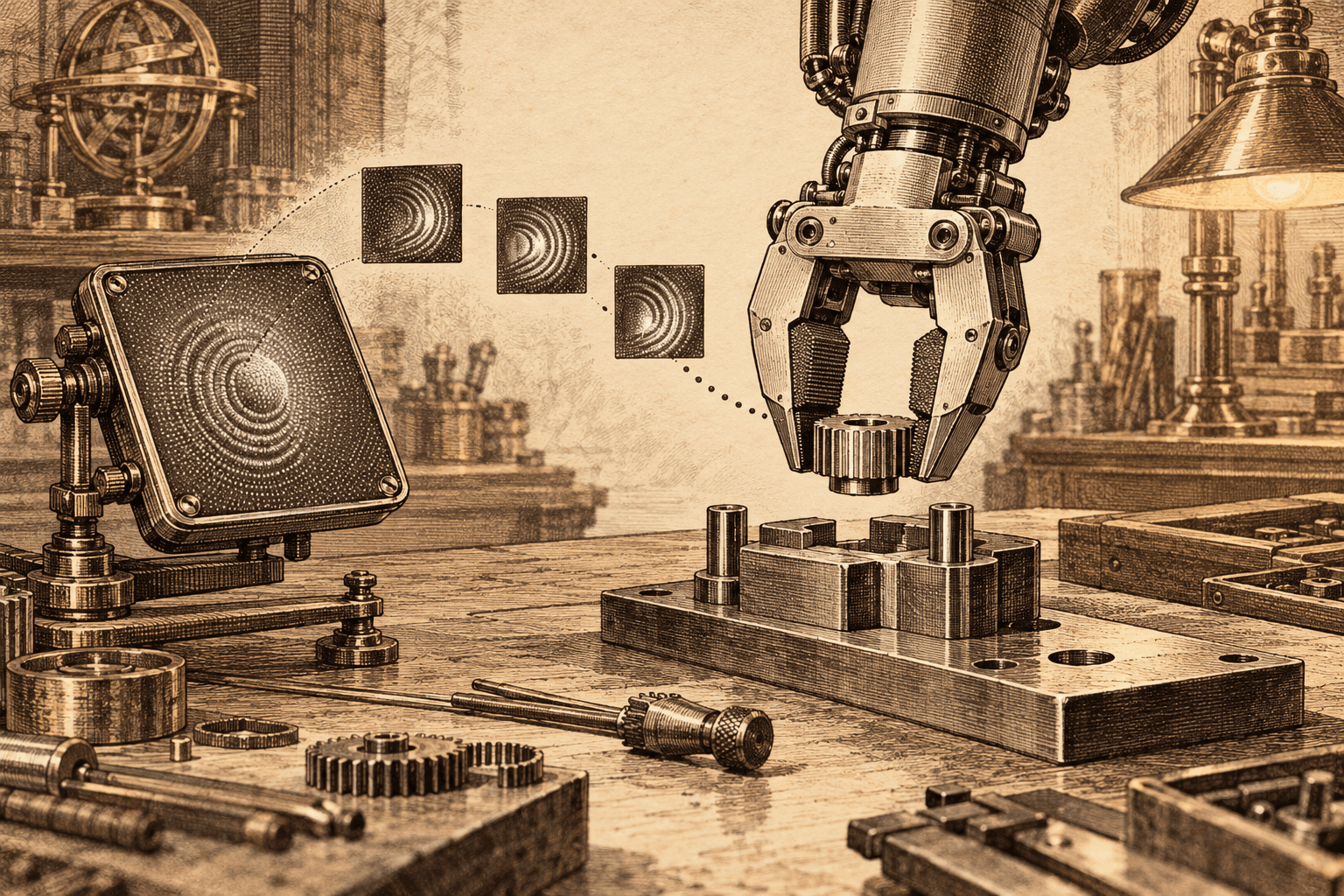
Concept illustration of visualized touch guiding robot manipulation; not the reported simulator, tactile hardware, robot or benchmark evidence. Original editorial illustration generated with built-in Codex Image Gen for The Machine Press, October 20, 2026 edition.
Touch has usually been treated as specialist territory in robot learning. In a new simulation study, researchers passed RGB images from vision-based tactile sensors through GPT-6 Astra's existing visual interface, then asked the model to control nineteen contact-rich tasks with few-shot demonstrations and closed-loop feedback. Across 210 sampled scene seeds per setting, the authors report mean success of 93.8 percent on UniVTAC tasks and 81.8 percent on OpenViTac tasks, exceeding the strongest specialist baselines in their comparison by 22.9 and 13.1 percentage points. Trajectories showed active probing, cautious grasps, contact-guided alignment and recovery; tangential loading and corrective execution remained difficult. This is not a physical-robot validation, and the authors warn of possible benchmark saturation. The narrower result is still useful: a general visual model may already possess primitives for reading touch when tactile sensing is rendered as images.
Concept illustration of combined neutron-decay measurements revealing weak magnetism; not an apparatus, detector, data plot or particle track. Original editorial illustration generated with built-in Codex Image Gen for The Machine Press, October 20, 2026 edition.
Combining beta asymmetry, neutron lifetime and superallowed-decay measurements lifted a long-standing degeneracy and produced a 5.1-sigma signal.
Nearly seven decades after Murray Gell-Mann introduced weak magnetism as a consequence of the conserved vector current hypothesis, researchers report its first observation in free-neutron decay. Beta asymmetry alone cannot separate the weak-magnetism form factor from the axial-to-vector coupling ratio, so the analysis combines asymmetry measurements with the neutron lifetime and the comparative half-life of superallowed nuclear decays. Current data yield a form factor of 4.47 with an uncertainty of 0.87, consistent with the predicted 4.71 and excluding no weak magnetism at 5.1 sigma. Across variations of the internally tense neutron dataset, the reported significance remains between 5.0 and 6.1 sigma. This is an inference from combined existing measurements, not a new detector event; its value is that three familiar observables expose a property each could not isolate alone.
StreamRPS labels spinning-radar data with completed LiDAR scenes, then performs streaming semantic and panoptic segmentation by sector.
Cameras and LiDAR can degrade in darkness or bad weather, while spinning radar remains available but difficult to interpret. StreamRPS pairs labels built from LiDAR scene completion with a radar-specific transformer that preserves range and angular structure. On the SAX and BOREAS datasets, the authors report at least a 1.4-point gain over the strongest evaluated baseline and throughput above 400 frames per second in a four-sector configuration. They also release manual annotations for 100 SAX scans. This is not an autonomous-driving safety certification, but it pushes radar from sparse detections toward real-time scene structure.
NASA OSAM-1 hardware used illustratively; it does not depict FunCAD-Harness, a generated mechanism, simulator or benchmark result. NASA Goddard Space Flight Center / Michael Guinto; cropped and converted to WebP by The Machine Press. Use does not imply NASA endorsement.
FunCAD-Harness turns underspecified mechanism requests into candidate-specific physical tests, then uses simulation failures to guide revisions.
A plausible rendering can conceal a mechanism that cannot perform its job. FunCAD-Harness asks agents to construct and revise mechanisms against physical simulation, generating tests for each candidate rather than matching one reference geometry. Its benchmark spans 46 mechanism families with interdependent, multistep operation. The authors report that the harness exposed failures invisible to visual inspection and improved functional success over evaluated simulation-assisted baselines. It does not certify generated designs for manufacture, but it moves CAD evaluation from appearance toward behavior.
Halcyon trained from scratch on paired images and text, and controlled comparisons found no generation benefit from text-only pretraining.
Modern text-to-image systems commonly inherit an internet-scale language model. Halcyon instead trained from scratch on 100 million image-text pairs. The authors report that a 520-million-parameter version beat a larger LlamaGen comparison with 18.2 times less pretraining compute, while a 1.6-billion-parameter model beat the evaluated JiT-T2I system with 275 times less compute. Controlled experiments found no image-generation benefit from text-only pretraining. The reported metrics do not settle every dimension of quality, but they challenge the assumption that an image generator must first become a broadly pretrained language model.
OpenVLHarness turns tool output into addressable images, data and web references that persist across a multimodal reasoning trace.
More inference did little on 22 visual benchmarks when the missing ingredient was external evidence. OpenVLHarness adds a capability layer that renders heterogeneous tool results into model-readable observations and persistent memory that keeps images, data and references addressable. Across eight evaluated backbones, the authors report average gains of 9.7 to 12.6 points over matched no-tool baselines. In one comparison, a medium-effort smaller model beat maximum-effort systems while using no more than 37 percent of their model-token cost. These are harness-specific results, but they show why tool access and evidence retention must be evaluated together.
Ropedia W0 combines 10,000 hours of egocentric human video with 3,000 hours of robot data across different bodies.
World models often separate locomotion from manipulation or bind themselves to one robot. Ropedia W0 represents movement with camera poses and manipulation with projected skeletons, combining 10,000 hours of human egocentric data with 3,000 hours of robot data. The authors report leading results across five cross-embodiment benchmarks and held-out human video, with additional human pretraining improving both human and robot evaluations. A distilled version produced real-time, minute-long rollouts for live virtual-reality interaction. The evidence is benchmark-based, but it suggests human motion can supply scale without pretending every body has the same joints.
PhysWord anchors continuous future-state representations to atomic action verbs before the policy acts.
Language can describe a task while missing the fine structure of contact and motion; latent forecasts contain that structure but are difficult to reuse. PhysWord predicts atomic action words and aligns their hidden states with future-observation targets, creating visual and optional tactile versions of each primitive. The authors report 90.3 percent success on visuotactile UniVTAC and 99.6 percent on LIBERO-Long, plus gains on real bimanual and dexterous tasks. The evaluations do not prove the vocabulary is universal, but they make a testable claim: action anchors can structure physical prediction without reducing it to prose.
Conceptual Visualising AI artwork used illustratively; it is not a WeAct adapter diagram, model architecture or benchmark result. Tim West / Google DeepMind / Pexels; cropped, resized, metadata stripped, and converted to WebP by The Machine Press.
WeAct adds selection among capability-specific adapters to the action space instead of fixing one parameter configuration for an entire trajectory.
A long research task may demand browsing, calculation and writing in sequence, while updating one shared model risks forgetting an earlier skill. WeAct freezes the backbone, trains separate LoRA adapters and lets the agent select one through its normal tool-calling interface. On eight deep-research benchmarks, the authors report a 6.2 percent average accuracy gain over full fine-tuning and 27.5 percent over the strongest evaluated static adapter merge. Adding a computation adapter and updating a writing adapter left other modules unchanged. The work tests one modular strategy, not arbitrary self-modification, but it turns internal parameter choice into an explicit action.
CoopUQ fuses occupancy forecasts across robots and makes uncertainty itself part of the navigation cost.
One robot may miss a pedestrian hidden from its sensors while another has a better view. CoopUQ combines cross-robot features into future occupancy maps, estimates uncertainty and penalizes policies for entering regions predicted to be occupied or poorly known. In simulated layouts with varied density, occlusion and rushing behavior, the authors report better prediction and safety than representative baselines, including under distribution shifts. Real-robot experiments provided additional robustness evidence. The paper does not establish safety in open public spaces, but it ties cooperation to a shared map of risk rather than consensus for its own sake.
PhysRSI-eval separates first attempts, efficiency, success, budget and recovery from failure across eighteen manipulation tasks.
A final success rate cannot say whether a robot learned quickly, recovered from failure or simply spent more trials. PhysRSI-eval measures five axes across eighteen manipulation tasks under a fixed budget. Removing history reduced late-round success, while frozen workspaces still helped on unseen layouts and three cross-task cases succeeded earlier. The observations do not demonstrate unrestricted recursive self-improvement. They provide a more disciplined way to separate scene adaptation, reusable experience and extra attempts.
AnyGoal holds familiar state and action factors inside training support, then recombines them into underrepresented planning tasks.
A world model can reproduce expert trajectories and still fail when familiar ingredients appear in a new combination. AnyGoal builds goal-shifted variants where each state factor and action remains known, but their pairing was rare in expert data. Across several model families and environments, the authors found consistent prediction and planning failures under those recombinations. The benchmark is a diagnostic rather than a solution, but it raises the standard for generalization: knowing every move independently is not the same as knowing the world's rules.
LatComm encodes shared context once, then lets a different frozen model select what to read for each question.
Multi-model systems repeatedly pay to transmit the same text. LatComm separates encoding from reading: one frozen model compresses context into a fixed-size packet, while a different frozen receiver uses prompt-conditioned cross-attention to select relevant content. Across twelve multiple-choice datasets, the authors report up to 10.2 points higher average accuracy than single-vector baselines. On QuALITY, receiver input fell by a factor of 57 and questions were answered three times faster. The learned bridge is not universally portable, but it demonstrates context that is compact, reusable and readable by a different model.
Illustrative laboratory-glassware file image; it does not show ProteinGeoBench, a protein structure, an agent calculation or study evidence. Rodolfo Clix / Pexels; cropped, resized, metadata stripped, and converted to WebP by The Machine Press.
ProteinGeoBench separates metadata lookup from numerical geometry and shows how harness, access and run budget can change the ranking.
Structural-biology agents are often asked to retrieve facts and compute geometry in one score. ProteinGeoBench splits those abilities across 131 tasks. In 4,249 rollouts from four frontier models, three landed within 0.031 of one another; three of the four performed better on metadata lookup than numerical calculation. Numeric questions made up 28 tasks but half of the twelve every model failed. Rankings also changed with run budget and command-line harness. The study does not crown one universal agent; it argues evaluations should expose task family, repeats, access and harness instead of letting lookup fluency hide geometric weakness.
WildAWM synthesizes executable GUI, tool and command-line environments with solvability and verifier gates.
Training computer-use agents directly in live systems is costly and risky. WildAWM uses open-source models to synthesize controlled environments spanning graphical interfaces, tool services and command lines. Quality gates test solvability, difficulty and verifier robustness with agent runs, judge agreement and counterfactual probes. The pipeline produced 341 long-horizon environment-task pairs, some requiring more than 100 steps; a frontier model solved 60 percent. Two Qwen models trained only in these worlds improved across eight out-of-distribution benchmarks. The collection is finite, but its execution checks make generation more than prompt-written scenery.
Retrieving a simulator report from files changed which value some models trusted even when the underlying computation stayed fixed.
Using deterministic PHREEQC geochemistry reports and 158 execution-verified questions, researchers tested the common practice of storing long tool output outside the context window. Under indexed retrieval, two GPT models lost 11.3 and 7.9 accuracy points while two Claude models showed no detectable cost. Replaying 11,007 simulator calls showed that the GPT models often computed the keyed value but answered from higher-precision files and misrounded. Naming the authoritative output recovered 6.3 to 7.9 points for three GPT models. The finding is harness-specific, but it shows why a correct tool call does not guarantee an evidence-grounded answer.
Independent builders turning improbable ideas into real things.
Four editorial selections
$7 for seven days
Paid work is clearly labeled
Placement is never endorsement
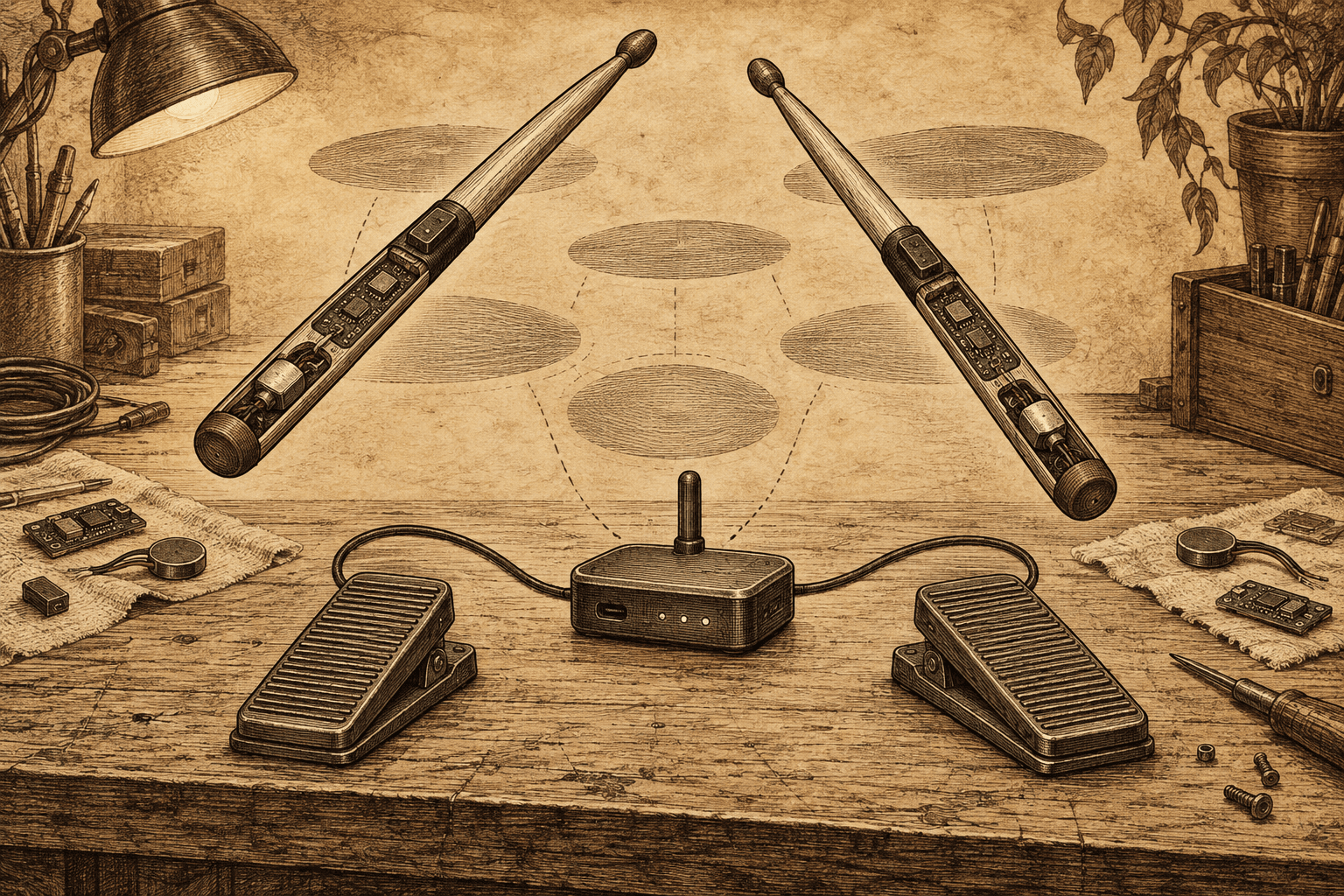
Original editorial concept art generated with built-in Codex Image Gen for The Machine Press, 2026-09-27; carried over because the October 4 handoff remains validation pending and no complete October 11 or October 18 replacement handoff exists.
Moves motion tracking onto two ESP32-S3 drumsticks, adds haptic hits and a two-pedal hub, and sends velocity-sensitive drum events to open PC or Android playback software.
Visit Space Drums 2.0Original editorial concept art generated with built-in Codex Image Gen for The Machine Press, 2026-09-27; carried over because the October 4 handoff remains validation pending and no complete October 11 or October 18 replacement handoff exists.
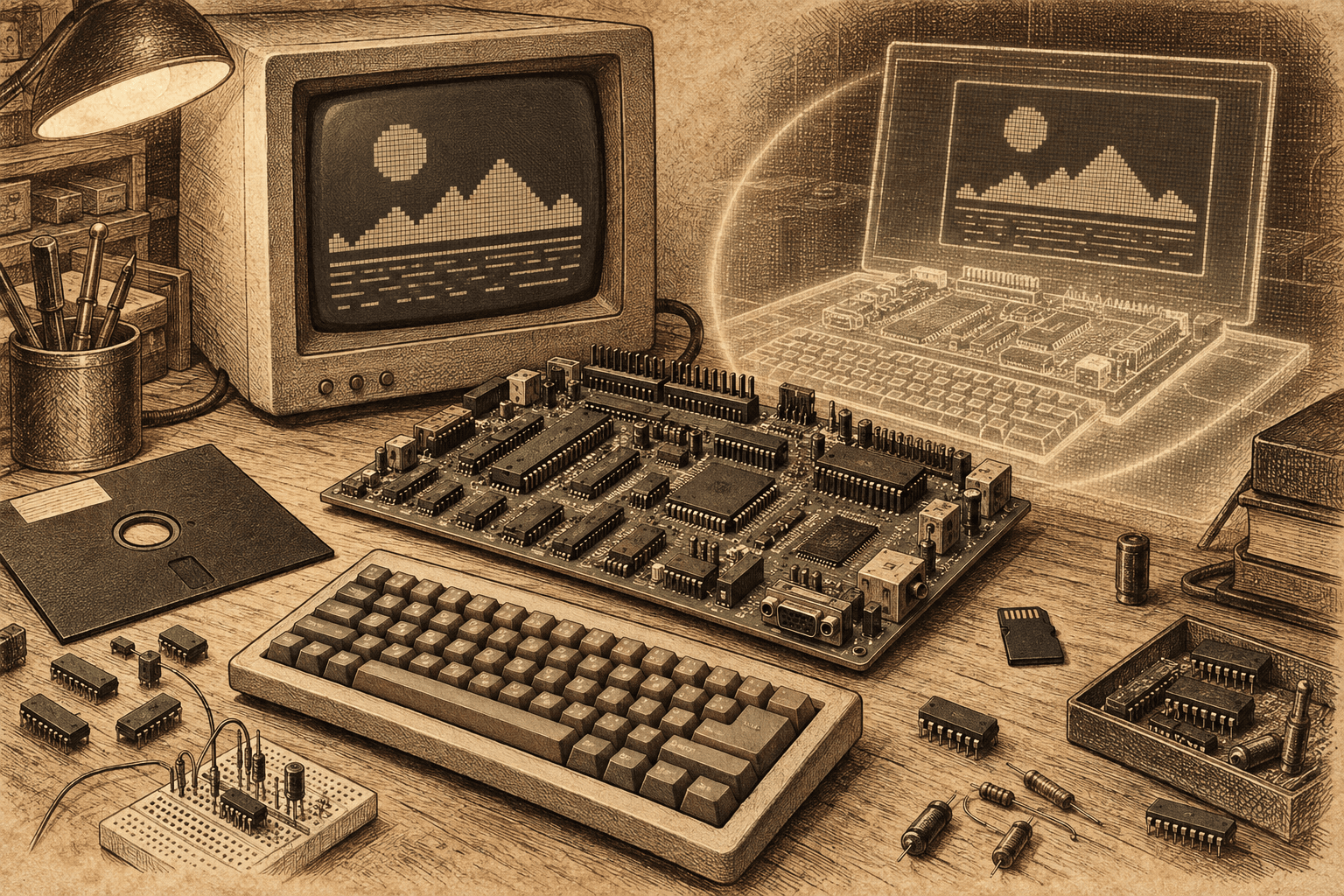
Pairs a chip-level 65C02 computer with custom hardware, video, sound, floppy, and microSD support with a cycle-honest emulator and browser assembler built around the same machine.
Visit 3RICOriginal editorial concept art generated with built-in Codex Image Gen for The Machine Press, 2026-09-27; carried over because the October 4 handoff remains validation pending and no complete October 11 or October 18 replacement handoff exists.
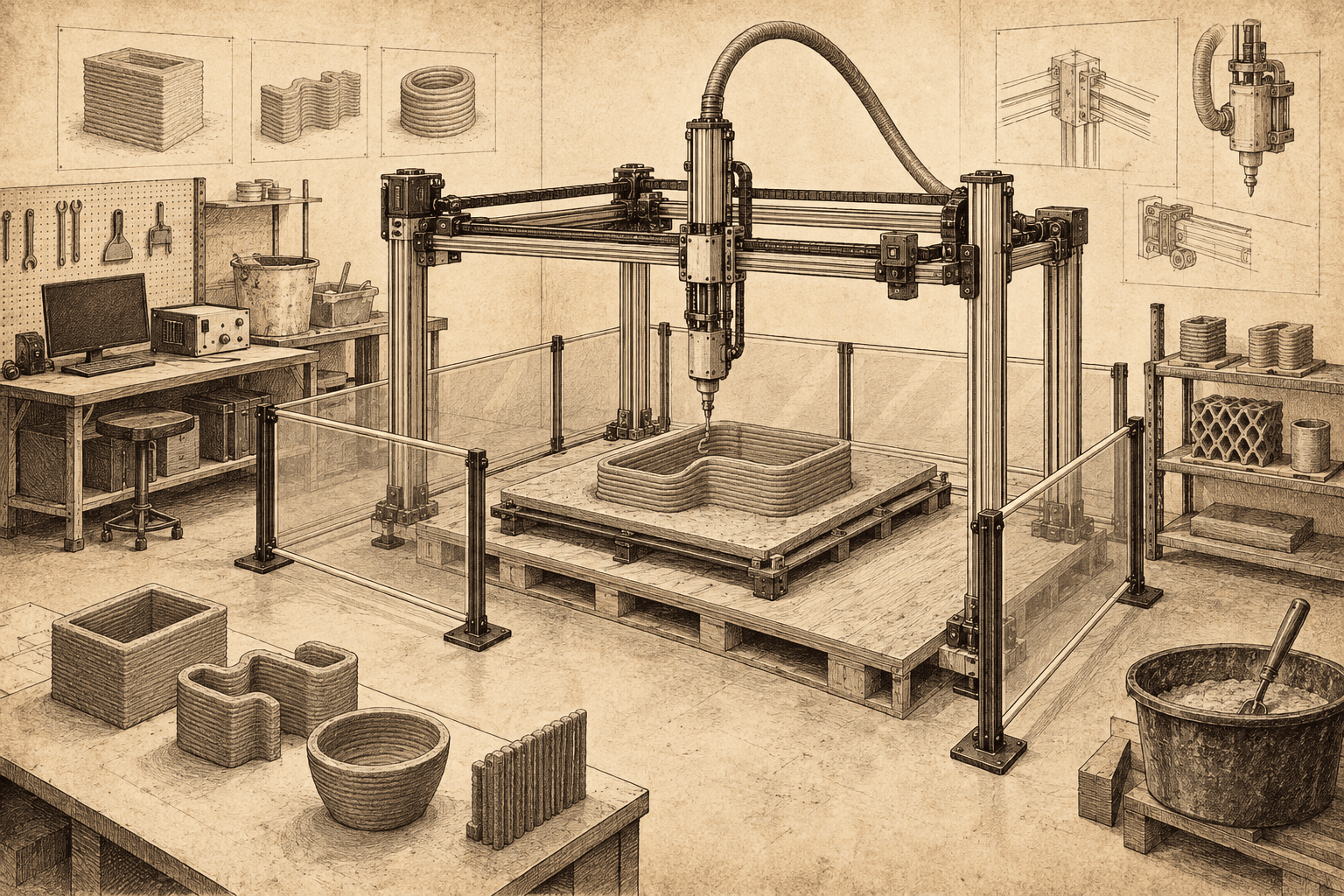
Publishes a pallet-scale cartesian motion reference, CAD, BOM, and low-voltage controls for supervised cementitious-extrusion research while explicitly excluding certified structural use.
Visit M3-CRETEOriginal editorial concept art generated with built-in Codex Image Gen for The Machine Press, 2026-09-27; carried over because the October 4 handoff remains validation pending and no complete October 11 or October 18 replacement handoff exists.
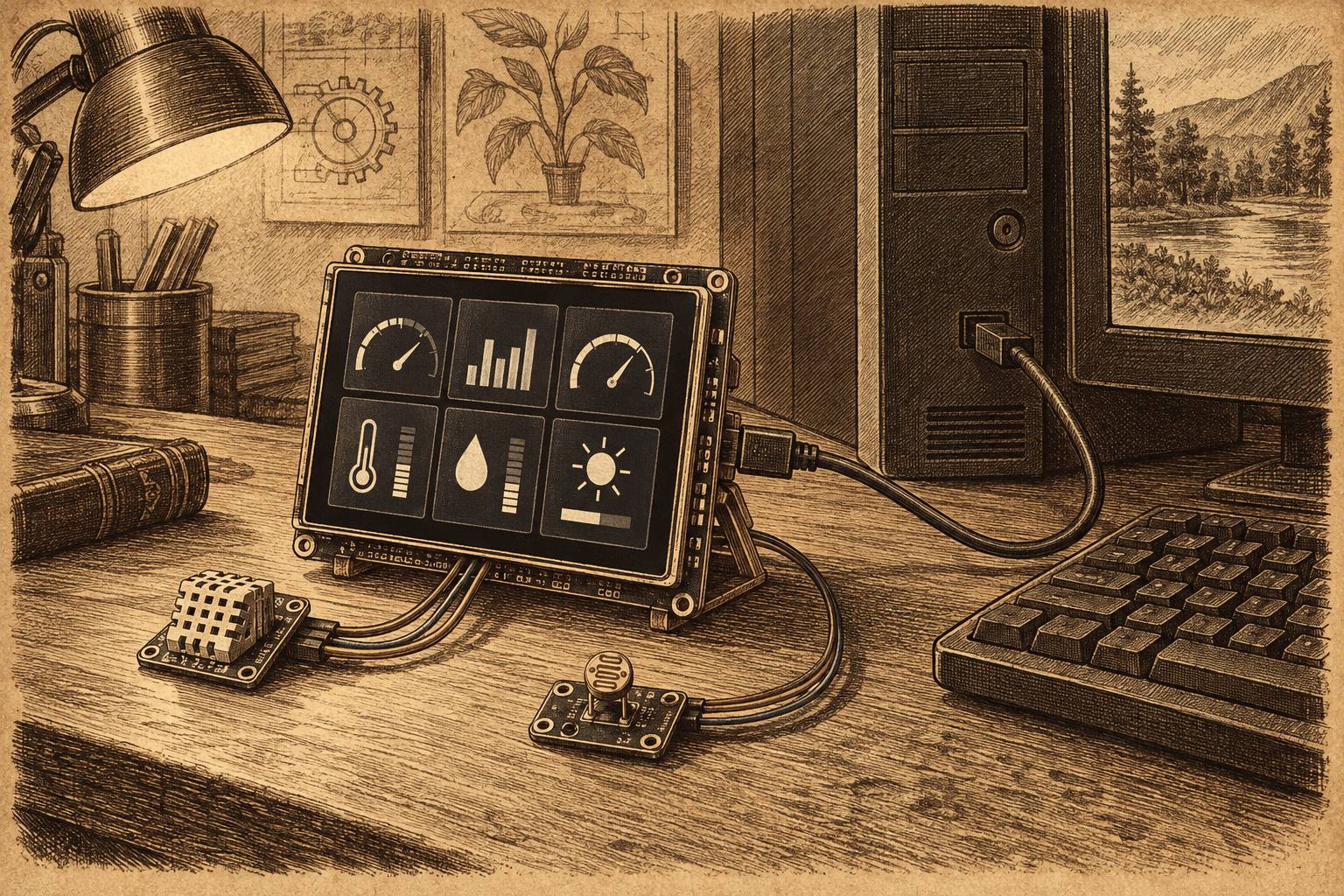
Turns a bare ESP32-S3 touchscreen into a USB-connected desk instrument for PC activity and optional room temperature, humidity, and light measurements.
Visit DeskNodeOriginal Codex Image Gen concept art from 2026-07-10; carried forward from the validated 2026-10-03 edition.
Desk Picks are selected by the newsroom. Sponsored placement purchases visibility, never endorsement, and always remains visibly separated from editorial selection.
 Editorial illustration